
Enamel Remineralization: The Science of Biomimetic Restoration
Last updated: June 2026
Tooth enamel is the strongest substance in the human body, but it has one major weakness: it is not living tissue. Unlike skin, bone, or gum tissue, enamel cannot regrow once it has been structurally destroyed. That does not mean weakened enamel is hopeless. Early mineral loss, surface roughness, white spot lesions, acid-softened enamel, and sensitivity linked to exposed dentin can often be supported through enamel remineralization.
Enamel remineralization is the process of restoring calcium, phosphate, and other mineral support back into weakened tooth surfaces before damage becomes a full cavity or irreversible enamel loss. In modern preventive dentistry, this process has moved far beyond ordinary “cavity prevention”. The most advanced conversation now includes biomimetic oral care, nano hydroxyapatite toothpaste, fluoride remineralization science, calcium phosphate systems, stannous fluoride effects, and new biomimetic mineral repair compounds designed to imitate the natural mineral structure of teeth.
At the center of this shift is hydroxyapatite, especially nano hydroxyapatite, a mineral form closely related to what enamel and dentin are already made of. This is why many consumers now search for enamel restoring toothpaste, toothpaste that rebuilds enamel, hydroxyapatite toothpaste reviews and products, toothpaste for sensitivity, and nano hydroxyapatite vs fluoride when comparing oral care formulas.
This guide explains how enamel remineralization works, what hydroxyapatite can and cannot do, how fluoride compares, which ingredients matter for sensitive teeth relief, and how to choose the right enamel repair toothpaste for your specific oral condition.
For people building a complete enamel-first routine, the HydroPaste oral care system connects enamel repair, sensitivity relief, oral microbiome balance, breath support, interdental cleaning, and daily preventive care into one structured oral health approach.
Quick Picks: Where to Start
Jump Into the Enamel Remineralization Guide
Explore the most important sections of this pillar page, from enamel science and sensitivity relief to toothpaste comparisons, brand reviews, condition-based repair, and your daily remineralization routine.
The Science: Understanding Enamel Remineralization
Learn how minerals, saliva, pH, hydroxyapatite, fluoride, and biomimetic repair systems support stronger enamel.
Explore scienceThe Architecture of Enamel
See how enamel structure, microscopic porosity, dentin exposure, and mineral loss shape the repair strategy.
View structureSensitive Teeth Relief: Why Enamel Loss Causes Pain
Understand how enamel thinning and open dentinal tubules trigger cold, heat, sweet, and brushing sensitivity.
Reduce sensitivityToothpaste Hub
Compare hydroxyapatite toothpaste, fluoride options, whitening toothpaste, tablets, and formulas for sensitive teeth.
Compare toothpasteShop-by-Brand
Review leading hydroxyapatite and enamel repair toothpaste brands, including daily, whitening, and sensitivity-focused options.
Browse brandsCondition-Based Remineralization
Match enamel repair strategies to erosion, early cavities, post-whitening sensitivity, acid attacks, and enamel loss.
Find your conditionDaily Enamel Remineralization Routine
Build a morning, after-meal, and nighttime routine using remineralizing toothpaste, water rinsing, and acid control.
Start routineOptimizing the Remineralization Environment
Learn why saliva, pH balance, oral microbiome health, dry mouth control, and acid timing affect enamel recovery.
Optimize recoveryWhat Is Enamel Remineralization?
Enamel remineralization is the natural and product-supported process of replacing minerals that have been pulled out of the enamel surface by acids, plaque bacteria, acidic drinks, sugar exposure, dry mouth, whitening treatments, and everyday wear.
Your teeth are constantly moving through two opposing states:
| Process | What Happens | Common Triggers |
|---|---|---|
| Demineralization | Minerals dissolve from enamel | Sugar, acid, plaque, reflux, dry mouth, acidic drinks |
| Remineralization | Minerals return to weakened enamel | Saliva, calcium, phosphate, fluoride, hydroxyapatite toothpaste |
When the mouth stays mineral-rich and pH-balanced, remineralization can help strengthen early enamel defects. When the mouth stays acidic too often, enamel loses minerals faster than they can be replaced. That imbalance is what leads to sensitivity, chalky white spots, enamel erosion, cavity risk, rough tooth texture, and a duller smile.
A strong enamel repair strategy is not just about brushing more often. It is about creating the right environment for minerals to return to the tooth surface.
Why Enamel Cannot Truly Grow Back
One of the most common questions in oral care is: can enamel grow back?
The honest answer is: enamel cannot regenerate like living tissue. Once a portion of enamel is physically worn away, broken, or cavitated, the body cannot grow a new enamel layer in the same way it heals a cut or repairs bone.
However, early enamel damage is different. Before a cavity becomes a hole, enamel often passes through a weakened mineral stage. At this point, the enamel surface may still be intact, but minerals have been lost from its microscopic structure. This is where enamel remineralization can be valuable.
| Enamel Condition | Can It Be Remineralized? | What It Needs |
|---|---|---|
| Early white spot lesion | Often yes | Calcium, phosphate, fluoride or hydroxyapatite, pH control |
| Acid-softened enamel | Often yes | Acid reduction, saliva support, remineralizing toothpaste |
| Mild sensitivity from enamel thinning | Often manageable | Tubule sealing, enamel support, sensitivity toothpaste |
| Visible cavity hole | No | Dental treatment |
| Chipped enamel | No | Dentist evaluation, bonding, restoration if needed |
| Severe erosion | Limited support only | Professional care plus preventive routine |
This distinction matters because many products use phrases like toothpaste that rebuilds enamel or enamel restoring toothpaste. These claims should be understood carefully, especially when comparing hydroxyapatite formulas with broader non-hydroxyapatite oral care options such as fluoride toothpaste, sensitivity formulas, whitening agents, and antiseptic rinses. A toothpaste may help replenish minerals and smooth microscopic enamel defects, but it cannot regrow missing tooth structure after advanced damage. For readers comparing the strongest product categories across enamel repair, whitening, sensitivity, breath control, and daily oral hygiene, Hydropaste’s Best Ever oral care guide can help place these claims into a more practical buying framework.
The Architecture of Enamel: How Enamel Repair Works

To understand enamel repair, you need to understand the mineral architecture of the tooth.
Enamel is made primarily of tightly packed hydroxyapatite crystals, a calcium phosphate mineral. These crystals create a hard, glass-like outer shield that protects the softer dentin underneath. When acid attacks the tooth surface, it dissolves minerals from this crystal structure. Over time, microscopic pores develop. The enamel may become rougher, weaker, more stain-prone, and more sensitive.
This is where remineralizing ingredients come in.
The Main Mineral Systems Used in Enamel Repair
| Ingredient System | Primary Role | Best For |
|---|---|---|
| Fluoride | Forms acid-resistant fluorapatite-like mineral support | Cavity prevention, high-risk decay environments |
| Nano hydroxyapatite | Supplies tooth-like mineral particles | Biomimetic enamel repair, sensitivity, daily remineralization |
| Calcium phosphate | Provides calcium and phosphate ions | Saliva support, early enamel mineral recovery |
| Stannous fluoride | Supports sensitivity, plaque control, and gingival health | Sensitive teeth with gum concerns |
| Arginine/calcium carbonate | Helps occlude dentinal tubules | Sensitivity relief |
| Potassium nitrate | Calms nerve response | Sensitive teeth pain relief |
The strongest enamel remineralization routines often combine mineral support with pH control, low-abrasion brushing, saliva protection, and consistent daily use.
The Science: Understanding Enamel Remineralization
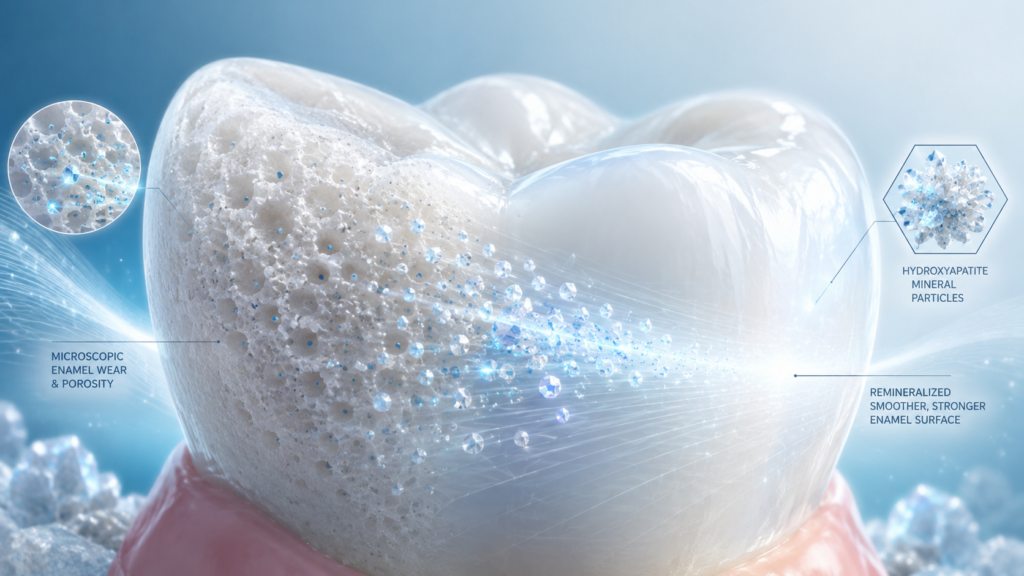
This strong Enamel Remineralization science hub explains clearly, so that people can understand, why different toothpastes, rinses and habits work differently.
Readers who want the full scientific foundation should start with enamel remineralization science, where biomimetic mineral repair compounds are compared with fluoride, hydroxyapatite, calcium phosphate, and stannous fluoride.
Hydroxyapatite Mechanism
Hydroxyapatite toothpaste works by supplying a tooth-like mineral that can bind to enamel surfaces and help fill microscopic defects. Nano hydroxyapatite is especially popular because its small particle size allows it to interact closely with enamel irregularities and exposed dentinal tubules.
This makes it highly relevant for readers searching for:
- hydroxyapatite toothpaste reviews
- toothpaste that rebuilds enamel
- enamel restoring toothpaste
- biomimetic toothpaste
- nano hydroxyapatite toothpaste
- toothpaste for sensitive teeth
Hydroxyapatite does not bleach teeth like peroxide. Instead, it may improve the appearance of teeth by smoothing the enamel surface, reducing roughness, and improving how light reflects from the tooth.
Fluoride Remineralization Science
Fluoride remains one of the most researched cavity-prevention ingredients in dentistry. Its primary value comes from helping enamel become more resistant to acid attacks. Fluoride can support the formation of a harder mineral surface and improve the tooth’s resistance to future demineralization.
For users at high cavity risk, fluoride toothpaste can remain extremely useful. For users looking for a non-toxic or biomimetic alternative, hydroxyapatite is often considered because it works through a different mineral-replacement logic.
Calcium Phosphate Systems
Calcium phosphate systems help supply the mineral building blocks enamel needs. Since enamel is largely a calcium phosphate structure, these systems are designed to increase mineral availability in the oral environment.
They are especially relevant when discussing:
- early enamel repair
- dry mouth and remineralization
- saliva-supported enamel recovery
- post-whitening enamel repair
- acid attack recovery protocols
Calcium and phosphate alone are not magic ingredients. They work best in a mouth where pH is controlled, saliva flow is healthy, and acid exposure is reduced.
Stannous Fluoride Effects
Stannous fluoride is different from sodium fluoride. It can support cavity prevention, sensitivity reduction, gum health, and plaque control. For people with both sensitivity and gum concerns, stannous fluoride toothpastes may be useful.
However, some users prefer hydroxyapatite because it is more biomimetic and does not rely on fluoride chemistry. The choice depends on cavity risk, sensitivity level, age, oral microbiome balance, and personal preference.
Biomimetic Mineral Repair Compounds
Biomimetic oral care refers to ingredients designed to imitate or support natural tooth structure. Hydroxyapatite is the leading example because it closely resembles the mineral already present in enamel and dentin.
This is why the term biomimetic has become important in modern enamel repair. Instead of simply coating or chemically modifying the tooth surface, biomimetic formulas aim to work with the natural mineral identity of the tooth.
Hydroxyapatite vs Fluoride: Two Different Approaches to Enamel Protection
The comparison between hydroxyapatite vs fluoride is one of the most searched topics in enamel repair. Both ingredients can support stronger teeth, but they do not work in the same way.
| Feature | Fluoride | Nano Hydroxyapatite |
|---|---|---|
| Main mechanism | Helps create a more acid-resistant mineral surface | Supplies tooth-like mineral particles |
| Repair style | Protective and acid-resistant | Biomimetic and mineral-replenishing |
| Sensitivity support | Indirect, or through stannous fluoride formulas | Physically helps seal exposed dentinal tubules |
| Whitening effect | No bleaching effect | May improve brightness through smoother enamel reflection |
| Swallowing concern | Should not be swallowed in large amounts | Generally positioned as biocompatible and non-toxic |
| Best for | High cavity risk, traditional prevention | Enamel support, sensitivity, biomimetic daily care |
| Common searches | fluoride toothpaste, fluoride remineralization | nano hydroxyapatite toothpaste, hydroxyapatite toothpaste reviews |
Hydroxyapatite vs Fluoride: Which Is Better?
The better choice depends on the person.
Fluoride may be preferred for people with a long history of cavities, poor access to dental care, orthodontic appliances, or high decay risk. Hydroxyapatite may be preferred by people looking for a biomimetic enamel repair toothpaste, a fluoride-free option, a daily sensitivity-support formula, or a toothpaste safe for families who want to avoid accidental swallowing concerns.
Read complete guide on hydroxyapatite vs fluoride
Which ingredient matches your oral risk profile?
| Oral Care Need | Better Fit |
|---|---|
| High cavity risk | Fluoride or dentist-recommended remineralizing protocol |
| Fluoride-free daily enamel support | Hydroxyapatite |
| Sensitive teeth from exposed dentin | Nano hydroxyapatite or sensitivity toothpaste |
| Gum inflammation plus sensitivity | Stannous fluoride may be useful |
| Holistic biomimetic oral care | Hydroxyapatite |
| Whitening toothpaste for sensitive teeth | Low-abrasion hydroxyapatite whitening toothpaste |
Sensitive Teeth Relief: Why Enamel Loss Causes Pain

Sensitive teeth usually develop when enamel becomes thin, gum recession exposes root surfaces, or dentinal tubules become open. These tubules are tiny channels inside dentin that connect external triggers to the nerve area of the tooth.
Common sensitivity triggers include:
- cold water
- hot drinks
- sweet foods
- acidic fruit
- whitening strips
- aggressive brushing
- gum recession
- enamel erosion
- tooth grinding
- acidic mouthwash
- post-dental cleaning irritation
How Toothpaste for Sensitive Teeth Works
Different sensitivity toothpastes use different strategies.
| Sensitivity Ingredient | How It Works | Best For |
|---|---|---|
| Nano hydroxyapatite | Helps seal tubules and support enamel mineral density | Long-term sensitivity and enamel support |
| Potassium nitrate | Calms nerve response | Fast comfort-focused sensitivity relief |
| Stannous fluoride | Supports tubule occlusion, plaque control, and gum health | Sensitivity with gum issues |
| Arginine | Helps block tubules | Dentin sensitivity |
| Low-abrasion polishing agents | Reduce stain without harsh enamel wear | Whitening toothpaste for sensitive teeth |
Nano hydroxyapatite is especially valuable because it addresses sensitivity through physical mineral support rather than only nerve desensitization. By helping fill surface defects and occlude tubules, it supports a more durable barrier between the outside world and the tooth nerve.
Whitening Toothpaste for Sensitive Teeth: What to Avoid
Many people want brighter teeth but already struggle with sensitivity. This creates a difficult balance. Some whitening products rely on abrasive polishing, peroxide, or strong stain-lifting systems that may irritate sensitive teeth when overused.
A better whitening toothpaste for sensitive teeth should focus on:
- low abrasiveness
- enamel-safe polishing
- hydroxyapatite or fluoride support
- pH balance
- no harsh daily peroxide exposure unless professionally guided
- no gritty charcoal overload
- no aggressive essential oil burn
- no acidic formula design
Hydroxyapatite whitening toothpastes do not bleach teeth dramatically. Instead, they support a smoother enamel surface, which can make teeth look cleaner, glossier, and naturally brighter over time.
Toothpaste Hub: Choosing the Right Enamel Restoring Toothpaste
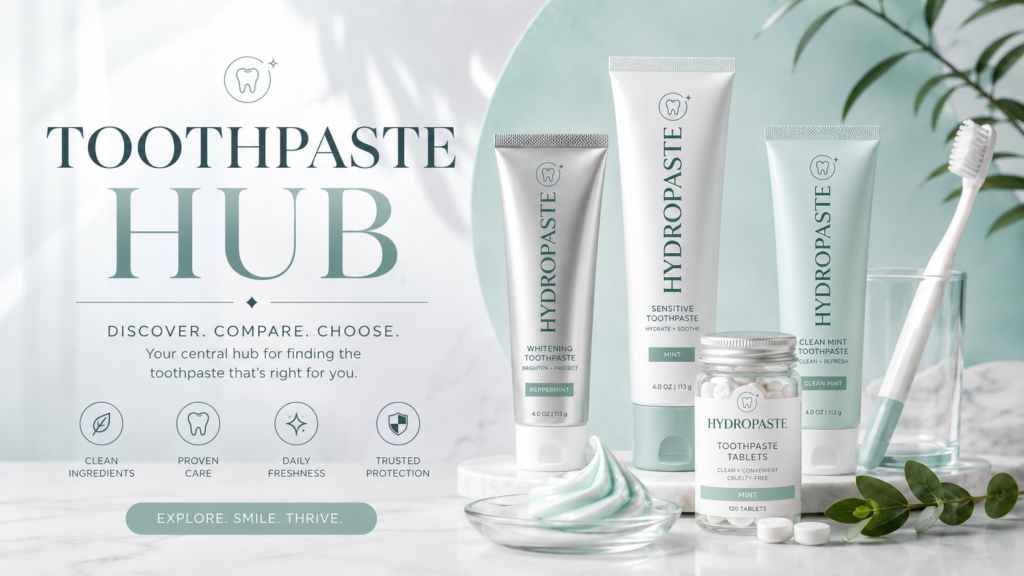
This toothpaste hub is to help people move from science to buy the best products, in the industry.
Important focused pages include:
- best hydroxyapatite toothpaste
- best whitening toothpaste
- best hydroxyapatite toothpaste for sensitivity relief
- fluoride vs nano hydroxyapatite options
- hydroxyapatite toothpaste reviews and products
- nobs toothpaste tablets
- enamel restoring toothpaste
- toothpaste that rebuilds enamel
What Makes a Good Remineralizing Toothpaste?
A high-quality enamel repair toothpaste should be judged by more than branding. The formula needs to make sense clinically and practically.
| Evaluation Factor | Why It Matters |
|---|---|
| Active remineralizing ingredient | Determines whether the formula supports enamel mineral recovery |
| Hydroxyapatite concentration | Higher-quality formulas often disclose meaningful mineral use |
| Particle size | Nano-sized particles may interact more closely with enamel defects |
| pH profile | Acidic formulas can work against remineralization |
| Abrasiveness | High-abrasion formulas may worsen enamel wear |
| Sensitivity support | Important for exposed dentin and enamel thinning |
| Flavor system | Harsh flavor oils may irritate some users |
| Microbiome compatibility | Daily oral care should clean without over-disrupting the mouth |
| Packaging and format | Tablets, tubes, gels, and pastes suit different habits |
Best Hydroxyapatite Toothpaste Brands: 2026 Overview
Below is a brand-level overview for your shop-by-brand structure. This is not a medical ranking; it is an editorial guide to formula positioning, audience fit, and keyword relevance.
| Brand | Primary Benefit | Key Differentiator |
| RiseWell | Clinical Remineralization | Uses Ca10(PO4)6(OH)2 (Science-heavy) |
| Boka | Daily Wellness | Features nHAp + antioxidant-rich flavors |
| Apagard | Professional Repair | Original Japanese medical-grade technology |
| ORL | pH Management | Alkalizing formula with organic oils |
| Davids | Aesthetic Polish | Premium nHAp in a recyclable metal tube |
| Ollie | Sensitivity + Repair | Hydroxyapatite + modern oral care system integration |
| Keeko | Natural Whitening | Charcoal-based polishing with natural ingredients |
| Miltodent | Optical Brightening | Color-correction technology instead of peroxide |
| Dr.Jen | High-Strength Repair | 10% nano-hydroxyapatite for advanced enamel remineralization |
| Nura | Microbiome Balance | Probiotic-based oral care approach |
| Himalaya | Herbal Care | Ayurvedic ingredients with gentle cleansing focus |
Brand Notes to Shop-by-Brand
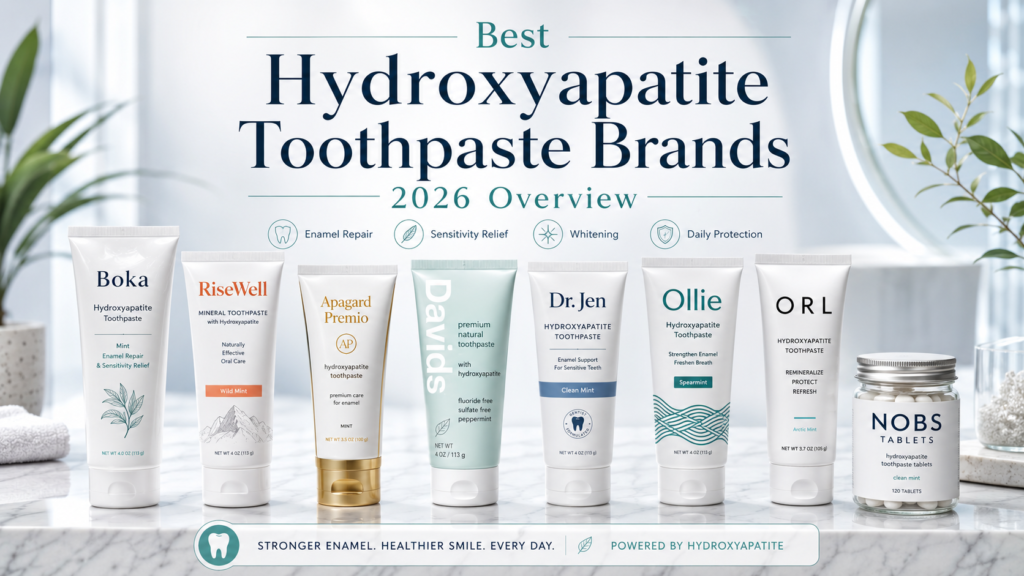
Boka
Boka is one of the best-known names in the hydroxyapatite toothpaste space. Its formulas are often associated with daily wellness, fluoride-free enamel support, and approachable flavors. Boka can fit readers looking for a polished, modern toothpaste for everyday remineralization rather than a harsh clinical formula.
RiseWell
RiseWell is about hydroxyapatite-based mineral support and fluoride-free family oral care. It fits people who want a clean, science-forward alternative to traditional fluoride toothpaste.
Apagard Premio
Apagard is strongly associated with Japanese hydroxyapatite toothpaste innovation. Apagard Premio is often bought by people who want premium enamel polishing, smoothness and advanced mineral repair positioning.
Dr. Jen’s
Dr. Jen’s is commonly discussed in the high-strength nano hydroxyapatite community. It is a strong fit for people who want a more intensive enamel repair toothpaste and are specifically comparing hydroxyapatite concentration.
Davids
Davids blends premium natural toothpaste branding with hydroxyapatite enamel support. It is a strong fit for people who care about ingredient quality, packaging and aesthetic oral care.
Keeko
Keeko fits people interested in natural oral care, gentle whitening and lifestyle-focused brushing routines. With natural polishing systems involved, Keeko supports greatly, abrasiveness and enamel safety.
Nura
Nura is a good fit for microbiome-focused oral care. This brand supports oral ecology, breath balance, plaque control and enamel-friendly routines.
Ollie
Ollie exists around modern oral care, sensitivity support, and enamel repair routines. It works well for daily brushing with whitening, sensitivity and enamel protection.
ORL
ORL stays connected to pH management and enamel environment support. Since enamel remineralization depends heavily on pH, ORL fits naturally within acid-control and enamel recovery processes.
Miltodent
Miltodent fits within optical brightening and color correcting toothpaste category. This is useful for people who want a whiter smile but may not be ideal candidates for aggressive whitening.
Himalaya Botanique Toothpaste
Himalaya Botanique fits people who prefer herbal oral care, gentle cleansing, and plant-based positioning. It should be understood carefully: herbal ingredients may support freshness and cleansing but enamel remineralization depends on mineral systems.
NOBS Toothpaste Tablets
NOBS toothpaste tablets are for people looking for convenience, low-waste oral care, travel-friendly brushing and hydroxyapatite tablet alternatives. Toothpaste tablets can be useful when they contain meaningful remineralizing ingredients and dissolve smoothly without excessive abrasiveness.
If you want a broader product-level comparison beyond enamel repair alone, our guide to the best oral care products helps compare toothpaste, mouthwash, whitening products, breath tools, interdental cleaners, and enamel-supportive daily essentials.
Condition-Based Remineralization: Matching the Routine to the Problem
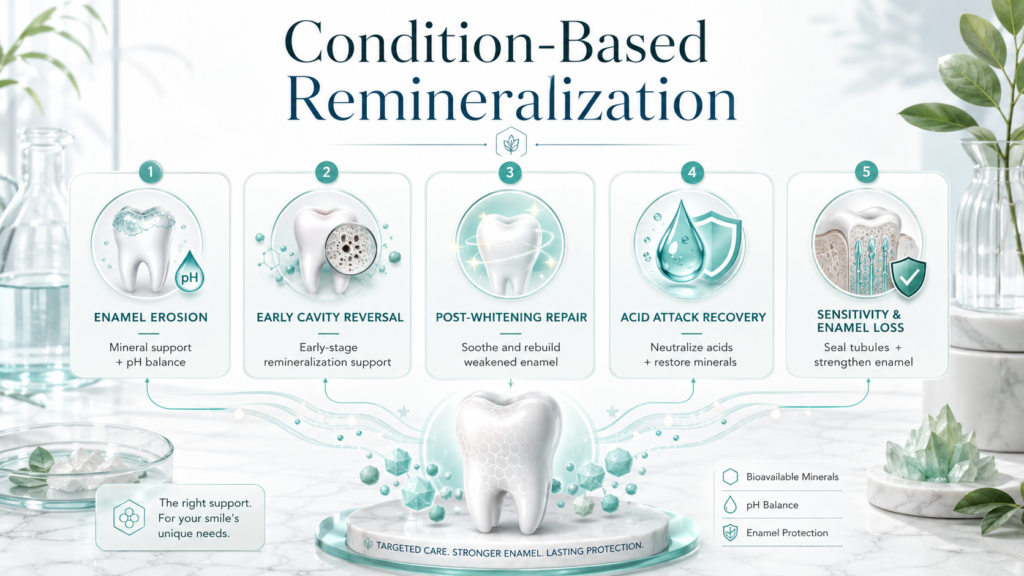
The best enamel repair routine depends on the condition you are trying to address. A person with acid erosion needs a different strategy than someone with post-whitening sensitivity or early white spot lesions, which is why a condition-based remineralization approach is more effective than relying on one universal enamel care routine.
Enamel Erosion Repair Strategy
Enamel erosion usually comes from acid exposure rather than bacteria alone. Common causes include citrus drinks, soda, sports drinks, vinegar-based foods, frequent snacking, acid reflux, and dry mouth.
A strong enamel erosion repair strategy should include:
- reduce acidic drinks
- avoid brushing immediately after acid exposure
- rinse with water after acidic meals
- use hydroxyapatite or fluoride toothpaste twice daily
- choose a low-abrasion toothpaste
- support saliva flow
- avoid harsh whitening products during recovery
For erosion, the goal is not only to add minerals. The bigger priority is to stop the acid cycle that keeps removing them.
Early Cavity Reversal Guide
Early cavities often begin as demineralized areas before the enamel surface collapses. At this stage, remineralization may help strengthen the area.
Helpful strategies include:
- twice-daily remineralizing toothpaste
- reduced sugar frequency
- improved plaque control
- fluoride or hydroxyapatite support
- xylitol gum after meals
- dental monitoring
- saliva support
- consistent pH control
Once a cavity becomes a physical hole, toothpaste cannot reverse it. That stage requires dental care.
Post-Whitening Enamel Repair
Whitening can temporarily increase sensitivity, especially if peroxide exposure, dehydration, or enamel roughness irritates the teeth.
A post-whitening enamel repair routine should focus on:
- hydroxyapatite toothpaste
- low-abrasion brushing
- avoiding acidic foods for 24–48 hours after whitening
- reducing whitening frequency if sensitivity increases
- using toothpaste for sensitive teeth
- avoiding aggressive charcoal products
- allowing saliva time to rebalance the enamel surface
This is where whitening toothpaste for sensitive teeth and hydroxyapatite formulas can fit naturally.
Acid Attack Recovery Protocol
An acid attack occurs when the mouth pH drops low enough to soften enamel. This can happen after soda, citrus, wine, candy, sports drinks, energy drinks, or reflux episodes.
A simple recovery protocol:
| Step | Action | Why It Helps |
|---|---|---|
| 1 | Rinse with plain water | Dilutes acids |
| 2 | Wait before brushing | Avoids scrubbing softened enamel |
| 3 | Use xylitol gum if appropriate | Encourages saliva flow |
| 4 | Brush with remineralizing toothpaste later | Supports mineral recovery |
| 5 | Spit, do not fully rinse | Leaves minerals on teeth longer |
Sensitivity and Enamel Loss Link
Sensitivity is often a warning sign that the protective barrier of the tooth has changed. It may come from enamel thinning, gum recession, dentin exposure, grinding, whitening overuse, or acidic erosion.
A sensitivity-focused remineralization routine should include:
- soft toothbrush
- gentle brushing pressure
- nano hydroxyapatite toothpaste
- sensitivity toothpaste if needed
- avoidance of acidic mouthwash
- night guard discussion if grinding is suspected
- dental evaluation for sharp or localized pain
If sensitivity is severe, sudden, or limited to one tooth, it should not be treated as a simple toothpaste issue. It may indicate decay, fracture, gum recession, or nerve irritation.
Optimizing the Remineralization Environment
Even the best enamel restoring toothpaste cannot work well in a mouth that stays acidic all day. Remineralization depends on the oral environment.
Because plaque bacteria, saliva quality, mouth pH, dry mouth, and breath chemistry all influence enamel recovery, readers should also understand oral microbiome balance as part of a complete enamel remineralization strategy.
The pH Factor
Enamel begins to lose minerals more easily when the mouth becomes acidic. Frequent acid exposure is more damaging than one occasional acidic meal because the teeth do not get enough recovery time.
Common acid sources include:
- soda
- sparkling water with acids
- citrus
- sports drinks
- energy drinks
- sour candy
- wine
- vinegar-heavy foods
- reflux
- frequent snacking
The Saliva Factor
Saliva is the mouth’s natural remineralization fluid. It buffers acids, carries minerals, lubricates oral tissues, supports the oral microbiome, and helps protect enamel between brushing sessions.
Dry mouth can make enamel more vulnerable because acids remain active longer and minerals are less available.
Support saliva by:
- drinking water
- chewing sugar-free xylitol gum
- limiting alcohol-based mouthwash
- breathing through the nose when possible
- reviewing dry-mouth medications with a clinician
- avoiding constant caffeine dehydration
- using oral moisturizers if needed
The “Spit, Don’t Rinse” Method
After brushing with hydroxyapatite or fluoride toothpaste, many dental professionals recommend spitting out excess toothpaste rather than rinsing thoroughly with water. This leaves a thin layer of active ingredients on the teeth longer.
For enamel repair routines, contact time matters. The longer minerals remain available on the tooth surface, the better the environment for remineralization.
Daily Enamel Remineralization Routine
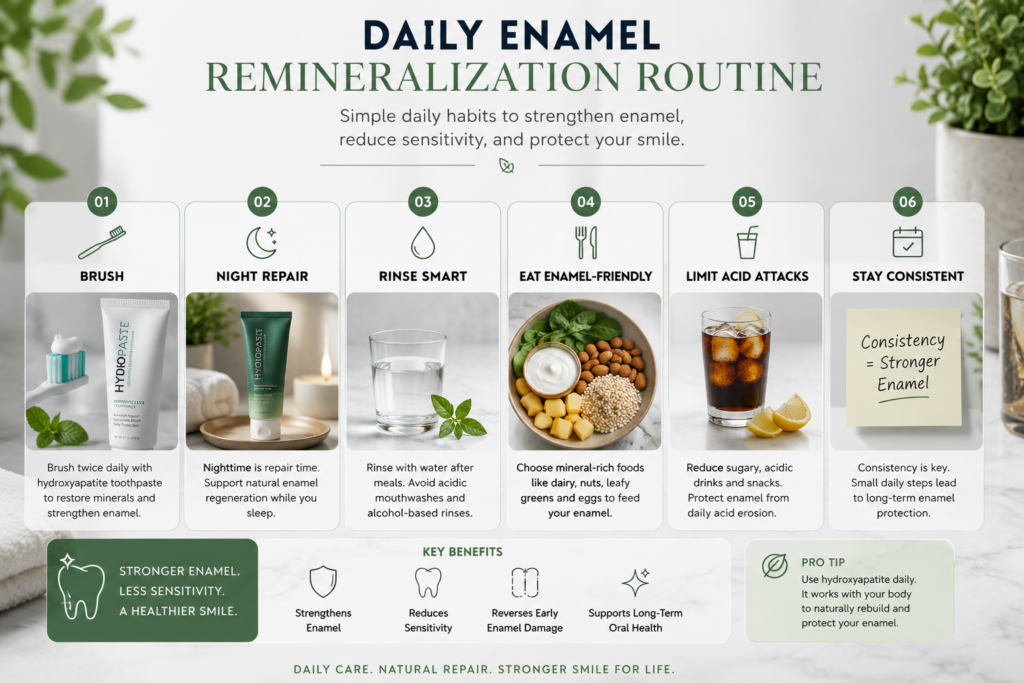
A practical routine is often more useful than a complicated product stack.
Morning
Brush gently with a remineralizing toothpaste. Choose nano hydroxyapatite if your goal is biomimetic enamel support or fluoride if your dentist recommends it for cavity risk. Spit out excess paste rather than rinsing aggressively.
After Meals
Rinse with water after acidic or sugary foods. Avoid brushing immediately after acidic exposure. Give saliva time to buffer the mouth before brushing.
Afternoon
Use xylitol gum or drink water if your mouth feels dry. This helps support saliva flow and reduces the length of acid exposure.
Evening
Brush thoroughly with an enamel repair toothpaste. Nighttime is important because saliva flow decreases during sleep, leaving teeth more vulnerable if plaque and acids remain.
Weekly
Review whether sensitivity, staining, roughness or gum irritation is improving. If symptoms continue or worsen, see a dental professional.
Enamel Remineralization Comparison Chart
| Category | Hydroxyapatite Toothpaste | Fluoride Toothpaste | Sensitivity Toothpaste | Whitening Toothpaste |
|---|---|---|---|---|
| Main purpose | Biomimetic enamel support | Cavity prevention | Pain reduction | Stain removal or brightness |
| Best for | Enamel repair, sensitivity, fluoride-free routines | High cavity risk | Cold/hot sensitivity | Cosmetic brightness |
| Key ingredient | Nano hydroxyapatite | Sodium fluoride, stannous fluoride | Potassium nitrate, stannous fluoride, hydroxyapatite | Silica, peroxide, enzymes, optical agents |
| Enamel support | Strong mineral-mimicking support | Strong acid-resistance support | Depends on formula | Depends on abrasiveness |
| Sensitivity support | Often strong | Strong if stannous fluoride | Strong | Can worsen if too abrasive |
| Whitening style | Surface smoothing | None | Minimal | Polishing, bleaching, or optical correction |
| Best caution | Check concentration and abrasiveness | Avoid swallowing large amounts | Persistent pain needs dental exam | Avoid harsh daily use if sensitive |
Frequently Asked Questions
What is enamel remineralization?
Enamel remineralization is the process of restoring lost minerals back into weakened enamel before the damage becomes irreversible. The main minerals involved are calcium and phosphate, supported by saliva, pH balance, fluoride, hydroxyapatite, and other remineralizing compounds. It is most useful for early enamel weakness, white spot lesions, acid-softened enamel, and sensitivity linked to mineral loss.
Can enamel remineralization actually repair teeth?
Enamel remineralization can help repair early mineral loss, microscopic enamel defects, and early-stage demineralization. It cannot repair a deep cavity, rebuild a broken tooth, or regrow enamel that has been physically lost. The word “repair” should be understood as mineral restoration and surface strengthening, not full biological regeneration.
What is the best toothpaste that rebuilds enamel?
The best toothpaste that rebuilds enamel is usually one that contains a proven remineralizing system such as nano hydroxyapatite, fluoride, stannous fluoride, or calcium phosphate. For biomimetic enamel repair, nano hydroxyapatite toothpaste is a strong option because it supplies tooth-like mineral particles that can help support enamel smoothness and tubule sealing.
Is hydroxyapatite toothpaste good for sensitive teeth?
Yes, hydroxyapatite toothpaste can be helpful for sensitive teeth because it supports enamel mineral density and helps seal exposed dentinal tubules. These tubules are tiny channels that allow cold, heat, sweetness, and air to irritate the tooth nerve. By helping block these channels, nano hydroxyapatite may support longer-term sensitive teeth relief.
Is hydroxyapatite better than fluoride?
Hydroxyapatite and fluoride work differently. Hydroxyapatite is biomimetic because it resembles the mineral found in enamel and dentin. Fluoride helps make enamel more resistant to acid and is widely used for cavity prevention. Hydroxyapatite may be preferred by people seeking fluoride-free enamel repair, while fluoride may be preferred for people with high cavity risk.
What is the difference between nano hydroxyapatite vs fluoride?
Nano hydroxyapatite supplies microscopic tooth-like mineral particles that can bind to enamel surfaces and help fill small defects. Fluoride supports acid-resistant mineral formation and helps prevent cavities. Nano hydroxyapatite is often discussed for biomimetic repair and sensitivity, while fluoride is strongly associated with traditional cavity prevention.
Can hydroxyapatite reverse cavities?
Hydroxyapatite may help remineralize very early enamel lesions before a cavity becomes a hole. It cannot reverse an advanced cavity with structural breakdown. If there is pain, a visible hole, dark soft spots, or food trapping in a tooth, a dentist should evaluate it.
How long does enamel remineralization take?
Sensitivity may improve within days or weeks, depending on the cause and the toothpaste used. Visible enamel strengthening, white spot improvement, and smoother texture usually require consistent use over several weeks or months. Results depend on acid exposure, brushing technique, saliva flow, diet, and whether the enamel damage is still in an early stage.
What is the best toothpaste for sensitive teeth?
The best toothpaste for sensitive teeth depends on the cause of sensitivity. Nano hydroxyapatite is useful for enamel support and tubule sealing. Potassium nitrate can help calm nerve response. Stannous fluoride may help sensitivity while also supporting gum health and cavity prevention. If sensitivity is sharp, severe, or isolated to one tooth, dental evaluation is important.
Is whitening toothpaste safe for sensitive teeth?
Whitening toothpaste can be safe for sensitive teeth if it is low-abrasion and includes enamel-supporting ingredients such as hydroxyapatite or fluoride. People with sensitivity should avoid overly abrasive charcoal powders, harsh daily whitening pastes, and frequent peroxide exposure unless guided by a dental professional.
Are NOBS toothpaste tablets good for enamel remineralization?
NOBS toothpaste tablets may be relevant for enamel remineralization if the formula contains hydroxyapatite or another meaningful remineralizing ingredient. Toothpaste tablets are convenient for travel and low-waste routines, but users should still check active ingredients, abrasiveness, fluoride status, and whether the tablets dissolve smoothly during brushing.
Can enamel grow back naturally?
Enamel cannot grow back naturally once it is physically lost. However, weakened enamel can often be strengthened through remineralization when mineral loss is still early and the enamel surface has not collapsed into a cavity. This is why early prevention matters.
People Also Ask
Does hydroxyapatite really rebuild enamel?
Hydroxyapatite can help rebuild enamel at the microscopic mineral level by supporting surface repair, filling small defects, and improving enamel smoothness. It does not regrow missing enamel structure, but it can support early remineralization and sensitivity relief.
Is nano hydroxyapatite approved by dentists?
Nano hydroxyapatite is widely used in oral care and is often recommended by dentists who support biomimetic or fluoride-free remineralization options. Its use is especially common in discussions around sensitivity, enamel support, and children’s toothpaste alternatives.
Which is safer: fluoride or hydroxyapatite?
Both can be safe when used correctly. Fluoride should not be swallowed in large amounts, especially by young children. Hydroxyapatite is commonly positioned as biocompatible and non-toxic, which is why many families and fluoride-free users prefer it.
Can you remineralize teeth at home?
Yes, early enamel mineral loss can often be supported at home with remineralizing toothpaste, improved plaque control, lower sugar frequency, acid reduction, saliva support, and regular dental visits. Advanced cavities cannot be fixed at home.
Does hydroxyapatite whiten teeth?
Hydroxyapatite does not bleach teeth like peroxide. It may help teeth appear brighter by smoothing the enamel surface, reducing surface roughness, and improving light reflection. This makes it useful in whitening toothpaste for sensitive teeth.
How do I know if my enamel is damaged?
Possible signs of enamel damage include sensitivity, yellowing, rough edges, transparent-looking tips, increased staining, white spots, dullness, and discomfort with cold or acidic foods. A dentist can confirm whether the issue is enamel erosion, decay, gum recession, or another problem.
What causes enamel loss?
Enamel loss can be caused by acidic drinks, sugar frequency, plaque acids, aggressive brushing, tooth grinding, acid reflux, dry mouth, whitening overuse, and abrasive toothpaste. Often, enamel loss is caused by several factors at once.
Is hydroxyapatite toothpaste good for kids?
Hydroxyapatite toothpaste is often considered a good option for children because it is fluoride-free, biomimetic, and generally regarded as safe if accidentally swallowed in small brushing amounts. Parents should still supervise brushing and use age-appropriate quantities.
Does hydroxyapatite replace calcium in teeth?
Hydroxyapatite supplies calcium and phosphate in a mineral form similar to the tooth’s own structure. This can help support enamel mineral density and repair microscopic defects in early enamel damage.
How often should I use hydroxyapatite toothpaste?
Most people use hydroxyapatite toothpaste twice daily, morning and night. For best results, brush gently, spit out excess toothpaste, avoid rinsing heavily with water afterward, and reduce frequent acid exposure throughout the day.
Editorial Verdict
Enamel remineralization is not a miracle cure, but it is one of the most important concepts in preventive oral care. The goal is to protect enamel before damage becomes permanent, support early mineral repair, reduce sensitivity, and build a daily routine that keeps the mouth less acidic and more mineral-rich.
Hydroxyapatite, fluoride, calcium phosphate, stannous fluoride, and other remineralizing systems all have a place in modern enamel care. The best choice depends on your cavity risk, sensitivity level, whitening goals, fluoride preference, oral microbiome balance, and the condition of your enamel.
For readers building a complete enamel repair routine, start with the science, compare hydroxyapatite vs fluoride, choose a toothpaste for your condition and then explore brand-specific reviews to find the formula that best fits your daily habits.