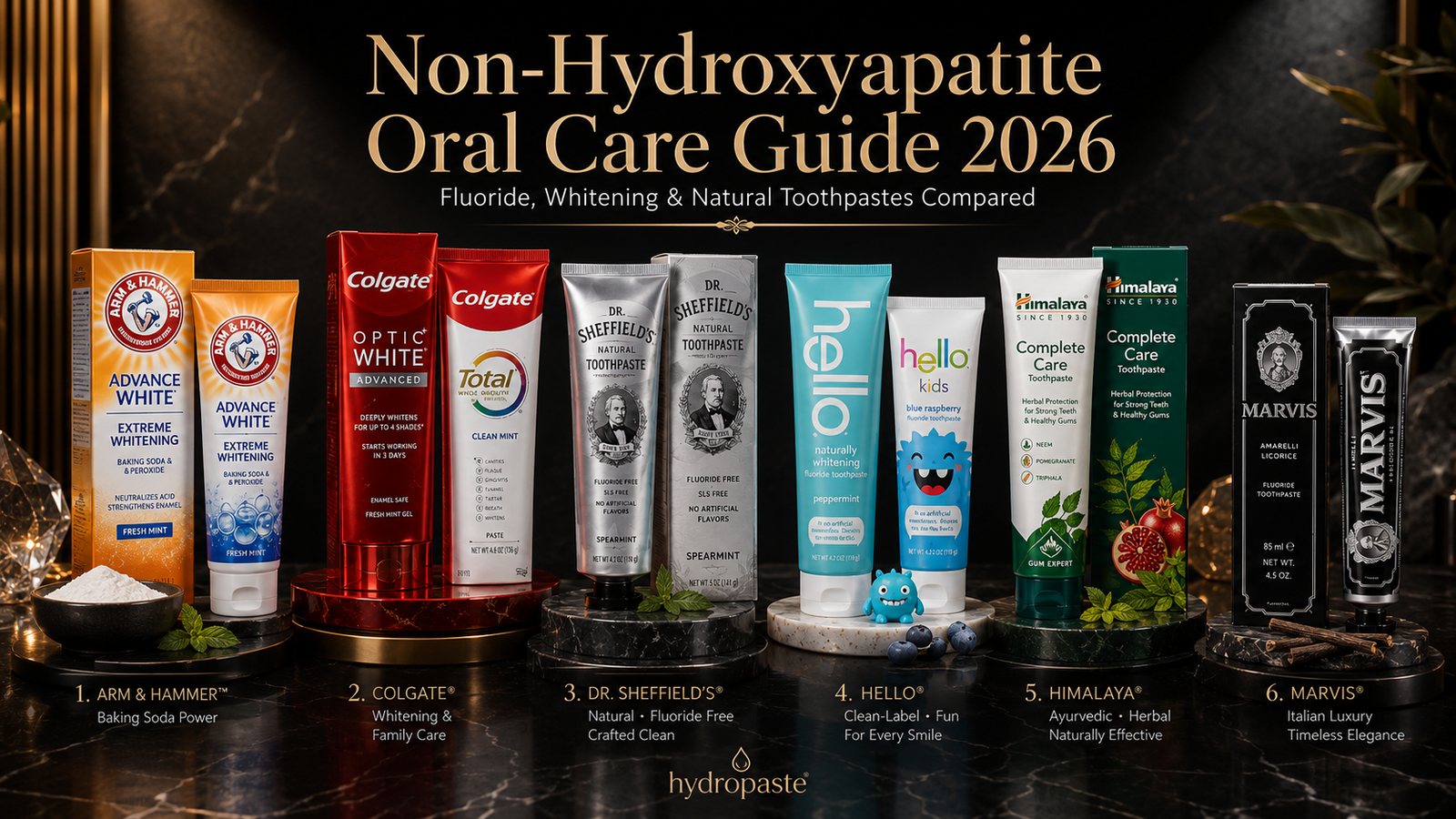
Non-Hydroxyapatite Oral Care Guide (2026): Fluoride, Whitening & Natural Toothpastes Compared
Updated June, 2026.
Beyond Hydroxyapatite: Why Non-Hydroxyapatite Oral Care Still Matters
Hydroxyapatite has become one of the most talked-about ingredients in modern toothpaste, especially for readers interested in enamel support, sensitivity care and biomimetic remineralization. But the oral-care market is much larger than nano-hydroxyapatite. Many of the most widely used toothpastes, whitening systems, gum-care formulas and family oral-care products still belong to the non-hydroxyapatite oral care category.
Non-hydroxyapatite oral care refers to toothpaste, mouthwash and hygiene systems that do not rely on nano-hydroxyapatite, micro-hydroxyapatite or biomimetic mineral particles as their main active strategy. Instead, these products use other established or emerging systems such as fluoride toothpaste, high fluoride toothpaste, peroxide whitening toothpaste, natural toothpaste, charcoal toothpaste, herbal oral-care formulas, polishing abrasives, antibacterial agents and sensitivity-focused compounds.
This category matters because not every individual is looking for the same result. One person may want stronger cavity prevention. Another may want a visibly brighter smile. A parent may be looking for a family-safe fluoride toothpaste. Someone with staining may compare whitening toothpaste against polishing powders. A natural-care buyer may want fluoride-free toothpaste with plant-based ingredients. A high-cavity-risk patient may need a clinical-grade fluoride system recommended by a dental professional.
That is why non-hydroxyapatite oral care should not be treated as one simple alternative. It is an entire ecosystem.
At its best, this category helps answer practical buyer questions:
- Which fluoride toothpaste is best for cavity prevention?
- Is high fluoride toothpaste worth it?
- Does whitening toothpaste actually remove stains?
- Are natural toothpastes effective enough for daily use?
- Is charcoal toothpaste too abrasive for enamel?
- What ingredients help with plaque control and gum health?
- Should a family choose fluoride or fluoride-free toothpaste?
- How do non-hydroxyapatite products compare with hydroxyapatite toothpaste?
The answer depends on the active system behind the product. Fluoride toothpaste focuses on cavity resistance and enamel protection. High fluoride toothpaste is typically used for people at higher risk of decay and should be guided by professional advice. Peroxide-based whitening systems target discoloration through oxidation, while abrasive whitening formulas focus more on surface stain removal. Natural toothpaste often appeals to buyers who prefer simpler ingredient lists, essential oils, plant extracts or fluoride-free formulas, although performance can vary widely. Charcoal toothpaste may feel visually powerful, but buyers need to understand abrasivity, enamel safety and long-term use concerns before choosing it as a daily product.
The bigger shift in 2026 is that oral care is no longer only about “killing bacteria” or scrubbing teeth until they feel clean. Modern dental hygiene is moving toward balance: controlling plaque without over-disrupting the oral environment, supporting enamel without ignoring gums, freshening breath without masking deeper biofilm issues, and choosing active ingredients based on risk level rather than marketing claims.
This guide organizes the full non-hydroxyapatite oral-care landscape so readers can compare fluoride, whitening and natural toothpaste systems with more confidence. It covers clinical-grade formulations, family-friendly toothpaste choices, whitening approaches, antibacterial strategies, gum-support formulas, sensitivity considerations and natural oral-care philosophies.
Non-hydroxyapatite products are not automatically better or worse than hydroxyapatite products. They simply work through different mechanisms. The smartest buyer does not choose based on trend alone. They choose based on cavity risk, sensitivity, stain type, gum condition, ingredient tolerance, age, brushing habits and long-term oral-health goals.
To understand how this fits into the broader future of mineral-based dentistry, you can also explore Hydropaste’s complete hydroxyapatite oral-care ecosystem, where toothpaste, mouthwash, remineralization science and enamel-support systems are explained in depth.
Quick Picks: Jump to What You Need
- Fluoride Protection → Start with Colgate for mainstream fluoride toothpaste and Arm & Hammer for baking soda fluoride formulas with acid-neutralizing support.
- Whitening Systems → Compare Colgate for Max White Refresh, Optic White, and peroxide-based whitening systems.
- Gum Health → Go to Colgate for PerioGard Professional and antibacterial gum-care support.
- Natural Toothpaste → Explore Dr. Sheffield’s for heritage-style natural toothpaste and Himalaya for herbal oral-care formulas.
- Kids Toothpaste → Visit Hello for kids toothpaste, family-friendly flavors, and fluoride or fluoride-free children’s oral-care options.
- Premium Lifestyle Toothpaste → See Marvis for Italian toothpaste, luxury flavors, premium packaging, and lifestyle-focused oral care.
- Baking Soda Toothpaste → Jump to Arm & Hammer for baking soda toothpaste, acid neutralization, plaque disruption, and gentle stain removal.
What Defines Non-Hydroxyapatite Toothpaste?
Non-hydroxyapatite toothpaste is defined by what it does instead of using hydroxyapatite particles as the central enamel-support mechanism. Rather than relying on nano-hydroxyapatite or micro-hydroxyapatite to interact with the tooth surface in a biomimetic way, these formulas usually work through fluoride chemistry, stain-control systems, antibacterial ingredients, sensitivity blockers, polishing agents, plant-based compounds, or lifestyle-driven ingredient profiles.
This category includes many of the world’s most familiar toothpaste types: fluoride toothpaste, high fluoride toothpaste, whitening toothpaste, charcoal toothpaste, natural toothpaste, herbal toothpaste, sensitivity toothpaste, antibacterial toothpaste, and family-focused daily-use formulas. Some are clinically oriented. Some are cosmetic. Some are built around natural positioning. Others are designed for convenience, flavor, freshness, or mass-market affordability.
The key distinction is mechanism. Hydroxyapatite-based toothpaste is usually discussed through the lens of mineral replacement, enamel surface repair, and biomimetic remineralization. Non-hydroxyapatite toothpaste is broader and more diverse. It may protect enamel, reduce cavity risk, brighten surface stains, control plaque, freshen breath, reduce sensitivity, or support gum hygiene — but it does so without making hydroxyapatite the main active system.
1. Enamel Protection Through Fluoride Ions
The most established non-hydroxyapatite toothpaste category is fluoride toothpaste. Fluoride works differently from hydroxyapatite. Instead of supplying tooth-like mineral particles, fluoride supports enamel by helping make the tooth surface more resistant to acid attack and assisting the remineralization process through fluoride-ion interaction.
This is why fluoride remains the standard in many global oral-care markets. It is widely used in daily toothpaste, family toothpaste, children’s toothpaste, prescription-strength formulas, and high fluoride toothpaste for people with elevated cavity risk.
For people, the main question is not whether fluoride toothpaste is popular. It is whether their oral-health profile fits the fluoride system. People with frequent cavities, dry mouth, orthodontic appliances, exposed roots, high sugar exposure, or a history of enamel weakness may need a stronger cavity-prevention strategy than a purely cosmetic toothpaste can provide.
2. Surface Stain Removal Instead of Enamel Rebuilding
Many non-hydroxyapatite toothpastes are built around surface stain removal rather than enamel rebuilding. These include whitening toothpaste, charcoal toothpaste, polishing toothpaste, smoker’s toothpaste, coffee-stain toothpaste, and abrasive stain-control formulas.
These products usually target extrinsic stains — the discoloration that sits on or near the outer tooth surface from coffee, tea, wine, tobacco, colored foods, or plaque-retained pigments. They may use hydrated silica, calcium carbonate, baking soda, charcoal, peroxide systems, optical brighteners, or polishing particles to improve the visual appearance of teeth.
This is where buyers need to be careful. A toothpaste can make teeth look cleaner without meaningfully rebuilding enamel. A whitening toothpaste may improve brightness by removing surface discoloration, but that is not the same as repairing mineral loss, treating deep intrinsic discoloration, or reversing structural damage.
The best whitening toothpaste should balance stain removal with enamel safety. Too much abrasiveness may create a short-term polished look while increasing long-term wear risk, especially for people with sensitivity, gum recession, or exposed root surfaces.
3. Antimicrobial Action Rather Than Structural Remineralization
Another major part of the non-hydroxyapatite ecosystem is antimicrobial oral care. These products focus on reducing plaque bacteria, controlling odor, supporting gum health, or limiting biofilm buildup.
Common systems may include CPC, zinc compounds, essential oils, stannous fluoride, herbal extracts, or other plaque-targeting ingredients. The aim is not usually to deposit enamel-like minerals. Instead, the goal is to influence bacterial activity, breath quality, gumline cleanliness, and plaque accumulation.
This matters because many users confuse a “clean feeling” with complete oral health. Strong mint, foam, or antibacterial intensity can make the mouth feel fresh, but soft-tissue comfort and oral microbiome balance still matter. A formula that is too harsh for a user’s mouth may create dryness, irritation, taste disturbance, or poor long-term compliance.
The strongest antimicrobial toothpaste is not necessarily the one that feels most intense. It is the one that helps control plaque while remaining comfortable enough for daily use.
4. Sensitivity Relief Through Nerve-Calming or Tubule-Blocking Systems
Some non-hydroxyapatite toothpastes are built for sensitivity rather than whitening or cavity prevention alone. These formulas may use potassium nitrate, stannous fluoride, arginine-based systems, or other ingredients designed to reduce the sensation of pain from exposed dentin.
Sensitivity toothpaste is especially relevant for people with:
- Gum recession
- Exposed root surfaces
- Enamel wear
- Whitening-related sensitivity
- Acid erosion
- Aggressive brushing history
- Post-treatment tenderness
Unlike hydroxyapatite toothpaste, which is often discussed as a mineral-support strategy, many non-HAp sensitivity formulas work by calming nerve response or helping block pathways in exposed dentin. The result is a different kind of benefit: less discomfort during brushing, cold drinks, sweet foods, or air exposure.
5. Flavor Experience and Lifestyle Positioning
Non-hydroxyapatite toothpaste also dominates the lifestyle side of oral care. This includes natural toothpaste, fluoride-free toothpaste, herbal toothpaste, charcoal toothpaste, kids’ toothpaste, luxury toothpaste, flavored toothpaste, zero-waste toothpaste tablets, and vegan or cruelty-free formulas.
These products often compete on:
- Taste
- Texture
- Foam level
- Ingredient simplicity
- Packaging
- Natural positioning
- Fluoride-free preference
- Whitening promise
- Breath freshness
- Family suitability
- Sustainability claims
This does not make them automatically weak or unserious. It means buyers need to separate branding from mechanism. A natural toothpaste may be pleasant and well-formulated, but its cavity-prevention profile may differ from a fluoride toothpaste. A charcoal toothpaste may look visually dramatic, but its abrasivity and daily-use safety matter. A fluoride-free formula may align with a buyer’s preferences, but it should still be evaluated honestly against that person’s cavity risk.
6. Market Dominance and Clinical Familiarity
Non-hydroxyapatite toothpaste still dominates global oral care because fluoride-based dentistry has shaped public health, dental education, and consumer habits for decades. In many regions, fluoride toothpaste is the default recommendation for cavity prevention. Whitening toothpaste dominates cosmetic shelves. Natural toothpaste attracts ingredient-conscious buyers. Sensitivity toothpaste serves a large adult population with gum recession, enamel wear, and cold sensitivity.
This category is therefore not a niche. It is the mainstream oral-care foundation from which hydroxyapatite toothpaste has emerged as an alternative or complementary system.
The modern man does not view non-hydroxyapatite toothpaste as an outdated category, therefor it is better understood as a wide family of oral-care systems with different goals:
| Non-Hydroxyapatite Toothpaste Type | Main Purpose | Best-Fit User |
|---|---|---|
| Fluoride toothpaste | Cavity prevention and enamel protection | Daily users, families, cavity-prone adults |
| High fluoride toothpaste | Stronger professional-level decay support | High-risk users under dental guidance |
| Whitening toothpaste | Surface stain removal and brightness | Coffee, tea, wine, or tobacco stain concerns |
| Charcoal toothpaste | Cosmetic polishing and stain-focused appeal | Occasional-use buyers who understand abrasivity |
| Natural toothpaste | Ingredient-conscious daily care | Lifestyle-focused users |
| Sensitivity toothpaste | Reduce tooth sensitivity | Recession, enamel wear, cold sensitivity |
| Antibacterial toothpaste | Plaque and breath support | Gumline plaque, odor, gingivitis-prone users |
| Herbal toothpaste | Plant-based freshness and gum comfort | Natural-care buyers |
The defining feature of non-hydroxyapatite toothpaste is not that it lacks value. It is that its value comes from a different active logic. Some formulas are built for fluoride-driven cavity prevention. Some are cosmetic stain systems. Some are gum-care products. Some are lifestyle oral-care products. Some are clinical tools. Some are simple daily refreshers.
The smartest choice depends on matching the formula to the problem: cavities, stains, sensitivity, plaque, breath, gum comfort, family use, or natural ingredient preference. Those interested in traditional and mineral-based cleaning alternatives may benefit from exploring the Best Tooth Powder options, which offer a different approach to daily oral care while complementing modern toothpaste routines.
Guides & Reviews (2026)
1. The Ultimate Arm & Hammer Toothpaste Guide
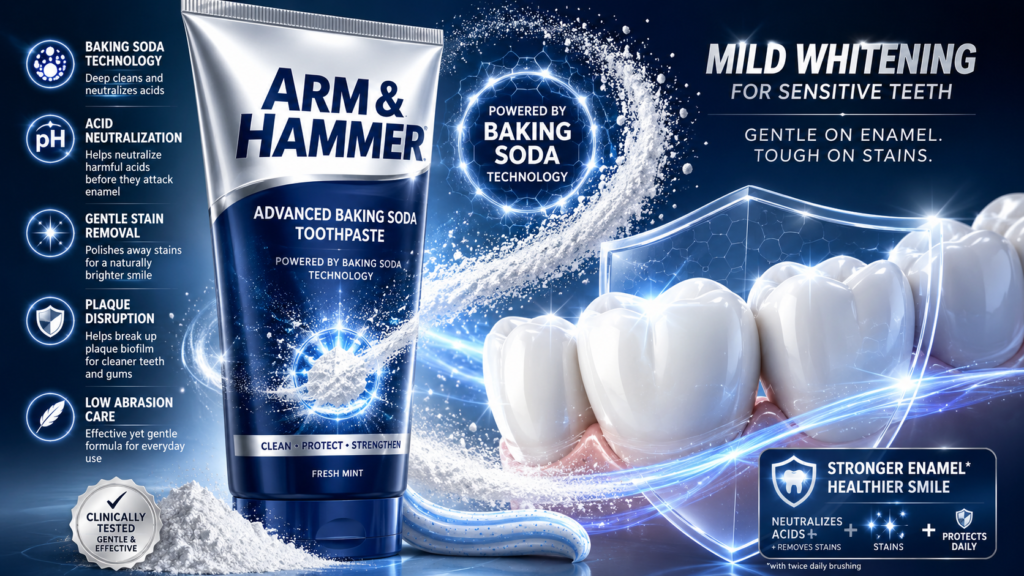
Arm & Hammer toothpaste sits in a distinctive position inside the non-hydroxyapatite oral care category because its identity is built around baking soda toothpaste technology rather than hydroxyapatite, peroxide-heavy whitening, charcoal polishing, or purely herbal ingredients. The central active cleaning philosophy is simple: use sodium bicarbonate to help neutralize oral acids, support plaque disruption, freshen breath, and gently polish surface stains without making the formula feel overly harsh.
For readers who want the full product-by-product breakdown before comparing formulas, Hydropaste’s complete Arm & Hammer toothpaste guide explains baking soda toothpaste benefits, whitening options, fluoride support, sensitivity considerations, and daily-use fit in more detail.
This makes Arm & Hammer especially relevant for readers comparing fluoride toothpaste, whitening toothpaste, natural toothpaste alternatives, and low-abrasion daily cleaning systems. It is not a hydroxyapatite remineralization product. It is a baking-soda-centered oral-care system designed around pH support, stain management, foam behavior, freshness, and daily plaque control.
For people, the real question is not simply “Is Arm & Hammer toothpaste good?” A better question is: does baking soda toothpaste match your oral-care goal?
If your main concern is deep enamel remineralization through biomimetic mineral replacement, hydroxyapatite toothpaste may be the category to compare. But if your concern is mild surface staining, plaque buildup, acidic mouthfeel, breath freshness, or a cleaner post-brushing sensation, Arm & Hammer deserves a closer look.
Why Arm & Hammer Toothpaste Uses Baking Soda
The defining ingredient in Arm & Hammer toothpaste is sodium bicarbonate, commonly known as baking soda. In oral care, baking soda is valued because it behaves differently from many standard toothpaste abrasives. It is mildly alkaline, dissolves easily, and can help create a cleaner-feeling mouth by interacting with acids and debris on the tooth surface.
Baking soda toothpaste is often associated with four major benefits:
- Acid neutralization
- Gentle surface stain removal
- Plaque disruption support
- Breath freshness
This does not mean baking soda “rebuilds enamel” in the same way hydroxyapatite products are often discussed. It also does not mean it replaces fluoride for cavity prevention. Instead, Arm & Hammer formulas usually combine baking soda with other ingredients depending on the product line, such as fluoride for cavity protection, peroxide for whitening support, or sensitivity-focused ingredients in selected formulas.
Core Advantage: Neutralizes Oral Acidity
One of the strongest reasons people choose Arm & Hammer toothpaste is its alkaline baking soda base. The mouth naturally experiences acid challenges throughout the day from food, drinks, plaque metabolism, dry mouth, and frequent snacking. Acidic conditions can make the mouth feel less fresh and may contribute to a less stable enamel environment over time.
Baking soda helps support a more neutral oral environment by counteracting acidity on the tooth surface and in the oral cavity. This is why many users describe Arm & Hammer toothpaste as leaving the mouth feeling especially clean.
The benefit is not only freshness. It is system-level balance. A toothpaste that helps reduce acidic mouthfeel can be useful for users who want a daily formula that feels clean without relying only on strong mint or aggressive foaming.
Core Advantage: Gentle Stain Removal
Arm & Hammer toothpaste is also popular among users looking for mild whitening toothpaste without jumping straight into strong peroxide systems or abrasive charcoal formulas.
Baking soda can help polish away surface stains from coffee, tea, wine, and everyday food pigments. These are extrinsic stains, meaning they sit on or near the outer surface of the tooth. Baking soda toothpaste does not bleach teeth internally in the same way stronger whitening systems may attempt to lighten deeper discoloration. Instead, it helps brighten the smile by removing some surface buildup that dulls the tooth’s appearance.
This makes Arm & Hammer a practical middle-ground option for users who want:
- Mild whitening
- Daily stain control
- A cleaner surface feel
- Lower-intensity polishing
- A non-charcoal whitening alternative
- A toothpaste that can be used more routinely than aggressive stain removers
The phrase “gentle whitening” should be understood carefully. Gentle does not mean risk-free for every user, and whitening does not mean dramatic shade transformation. Arm & Hammer is best understood as a surface stain management toothpaste, not a professional whitening treatment.
Core Advantage: Effective Plaque Disruption Support
Plaque is a sticky biofilm, and toothpaste alone does not remove it without brushing technique. However, toothpaste texture, pH behavior, foaming pattern, and cleaning agents can influence how effective brushing feels and performs.
Arm & Hammer’s baking soda base can help loosen and disrupt surface buildup during brushing. When paired with proper technique, it may support daily plaque control around tooth surfaces and near the gumline.
This is especially important in the non-hydroxyapatite category because many buyers are comparing mechanisms. Fluoride supports cavity protection. Peroxide supports whitening. Charcoal targets visual stain removal. Herbal formulas often focus on freshness and ingredient preference. Arm & Hammer’s strongest identity is practical daily cleaning: plaque disruption, acid neutralization, and surface polishing.
For users with heavy plaque accumulation, toothpaste choice should not be the only strategy. Brushing technique, flossing, interdental cleaning, tongue cleaning, and professional cleanings all matter. But as a daily toothpaste option, Arm & Hammer fits users who want a formula that feels active against buildup without being positioned as a mineral-repair toothpaste.
Best Use Case: Sensitive Teeth With Mild Whitening Needs
Arm & Hammer toothpaste can be a strong fit for users who want a balance between comfort and brightness. Many people with sensitive teeth hesitate to use whitening toothpaste because some whitening systems feel too intense. A baking-soda-based formula may offer a more approachable option for mild stain removal.
The best-fit user is someone who wants:
- A cleaner mouthfeel
- Mild surface whitening
- Fluoride-based cavity protection, depending on the formula
- Less aggressive polishing than many charcoal products
- A daily toothpaste that does not depend on hydroxyapatite
- A practical balance between freshness, plaque control, and stain removal
However, sensitive teeth are not all the same. Sensitivity can come from enamel wear, gum recession, exposed dentin, whitening products, acidic diet, brushing pressure, cracked teeth, or dental treatment. If sensitivity is persistent or sharp, the user should not rely on toothpaste alone to diagnose the cause.
Best Use Case: Users Seeking Low-Abrasion Polishing
Arm & Hammer is often attractive to users who want polishing but are concerned about harsh abrasives. In the whitening category, this distinction matters. Some toothpastes focus heavily on stain removal, but aggressive abrasivity can become a concern for people with thin enamel, gum recession, exposed roots, or a history of brushing too hard.
Baking soda is commonly perceived as a gentler polishing system than many rougher-feeling whitening pastes. That makes Arm & Hammer relevant for people who want a cleaner, brighter look without choosing a harsh daily scrub.
Still, “low-abrasion” should not be treated as permission to overbrush. Even a gentler toothpaste can become problematic when combined with hard pressure, stiff bristles, or excessive brushing frequency. The safest whitening routine pairs the right toothpaste with a soft brush and controlled technique.
Who Should Consider Arm & Hammer Toothpaste?
Arm & Hammer toothpaste may be a good fit for:
| User Type | Why It May Fit |
|---|---|
| Coffee or tea drinkers | Helps manage mild surface staining |
| Users with acidic mouthfeel | Baking soda supports acid neutralization |
| People wanting non-HAp toothpaste | Uses baking soda and other non-hydroxyapatite systems |
| Mild whitening buyers | Helps polish surface stains without relying only on peroxide |
| Daily plaque-control users | Supports a cleaner brushing experience |
| Fresh-breath-focused users | Alkaline cleaning and flavor systems support freshness |
| Value-focused shoppers | Widely available and often affordable |
| Users avoiding charcoal | Offers a stain-focused alternative without black charcoal paste |
Who May Need a Different Toothpaste?
Arm & Hammer may not be the ideal first choice for every buyer.
You may need a different formula if:
- You specifically want hydroxyapatite-based remineralization
- You need prescription-strength fluoride
- You have severe tooth sensitivity
- You want dramatic whitening results
- You dislike the taste or texture of baking soda
- You have active gum disease requiring professional care
- You need a toothpaste recommended for a specific dental condition
This is why the Ultimate Arm & Hammer Toothpaste Guide should compare different formulas within the brand rather than treating all Arm & Hammer products as the same. Some formulas focus more on whitening. Some focus more on cavity protection. Some are designed for sensitivity. Others emphasize freshness or enamel care.
Arm & Hammer vs Hydroxyapatite Toothpaste
The comparison between Arm & Hammer and hydroxyapatite toothpaste comes down to mechanism.
| Category | Arm & Hammer Baking Soda Toothpaste | Hydroxyapatite Toothpaste |
|---|---|---|
| Core system | Sodium bicarbonate cleaning and pH support | Enamel-like mineral particles |
| Main strength | Acid neutralization, stain polishing, freshness | Enamel surface support and sensitivity care |
| Whitening approach | Surface stain removal | Usually not primarily whitening-focused |
| Cavity strategy | Often fluoride-based, depending on formula | Mineral-support strategy, sometimes fluoride-free |
| Best for | Mild whitening, plaque feel, fresh mouth | Remineralization-focused buyers |
| Buyer intent | Practical daily cleaning | Biomimetic enamel support |
Neither category is automatically superior. They answer different needs. Arm & Hammer is better understood as a baking soda toothpaste system for daily cleaning, mild whitening, plaque disruption, and acidity control. Hydroxyapatite toothpaste is better understood as a mineral-support system for enamel-focused users.
Arm & Hammer vs Charcoal Toothpaste
Many whitening-focused buyers compare Arm & Hammer with charcoal toothpaste. This comparison matters because both are often marketed for stain removal, but they feel very different in the mouth.
Arm & Hammer uses baking soda as its signature cleaning base. Charcoal toothpaste usually relies on activated charcoal or charcoal-inspired polishing claims. Charcoal can be visually dramatic and heavily marketed, but users should pay close attention to abrasivity, enamel safety, and whether the product contains fluoride.
For daily use, many buyers may find baking soda toothpaste more practical and less messy than charcoal toothpaste.
Arm & Hammer vs Peroxide Whitening Toothpaste
Peroxide whitening toothpaste is designed around a different whitening mechanism. Peroxide targets discoloration through oxidation, while baking soda focuses more on cleaning and surface stain polishing.
Choose Arm & Hammer if you want:
- Mild daily whitening
- Freshness
- Acid neutralization
- A less intense whitening routine
- Surface stain control
Consider peroxide whitening toothpaste if you want:
- Stronger whitening focus
- More visible cosmetic brightening
- A formula specifically built around stain oxidation
People with sensitivity should be cautious with stronger whitening systems and should choose based on tolerance, not just promised results.
Editorial Takeaway
Arm & Hammer toothpaste is not just another mass-market toothpaste. It represents one of the most recognizable non-hydroxyapatite toothpaste systems built around baking soda technology. Its strength is not biomimetic enamel rebuilding. Its strength is practical daily oral care: neutralizing acidity, supporting plaque disruption, polishing mild stains, and leaving the mouth feeling clean.
For individuals comparing fluoride toothpaste, whitening toothpaste, natural toothpaste, charcoal toothpaste, and hydroxyapatite alternatives, Arm & Hammer belongs in the conversation because it solves a specific set of problems well. It is best suited for users who want a baking-soda-based toothpaste with mild whitening, freshness, plaque-control support, and a lower-intensity polishing feel.
The smartest way to evaluate Arm & Hammer is not by asking whether it is the “best toothpaste” for everyone. It is by asking whether your oral-care goal matches its formula logic: clean the surface, balance acidity, manage mild stains, support freshness, and keep the daily routine simple.
2. Colgate Toothpaste: Freshness, Whitening & Family Care
Colgate is one of the strongest names in the non-hydroxyapatite toothpaste category because it represents the mainstream fluoride-based oral-care system at global scale. While hydroxyapatite toothpastes are often discussed through the lens of biomimetic enamel support, Colgate’s product ecosystem is built around a different set of buyer needs: fluoride cavity protection, daily freshness, whitening toothpaste systems, gum-care support, family oral hygiene, and clinically familiar plaque-control routines.
For many households, Colgate is not just a toothpaste brand. It is the default oral-care reference point. Parents recognize it. Dentists discuss it. Retail shelves prioritize it. Whitening buyers compare its cosmetic formulas. Gum-health users look toward its professional systems. People with simple daily needs choose it for freshness, fluoride protection, and routine consistency.
That broad reach is why Colgate deserves its own section inside a non-hydroxyapatite oral-care guide. It is not one formula. It is a family of toothpaste and oral-care systems designed for different outcomes: whiter-looking teeth, fresher breath, cavity prevention, enamel protection, plaque control, gum support, and targeted whitening beyond standard brushing.
For readers who want to begin with Colgate’s daily whitening toothpaste category, Hydropaste’s Colgate Toothpaste breaks down how instant brightness, polishing action, cooling freshness, and cosmetic stain management fit into a non-hydroxyapatite routine.
Why Colgate Matters in Non-Hydroxyapatite Oral Care
Colgate’s strongest role is its ability to serve multiple oral-care intents without relying on hydroxyapatite as the central active system. A Colgate product may use fluoride, peroxide, polishing agents, antibacterial ingredients, breath-freshening systems, enamel-support claims, or professional gum-care compounds, depending on the formula.
That makes Colgate relevant for several high-intent buyer searches:
- best fluoride toothpaste
- Colgate whitening toothpaste
- Colgate Optic White review
- toothpaste for family care
- toothpaste for fresh breath
- Colgate toothpaste for gum health
- whitening toothpaste for daily use
- hydrogen peroxide whitening pen
- antibacterial toothpaste for gums
- non-hydroxyapatite toothpaste
The brand’s strength is not that every formula solves every problem. Its strength is category coverage. Colgate offers everyday fluoride toothpaste for routine cavity prevention, cosmetic whitening systems for surface stains, peroxide-based products for deeper whitening goals, and professional gum-care systems for users focused on gingivitis or periodontal support.
The Colgate Formula Logic
Colgate’s non-hydroxyapatite approach usually fits into three major systems:
| Colgate System | Main Purpose | Best-Fit User |
|---|---|---|
| Daily fluoride toothpaste | Cavity prevention, freshness, plaque-control support | Families and daily users |
| Whitening toothpaste and pens | Surface stain removal, cosmetic brightness, deeper whitening support | Coffee, tea, wine, and cosmetic-focused users |
| Gum-health and professional systems | Antibacterial support, gingivitis care, periodontal maintenance | Gum-focused users under appropriate guidance |
This makes Colgate different from more niche brands that focus on a single philosophy. Colgate is a mass-market ecosystem. It can serve a basic family bathroom, a whitening routine, or a more professional gum-health protocol depending on the selected product.
A. Colgate Max White Refresh Review: Instant Brightness and Cooling Freshness
Colgate Max White Refresh is best understood as a daily cosmetic whitening toothpaste built for people who want a brighter smile feel, fresher breath, and visible cleanliness without moving immediately into strips, trays, or intensive whitening systems.
Its core appeal is the combination of instant brightness perception and a cooling sensation. This matters because many whitening toothpaste buyers are not looking for clinical-level shade transformation. They want teeth to look cleaner, feel smoother, and appear less dull after daily brushing.
The product’s focus is cosmetic enhancement through surface-level brightness. It may use optical whitening effects, polishing ingredients, freshness systems, and stain-management support to create a whiter-looking smile experience.
Core Focus: Instant Brightness
The phrase “instant brightness” should be understood carefully. In toothpaste, instant brightness often relates to how light reflects from the tooth surface after brushing, how surface buildup is polished away, and whether optical effects make teeth appear temporarily brighter.
This is different from deep whitening. A daily whitening toothpaste is usually better for:
- Mild surface stains
- Coffee and tea discoloration
- Dull tooth appearance
- Freshness after meals
- Daily cosmetic confidence
- Maintaining whitening results after treatment
It is not usually the strongest choice for deeply embedded stains, intrinsic discoloration, or dramatic shade change.
Technology: Optical Whitening and Polishing Agents
Colgate Max White Refresh fits the non-hydroxyapatite category because its whitening identity is based on cosmetic stain management rather than hydroxyapatite mineral deposition. The formula logic may include polishing agents to help remove surface discoloration and optical whitening effects that make teeth appear brighter.
This gives it a clear role in a buyer’s routine: it is for daily smile enhancement.
It is especially relevant for readers comparing:
- whitening toothpaste vs hydroxyapatite toothpaste
- Colgate Max White vs Optic White
- toothpaste for coffee stains
- daily whitening toothpaste
- fresh breath whitening toothpaste
Ideal User: Daily Cosmetic Enhancement
Colgate Max White Refresh is best suited for users who want a daily toothpaste that feels fresh, supports a cleaner-looking smile, and helps manage surface stains without committing to a more intensive whitening process.
It may fit:
- Coffee drinkers
- Tea drinkers
- Users with mild surface stains
- People who want a cooling brushing experience
- Daily whitening toothpaste buyers
- Users who prioritize freshness and appearance
- People maintaining results after a whitening routine
It may not be the best first choice for people with severe sensitivity, deep intrinsic stains, or gum irritation from strong mint and whitening formulas.
Editorial View
Colgate Max White Refresh is not a deep whitening system. It is a daily polish-and-refresh toothpaste. Its value is consistency: brighter-looking teeth, fresher breath, and a cleaner surface feel through routine use.
For the right buyer, that is exactly enough.
B. Colgate Optic White Overnight Advantage: Whitening While Sleeping
Colgate Optic White represents a more intensive whitening direction within the Colgate ecosystem. Unlike standard whitening toothpaste, the Optic White pen-style system is designed around targeted application and longer contact time, often positioned around overnight whitening.
Hydropaste’s Colgate Optic White Overnight pen review gives readers a focused look at how peroxide-based whitening, night application, stain type, sensitivity risk, and realistic whitening expectations fit together.
This category is important because many buyers misunderstand whitening. A toothpaste that polishes surface stains is not the same as a peroxide whitening system. A whitening pen is not the same as a toothbrush routine. Contact time, active ingredient type, stain depth, and user tolerance all change the outcome.
Core Focus: Whitening While Sleeping
The key idea behind an overnight whitening pen is extended contact. Instead of brushing for two minutes and rinsing away most of the formula, the user applies a whitening gel more directly to the tooth surface. The system is usually designed to stay in place longer, allowing the whitening agent more time to interact with stains.
This makes it attractive for people who want a more targeted cosmetic result than a daily whitening toothpaste can provide.
Technology: Hydrogen Peroxide Gel System
The major distinction is peroxide chemistry. Hydrogen peroxide whitening systems work differently from polishing toothpastes. While polishing agents focus on surface stain removal, peroxide-based formulas are designed to help break down discoloration through oxidation.
This makes Colgate Optic White more relevant for users searching for:
- hydrogen peroxide whitening pen
- Colgate Optic White pen review
- overnight teeth whitening
- whitening pen for deep stains
- best whitening pen for teeth
- whitening toothpaste vs whitening pen
However, buyers should understand that peroxide whitening is not the same as ordinary toothpaste. It may be more effective for certain discoloration goals, but it also requires more attention to sensitivity, gum contact, application technique, and realistic expectations.
Ideal User: Deeper Stain Removal
The Colgate Optic White Overnight system is best suited for people who want more than mild brightness from toothpaste but are not ready for professional whitening or tray-based systems.
It may fit:
- Coffee and wine stain concerns
- Yellowing that does not respond well to regular toothpaste
- Users who want targeted whitening
- People seeking an at-home cosmetic upgrade
- Buyers comparing whitening pens, strips, and toothpaste
- Users who can follow application instructions carefully
It may not be ideal for users with untreated cavities, gum inflammation, severe sensitivity, exposed roots, or those who expect instant professional-grade results from one application.
Whitening Buyer Insight
The smartest way to view Colgate Optic White is as a targeted whitening layer, not a replacement for oral hygiene. It does not replace brushing, flossing, fluoride protection, or gum care. It adds a cosmetic whitening step for users who want stronger stain-management support than toothpaste alone.
Colgate Max White vs Colgate Optic White
| Feature | Colgate Max White Refresh | Colgate Optic White Overnight |
|---|---|---|
| Product Type | Whitening toothpaste | Whitening pen or gel system |
| Main Goal | Daily brightness and freshness | More targeted whitening |
| Whitening Method | Optical effect and polishing | Hydrogen peroxide gel system |
| Best For | Mild surface stains | Deeper cosmetic stain goals |
| Use Timing | During brushing | Often overnight or targeted use |
| Sensitivity Potential | Usually lower | May be higher depending on user |
| Ideal Buyer | Daily cosmetic maintenance | Stronger whitening seeker |
The two systems do not compete in a simple winner-takes-all way. They serve different layers of a whitening routine. Max White Refresh is a daily-use cosmetic toothpaste. Optic White Overnight is a more targeted whitening system.
C. PerioGard Professional System: Gum Health and Antibacterial Protection
PerioGard represents a different side of Colgate’s non-hydroxyapatite ecosystem: professional gum support. While Max White focuses on brightness and Optic White focuses on whitening, PerioGard is associated with gum health, antibacterial protection, gingivitis management, and periodontal support.
Hydropaste’s PerioGard Professional System guide explains how gum-focused antibacterial oral care fits into a broader non-hydroxyapatite routine, especially for readers comparing plaque control, gingivitis support, professional recommendations, and daily tissue tolerance.
Core Focus: Gum Health
Gum-focused oral care is different from whitening-focused oral care. Whitening buyers often think about shade, stain, and brightness. Gum-health buyers need to think about plaque at the gumline, bleeding, inflammation, bacterial load, brushing technique, interdental cleaning, and professional monitoring.
PerioGard fits users who are not merely asking, “How do I make my teeth whiter?” They are asking:
- Why do my gums bleed?
- What helps with gingivitis?
- What is a professional gum-care rinse?
- Is antibacterial oral care useful for plaque control?
- How do I support periodontal maintenance?
- What oral-care system helps gumline health?
Technology: Chlorhexidine-Based Care in Some Regions
In some markets, PerioGard is associated with chlorhexidine-based care. Chlorhexidine is a professional-strength antibacterial ingredient often used in specific gum-care contexts. It is not a casual cosmetic ingredient and should be understood differently from ordinary mint mouthwash or whitening toothpaste.
The important editorial distinction is this: professional antibacterial systems can be useful, but they are not lifestyle products to use carelessly forever. Depending on formula, region, concentration, and dental guidance, chlorhexidine-style products may be used for targeted periods rather than as an indefinite daily rinse.
Users should follow product instructions and professional advice, especially if they have gum disease, periodontal treatment history, dental implants, oral irritation, staining concerns, or medication-related dry mouth.
Ideal User: Gingivitis and Periodontal Support
PerioGard-style systems may be relevant for:
- Gingivitis-prone users
- People with bleeding gums
- Periodontal maintenance patients
- Users needing professional antibacterial support
- People recovering from certain dental treatments
- Users with high plaque accumulation near the gumline
- People advised by a dentist to use antibacterial oral care
It is not the same kind of product as a whitening toothpaste. It belongs to a gum-health protocol.
PerioGard vs Standard Mouthwash
| Feature | PerioGard-Type Professional System | Standard Fresh-Breath Mouthwash |
|---|---|---|
| Main Goal | Gum-health and antibacterial support | Breath freshness |
| Use Case | Gingivitis or periodontal support | Daily odor control |
| Active Logic | Professional antibacterial strategy | Flavor, freshness, mild antimicrobial action |
| User Type | Gum-risk or dentist-guided users | General daily users |
| Watch-Out | Follow instructions carefully | Avoid masking deeper issues |
A fresh-breath rinse can make the mouth feel cleaner, but gum-focused systems are built for a different level of oral-care intent.
Colgate’s Role in Family Oral Care
Colgate also matters because of its broad family-care presence. Many households need toothpaste that is easy to find, familiar, affordable, and suitable for routine use. This is where fluoride toothpaste remains important.
A family toothpaste decision usually includes:
- Cavity prevention
- Age-appropriate fluoride use
- Flavor acceptance
- Gentle daily brushing
- Compliance for children
- Parent trust
- Easy availability
- Consistent routine building
In a family-care context, the best toothpaste is not always the most advanced. It is often the one that supports regular brushing twice daily, encourages children to accept brushing, and fits the household’s cavity-risk profile.
Colgate’s broad product range allows families to choose from standard fluoride formulas, kids’ toothpaste, whitening toothpaste for adults, sensitivity options, gum-care products, and professional systems where appropriate.
Colgate in the Non-Hydroxyapatite Decision Framework
Colgate is best evaluated by matching the product to the problem.
| Buyer Goal | Colgate Direction | Why |
|---|---|---|
| Daily cavity prevention | Fluoride toothpaste | Mainstream enamel protection |
| Fresher breath | Freshness-focused toothpaste | Routine comfort and confidence |
| Mild brightness | Colgate Max White Refresh | Daily cosmetic enhancement |
| Stronger whitening | Optic White pen system | Targeted peroxide whitening |
| Gum support | PerioGard-style system | Antibacterial periodontal focus |
| Family use | Standard fluoride or kids’ formulas | Familiar and accessible |
| Plaque control | Fluoride + brushing technique | Supports daily hygiene |
| Cosmetic maintenance | Whitening toothpaste | Surface stain management |
The strongest Colgate choice depends on whether the reader is trying to prevent cavities, freshen breath, brighten teeth, support gums, or manage a family routine.
Colgate vs Hydroxyapatite Toothpaste
Colgate and hydroxyapatite toothpaste often serve different buyer philosophies.
| Category | Colgate Non-Hydroxyapatite Systems | Hydroxyapatite Toothpaste |
|---|---|---|
| Main Identity | Fluoride, freshness, whitening, gum-care systems | Biomimetic mineral support |
| Cavity Strategy | Fluoride-based in many formulas | Hydroxyapatite-based, sometimes fluoride-free |
| Whitening Strategy | Polishing, optical effects, peroxide systems | Usually not primary whitening category |
| Gum-Care Strategy | Antibacterial and plaque-control products | Often gentler mineral-focused routines |
| Best Buyer | Mainstream, family, whitening, gum-specific users | Remineralization-focused users |
| Product Range | Very broad | More specialized |
The decision is not about declaring one category universally better. It is about fit. A high-cavity-risk user may prioritize fluoride. A whitening buyer may choose Optic White. A gum-health user may explore PerioGard. A hydroxyapatite buyer may prioritize enamel-surface support and sensitivity comfort.
Editorial Takeaway
Colgate remains one of the most important names in non-hydroxyapatite oral care because it covers the full mainstream spectrum: fluoride toothpaste, whitening toothpaste, freshness systems, family care, and professional gum-health support.
Colgate Max White Refresh fits the individual who wants daily brightness and a cooler, fresher brushing experience. Colgate Optic White Overnight fits the person who wants a more targeted peroxide whitening step. PerioGard fits the user looking at gum health, antibacterial support, gingivitis care, or periodontal maintenance.
That range is what makes Colgate powerful. It is not one product. It is a complete non-hydroxyapatite oral-care ecosystem for different stages of the buyer journey: daily brushing, cosmetic enhancement, deeper whitening, and gum-focused support.
The smartest Colgate choice begins with intent. If the problem is mild surface staining, choose a daily whitening toothpaste. If the problem is deeper discoloration, consider a targeted whitening system. If the concern is bleeding gums or periodontal support, look toward gum-health products and professional guidance. If the goal is family prevention, fluoride toothpaste remains the foundation.
Colgate’s value is not trend appeal. Its value is familiarity, clinical relevance, broad product coverage, and the ability to match a toothpaste or oral-care system to a very specific need.
3. Dr. Sheffield’s Natural Toothpaste and Oral Care Solutions
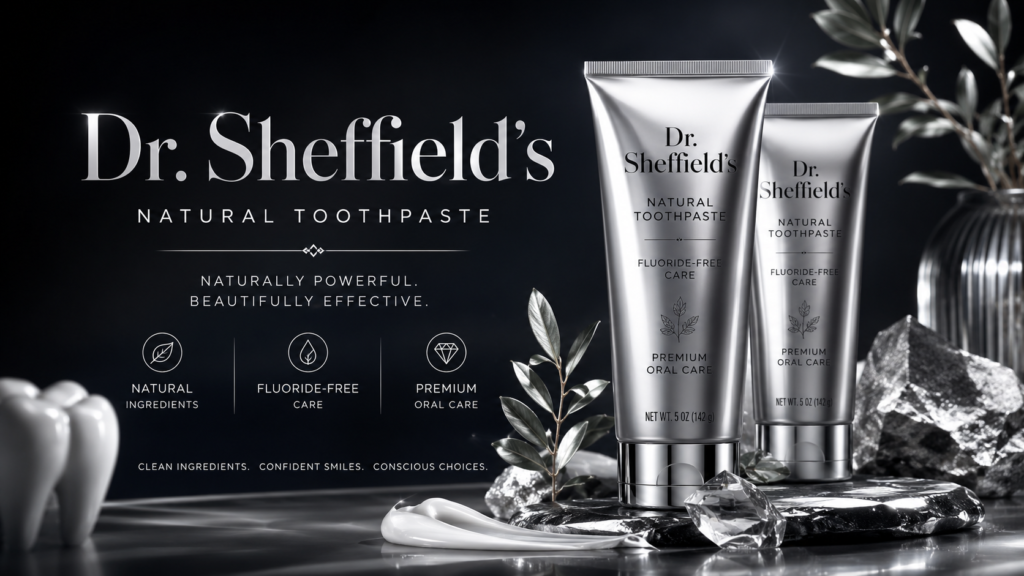
Dr. Sheffield’s occupies a different lane inside the non-hydroxyapatite oral care category. While Colgate represents mainstream fluoride systems and Arm & Hammer is known for baking soda toothpaste, Dr. Sheffield’s connects oral care with heritage, ingredient simplicity, natural toothpaste positioning, and fluoride-free daily brushing.
The brand is especially relevant for buyers who are not only asking, “Which toothpaste works?” but also asking, “What is inside my toothpaste, and does it fit the way I want to care for my mouth every day?”
That makes Dr. Sheffield’s a strong fit for the natural oral-care audience: ingredient-conscious users, fluoride-free toothpaste buyers, people avoiding certain synthetic additives, and readers who prefer plant-based, simpler, or heritage-style formulas over heavily cosmetic whitening systems.
For a deeper breakdown of ingredients, formula types, daily-use fit, and natural toothpaste positioning, read Hydropaste’s full Dr. Sheffield toothpaste guide.
Why Dr. Sheffield’s Matters in Non-Hydroxyapatite Oral Care
Dr. Sheffield’s is important because it helps define the natural side of the non-hydroxyapatite market. Many toothpaste categories are built around clinical actives, whitening claims, foam intensity, or strong mint flavor. Dr. Sheffield’s instead leans into a more traditional oral-care identity: simple brushing, plant-derived ingredients, familiar flavors, and a brand history tied to the early development of toothpaste in tube form.
This does not make it a hydroxyapatite alternative in the mineral-repair sense. Dr. Sheffield’s does not primarily compete by claiming biomimetic enamel rebuilding. Its appeal is different. It belongs to the world of natural toothpaste, fluoride-free toothpaste, plant-based oral care, and clean-label daily brushing.
That distinction matters because natural toothpaste buyers often have different priorities from whitening buyers or cavity-risk buyers. They may care about ingredient lists, taste, texture, foaming agents, sweeteners, preservatives, fluoride status, animal testing policies, packaging feel, and whether the product fits a more natural household routine.
The Dr. Sheffield Formula Logic
Dr. Sheffield’s is best understood through three core ideas: natural positioning, ingredient-conscious design, and heritage credibility.
| Formula Direction | What It Means | Best-Fit Buyer |
|---|---|---|
| Fluoride-free toothpaste | Daily brushing without fluoride as the main active | Users choosing fluoride-free oral care |
| Plant-based ingredients | Natural extracts, essential oils, and simpler ingredient philosophy | Ingredient-conscious buyers |
| Heritage toothpaste identity | Historic brand story and traditional oral-care feel | Buyers attracted to legacy and authenticity |
| Gentle daily brushing | Less aggressive cosmetic positioning | Users who want simple routine care |
| Natural flavor systems | Botanical or classic flavor profiles | Users avoiding overly strong synthetic flavor intensity |
Dr. Sheffield’s fits users who want a toothpaste that feels less like a laboratory whitening treatment and more like a natural daily-care product.
Highlight: Fluoride-Free Formulations
One of the most important reasons individuals search for Dr. Sheffield’s is its fluoride-free toothpaste positioning. Fluoride-free oral care remains a major part of the non-hydroxyapatite category because not every user wants fluoride in their daily routine.
Some people avoid fluoride because of personal preference. Some are comparing natural toothpaste brands. Some want a toothpaste for a specific household philosophy. Some dislike the taste or mouthfeel of conventional toothpaste. Others are looking for formulas with fewer synthetic additives.
A fluoride-free toothpaste can be a valid lifestyle choice, but it should be evaluated honestly. Fluoride is widely used for cavity prevention, so buyers who choose fluoride-free toothpaste should think carefully about their cavity risk, diet, oral hygiene consistency, dry mouth status, and dental history.
Dr. Sheffield’s may be a good fit for people who:
- Prefer fluoride-free toothpaste
- Want a more natural daily brushing formula
- Are comfortable with a non-fluoride cavity strategy
- Have low cavity risk and strong brushing habits
- Want to avoid certain conventional toothpaste ingredients
- Prefer simpler product positioning
- Are building a natural household oral-care routine
However, people with frequent cavities, dry mouth, exposed roots, braces, high sugar intake, or elevated decay risk may need to discuss fluoride use with a dental professional before choosing a fluoride-free routine as their only toothpaste strategy.
Highlight: Plant-Based Ingredients
Dr. Sheffield’s also appeals to users searching for plant-based toothpaste and natural oral-care ingredients. Depending on the formula, natural toothpastes may use botanical extracts, essential oils, naturally derived flavors, gentle cleaning agents, and alternative sweeteners.
For many people, the appeal is not only performance. It is trust and comfort. They want a toothpaste that feels closer to wellness, less synthetic, and more aligned with a natural personal-care routine.
Common buyer intents include:
- best natural toothpaste
- fluoride-free toothpaste
- plant-based toothpaste
- toothpaste without synthetic additives
- natural toothpaste for daily use
- Dr. Sheffield toothpaste review
- non-hydroxyapatite natural toothpaste
The important editorial point is that “natural” is not a single performance category. Some natural toothpastes are built mainly for freshness. Others focus on fluoride-free brushing. Some use baking soda. Some use essential oils. Some are mild and simple. Others may feel strong because of botanical flavor intensity.
A natural toothpaste should still be judged by practical questions:
- Does it clean well during brushing?
- Does it feel comfortable on gums?
- Does it support fresh breath?
- Does it fit the user’s cavity-risk profile?
- Is the texture pleasant enough for daily use?
- Are the ingredients clearly explained?
- Is the formula appropriate for the user’s age and oral condition?
Natural positioning is only useful when it supports real routine compliance.
Highlight: Historical Legacy
Dr. Sheffield’s has one of the strongest heritage stories in toothpaste. It is often associated with the early history of toothpaste packaging and the transition toward tube-based toothpaste. This gives the brand an unusual identity in a market dominated by modern clinical claims and cosmetic promises.
That history matters from a branding perspective because many natural-care buyers are skeptical of products that feel overly engineered or aggressively marketed. A heritage brand can feel more grounded, especially when combined with natural ingredient positioning.
The legacy angle also helps Dr. Sheffield’s stand apart from newer natural toothpaste brands. It is not only a clean-label product. It is a brand with a historical oral-care narrative.
For people, that creates a particular emotional fit: traditional, simple, familiar, natural, and less trend-driven.
Ideal Audience: Ingredient-Conscious Users
Dr. Sheffield’s is best suited for people who read ingredient panels. These users may compare toothpaste based on what it does not contain as much as what it includes. They may be looking to avoid artificial flavors, certain preservatives, synthetic dyes, SLS, fluoride, or other ingredients depending on the formula and personal preference.
The ingredient-conscious buyer is usually not satisfied with “clinically proven” as a broad claim. They want to know the formula logic. They want to understand why the toothpaste fits their routine. They may care about natural flavor, mouthfeel, aftertaste, ingredient sourcing, packaging identity, and whether the toothpaste aligns with their broader wellness philosophy.
Ideal Audience: Users Avoiding Synthetic Additives
Some users want to reduce synthetic additives across personal-care products. Toothpaste is a natural category for that shift because it is used daily, placed directly in the mouth, and often shared across the household.
Dr. Sheffield’s may appeal to users looking for:
- Fluoride-free toothpaste
- Natural toothpaste for adults
- Plant-based oral care
- Gentle daily toothpaste
- Simple ingredient toothpaste
- Heritage toothpaste brand
- Toothpaste without artificial colors
- Toothpaste for natural lifestyle routines
Still, avoiding synthetic additives should not mean ignoring oral-health needs. A person choosing a more natural toothpaste should still maintain proper brushing time, flossing or interdental cleaning, tongue cleaning when needed, and routine dental visits.
Dr. Sheffield’s vs Fluoride Toothpaste
The main comparison is between natural fluoride-free positioning and traditional fluoride-based cavity prevention.
| Category | Dr. Sheffield’s Natural Toothpaste | Mainstream Fluoride Toothpaste |
|---|---|---|
| Core Identity | Natural, heritage, often fluoride-free | Cavity-prevention focused |
| Main Appeal | Ingredient-conscious daily brushing | Fluoride enamel protection |
| Buyer Type | Natural-care users | General family and cavity-risk users |
| Whitening Focus | Usually secondary | Varies by formula |
| Clinical Positioning | Lifestyle and natural oral care | Dental-standard cavity support |
| Best Fit | Low-risk users seeking natural formulas | Users prioritizing decay prevention |
This comparison should not be framed as natural versus clinical in a simplistic way. The better question is risk fit. A fluoride-free natural toothpaste may work well for a low-risk user with strong oral hygiene and regular dental care. A high-risk user may need fluoride support regardless of lifestyle preference.
Dr. Sheffield’s vs Hydroxyapatite Toothpaste
Dr. Sheffield’s and hydroxyapatite toothpaste can both appeal to people seeking alternatives to conventional fluoride toothpaste, but they are not the same.
Hydroxyapatite toothpaste is often chosen by users interested in mineral support, enamel surface repair, and sensitivity management. Dr. Sheffield’s is usually chosen for natural ingredients, heritage positioning, and fluoride-free daily brushing.
| Category | Dr. Sheffield’s | Hydroxyapatite Toothpaste |
|---|---|---|
| Main System | Natural toothpaste philosophy | Biomimetic mineral support |
| Primary Appeal | Ingredient simplicity and heritage | Enamel support and sensitivity care |
| Fluoride Status | Often fluoride-free | Often fluoride-free, but varies |
| Best Buyer | Natural lifestyle user | Remineralization-focused user |
| Whitening Role | Usually mild or secondary | Usually not primarily whitening |
| Differentiator | Historic natural brand identity | Tooth-like mineral technology |
Someone who wants natural toothpaste may prefer Dr. Sheffield’s. A buyer who wants fluoride-free enamel-support technology may compare hydroxyapatite products. The decision depends on whether the user values ingredient philosophy or mineral mechanism more.
Dr. Sheffield’s vs Whitening Toothpaste
Whitening toothpaste is typically built for cosmetic brightness, stain removal, and surface polish. Dr. Sheffield’s is not mainly a high-intensity whitening system. It is better positioned as a natural daily toothpaste.
Choose Dr. Sheffield’s if your priority is:
- Natural ingredients
- Fluoride-free brushing
- Simple daily use
- Heritage brand identity
- Avoiding synthetic additives
- Gentle freshness
Choose a whitening toothpaste if your priority is:
- Coffee stain management
- Brighter cosmetic appearance
- Surface polish
- Peroxide or optical whitening
- Smile brightness maintenance
Some people may use a natural toothpaste daily and reserve whitening products for occasional cosmetic support, depending on sensitivity and dental advice.
Dr. Sheffield’s in the Non-Hydroxyapatite Decision Framework
| Buyer Goal | Does Dr. Sheffield’s Fit? | Why |
|---|---|---|
| Fluoride-free daily care | Yes | Natural formulas often avoid fluoride |
| Plant-based oral care | Yes | Ingredient-conscious positioning |
| Strong cavity prevention | Depends | Higher-risk users may need fluoride |
| Mild freshness | Yes | Natural flavors and daily brushing support |
| Heavy whitening | Not primary | Better to compare whitening systems |
| Sensitivity management | Depends | Formula-specific; not always a dedicated sensitivity toothpaste |
| Family natural routine | Possibly | Check age suitability and fluoride preference |
| Lifestyle oral care | Strong fit | Natural, heritage, clean-label appeal |
Dr. Sheffield’s is strongest when the user’s intent is natural daily care, not aggressive whitening or professional gum treatment.
Editorial Takeaway
Dr. Sheffield’s Natural Toothpaste is one of the more distinctive entries in the non-hydroxyapatite oral-care landscape because it combines three things many buyers care about: natural ingredients, fluoride-free options, and historical credibility.
It is not designed to compete directly with every fluoride toothpaste, whitening pen, gum-treatment rinse, or hydroxyapatite remineralization formula. Its role is more specific. It serves the buyer who wants a natural toothpaste that feels simple, traditional, and ingredient-conscious.
For the right user, that is a powerful position. Oral care is not only about chasing the strongest active ingredient. It is also about choosing a routine someone will actually follow every morning and night. If a natural toothpaste improves consistency, feels comfortable, and aligns with a person’s values, it can become a meaningful part of a well-built hygiene system.
The key is honest fit. Dr. Sheffield’s is best for users who want natural daily brushing and are comfortable with its fluoride-free philosophy. Users with high cavity risk, ongoing sensitivity, gum disease, or complex dental needs should evaluate whether they need additional support from fluoride, hydroxyapatite, professional products, or dentist-guided care.
4. Say Hello to a Brighter Smile
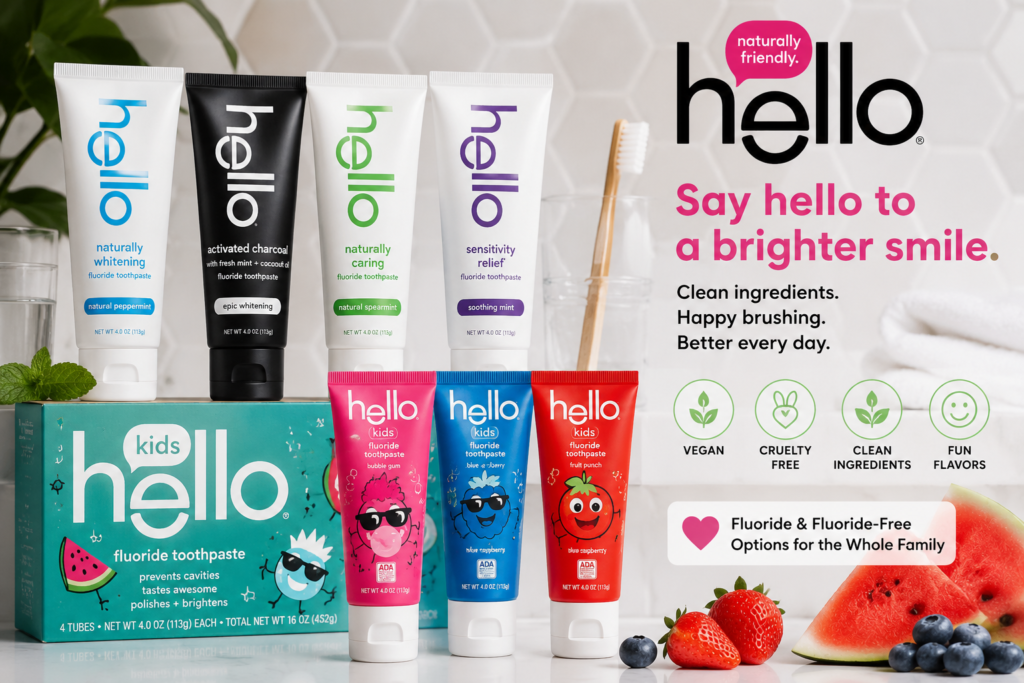
Hello has become one of the most recognizable modern brands in the non-hydroxyapatite toothpaste category because it speaks to a different kind of oral-care buyer. Instead of positioning toothpaste only as a clinical necessity, Hello turns daily brushing into something more approachable: cleaner labels, friendlier flavors, brighter packaging, vegan formulas, cruelty-free values, and a more lifestyle-driven experience.
This makes Hello especially relevant for families, ingredient-conscious shoppers, younger buyers, and parents trying to build better brushing habits in children. While traditional toothpaste brands often lead with cavity prevention, whitening power, or dentist-trusted heritage, Hello leads with accessibility, personality, and routine compliance.
For a complete look at the brand’s adult and family toothpaste range, Hydropaste’s full Hello toothpaste guide explains how Hello fits into clean-label oral care, fluoride and fluoride-free toothpaste choices, whitening formulas, kids products, and modern non-hydroxyapatite routines.
Why Hello Matters in Non-Hydroxyapatite Oral Care
Hello matters because it represents the new consumer-facing side of toothpaste. Many buyers are no longer choosing oral-care products only by clinical claims. They also care about what the product feels like, how it looks in the bathroom, whether children enjoy using it, whether the brand avoids animal testing, whether the formula is vegan, and whether the ingredient list feels easier to understand.
That does not mean performance becomes irrelevant. It means performance has to meet lifestyle fit.
Hello’s strongest position is the ability to make oral care feel less intimidating, less medicinal, and more habit-friendly. This is especially important for children, reluctant brushers, and families trying to make twice-daily brushing more consistent.
The brand’s appeal is not based on hydroxyapatite remineralization. It belongs to the broader world of clean-label toothpaste, family oral care, fluoride and fluoride-free formulas, and everyday routine design.
The Hello Products Philosophy
Hello’s philosophy is built around modern oral-care values: friendly design, accessible ingredients, inclusive product positioning, and formulas that feel easier for everyday users to accept.
| Hello Brand Direction | What It Means | Best-Fit Buyer |
|---|---|---|
| Vegan toothpaste | No animal-derived formula identity | Ethical and lifestyle-conscious users |
| Cruelty-free positioning | Appeals to buyers avoiding animal testing | Clean personal-care shoppers |
| Fluoride and fluoride-free options | Lets families choose based on risk and preference | Parents and ingredient-conscious adults |
| Friendly flavors | Makes brushing less harsh or medicinal | Children and flavor-sensitive users |
| Bright aesthetics | Turns oral care into a more enjoyable routine | Modern lifestyle buyers |
| Family-friendly identity | Supports habit-building at home | Parents and children |
This combination gives Hello a strong place in the non-hydroxyapatite category. It is not the most clinical-looking brand, and that is part of the point. It makes oral care feel more human, more relaxed, and easier to repeat.
Vegan and Cruelty-Free Toothpaste Positioning
One of Hello’s strongest differentiators is its vegan and cruelty-free identity. For many buyers, toothpaste is part of a larger personal-care philosophy. They want products that align with their values across skincare, haircare, household products, and oral hygiene.
A vegan toothpaste does not automatically mean a toothpaste is more effective. A cruelty-free toothpaste does not automatically mean it is better for cavities. But these labels matter because they help users choose products that fit their ethical and lifestyle preferences.
Hello’s value is that it makes those preferences visible without making the product feel niche or difficult to use. The brand brings vegan and cruelty-free oral care into mainstream retail spaces.
This matters for buyers who want:
- Vegan toothpaste for daily brushing
- Cruelty-free toothpaste for adults
- Kids toothpaste without harsh branding
- Fluoride-free toothpaste options
- Clean-label oral-care products
- Toothpaste with fun flavors
- Family toothpaste that feels modern
Friendly Flavors and Aesthetic Design
Flavor is one of the most underestimated factors in oral care. Many people skip brushing, rush brushing, or avoid certain products because they dislike the taste, burn, foam level, or afterfeel. Children are especially sensitive to this.
Hello understands that a toothpaste can be technically good and still fail if the user refuses to use it consistently.
The brand’s flavors are designed to feel friendlier than traditional strong mint formulas. For children, this may include fruit punch, bubblegum, watermelon-style profiles, or other playful flavors depending on the product line. For adults, Hello often leans into approachable mint, charcoal, whitening, or clean-feeling formulas with a less clinical personality.
Aesthetic design also matters. Bright tubes, playful packaging, and clear labeling can make oral care feel less like a chore. That may sound small, but habit-building often depends on small emotional cues. A child who likes the flavor and packaging is more likely to cooperate. An adult who likes the look and feel of a product is more likely to keep using it.
Performance Meets Lifestyle Branding
Hello’s strongest strategic advantage is the balance between performance and lifestyle branding. The brand does not ask buyers to choose between oral care and personal values. Instead, it tries to make brushing feel clean, modern, enjoyable, and practical.
This balance is especially important in the non-hydroxyapatite toothpaste category because buyers are comparing very different formula philosophies:
- Fluoride toothpaste for cavity prevention
- Fluoride-free toothpaste for ingredient preference
- Whitening toothpaste for cosmetic brightness
- Kids toothpaste for habit-building
- Natural toothpaste for cleaner labels
- Charcoal toothpaste for stain-focused users
- Gum-care toothpaste for soft-tissue support
Hello participates in several of these areas, but its identity remains consistent: friendly, modern, accessible, and lifestyle-aware.
Hello Kids Toothpaste Reviews: Habit-Building Comes First
Hello Kids toothpaste deserves special attention because children’s oral care is not only about ingredients. It is about behavior. A toothpaste can only support a child’s teeth if the child actually uses it correctly and consistently.
For parents comparing flavors, fluoride status, safety, age fit, and brushing compliance, Hydropaste’s Hello Kids toothpaste review provides a more focused look at the children’s range and how it fits family brushing routines.
Fluoride and Fluoride-Free Options for Kids
Hello’s kids range may include both fluoride and fluoride-free options, depending on the product. This matters because parents often have different preferences and dental-risk profiles for their children.
A fluoride kids toothpaste is typically chosen by parents who prioritize cavity prevention and want a mainstream dental-care approach. A fluoride-free kids toothpaste may appeal to parents who prefer a training toothpaste, have concerns about swallowing, or want a more natural-style product for younger children, depending on age and dental guidance.
The best choice depends on:
- Child’s age
- Cavity risk
- Swallowing behavior
- Dentist guidance
- Parent preference
- Diet and snacking frequency
- Brushing consistency
- Whether the child uses the correct amount of toothpaste
Parents should not choose only by flavor or packaging. The product needs to match the child’s oral-health needs.
Fun Flavors: Fruit Punch, Bubblegum and Beyond
Kids toothpaste succeeds when children are willing to use it. Fun flavors like fruit punch, bubblegum, and other playful profiles can help reduce resistance.
This is not just marketing. Flavor can shape compliance. If a child dislikes strong mint, a traditional toothpaste may create daily friction. A more child-friendly flavor can make brushing feel less unpleasant and more routine.
However, fun flavors need structure. Parents still need to supervise brushing, control toothpaste amount, teach proper spitting when age-appropriate, and make sure children do not treat toothpaste like candy.
Hello’s flavor strategy works best when paired with a consistent parent-led routine.
Designed for Habit-Building in Children
The most important job of a kids toothpaste is not to create a perfect brushing experience once. It is to help build a habit that lasts.
Hello Kids toothpaste supports habit-building through:
- Friendly packaging
- Non-intimidating flavors
- Fluoride and fluoride-free options
- Clean-label appeal for parents
- A fun brand tone
- Easy daily acceptance
- Family-friendly positioning
A strong children’s brushing routine should include:
- Morning brushing
- Night brushing before sleep
- Parent supervision
- Pea-sized or age-appropriate toothpaste amount
- Gentle brushing technique
- Limited rinsing habits when appropriate
- Regular dental visits
- Healthy snack and drink patterns
Toothpaste is only one part of the system, but it can make the system easier to follow.
Hello Toothpaste vs Traditional Fluoride Toothpaste
Hello often competes with traditional fluoride toothpaste brands, but the comparison depends on the formula. Some Hello toothpastes contain fluoride; some may not. That means buyers should read the product label rather than assume.
| Category | Hello Toothpaste | Traditional Fluoride Toothpaste |
|---|---|---|
| Brand Feel | Modern, friendly, lifestyle-focused | Clinical, familiar, mainstream |
| Fluoride Options | Fluoride and fluoride-free choices | Usually fluoride-based |
| Best For | Clean-label and family-friendly buyers | Cavity-prevention-focused users |
| Kids Appeal | Strong flavor and packaging appeal | Varies by brand |
| Lifestyle Fit | Vegan and cruelty-free positioning | Varies |
| Main Differentiator | Values + design + routine acceptance | Clinical familiarity and prevention |
Hello is strongest when the user values both oral-care function and product experience.
Hello Toothpaste vs Hydroxyapatite Toothpaste
Hello and hydroxyapatite toothpaste are often found in the same “alternative oral care” conversation, but they are not the same category.
Hydroxyapatite toothpaste is usually chosen for enamel-support and sensitivity-focused mineral technology. Hello is usually chosen for clean-label identity, fluoride or fluoride-free options, family care, vegan positioning, and fun usability.
| Category | Hello Toothpaste | Hydroxyapatite Toothpaste |
|---|---|---|
| Core Identity | Clean-label lifestyle oral care | Biomimetic enamel support |
| Main Appeal | Vegan, cruelty-free, family-friendly, fun flavors | Remineralization and sensitivity support |
| Kids Role | Strong habit-building appeal | Often enamel-support focused |
| Whitening Role | Formula-specific | Usually secondary |
| Fluoride Status | Varies by product | Often fluoride-free, but varies |
| Best Buyer | Modern family and lifestyle user | Mineral-support buyer |
A parent choosing Hello Kids may be solving a behavior problem: getting the child to brush. A hydroxyapatite buyer may be solving an enamel-support problem. Both can be valid, but the intent is different.
Hello Toothpaste vs Natural Toothpaste
Hello overlaps with natural toothpaste, but it is more modern and design-driven than many traditional natural brands. Instead of leaning only on herbal heritage or minimalist ingredient claims, Hello combines clean-label appeal with bright branding and mainstream usability.
Choose Hello if you want:
- Vegan toothpaste
- Cruelty-free toothpaste
- Kid-friendly flavor options
- Fluoride and fluoride-free choices
- Modern packaging
- Clean-label family oral care
- Fun brushing experience
Choose a more traditional natural toothpaste if you want:
- Herbal ingredients
- Heritage brand positioning
- Minimalist formula identity
- Less playful branding
- Classic natural-care flavor profiles
Hello’s strongest advantage is that it makes clean-label oral care feel less serious and more approachable.
Who Should Consider Hello Toothpaste?
Hello may be a strong fit for:
| User Type | Why It Fits |
|---|---|
| Parents | Kids flavors and family-friendly options |
| Children who dislike mint | Fun flavors may improve compliance |
| Vegan product buyers | Vegan positioning supports lifestyle values |
| Cruelty-free shoppers | Ethical personal-care alignment |
| Ingredient-conscious adults | Clean-label style and formula transparency |
| Fluoride-free buyers | Selected formulas offer fluoride-free options |
| Modern oral-care users | Bright branding and friendly product design |
| Habit-focused families | Helps reduce brushing resistance |
Who May Need a Different Toothpaste?
Hello may not be the ideal first choice for every user.
A different toothpaste may be better if:
- You need prescription-strength fluoride
- You have severe sensitivity
- You need a professional gum-care system
- You want strong peroxide whitening
- You prefer traditional mint intensity
- Your dentist recommends a specific clinical formula
- Your child has high cavity risk and needs a fluoride-focused plan
Hello is strongest as a modern daily-use brand. It should still be matched to risk level and oral-health needs.
Hello in the Non-Hydroxyapatite Decision Framework
| Buyer Goal | Does Hello Fit? | Why |
|---|---|---|
| Clean-label oral care | Yes | Modern ingredient-conscious positioning |
| Vegan toothpaste | Yes | Strong vegan identity |
| Cruelty-free toothpaste | Yes | Strong lifestyle appeal |
| Kids toothpaste | Yes | Fun flavors and child-friendly design |
| Fluoride-free toothpaste | Yes, selected products | Fits natural preference users |
| Fluoride cavity prevention | Yes, selected products | Check label for fluoride |
| Strong whitening | Depends | Some formulas support whitening, but not all |
| Professional gum care | Not primary | Better to compare gum-specific systems |
Editorial Takeaway
Hello Products has earned its place in the non-hydroxyapatite oral-care landscape because it understands something many clinical brands overlook: people do not build routines from ingredients alone. They build routines from taste, comfort, design, values, and daily willingness.
Hello toothpaste is especially valuable for families and clean-label buyers because it makes oral care feel more approachable. Its vegan and cruelty-free positioning appeals to modern personal-care shoppers. Its kids toothpaste range supports habit-building with friendly flavors and packaging. Its fluoride and fluoride-free options allow households to choose based on preference, age, and risk profile.
The brand’s strength is not that every formula is the most clinical solution for every mouth. Its strength is making daily brushing easier to accept. For children, that can be a major advantage. For adults, it can make oral care feel less harsh and more aligned with personal values.
The best Hello product is the one that matches the user’s real need: fluoride protection, fluoride-free brushing, kids habit-building, whitening support, or clean-label daily care. When the formula matches the goal, Hello becomes more than a friendly brand name. It becomes a practical routine-building tool.
5. Himalaya Toothpaste: Ayurvedic Oral Wellness and Herbal Plaque Control
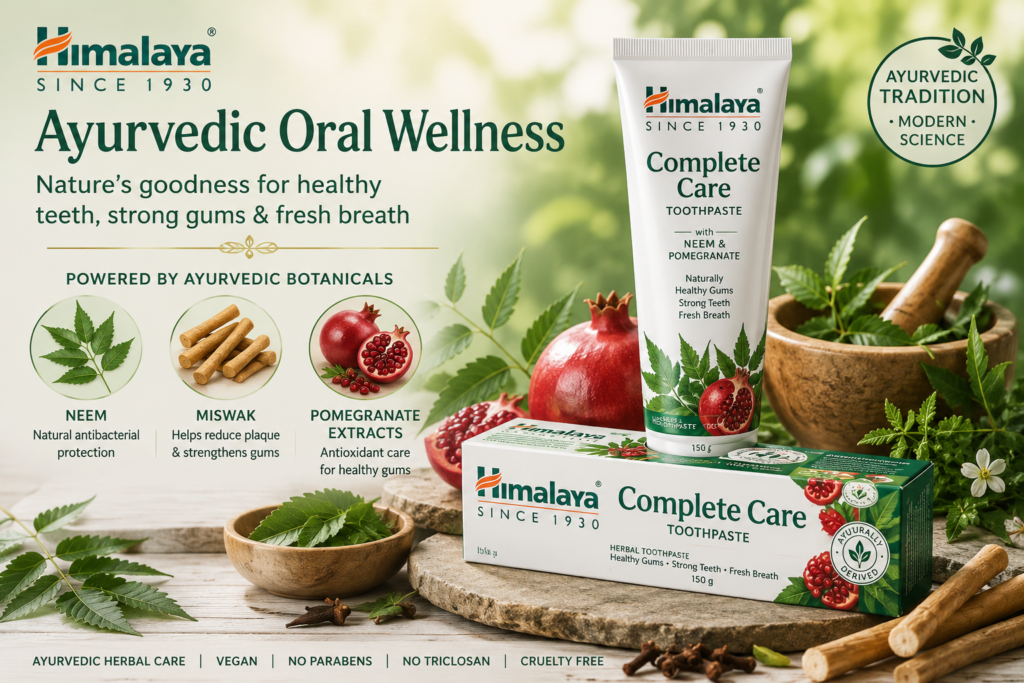
Himalaya toothpaste represents the herbal and Ayurvedic side of the non-hydroxyapatite toothpaste market. While fluoride toothpaste focuses on cavity prevention, whitening toothpaste focuses on stain removal, and hydroxyapatite toothpaste focuses on enamel-like mineral support, Himalaya is built around a different oral-care philosophy: plant-based cleansing, traditional herbal ingredients, gum comfort, breath freshness, and natural plaque-control support.
This makes Himalaya especially relevant for readers searching for Ayurvedic toothpaste, herbal toothpaste, chemical-free toothpaste, natural toothpaste for gums, neem toothpaste, miswak toothpaste, and fluoride-free toothpaste alternatives. Its appeal comes from tradition, not trend. The brand is rooted in the idea that oral care can be supported through botanicals used for generations in traditional wellness systems.
For a deeper formula-level review of Himalaya’s herbal ingredient approach, daily-use fit, and natural oral-care positioning, read Hydropaste’s full Himalaya Original toothpaste guide.
Why Himalaya Matters in Non-Hydroxyapatite Oral Care
Himalaya matters because many toothpaste buyers are looking beyond standard mint fluoride formulas. They want a product that feels closer to nature, avoids a heavily synthetic experience, and fits a broader wellness lifestyle. For these users, the ideal toothpaste is not only about foam, flavor, and polish. It is also about ingredient heritage.
Himalaya’s oral-care identity is built around botanicals commonly associated with traditional oral hygiene, including neem, miswak, pomegranate, triphala, clove, and other plant-derived ingredients depending on the formula. Instead of presenting oral care as purely chemical intervention, Himalaya frames it as daily herbal support for teeth, gums, breath, and plaque control.
The key distinction is that Himalaya does not rely on nano-hydroxyapatite as its main enamel-support mechanism. It belongs to the broader natural and herbal toothpaste category, where the formula story is based on plant extracts, traditional ingredients, and everyday oral wellness.
The Himalaya Formula Logic
Himalaya toothpaste is best understood through three core ideas: herbal cleaning, gum support, and natural routine compatibility.
| Himalaya Formula Direction | What It Means | Best-Fit Buyer |
|---|---|---|
| Ayurvedic oral wellness | Uses herbs associated with traditional oral care | Herbal lifestyle users |
| Neem-based support | Often linked with antibacterial oral-care positioning | Users focused on plaque and gum freshness |
| Miswak-inspired cleaning | Traditional natural tooth-cleaning heritage | Buyers interested in natural plaque control |
| Pomegranate extracts | Plant-based support for gum comfort and oral freshness | Natural gum-care users |
| Fluoride-free or natural options | Formula-dependent alternative to conventional toothpaste | Ingredient-conscious buyers |
| Herbal flavor profile | Less conventional than standard mint-only toothpaste | Users who prefer botanical freshness |
This gives Himalaya a clear role: it is not trying to be a luxury toothpaste, a peroxide whitening system, or a hydroxyapatite remineralization formula. It is an herbal oral-care system designed for buyers who want a more traditional, plant-centered brushing experience.
Core Ingredient: Neem for Herbal Antibacterial Support
Neem is one of the most recognizable ingredients in Ayurvedic oral care. It has long been associated with gum hygiene, breath freshness, and microbial balance in traditional wellness systems. In toothpaste, neem is commonly used as part of an herbal plaque-control and gum-care story.
For buyers, neem toothpaste is attractive because it feels natural but purposeful. It is not just a flavor ingredient. It is usually included because of its traditional association with oral cleanliness and gum support.
People searching for neem toothpaste are often trying to solve problems such as:
- Plaque buildup
- Gum discomfort
- Bad breath
- Desire for herbal antibacterial support
- Avoidance of synthetic-feeling formulas
- Interest in Ayurvedic oral care
Neem does not make Himalaya toothpaste the same as a professional antibacterial rinse or a prescription gum-care product. It should be understood as part of a daily herbal hygiene routine, not a replacement for dental treatment when gum disease is present.
Core Ingredient: Miswak for Natural Plaque Control
Miswak has a deep history in traditional oral hygiene. Before modern toothbrushes and toothpaste became common, chewing sticks from specific plants were used in many cultures for mechanical tooth cleaning. Miswak is strongly associated with this heritage.
In Himalaya toothpaste, miswak helps reinforce the brand’s identity as a natural plaque-control toothpaste rooted in oral-care tradition. It gives the product a bridge between ancient hygiene practices and modern toothpaste format.
Miswak-focused buyers are often looking for:
- Natural plaque control toothpaste
- Traditional oral-care ingredients
- Herbal toothpaste for daily brushing
- Chemical-free toothpaste alternatives
- Plant-based tooth-cleaning systems
The important point is that miswak does not remove the need for proper brushing technique. A toothpaste ingredient can support cleaning, but plaque control still depends on mechanical brushing, interdental cleaning, and consistency.
Core Ingredient: Pomegranate Extracts for Gum-Focused Oral Wellness
Pomegranate extracts are often included in herbal oral-care discussions because of their association with antioxidant-rich plant chemistry and gum-focused wellness positioning. In toothpaste, pomegranate helps strengthen the natural oral-care story by adding a botanical ingredient that feels both familiar and premium.
For users comparing natural toothpaste options, pomegranate gives Himalaya a broader appeal than formulas built around mint alone. It suggests gum comfort, plant-based freshness, and ingredient depth.
This is especially useful for buyers who want a toothpaste that feels closer to herbal wellness than standard cosmetic toothpaste.
Ideal Audience: Herbal Lifestyle Users
Himalaya toothpaste is best suited for people who already prefer herbal, natural, or Ayurvedic personal-care products. These users may choose plant-based skincare, herbal supplements, natural shampoos, botanical mouth rinses, and fluoride-free oral-care products. For them, toothpaste is part of a larger lifestyle pattern.
Himalaya may fit users who want:
- Herbal toothpaste for daily brushing
- Ayurvedic toothpaste with neem and miswak
- Natural toothpaste for gums
- Fluoride-free toothpaste options
- Plant-based oral care
- Less synthetic flavor intensity
- Traditional wellness-inspired oral hygiene
- A toothpaste aligned with natural household routines
This audience may not be chasing the strongest whitening result or the most clinical cavity-prevention formula. They want a daily toothpaste that feels aligned with their values and is pleasant enough to use consistently.
Ideal Audience: Users Seeking Chemical-Free Oral Care Traditions
The phrase “chemical-free toothpaste” is popular in search behavior, but it should be used carefully. Everything material is made of chemicals, including water, minerals, and plant extracts. What users usually mean is toothpaste without certain synthetic additives, harsh-feeling ingredients, artificial colors, strong detergents, or overly processed formula profiles.
Himalaya fits this intent because it is positioned around herbal oral care rather than heavy cosmetic chemistry. The more accurate way to describe it is natural-style toothpaste, herbal toothpaste, or plant-based oral care, rather than literally chemical-free.
It may appeal to users avoiding:
- Strong artificial flavor intensity
- Harsh-feeling foaming agents
- Conventional whitening systems
- Charcoal abrasives
- Peroxide-based whitening
- Highly synthetic product positioning
However, users should still evaluate the actual label. Natural branding does not automatically mean a toothpaste is ideal for every mouth. The formula must match cavity risk, sensitivity level, gum condition, and age.
Himalaya Toothpaste vs Fluoride Toothpaste
Himalaya and mainstream fluoride toothpaste usually serve different buyer priorities. Fluoride toothpaste is generally chosen for cavity prevention. Himalaya is often chosen for herbal lifestyle compatibility and natural oral wellness.
| Category | Himalaya Toothpaste | Mainstream Fluoride Toothpaste |
|---|---|---|
| Core Identity | Herbal, Ayurvedic, plant-based oral care | Cavity-prevention focused |
| Main Appeal | Natural ingredients and traditional wellness | Fluoride enamel protection |
| Buyer Type | Herbal lifestyle users | General daily and family users |
| Plaque Control | Herbal support plus brushing | Fluoride formula plus brushing |
| Whitening Focus | Usually secondary | Formula-dependent |
| Best Fit | Natural oral-care routines | Cavity-risk and mainstream prevention |
This comparison does not mean one category is always better. It means the buyer should start with oral-health risk. A low-risk user may prefer an herbal toothpaste for lifestyle reasons. A high-cavity-risk user may need fluoride or dentist-guided support.
Himalaya Toothpaste vs Hydroxyapatite Toothpaste
Himalaya and hydroxyapatite toothpaste can both attract users looking for alternatives to conventional toothpaste, but their mechanisms are different.
Hydroxyapatite toothpaste is usually selected for enamel support and sensitivity-related mineral logic. Himalaya is selected for Ayurvedic ingredients, herbal plaque support, and natural wellness identity.
For people comparing Himalaya’s herbal toothpaste philosophy with mineral-support formulas, Hydropaste’s Himalaya Hydroxyapatite Botanique Toothpaste review explains how the brand’s hydroxyapatite-oriented formula fits into enamel remineralization, sensitivity support, and natural oral-care positioning.
| Category | Himalaya Toothpaste | Hydroxyapatite Toothpaste |
|---|---|---|
| Main System | Herbal and Ayurvedic ingredients | Biomimetic mineral particles |
| Primary Appeal | Neem, miswak, plant-based oral care | Enamel support and remineralization |
| Best Buyer | Herbal lifestyle user | Mineral-support buyer |
| Whitening Role | Usually mild or secondary | Usually not primary |
| Gum Support | Botanical gum-care positioning | Formula-dependent |
| Differentiator | Traditional oral wellness | Tooth-like mineral technology |
A person choosing Himalaya may be thinking about herbal tradition. A person choosing hydroxyapatite may be thinking about enamel repair and sensitivity. The best choice depends on what problem the toothpaste is expected to solve.
Himalaya Toothpaste vs Charcoal Toothpaste
Charcoal toothpaste is often marketed as a natural whitening solution, but it can raise questions about abrasivity and long-term enamel safety. Himalaya is usually a better fit for people who want natural oral care without making abrasive whitening the center of the routine.
Choose Himalaya if your priority is:
- Herbal daily brushing
- Natural plaque-control support
- Gum-focused oral wellness
- Ayurvedic ingredients
- Plant-based freshness
- Gentle routine compatibility
Choose charcoal toothpaste only if your priority is:
- Cosmetic stain removal
- Occasional polishing
- A visual whitening experience
- A charcoal-based product philosophy
For daily use, many natural-care buyers may find Himalaya’s herbal profile more balanced than a charcoal-heavy formula.
Himalaya Toothpaste in the Non-Hydroxyapatite Decision Framework
| Buyer Goal | Does Himalaya Fit? | Why |
|---|---|---|
| Ayurvedic oral care | Yes | Strong herbal tradition identity |
| Natural toothpaste | Yes | Plant-based ingredient positioning |
| Neem toothpaste | Yes | Neem is central to herbal oral-care appeal |
| Miswak toothpaste | Yes | Supports traditional plaque-control story |
| Strong whitening | Not primary | Better to compare whitening systems |
| High cavity prevention | Depends | Fluoride status and risk profile matter |
| Gum-focused daily care | Yes | Herbal gum-support positioning |
| Chemical-free lifestyle intent | Partly | Better described as natural or herbal toothpaste |
Himalaya is strongest when the buyer wants an herbal oral-care routine, not an aggressive cosmetic or clinical system.
Who Should Consider Himalaya Toothpaste?
Himalaya is a strong fit for:
- Herbal lifestyle users
- Ayurvedic oral-care buyers
- People looking for neem toothpaste
- People interested in miswak-based plaque control
- Ingredient-conscious adults
- Natural toothpaste users
- People avoiding harsh-feeling toothpaste
- Users who prefer botanical flavors
- Buyers comparing fluoride-free alternatives
- Families building a natural personal-care routine
Who May Need a Different Toothpaste?
A different toothpaste may be better if:
- You have frequent cavities
- You need prescription-strength fluoride
- You want dramatic whitening
- You have severe sensitivity
- You need a professional gum-care system
- Your dentist recommends a specific active ingredient
- You dislike herbal flavors
- You need a children’s formula with specific fluoride guidance
Himalaya is a strong natural oral-care option, but it should still be matched to dental risk.
Editorial Takeaway
Himalaya toothpaste is one of the clearest examples of how non-hydroxyapatite oral care can be rooted in tradition rather than laboratory-style innovation. Its value comes from Ayurvedic identity, herbal ingredients, neem, miswak, pomegranate, natural freshness, and a plant-based approach to daily brushing.
It is not trying to be Colgate. It is not trying to be a peroxide whitening pen. It is not trying to be hydroxyapatite enamel repair. Its role is different: support users who want herbal oral wellness and a more natural brushing experience.
For the right person, that distinction matters. A toothpaste does not need to be the strongest whitening system or the most advanced mineral technology to be useful. It needs to match the user’s routine, values, oral-health risk, and comfort.
Himalaya is best for people who want Ayurvedic toothpaste, herbal plaque-control support, natural gum-care positioning, and a daily oral-care product that feels connected to traditional wellness. Users with high cavity risk, ongoing gum disease, or complex dental needs should view it as one part of a broader dental-care strategy rather than a complete solution by itself.
6. MARVIS – Italy’s Iconic Premium Toothpaste for Luxury Oral Care
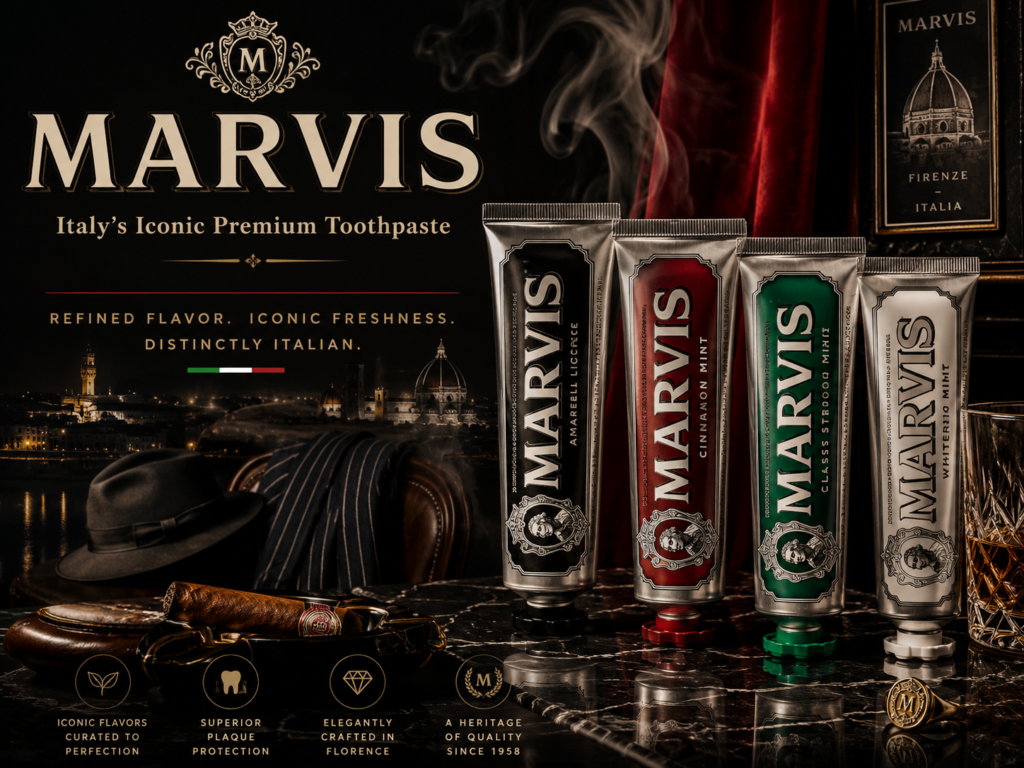
MARVIS is one of the most recognizable names in premium toothpaste because it treats oral care as part of a wider grooming ritual. While many non-hydroxyapatite toothpastes compete on fluoride protection, natural ingredients, whitening claims, or family care, MARVIS competes through a different language: Italian design, distinctive flavors, polished packaging, and a luxury bathroom-shelf identity.
This makes MARVIS especially important inside the non-hydroxyapatite oral care category. It does not rely on hydroxyapatite remineralization as its central appeal. It is not positioned like a prescription-strength fluoride toothpaste. It is not a children’s habit-building brand. Instead, MARVIS speaks to lifestyle-oriented consumers who want toothpaste to feel premium, aesthetic, flavorful, and part of a refined personal-care routine.
For a deeper product-by-product breakdown of flavors, whitening claims, packaging, daily-use fit, and luxury oral-care positioning, read Hydropaste’s complete MARVIS toothpaste guide.
Why MARVIS Matters in Non-Hydroxyapatite Oral Care
MARVIS matters because it shows how toothpaste can move beyond basic hygiene and become a grooming product. Most people think of toothpaste as a functional bathroom item: brush, rinse, move on. MARVIS changes that experience by turning toothpaste into something closer to fragrance, skincare, or premium shaving cream.
Its value is not only what it does for the mouth. Its value is also how it makes the routine feel.
For users building a premium grooming routine, MARVIS can feel more intentional than ordinary toothpaste. It has shelf presence. It has flavor personality. It has a luxury design language. That makes it a strong fit for buyers who see oral care as part of self-presentation, not just plaque removal.
MARVIS Formula Logic: Luxury, Freshness, Polish and Flavor
MARVIS is best understood through four core ideas: premium experience, distinctive flavors, polishing action, and lifestyle identity.
| MARVIS Direction | What It Means | Best-Fit Buyer |
|---|---|---|
| Premium toothpaste | Designed as a luxury grooming product | Style-conscious users |
| Italian oral care | Heritage, design, and premium presentation | Buyers attracted to European grooming |
| Unique flavors | Mint blends with jasmine, cinnamon, ginger, licorice, and other profiles | Flavor-driven users |
| Polishing action | Supports smoother-feeling teeth and surface stain management | Cosmetic-focused users |
| High-end packaging | Strong bathroom-shelf appeal | Design and lifestyle buyers |
| Daily grooming ritual | Toothpaste as part of a refined personal-care routine | Premium routine builders |
MARVIS is not a purely clinical toothpaste story. It is a sensory and design story supported by everyday cleaning.
Differentiation: Unique Flavor Profiles
The most memorable part of MARVIS is its flavor architecture. Many toothpaste brands rely on simple mint, strong mint, mild mint, or kids’ fruit flavors. MARVIS builds a more sophisticated taste experience around unusual mint combinations.
Examples may include flavor profiles such as:
- Classic Strong Mint
- Whitening Mint
- Jasmine Mint
- Cinnamon Mint
- Ginger Mint
- Licorice Mint
- Aquatic Mint
- Anise Mint
This gives MARVIS a fragrance-like quality. The user is not simply choosing “toothpaste.” They are choosing a flavor mood.
Jasmine Mint and the Luxury Flavor Strategy
MARVIS Jasmine Mint is a useful example because it shows the brand’s difference clearly. Jasmine is not a standard toothpaste flavor. It feels floral, unusual, and premium. Combined with mint, it creates a brushing experience that is less medicinal and more sensorial.
This matters because taste affects compliance. A toothpaste that feels enjoyable may encourage more consistent use. MARVIS understands that daily oral care is repetitive, so the sensory experience can become part of the product’s value.
For buyers who dislike ordinary toothpaste flavors or want something more elegant, MARVIS offers a clear alternative.
Differentiation: High-End Packaging
MARVIS packaging is a major part of the brand’s appeal. The tubes often have a vintage apothecary look with metallic finishes, bold typography, and a premium Italian grooming aesthetic. This makes MARVIS popular among buyers who care about how products look on a bathroom counter, vanity shelf, travel kit, or grooming station.
Packaging does not clean teeth, but it does shape routine behavior. A product that feels premium may be used more consistently and appreciated more as part of a daily ritual.
MARVIS fits users who want:
- Luxury toothpaste
- Designer toothpaste packaging
- Premium grooming products
- Aesthetic bathroom products
- Travel-friendly oral-care style
- Toothpaste that feels giftable
- A refined alternative to supermarket toothpaste
This is the lifestyle side of oral care, and MARVIS owns it better than most brands.
Differentiation: Strong Polishing Action
MARVIS is also known for its polished, clean-mouth feel. Many buyers choose it because teeth feel smooth after brushing and the flavor leaves a long-lasting freshness.
In the non-hydroxyapatite category, this places MARVIS closer to cosmetic and lifestyle toothpaste than mineral-repair toothpaste. Its polishing identity is useful for people who want cleaner-feeling teeth, surface stain management, and daily brightness support.
However, people should understand the difference between polishing and deep whitening.
Polishing vs Whitening
Polishing helps remove or reduce surface-level buildup that can make teeth look dull. Whitening systems may use peroxide or other technologies to address deeper discoloration. MARVIS can support a brighter-looking smile through surface cleaning and polish, but it should not be confused with professional whitening treatment or high-strength peroxide systems.
| Goal | MARVIS Fit | Notes |
|---|---|---|
| Fresh breath | Strong fit | Distinctive mint profiles support freshness |
| Smooth tooth feel | Strong fit | Polishing action is a key appeal |
| Surface stain management | Moderate to strong | Useful for cosmetic maintenance |
| Deep whitening | Limited to formula-specific claims | Not the same as professional whitening |
| Enamel remineralization | Not primary | Compare hydroxyapatite or fluoride-focused systems |
| Luxury grooming | Excellent | One of the strongest premium-positioned toothpaste brands |
MARVIS is best for cosmetic maintenance and premium routine feel, not for solving serious dental issues on its own.
Best Use Case: Lifestyle-Oriented Consumers
MARVIS is ideal for people who view oral care as part of a broader lifestyle. These buyers may already care about fragrance, skincare, grooming, clothing, interior design, and product aesthetics. They want toothpaste that feels aligned with that lifestyle.
MARVIS may fit users who want:
- Premium toothpaste for daily brushing
- Luxury oral care with Italian design
- A toothpaste that looks good in the bathroom
- Unique toothpaste flavors
- Fresh breath with a refined flavor profile
- A polished, smooth tooth feel
- A grooming product rather than a basic hygiene item
- A giftable toothpaste option
- A travel-friendly premium toothpaste
This audience is not always looking for the cheapest or most clinical product. They want the experience to feel elevated.
Best Use Case: Premium Grooming Routines
MARVIS works especially well in premium grooming routines because it sits naturally next to high-end skincare, shaving products, fragrance, haircare, and bathroom accessories. It feels designed, not generic.
A premium grooming routine may include:
- Face wash or cleanser
- Shaving or beard care
- Oral care with MARVIS toothpaste
- Tongue cleaning or mouth rinse
- Skincare
- Fragrance
- Hair styling
In that context, toothpaste becomes part of daily presentation. MARVIS supports the user who wants their oral-care product to feel as polished as the rest of their routine.
MARVIS vs Standard Fluoride Toothpaste
MARVIS and standard fluoride toothpaste often serve different buyer needs. Standard fluoride toothpaste is usually chosen for cavity prevention, affordability, and family use. MARVIS is chosen for flavor, design, and premium feel.
| Category | MARVIS Toothpaste | Standard Fluoride Toothpaste |
|---|---|---|
| Main Identity | Premium lifestyle toothpaste | Everyday cavity-prevention toothpaste |
| Buyer Appeal | Flavor, packaging, grooming ritual | Clinical familiarity and affordability |
| Flavor Profile | Distinctive and refined | Usually mint-focused |
| Packaging | High-end, giftable, shelf-worthy | Functional |
| Best Use | Premium daily routine | Family and prevention-focused brushing |
| Main Concern | Experience and polish | Cavity protection |
If a user’s main concern is high cavity risk, they should check the specific MARVIS formula and compare it with fluoride-focused options. If the user’s main concern is a premium brushing experience, MARVIS is a strong candidate.
MARVIS vs Hydroxyapatite Toothpaste
MARVIS and hydroxyapatite toothpaste appeal to different kinds of premium buyers. Hydroxyapatite toothpaste is often chosen for enamel support, sensitivity comfort, and biomimetic mineral science. MARVIS is chosen for aesthetic oral care, flavor sophistication, and grooming identity.
| Category | MARVIS | Hydroxyapatite Toothpaste |
|---|---|---|
| Core Appeal | Luxury, flavor, polish, packaging | Enamel support and remineralization |
| Main Buyer | Lifestyle and grooming user | Mineral-support and sensitivity user |
| Flavor Strategy | Highly distinctive | Usually functional or mild |
| Design Positioning | Strong premium shelf appeal | Varies by brand |
| Whitening Role | Cosmetic polish and selected formulas | Usually secondary |
| Best Fit | Premium routine builders | Enamel-focused users |
A person choosing MARVIS may be motivated by taste and presentation. A person choosing hydroxyapatite may be motivated by enamel and sensitivity goals. The best choice depends on whether the priority is experience or mineral support.
MARVIS vs Natural Toothpaste
MARVIS is sometimes grouped with boutique toothpaste brands, but it is not the same as a natural toothpaste brand. Natural toothpaste usually emphasizes plant-based ingredients, fluoride-free options, clean-label claims, or avoidance of synthetic additives. MARVIS emphasizes premium experience, flavor, and design.
Choose MARVIS if you want:
- Luxury toothpaste
- Italian design
- Unique flavors
- Premium packaging
- Strong freshness
- Smooth tooth feel
- Lifestyle grooming appeal
Choose natural toothpaste if you want:
- Plant-based ingredient focus
- Fluoride-free formulas
- Herbal oral care
- Minimalist ingredient philosophy
- Vegan or clean-label positioning
MARVIS is more “premium grooming” than “natural wellness.”
MARVIS in the Non-Hydroxyapatite Decision Framework
| Buyer Goal | Does MARVIS Fit? | Why |
|---|---|---|
| Premium toothpaste | Yes | Strong luxury positioning |
| Unique flavor experience | Yes | One of the brand’s biggest strengths |
| Daily fresh breath | Yes | Mint-forward flavor profiles |
| Surface polish | Yes | Smooth, clean-mouth feel |
| Deep whitening | Depends | Formula-specific; not the core identity |
| Fluoride cavity prevention | Depends | Check formula details |
| Natural toothpaste | Not primary | Better to compare herbal or clean-label brands |
| Enamel remineralization | Not primary | Hydroxyapatite formulas are more relevant |
| Giftable oral care | Yes | Premium packaging and lifestyle appeal |
MARVIS is strongest when the buyer wants oral care that feels elevated, stylish, and sensory.
Who Should Consider MARVIS Toothpaste?
MARVIS may be a strong fit for:
- Premium grooming buyers
- People who dislike ordinary toothpaste flavors
- Users who want luxury toothpaste
- Design-conscious shoppers
- Gift buyers
- Travel-kit builders
- Adults who want strong freshness
- Lifestyle-oriented oral-care users
- People interested in Italian toothpaste
- Buyers who want polished teeth and a refined brushing experience
Who May Need a Different Toothpaste?
MARVIS may not be the best first choice if:
- You need prescription-strength fluoride
- You have high cavity risk
- You want a children’s toothpaste
- You need a professional gum-health product
- You want hydroxyapatite enamel support
- You prefer simple natural formulas
- You want the lowest-cost toothpaste
- You have severe sensitivity and need a dedicated sensitivity formula
MARVIS is a premium lifestyle toothpaste. It should be matched to the right oral-care goal.
Editorial Takeaway
MARVIS is Italy’s iconic premium toothpaste because it understands something most toothpaste brands ignore: brushing is a daily ritual, and rituals are shaped by taste, design, texture, and mood. It takes a basic hygiene step and turns it into a grooming experience.
Its strongest qualities are unique flavor profiles, high-end packaging, long-lasting freshness, and a polished tooth feel. It is best for lifestyle-oriented consumers, premium grooming routines, giftable oral care, and users who want toothpaste to feel more refined than ordinary supermarket options.
MARVIS is not the first product to choose if the main goal is prescription-level cavity prevention, deep whitening, professional gum treatment, or hydroxyapatite remineralization. But for users who want premium toothpaste with Italian style, distinctive flavors, and daily brushing appeal, MARVIS remains one of the most recognizable names in luxury oral care.
The right way to evaluate MARVIS is not to ask whether it replaces every clinical toothpaste. It does not. The better question is whether it makes your daily routine more enjoyable, more consistent, and more aligned with a premium personal-care lifestyle. For many buyers, that is exactly why MARVIS works.
Comparison of Major Toothpaste Types
Key Non-Hydroxyapatite Toothpastes
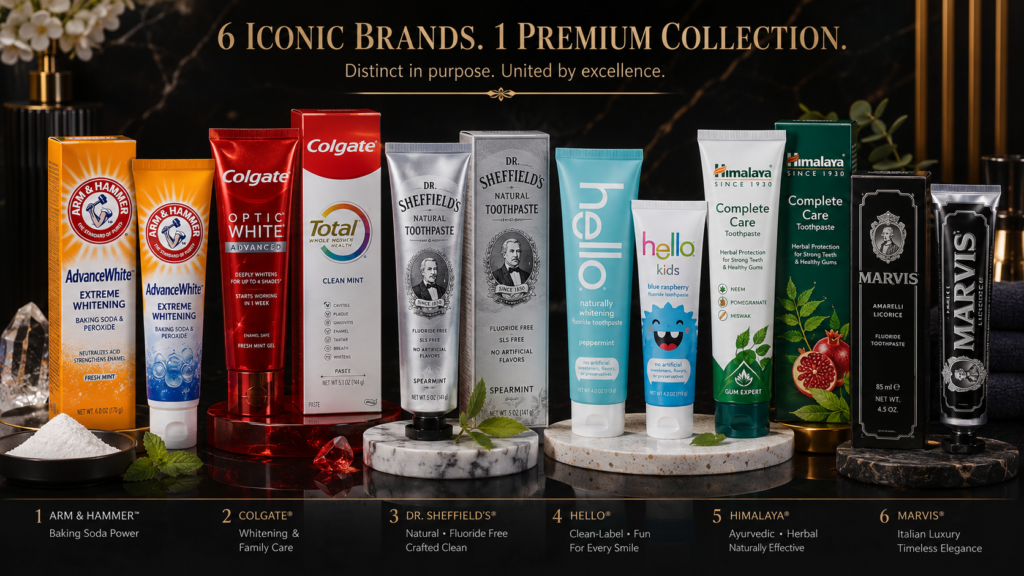
| Brand/System | Core Function | Key Ingredient | Best For | Fluoride |
|---|---|---|---|---|
| Arm & Hammer | Acid neutralization | Baking Soda | Gentle cleaning | Optional |
| Colgate Max White | Surface whitening | Silica + optics | Daily whitening | Yes |
| Optic White | Deep whitening | Hydrogen peroxide | Stain removal | Yes |
| PerioGard | Gum treatment | Antibacterial agents | Gingivitis | Yes |
| Dr. Sheffield’s | Natural care | Plant extracts | Clean-label users | No |
| Hello Toothpaste | Balanced lifestyle | Natural + mild actives | Families | Both |
| Himalaya | Herbal therapy | Neem, miswak | Ayurvedic users | No |
| Marvis | Premium polishing | Silica | Luxury experience | Yes |
Fluoride vs Natural vs Whitening
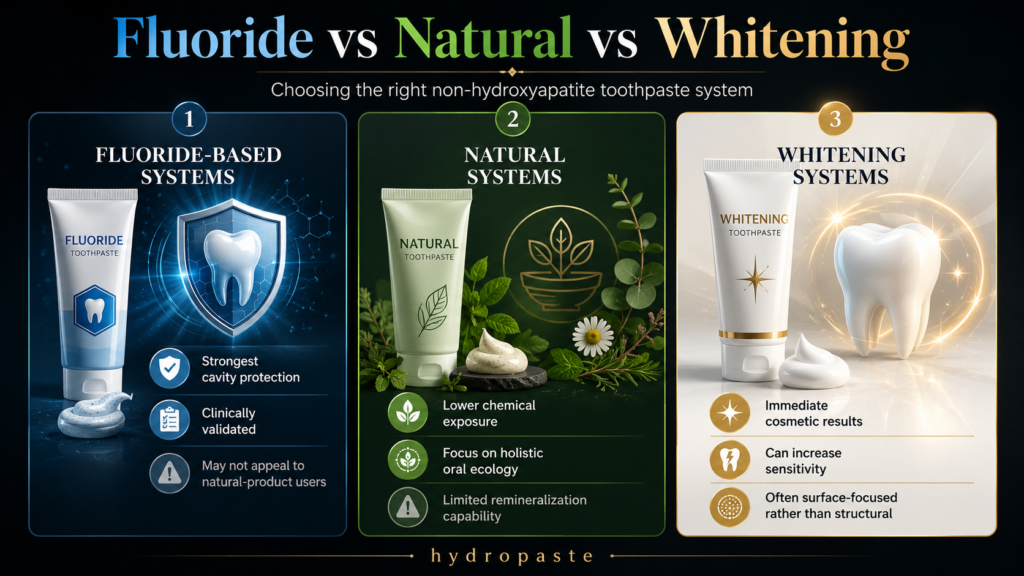
The non-hydroxyapatite toothpaste category is not one simple shelf. It is a wide oral-care ecosystem built around different active philosophies. Some formulas are designed for fluoride cavity protection. Others are built around natural toothpaste ingredients, herbal traditions, and clean-label routines. A third group focuses on whitening toothpaste, surface stain removal, peroxide systems, and cosmetic brightness.
This comparison matters because most toothpaste people choose too quickly. They see “whitening,” “natural,” “fresh,” “fluoride,” or “premium” on the package and assume the product matches their mouth. But toothpaste should be selected by oral-health goal, not only by branding.
A cavity-prone user, a coffee drinker, a parent buying kids toothpaste, a natural-product shopper, and a person with gum sensitivity may all need different formulas. The right non-hydroxyapatite toothpaste depends on risk profile, stain type, gum condition, ingredient preference, age, brushing technique, and whether the user wants clinical protection, cosmetic improvement, or a more natural daily routine.
Fluoride-Based Systems: Colgate and PerioGard
Fluoride-based toothpaste systems remain the strongest mainstream category for people focused on cavity prevention, enamel protection, and clinically familiar daily oral care. Colgate is the classic example of a mass-market fluoride toothpaste system, while PerioGard represents a more professional gum-care direction within antibacterial oral care.
Fluoride toothpaste is usually selected by users who want a direct cavity-prevention strategy. It is especially relevant for people with a history of cavities, dry mouth, exposed roots, orthodontic appliances, frequent snacking, high sugar intake, or weak enamel concerns.
Why Fluoride-Based Toothpaste Works for Many Users
Fluoride-based systems are popular because they are practical, familiar, widely available, and strongly associated with dental prevention. They help support enamel resistance against acid challenges and are often recommended in standard dental routines.
The main strengths include:
- Strong cavity protection
- Enamel defense against acid exposure
- Broad family-use availability
- Familiar taste and texture
- Professional acceptance in many regions
- Easy access in supermarkets and pharmacies
- Formula variety for whitening, sensitivity, breath, and gum support
For many users, fluoride toothpaste is the safest default because it directly addresses cavity risk, which remains one of the most common oral-health concerns.
Where PerioGard Fits
PerioGard-style systems are different from ordinary fluoride toothpaste. They are more closely associated with gum health, antibacterial support, gingivitis care, and periodontal maintenance. Depending on region and formula, some PerioGard products may be chlorhexidine-based or professionally oriented, which means they should be used with attention to instructions and dental guidance.
PerioGard is not a cosmetic whitening system. It is a gum-focused oral-care direction for people concerned with plaque, bleeding gums, gingivitis, or periodontal support.
Best Use Cases for Fluoride-Based Systems
| Best For | Why Fluoride Toothpaste Fits |
|---|---|
| Cavity-prone users | Supports stronger enamel defense |
| Families | Familiar daily prevention system |
| Children and teens | Age-appropriate fluoride toothpaste can support cavity prevention |
| Orthodontic users | Braces and aligners increase plaque-control needs |
| Dry mouth users | Higher cavity risk often requires stronger prevention |
| Gum-risk users | PerioGard-style systems may support antibacterial care |
| General daily brushing | Easy, practical, widely available |
Potential Limitations
Fluoride-based toothpaste may not appeal to users who prefer natural, fluoride-free, herbal, or clean-label oral care. Some buyers want to avoid synthetic-feeling formulas, strong mint intensity, artificial colors, or conventional foaming agents. Others are comparing fluoride toothpaste against hydroxyapatite or natural toothpaste because they want a different active philosophy.
The key is not to frame fluoride as “good” and natural as “bad,” or the reverse. The better question is: what risk are you trying to manage?
If the main risk is cavities, fluoride toothpaste usually deserves serious consideration. If the main priority is ingredient preference and the user has low cavity risk, natural toothpaste may be a reasonable comparison. If the main concern is stain, whitening toothpaste may be more relevant.
Natural Toothpaste Systems: Himalaya, Dr. Sheffield’s and Hello
Natural toothpaste systems appeal to buyers who want a cleaner, gentler, more ingredient-conscious brushing experience. In the non-hydroxyapatite category, this includes brands such as Himalaya, Dr. Sheffield’s, and Hello, each with a different version of natural or clean-label oral care.
Himalaya leans into Ayurvedic and herbal oral wellness. Dr. Sheffield’s focuses on heritage-style natural toothpaste and fluoride-free daily brushing. Hello brings a modern, vegan, cruelty-free, family-friendly identity with clean-label packaging and kids toothpaste options.
These brands are not identical, but they share a common buyer intent: oral care that feels less synthetic, less clinical, and more aligned with lifestyle values.
Why Natural Toothpaste Appeals to The Modern Man
Natural toothpaste users often care about more than plaque removal. They may also care about what the product contains, what it avoids, how it tastes, whether it is vegan, whether it is cruelty-free, and whether it fits a natural household routine.
This audience often wants a formula that feels safe, simple, and comfortable for daily use.
Lower Chemical Exposure: What people Usually Mean
Many users search for “chemical-free toothpaste,” but the phrase is not technically precise because all ingredients are chemicals, including water, minerals, and plant extracts. What buyers usually mean is toothpaste with fewer harsh-feeling or synthetic additives.
They may want to avoid:
- Artificial colors
- Strong synthetic flavors
- Certain foaming agents
- Peroxide whitening systems
- Charcoal abrasives
- Triclosan-style legacy ingredients
- Overly intense mint burn
- Fluoride, depending on personal preference
Natural toothpaste brands often answer that concern by focusing on plant-derived ingredients, herbal extracts, softer flavors, vegan positioning, cruelty-free claims, fluoride-free options, and simpler formula identities.
Focus on Holistic Oral Ecology
Natural toothpaste buyers are often interested in oral ecology rather than only cavity prevention or whitening. They may think about gums, breath, tongue coating, mouthfeel, dryness, ingredient tolerance, and daily comfort.
This is where brands differ:
| Natural System | Main Identity | Best-Fit User |
|---|---|---|
| Himalaya | Ayurvedic herbs, neem, miswak, pomegranate | Herbal lifestyle users |
| Dr. Sheffield’s | Heritage natural toothpaste, fluoride-free care | Ingredient-conscious adults |
| Hello | Vegan, cruelty-free, kids and family-friendly formulas | Modern clean-label families |
Natural toothpaste is strongest when it improves consistency. If a user dislikes harsh toothpaste and therefore brushes poorly, a more comfortable natural formula may help the routine survive.
Limited Remineralization Capability
Natural toothpaste should be evaluated honestly. Many natural formulas do not offer the same cavity-prevention strength as fluoride toothpaste, and they may not provide the same enamel-surface support associated with hydroxyapatite toothpaste.
That does not make them useless. It means the buyer needs to match the product to their risk.
Natural toothpaste may be a good fit for low-risk users with strong brushing habits, low sugar exposure, regular dental care, and a preference for cleaner labels. However, users with frequent cavities, dry mouth, braces, exposed roots, or high decay risk may need fluoride, hydroxyapatite, or a dentist-guided strategy.
Whitening Toothpaste Systems: Optic White and MARVIS
Whitening systems are built for a different buyer intent: visible brightness. These products appeal to users who want whiter-looking teeth, stain reduction, polished surfaces, fresher breath, or a more cosmetic brushing experience.
In this category, Colgate Optic White represents a more targeted peroxide-based whitening direction, while MARVIS represents premium lifestyle toothpaste with strong freshness, polishing action, and luxury appeal.
Whitening toothpaste and whitening systems are especially relevant for people with:
- Coffee stains
- Tea stains
- Wine stains
- Tobacco staining
- Dull enamel appearance
- Surface discoloration
- Cosmetic smile goals
- Premium grooming routines
Immediate Cosmetic Results
The biggest strength of whitening toothpaste is fast visual reward. Many users want a toothpaste that makes teeth look cleaner immediately after brushing. Polishing agents can remove surface buildup, while optical effects may improve brightness perception. Peroxide systems may go further by targeting discoloration through oxidation.
This makes whitening toothpaste attractive because users can see and feel the difference more quickly than with purely preventive products.
Sensitivity Risk
The main tradeoff is sensitivity. Whitening products can be more irritating for some users, especially if they contain peroxide, stronger polishing agents, intense flavors, or are used too aggressively.
Sensitivity risk may increase when a user has:
- Gum recession
- Exposed dentin
- Thin enamel
- Existing sensitivity
- Recent whitening treatment
- Aggressive brushing habits
- Acid erosion
- Cracked teeth or untreated cavities
Whitening toothpaste should not be used as a substitute for diagnosing sensitivity. If teeth hurt with cold, sweets, brushing, or air exposure, the cause matters.
Surface-Focused Rather Than Structural
Many whitening systems are surface-focused. They make teeth look brighter by removing or reducing stains, but that does not necessarily mean they rebuild enamel or improve tooth structure.
This is the most important distinction for individuals:
| Goal | Whitening Toothpaste Role |
|---|---|
| Surface stain removal | Strong fit |
| Coffee and tea stain control | Strong fit |
| Cosmetic brightness | Strong fit |
| Deep intrinsic discoloration | Limited without stronger systems |
| Enamel remineralization | Not the main purpose |
| Sensitivity repair | Formula-specific, not guaranteed |
| Gum health | Usually secondary |
A whitening toothpaste may improve appearance, but a cavity-prone user may still need fluoride. A sensitivity-focused user may need a desensitizing or hydroxyapatite formula. A gum-health user may need antibacterial or periodontal support. Whitening is a cosmetic goal, not a complete oral-health strategy.
Fluoride vs Natural vs Whitening Toothpaste
| Toothpaste Type | Best For | Main Strength | Main Limitation | Example Brands |
|---|---|---|---|---|
| Fluoride-based toothpaste | Cavity prevention, enamel protection, family care | Strongest mainstream cavity support | May not appeal to natural-product users | Colgate, PerioGard systems |
| Natural toothpaste | Ingredient-conscious users, herbal routines, clean-label care | Better lifestyle fit and gentler product identity | May offer limited remineralization or cavity support | Himalaya, Dr. Sheffield’s, Hello |
| Whitening toothpaste | Stain removal, cosmetic brightness, premium grooming | Fast visible improvement and smooth tooth feel | Can increase sensitivity and may be surface-focused | Optic White, MARVIS |
Each category has value, but each category also has limits. The best toothpaste is the one that matches the user’s primary problem.
For readers comparing mineral-based and fluoride-based enamel strategies more directly, Hydropaste’s full comparison on nHA vs fluoride can help explain how hydroxyapatite and fluoride differ in cavity protection, remineralization logic, sensitivity support, and daily toothpaste selection.
How to Choose the Right Non-Hydroxyapatite Toothpaste
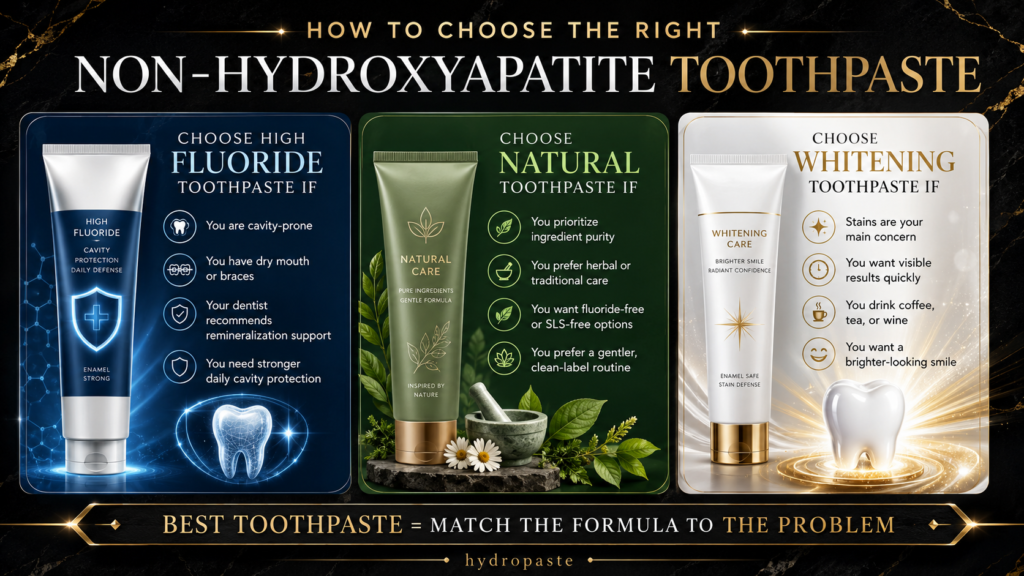
Choosing the right non-hydroxyapatite toothpaste starts with one question: what is your main oral-care priority right now?
Do not start with the brand. Start with the problem.
Choose High Fluoride Toothpaste If:
You should consider high fluoride toothpaste or a stronger fluoride-based system if your main concern is cavity risk. This is especially important if you have had repeated cavities, exposed root surfaces, dry mouth, orthodontic appliances, or a dentist has recommended stronger prevention.
High fluoride toothpaste may be appropriate if:
- You are cavity-prone
- You have dry mouth
- You wear braces or aligners
- You have exposed roots
- You snack frequently
- You drink acidic or sugary beverages often
- Your dentist recommends remineralization support
- You have a history of enamel weakness
- You need stronger daily cavity protection
High fluoride toothpaste should be used according to label directions and dental guidance, especially if it is a professional-strength formula.
Choose Natural Toothpaste If:
Natural toothpaste may fit if your main priority is ingredient preference, comfort, and lifestyle alignment. It is especially relevant for users who dislike strong conventional toothpaste, prefer herbal ingredients, want fluoride-free options, or are building a clean-label oral-care routine.
Natural toothpaste may be a good fit if:
- You prioritize ingredient purity
- You prefer herbal or traditional care
- You want fluoride-free toothpaste
- You are looking for SLS free toothpaste
- You prefer toothpaste without fluoride
- You want vegan or cruelty-free toothpaste
- You want a gentler flavor experience
- You are a low-cavity-risk user
- You want natural toothpaste for family routines
- You prefer plant-based oral care
Natural toothpaste should still be chosen carefully. If you are cavity-prone, a fluoride-free formula may not be enough as your only preventive strategy.
Choose Whitening Toothpaste If:
Whitening toothpaste is the right category when stains and cosmetic brightness are the main concerns. It can be useful for people who drink coffee, tea, or wine, or for users who feel their smile looks dull even after regular brushing.
Whitening toothpaste may fit if:
- Stains are your main concern
- You want visible results quickly
- You drink coffee, tea, or red wine
- You want a brighter-looking smile
- You want surface stain removal
- You want premium grooming toothpaste
- You are maintaining whitening results
- You prefer a polished tooth feel
- You want cosmetic oral-care improvement
Whitening toothpaste is not always ideal for users with strong sensitivity, gum recession, enamel wear, or untreated dental issues. If sensitivity appears or worsens, the routine may need adjustment.
Decision Framework: Match the Toothpaste to the Problem
| Your Main Problem | Best Toothpaste Direction | Why |
|---|---|---|
| Frequent cavities | Fluoride or high fluoride toothpaste | Strongest cavity-prevention fit |
| Ingredient concerns | Natural toothpaste | Better clean-label alignment |
| Coffee stains | Whitening toothpaste | Surface stain control |
| Gum bleeding | Gum-health or antibacterial system | Targets plaque and gumline concerns |
| Kids brushing resistance | Hello-style kids toothpaste | Flavor and packaging support habits |
| Herbal lifestyle | Himalaya-style toothpaste | Ayurvedic and plant-based oral care |
| Premium grooming | MARVIS-style toothpaste | Luxury flavor and design |
| Acidic mouthfeel | Baking soda toothpaste | Acid-neutralizing support |
| Sensitivity | Sensitivity-specific formula | Needs comfort-focused ingredients |
| Enamel repair focus | Compare hydroxyapatite or fluoride | Whitening alone is not structural support |
The smartest buyer does not ask, “What toothpaste is best?” They ask, “Best for what?”
A non-hydroxyapatite toothpaste can be excellent when it is matched correctly. Fluoride systems support cavity prevention. Natural systems support ingredient-conscious routines. Whitening systems support cosmetic brightness. Gum systems support soft-tissue care. Baking soda systems support freshness, plaque feel, and acid neutralization. Premium systems support experience and compliance.
The right toothpaste is the one that fits the mouth, the risk, and the routine.
Hydro View
Non-hydroxyapatite oral care is not a single category—it’s an entire spectrum ranging from clinical fluoride systems to herbal traditions and cosmetic whitening technologies. Understanding where each product sits allows users to align oral care with health goals, lifestyle, and philosophy, rather than just marketing claims.