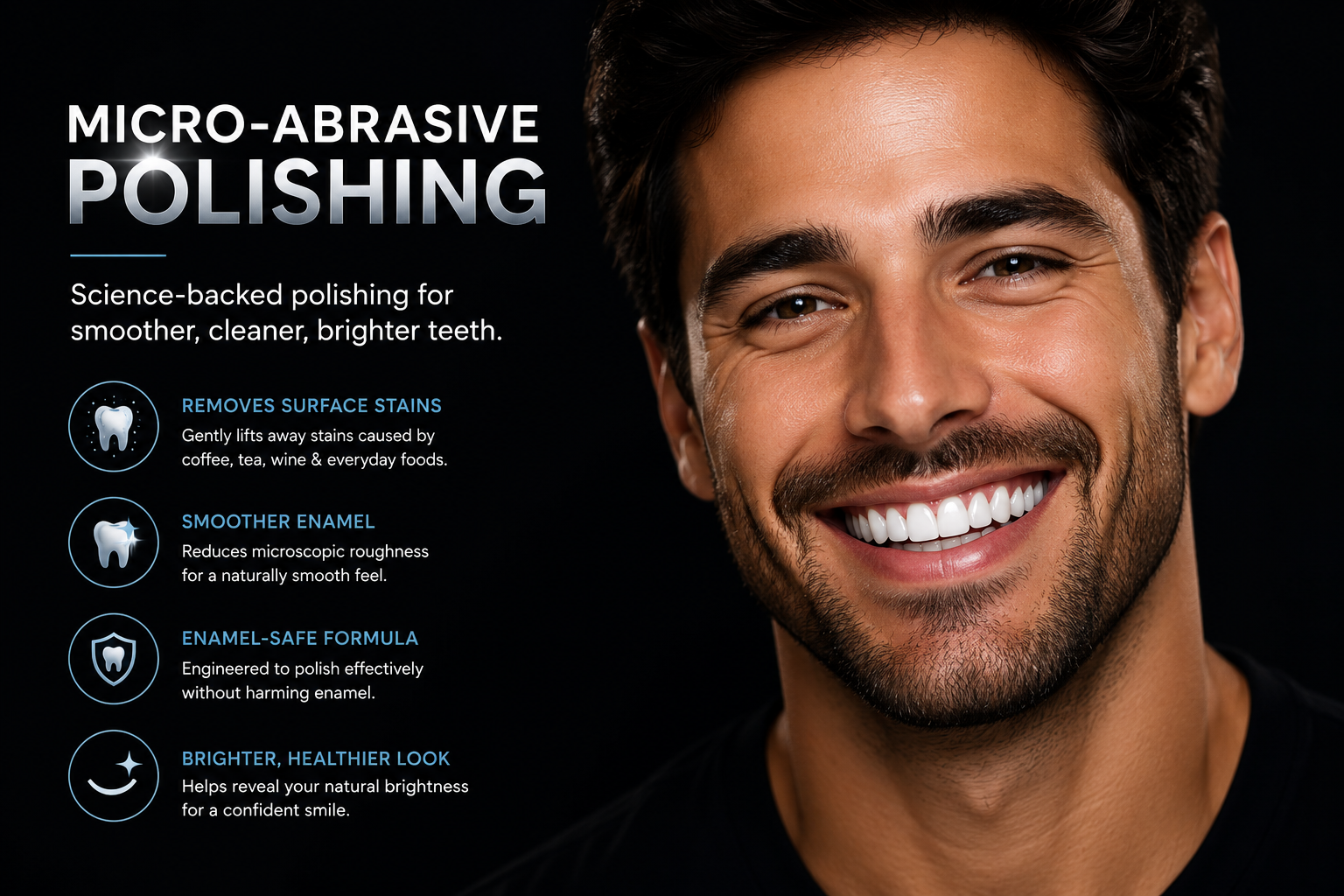
Tooth Polishing Science: How Enamel-Safe Micro-Abrasive Polishing Works
Amazon Affiliate Disclosure
HydroPaste may earn a commission from qualifying purchases made through affiliate links on this page. This does not affect the price paid by the individual and does not influence our editorial standards, product analysis, or oral-care guidance.
The Science Behind a Cleaner, Smoother Tooth Surface
Tooth polishing science is often misunderstood because many people think polishing is simply “making teeth look shiny.” In reality, micro-abrasive polishing is a controlled surface-management process. It is about removing what does not belong on the outer tooth surface while respecting what must remain protected: enamel, dentin, the gumline, and the natural oral environment.
At HydroPaste, polishing is treated as part of a larger oral-care system, not a shortcut for whitening or a replacement for dentistry. A well-designed polishing routine can help reduce surface stain, smooth microscopic roughness, improve the feel of teeth, and support a cleaner-looking smile. A poorly designed routine can do the opposite: over-polish, irritate gums, increase sensitivity, or confuse cosmetic brightness with actual tooth health.
The science matters because teeth are not flat ceramic tiles. Enamel is mineral-rich, extremely hard, and biologically exposed to acids, saliva, plaque, brushing pressure, diet, and time. A polishing ingredient or device does not interact with enamel in isolation. It interacts with saliva, the pellicle layer, plaque film, stain particles, brushing force, bristle stiffness, frequency of use, and the person’s existing enamel condition.
That is why the best question is not simply, “Does polishing work?” The better question is: what kind of polishing, on which type of stain, at what abrasivity level, with what pressure, and for which mouth?
Quick Picks
Use these quick links to move directly to the most relevant part of this guide.
| Section | Best For Visitors Who Want To Understand | Jump Link |
|---|---|---|
| What Is Tooth Polishing Science? | The basic science behind how tooth polishing works and why it is different from ordinary brushing | Jump |
| What Is Micro-Abrasive Polishing For? | The real purpose of micro-abrasive polishing, including stain removal, smoother enamel, and surface refinement | Jump |
| Who Needs Enamel Polishing? | Whether enamel polishing is useful for coffee drinkers, tea drinkers, smokers, or people with surface stains | Jump |
| Benefits of Micro-Abrasive Polishing | The practical benefits of enamel-safe polishing, including cleaner teeth, smoother texture, and reduced stain buildup | Jump |
| Enamel Abrasion vs Polishing | The difference between safe polishing and harmful tooth surface wear | Jump |
| Extrinsic vs Intrinsic Stains | Why polishing works better for surface stains than deep internal discoloration | Jump |
| How Tooth Surface Polishing Works | How polishing particles, pressure, particle size, and brushing motion interact with the tooth surface | Jump |
| The Tooth Surface System: Enamel, Pellicle, Plaque, and Stain | How enamel, saliva film, plaque, and stain layers work together on the tooth surface | Jump |
| RDA Scale and Safe Abrasivity | How abrasivity levels are measured and why RDA matters for enamel and dentin safety | Jump |
| Teeth Whitening vs Polishing | The difference between bleaching tooth color and polishing away external surface stains | Jump |
| Tooth Polisher Selection Framework | How to choose a tooth polisher based on sensitivity, stain type, gum recession, and routine needs | |
| Latest Research Direction | The newest direction in enamel polishing science, abrasivity testing, stain chemistry, and safer formulas | |
| Micro-Abrasive Polishing and Remineralization | How polishing and remineralizing toothpaste can work together when used correctly | |
| Micro-Abrasive Polishing Risk Factors | What increases the risk of over-polishing, sensitivity, gumline wear, or enamel stress | |
| The Science of Smoothness | Why smoother tooth surfaces may feel cleaner and hold fewer stains over time | |
| Practical Use Guidance | How to use polishing safely for daily care, coffee stains, sensitive teeth, and surface maintenance | |
| Editorial Insights | HydroPaste’s expert view on the future of enamel-safe polishing and smarter stain control | |
| FAQs | Detailed answers to common questions about tooth polishing science, enamel safety, and stain removal | Jump |
What Is Tooth Polishing Science?
Tooth polishing science studies how controlled friction, particle size, surface chemistry, brushing motion, and enamel structure interact to remove deposits from the outer tooth surface.
A polish is not automatically harmful. Abrasion is not automatically useful. The difference lies in control.
In oral care, polishing usually involves one or more of the following mechanisms:
| Polishing Science Element | What It Means | What It Does on the Tooth Surface | Best For | Editorial Safety Note |
|---|---|---|---|---|
| Micro-abrasion | Controlled friction from fine polishing particles | Lifts surface stains, plaque film, and dull residue | Coffee stains, tea stains, light surface discoloration | Should be gentle, not aggressive scrubbing |
| Surface smoothing | Refining microscopic roughness on enamel | Helps teeth feel cleaner and reduces stain grip | Rough-feeling teeth, recurring surface stain | Over-polishing can create sensitivity |
| Pellicle management | Cleaning the thin saliva-based film on teeth | Removes pigment that attaches to the outer film | Daily stain buildup from food and drinks | The pellicle is natural, so it should be managed, not stripped harshly |
| Extrinsic stain removal | Removing stains that sit on the outside of teeth | Improves visible brightness without changing internal tooth color | Coffee, tea, wine, tobacco, plaque-related stains | Works best when stains are external |
| Intrinsic stain limitation | Recognizing stains inside the tooth structure | Polishing has limited effect on deeper discoloration | Aging tooth color, trauma stains, internal yellowing | Whitening or dental treatment may be needed instead |
| Abrasivity control | Balancing cleaning power with enamel safety | Reduces unnecessary enamel or dentin wear | Sensitive mouths, daily oral care routines | RDA level, pressure, brush type, and frequency all matter |
| Remineralization support | Helping protect mineral balance after cleaning | Supports a smoother, healthier-feeling enamel surface | People using enamel-focused toothpaste | Polishing should work with remineralization, not against it |
| Safe routine design | Matching product strength to the person’s mouth | Prevents overuse and irritation | Long-term stain maintenance | The best tooth polisher is not always the strongest one |
The goal is not to grind enamel away. The goal is to manage the surface layer above enamel: pellicle, plaque film, stain deposits, and rough deposits that make teeth appear dull.
This is why Tooth polisher science must be discussed differently from aggressive whitening or cosmetic stain removal. A good polish works with the tooth surface. A harsh polish fights against it.
What Is Micro-Abrasive Polishing For?
Micro-abrasive polishing is for controlled surface refinement. It is designed to help with stains and texture changes that sit on or near the outer surface of the tooth.
It is most relevant for:
- Surface stains from coffee, tea, red wine, cola, berries, sauces, and tobacco exposure
- Plaque-related dullness that remains even after routine brushing
- Minor roughness that attracts repeated stain buildup
- A less smooth tooth feel after meals, drinks, or inconsistent oral care
- Cosmetic maintenance between dental cleanings
- Supporting a brighter appearance without relying only on peroxide whitening
Micro-abrasive polishing is not designed to treat cavities, rebuild lost enamel, reverse gum disease, repair cracks, or bleach intrinsic tooth discoloration. It is a surface-care method, not a dental treatment.
The Simple Analogy
Think of enamel like a polished stone countertop. Dust, oil, pigment, and residue can sit on top of it. A gentle polish can remove surface buildup and restore smoothness. But if someone uses the wrong grit, presses too hard, or repeats the process too often, the surface itself can become worn.
That is the central tension of tooth polishing science: enough action to clean, not enough force to damage.
Who Needs Enamel Polishing?
Enamel polishing is most useful for individuals whose main concern is external discoloration, surface dullness, or rough-feeling teeth.
Enamel Polishing May Help If You
- Drink coffee, tea, cola, or red wine regularly
- Notice yellow-brown surface stains near the gumline or between teeth
- Feel that teeth become dull soon after brushing
- Want a smoother tooth feel without using strong whitening gels
- Prefer stain-control maintenance over dramatic whitening
- Use remineralizing toothpaste and want a cleaner surface for daily care
- Have mild surface discoloration rather than deep internal staining
Enamel Polishing May Not Be the First Choice If You
- Have active cavities or untreated tooth pain
- Have severe tooth sensitivity
- Have gum recession with exposed root surfaces
- Recently had dental surgery or gum treatment
- Have enamel erosion from acid reflux or frequent acidic drinks
- Want to change the natural shade of teeth by several levels
- Have intrinsic staining from trauma, medication, fluorosis, or internal tooth changes
For deeper discoloration, the more relevant science is shade alteration, not surface polishing. For rough external stain, polishing may be a better fit than whitening. The distinction matters because using the wrong method can lead to disappointment or overuse.
Benefits of Micro-Abrasive Polishing
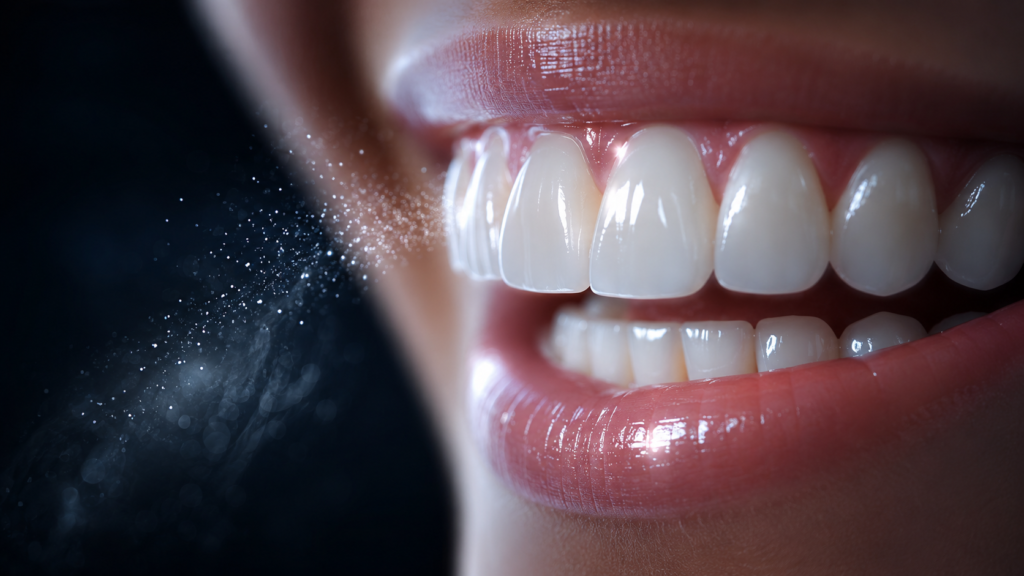
The benefits of micro-abrasive polishing depend on formula design, frequency, pressure, and the condition of the mouth. When used correctly, the benefits are practical, visible, and sensory.
| Benefit | What It Means in Real Life | Why It Matters |
|---|---|---|
| Surface stain reduction | Teeth may look cleaner and less dull | Helps with external discoloration |
| Smoother tooth feel | Tongue detects less film or roughness | Improves daily clean-mouth sensation |
| Better cosmetic maintenance | Helps manage recurring stain between cleanings | Useful for coffee and tea drinkers |
| Plaque film disruption | Can help remove superficial buildup | Supports routine oral hygiene |
| Less dependence on bleaching | May improve appearance without peroxide | Better fit for some sensitive mouths |
| Improved polish-to-clean ratio | Fine particles can clean without aggressive grit | Reduces unnecessary surface stress |
The best micro-abrasive polishing routines are not dramatic. They are controlled. Their value is cumulative: cleaner surface, smoother feel, less visible stain accumulation, and better alignment between cosmetic goals and enamel safety.
Enamel Abrasion vs Polishing
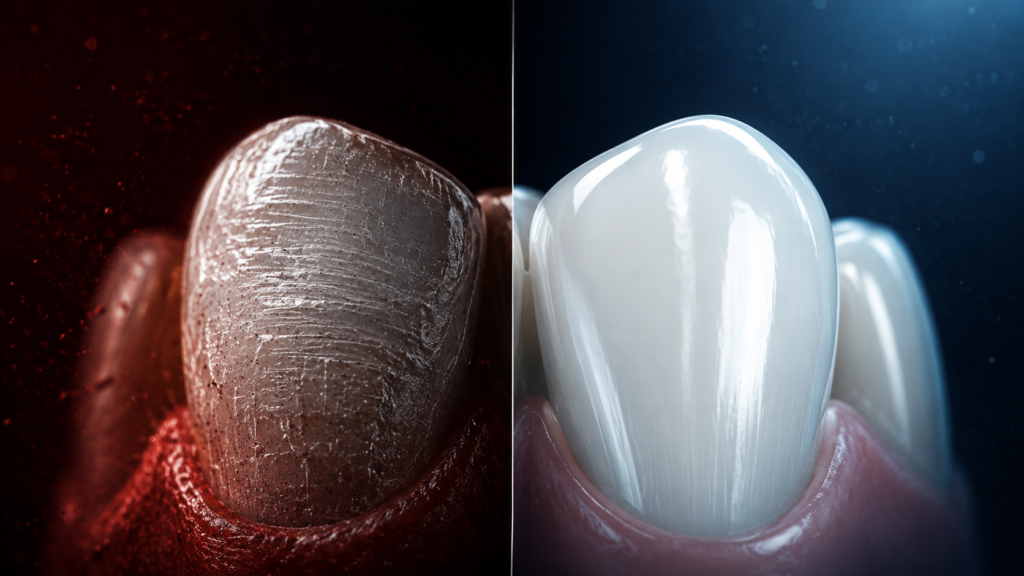
To understand polishing, a person must first understand abrasion. They are related, but they are not the same.
Enamel abrasion vs polishing science explains the difference between controlled refinement and unnecessary surface wear.
Polishing Is Controlled Surface Refinement
Polishing aims to remove removable material from the tooth surface. That material may include stain, plaque film, pellicle-bound pigment, or superficial residue. A well-designed polish uses fine particles, balanced pressure, and appropriate frequency.
Abrasion Is Surface Wear
Abrasion refers to the physical wearing away of tooth structure or exposed root surface. It may come from aggressive brushing, hard bristles, gritty toothpaste, overuse of whitening formulas, or using a polishing device too frequently.
The Key Difference
| Factor | Healthy Polishing | Harmful Abrasion |
|---|---|---|
| Target | Surface film and external stain | Tooth structure or exposed dentin |
| Pressure | Light to moderate | Heavy or repeated force |
| Frequency | Controlled and intentional | Excessive or habitual |
| Texture result | Smooth and clean | Worn, sensitive, or rough |
| Comfort | Should remain comfortable | May trigger sensitivity |
| Outcome | Cosmetic maintenance | Potential tissue loss |
The invisible risk is not a single polish. It is repeated misuse. Enamel does not regenerate like skin. Once meaningful structure is worn away, the goal shifts from cosmetic improvement to damage control.
Extrinsic vs Intrinsic Stains
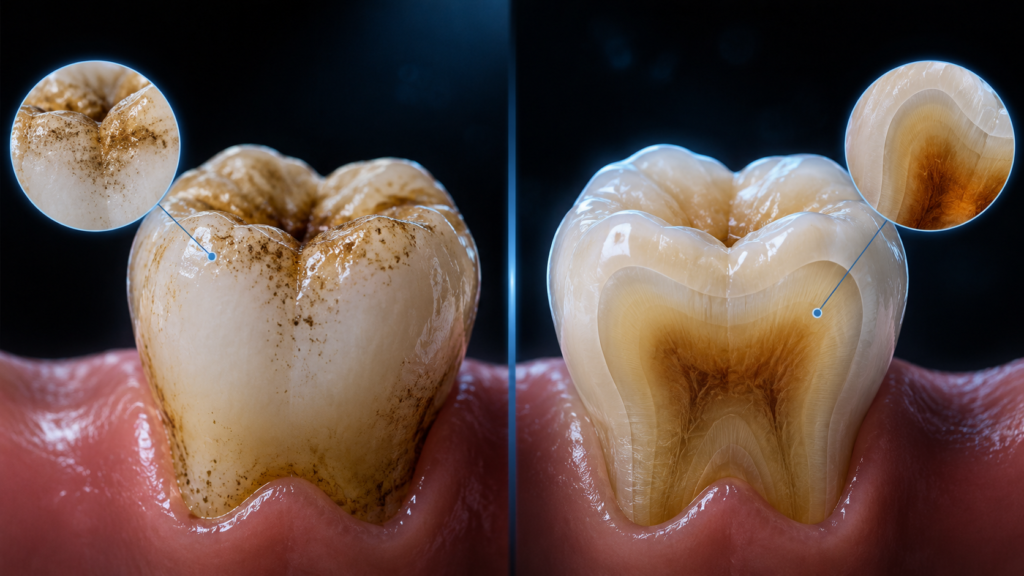
The science of polishing begins with stain location. Not all discoloration is on the same layer of the tooth.
Extrinsic vs intrinsic stains explained is one of the most important concepts for anyone choosing between polishing, whitening, professional cleaning, or restorative dentistry.
Extrinsic Stains
Extrinsic stains sit on the outside of the tooth or within the pellicle layer. They often come from:
- Coffee
- Tea
- Red wine
- Cola
- Tobacco
- Dark sauces
- Highly pigmented foods
- Plaque retention
- Poor brushing access
- Rough enamel surfaces that hold pigment more easily
These stains are the natural target of micro-abrasive polishing.
Intrinsic Stains
Intrinsic stains come from within the tooth structure. They may involve enamel, dentin, or internal tooth changes. Common causes include:
- Trauma
- Aging dentin
- Medication-related discoloration
- Developmental enamel conditions
- Fluorosis
- Internal tooth changes after dental injury
- Deep discoloration beneath the surface
Micro-abrasive polishing has limited value for intrinsic discoloration because the discoloration is not simply sitting on top of the tooth.
Why This Distinction Changes Everything
A person with extrinsic staining may benefit from polishing. A person with intrinsic staining may keep polishing harder and harder without seeing meaningful shade change. That is how a cosmetic mismatch can become an enamel-safety problem.
Before choosing a polish, the first question should be: is the discoloration on the surface, or is it inside the tooth?
How Tooth Surface Polishing Works
Tooth surface polishing works through controlled contact between a polishing medium and the outer tooth surface.
How tooth surface polishing works can be understood through five interacting forces.
1. Particle Size
Smaller, more uniform particles tend to polish more predictably. Larger or irregular particles may remove deposits more aggressively but can also increase scratch potential.
2. Particle Hardness
A polishing particle must be hard enough to disrupt stain but not so harsh that it creates avoidable surface wear. The relationship between particle hardness and enamel hardness is central to safe formula design.
3. Particle Shape
Rounder particles behave differently from sharp-edged particles. A rounded particle may buff and glide. An angular particle may cut more aggressively.
4. Brushing Pressure
Even a mild toothpaste can become more abrasive when used with heavy hand pressure. Pressure changes the way particles interact with enamel and dentin.
5. Time and Frequency
A product used occasionally may be safe in context. The same product used aggressively several times daily may become problematic. In polishing science, exposure pattern matters as much as ingredients.
The Tooth Surface System: Enamel, Pellicle, Plaque and Stain
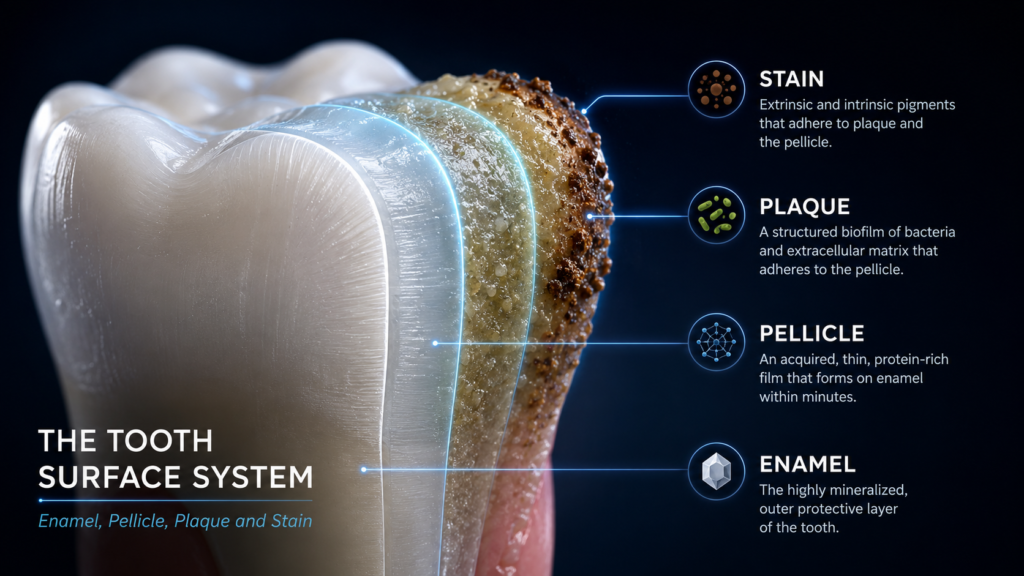
A tooth surface is not bare enamel most of the time. It is covered by a thin acquired pellicle, a naturally forming protein-rich film from saliva. This pellicle can protect the tooth, but it can also bind pigments from food and drink.
The Surface Layers
| Layer | What It Is | Polishing Relevance |
|---|---|---|
| Enamel | Mineral-rich outer tooth layer | Must be protected |
| Pellicle | Saliva-derived film | Can hold stain particles |
| Plaque biofilm | Bacterial community on tooth surface | Should be disrupted daily |
| Chromogen deposits | Pigmented stain particles | Main cosmetic polishing target |
| Calculus | Hardened mineralized plaque | Requires professional removal |
Micro-abrasive polishing is most appropriate for pellicle-bound stains and superficial deposits. It is not appropriate for removing hardened tartar. If a rough area does not improve with normal brushing and safe polishing, it may be calculus and should be evaluated professionally.
RDA Scale and Safe Abrasivity
The RDA scale, or Relative Dentin Abrasivity scale, is often used to discuss toothpaste abrasiveness. It measures dentin abrasion under controlled laboratory conditions. Dentin is softer than enamel, which is why this measurement is useful for safety discussions, especially when gum recession exposes root surfaces.
Safe abrasivity levels and RDA scale should not be interpreted as a simple “higher equals better cleaning” score. Higher abrasivity can increase stain removal potential, but it may also increase wear risk, especially when paired with aggressive brushing.
Practical RDA Interpretation
| RDA Range | Practical Meaning | Best Use Case | Editorial Caution |
|---|---|---|---|
| Very low | Gentle daily cleaning | Sensitivity, recession risk, delicate enamel | May remove stain slowly |
| Low to moderate | Balanced daily use | General oral care and mild stain control | Often the best routine range |
| Moderate to high | Stronger surface stain removal | Occasional cosmetic use | Watch pressure and frequency |
| Very high | Aggressive stain removal potential | Limited or professional-context use | Not ideal for careless daily use |
Why RDA Alone Is Not Enough
RDA focuses on dentin abrasion. Enamel behavior may differ. A complete safety view should consider:
- RDA
- REA, or Relative Enamel Abrasivity
- Particle shape
- Particle size
- pH
- Brushing pressure
- Brush type
- User frequency
- Existing gum recession
- Acid exposure from diet or reflux
A toothpaste can look “safe” in one number and still be poorly matched to a person’s mouth if that person brushes aggressively, has exposed dentin, or uses it too often.
Teeth Whitening vs Polishing
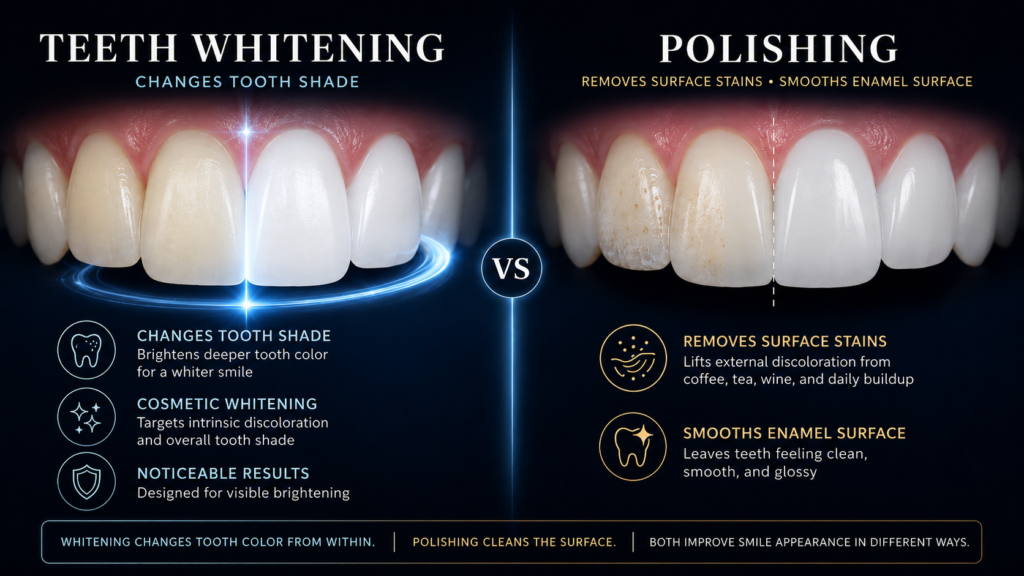
Teeth whitening vs polishing is one of the most important comparison topics in cosmetic oral care.
Whitening vs enamel polishing differences comes down to whether the goal is surface stain removal or internal shade change.
| Feature | Enamel Polishing | Teeth Whitening |
|---|---|---|
| Main target | External stain and surface film | Deeper shade molecules |
| Common method | Mild abrasives and polishing agents | Peroxide or bleaching chemistry |
| Best for | Coffee, tea, tobacco, plaque-related dullness | Yellowing from deeper tooth color |
| Speed | Gradual surface improvement | Can be faster shade change |
| Sensitivity risk | Often pressure and abrasion related | Often peroxide and nerve response related |
| Best routine role | Maintenance | Periodic cosmetic treatment |
| Limitations | Cannot bleach internal color | Does not physically smooth surface film the same way |
When Polishing Makes More Sense
Polishing is often more logical when teeth look dull from surface deposits but are not deeply discolored. It is also a better first step for individuals who want a cleaner appearance without committing to bleaching.
When Whitening Makes More Sense
Whitening may be more appropriate when teeth are generally yellow from internal tooth shade rather than external stain. However, whitening does not remove calculus, fix enamel defects, or replace a healthy cleaning routine.
The Smart Sequence
For many people, the logical sequence is:
- Professional dental evaluation if there is pain, sensitivity, bleeding, or heavy tartar
- Daily plaque control with gentle brushing and interdental cleaning
- Surface polishing for extrinsic stains
- Whitening only if deeper shade change is still desired
- Maintenance through low-stain habits and enamel-safe care
Tooth Polisher Selection Framework
A tooth polisher should be selected based on the mouth, not only the promise on the label.
The HydroPaste Surface-Safety Framework
| Question | Why It Matters | Better Choice |
|---|---|---|
| Is the stain external or internal? | Polishing works best on external stain | Choose polishing for surface stain |
| Do you have sensitivity? | Sensitive teeth may react to harsh products | Choose lower abrasivity |
| Do you have gum recession? | Exposed dentin is more vulnerable | Avoid aggressive polishing |
| Do you brush hard? | Pressure increases abrasion risk | Use soft bristles and lighter force |
| Do you drink coffee or tea daily? | Stain returns faster | Use maintenance polishing, not harsh scrubbing |
| Are you chasing dramatic whitening? | Polishing may not change intrinsic shade | Consider whitening separately |
| Do teeth feel rough? | Could be plaque, stain, or calculus | If persistent, see a dentist |
| Is the product for daily use? | Frequency changes safety | Prefer gentle formulas for daily routines |
The Best Tooth Polisher Is Not Always the Strongest
A strong polisher may create a fast visual change, but the strongest option is not automatically the smartest option. In oral care, the winning formula is usually the one that gives enough cleaning power with the lowest unnecessary surface stress.
Latest Research Direction
The latest direction in polishing science is moving away from simple “abrasive or non-abrasive” thinking. The more advanced view is multi-factor safety.
Modern research attention is increasingly focused on:
1. RDA and REA Together
Dentin and enamel do not wear the same way. A more complete abrasivity profile looks at both dentin and enamel behavior rather than treating one number as the entire safety story.
2. Surface Roughness After Polishing
A polish should ideally leave the surface smoother, not more scratched. Rougher surfaces can hold plaque and pigments more easily, which may create a cycle where a person keeps polishing because stains return faster.
3. Particle Engineering
The future of enamel polishing is not simply “less abrasive.” It is smarter abrasive design: particle size, shape, hardness, distribution, and how those particles behave under brushing force.
4. Stain Chemistry
Extrinsic stains are not all identical. Coffee, tea, wine, tobacco, and plaque-associated pigments attach differently. A better polish may combine gentle mechanical action with chemistry that helps loosen pigments without relying on harsh scrubbing.
5. Enamel-Safe Cosmetic Maintenance
The future is likely to favor formulas that combine surface polish, remineralization support, low irritation, and better compatibility with sensitive teeth.
6. Personalized Oral Care
A person with thick enamel, no recession, and coffee stains does not need the same polishing routine as someone with sensitivity, gum recession, acidic diet patterns, and exposed root surfaces. The next generation of oral care will likely become more condition-specific.
Micro-Abrasive Polishing and Remineralization
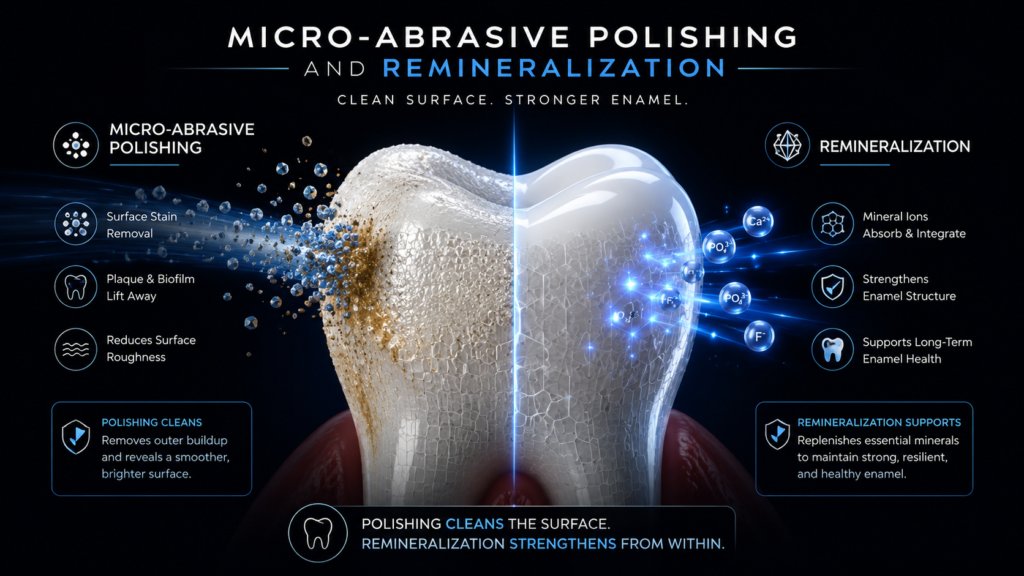
Polishing and remineralization should not be treated as enemies. They can support each other when used properly.
A cleaner tooth surface may allow daily oral-care ingredients to contact the tooth more effectively. However, over-polishing can make the surface more vulnerable, especially if the person also consumes acidic drinks, brushes aggressively, or has dry mouth.
The ideal oral-care sequence is:
- Remove plaque and surface deposits gently
- Avoid unnecessary enamel wear
- Support mineral balance with enamel-friendly ingredients
- Reduce acid attacks
- Maintain saliva flow
- Use polishing as a surface-care tool, not a daily punishment
The science is not about making enamel look artificially perfect. It is about keeping the tooth surface clean enough, smooth enough, and protected enough for long-term oral health.
Micro-Abrasive Polishing Risk Factors
Polishing risk increases when multiple stressors stack together.
| Risk Factor | Why It Raises Concern | Safer Adjustment |
|---|---|---|
| Hard-bristle toothbrush | Increases mechanical stress | Use soft bristles |
| Heavy brushing pressure | Turns mild products harsher | Use lighter pressure |
| Acidic diet | Softens surface temporarily | Wait before brushing after acid exposure |
| Gum recession | Exposes softer dentin | Use low-abrasion formulas |
| Daily whitening toothpaste overuse | Adds repeated abrasive load | Rotate with gentle toothpaste |
| Existing sensitivity | Signals possible vulnerability | Reduce polishing frequency |
| Dry mouth | Less saliva protection | Support hydration and saliva flow |
| Tartar buildup | Cannot be polished away safely at home | Schedule professional cleaning |
The biggest mistake is using cosmetic frustration as a reason to increase force. If teeth are not improving, the answer is not always “scrub harder.” It may be the wrong stain type, wrong product, or a dental issue that needs a different approach.
The Science of Smoothness
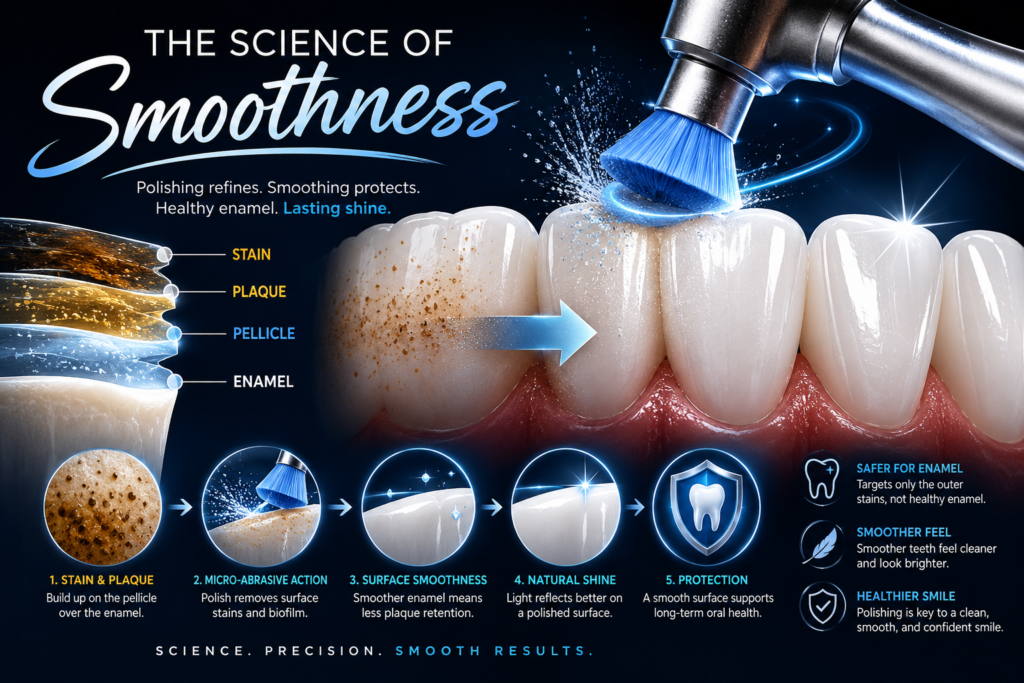
Smoothness is not just cosmetic. A smoother tooth surface can feel cleaner and may hold fewer stain particles than a rougher surface. But smoothness must be achieved carefully.
A surface can become rough from:
- Plaque accumulation
- Acid erosion
- Abrasive brushing
- Poor-quality polishing particles
- Existing enamel defects
- Calculus
- Stain buildup
- Wear at the gumline
Micro-abrasive polishing should aim to reduce unwanted surface material without creating new scratches. That is why controlled abrasivity is more important than aggressive stain removal.
Practical Use Guidance
For Daily Surface Maintenance
Choose a gentle toothpaste, soft brush, light pressure, and consistent interdental cleaning. Daily oral care should prioritize plaque control first and cosmetic polish second.
For Coffee or Tea Stains
A mild polishing formula can be used as part of a maintenance routine. The goal is to prevent stain from becoming deeply established rather than aggressively removing months of buildup in one session.
For Sensitive Teeth
Use low-abrasion formulas and avoid intense polishing devices unless recommended by a dental professional. Sensitivity changes the safety calculation.
For Gum Recession
Be especially cautious. Exposed root surfaces are more vulnerable than enamel. A product that feels fine on enamel may be too aggressive near the gumline.
For Deep Yellowing
Do not keep polishing endlessly. If the discoloration is intrinsic, polishing may not deliver the desired shade change.
Editorial Insights
Tooth polishing science is entering a more mature phase. The old cosmetic message was simple: scrub away stains and reveal a whiter smile. The better message is more precise: identify the stain type, respect enamel biology, control abrasivity, and use polishing as one part of a complete oral-care system.
The most promising future is not harsher polishing. It is smarter polishing. That means finer particle engineering, better stain chemistry, lower sensitivity risk, and formulas that recognize the difference between enamel, dentin, plaque, pellicle, and pigment.
For HydroPaste, the editorial position is clear: micro-abrasive polishing should be judged by balance. A good tooth polisher does not merely chase brightness. It protects the surface that makes brightness possible.
For a wider view of enamel-focused oral care, surface science, and practical product education, return to HydroPaste.
FAQs
Is tooth polishing science different from teeth whitening science?
Yes. Tooth polishing science focuses on removing external deposits, surface film, and extrinsic stains from the outer tooth surface. Teeth whitening science usually focuses on changing tooth shade through bleaching chemistry, often using peroxide-based ingredients. Polishing is mainly a surface-refinement process. Whitening is mainly a shade-change process. They can overlap in cosmetic goals, but they work differently and should not be treated as the same routine.
Is enamel polishing safe for sensitive teeth?
Enamel polishing can be safe for some sensitive teeth, but the formula, pressure, brush type, and frequency matter. Individuals with sensitivity should avoid aggressive polishing, hard brushes, and high-abrasion whitening toothpaste. A low-abrasion formula used gently is usually a more sensible direction. If sensitivity is sharp, worsening, or linked to cold, sweets, or biting pressure, polishing should not be used as a substitute for dental evaluation.
What is the safest tooth polisher for coffee stains?
The safest tooth polisher for coffee stains is usually one that targets extrinsic stain with fine polishing particles, moderate abrasivity, and a formula designed for routine oral care rather than harsh stain stripping. Coffee stains often bind to the pellicle layer, so consistency matters more than force. A gentle polishing routine used correctly is usually better than aggressive scrubbing after stains become heavy.
Can micro-abrasive polishing damage enamel?
Micro-abrasive polishing can contribute to enamel or dentin wear if used too aggressively, too often, or with high-abrasion products. The risk rises with hard brushing, acidic diet patterns, gum recession, and existing sensitivity. Safe polishing is about controlled friction. The goal is to lift stain and smooth surface film, not remove healthy tooth structure.
Does polishing remove intrinsic tooth stains?
No, polishing does not reliably remove intrinsic tooth stains because intrinsic discoloration is located within the tooth structure rather than simply on the surface. Polishing may improve surface brightness if external stains are also present, but it will not fundamentally change deep internal discoloration. Intrinsic stains may require whitening, restorative dentistry, or professional evaluation depending on the cause.
People Also Ask
What is the difference between tooth polishing and enamel abrasion?
Tooth polishing is controlled surface cleaning or smoothing. Enamel abrasion is unwanted tooth surface wear. Polishing targets stain, plaque film, and external deposits. Abrasion affects the tooth structure itself. The two can look similar from the outside because both involve friction, but the outcome is different. Good polishing preserves the tooth surface. Harmful abrasion weakens it over time.
Is tooth polishing safe to do at home?
At-home tooth polishing can be safe when it uses gentle products, soft brushing, light pressure, and reasonable frequency. The problem begins when a person treats polishing like sanding. Devices, gritty pastes, hard bristles, and frequent use can increase risk. At-home polishing should be cosmetic maintenance, not an attempt to remove tartar, fix discoloration, or replace professional dental care.
Does a tooth polisher make teeth whiter?
A tooth polisher can make teeth look whiter if the discoloration is caused by surface stains. It removes or reduces extrinsic stain, which can reveal a cleaner-looking tooth surface. However, it may not change the natural underlying shade of the tooth. If teeth are yellow because of dentin color, aging, trauma, or intrinsic discoloration, polishing alone may have limited effect.
How often should you use enamel polishing products?
Frequency depends on the product and the mouth. A gentle daily toothpaste with mild polishing properties may be appropriate for routine use, while stronger polishing pastes or devices should be used less often. Individuals with sensitivity, gum recession, acid erosion, or exposed dentin should be more cautious. The safest approach is to use the lowest effective intensity and avoid chasing instant brightness through repeated polishing.
What is better for stains: whitening toothpaste or polishing toothpaste?
It depends on the stain type. Polishing toothpaste is often better for external stains from coffee, tea, tobacco, and surface plaque film. Whitening toothpaste may combine polishing agents with chemical brightening ingredients, but it can also increase sensitivity for some individuals. If the goal is stain maintenance and smoothness, polishing is usually the more precise category. If the goal is deeper shade change, whitening may be more relevant.