
Stannous Fluoride Effects: How It Protects Enamel, Sensitivity, Plaque, and Gumline Health
Amazon Affiliate Disclosure
Hydropaste.com may earn a commission from qualifying purchases made through affiliate links, including Amazon links. This does not change the price you pay. Editorial recommendations are based on ingredient science, oral health use cases, product category fit, and practical risk profiles rather than commission value.
Stannous fluoride effects go beyond ordinary cavity protection. Standard fluoride toothpaste is mainly discussed for its ability to Regenerate Enamel and prevent tooth decay, but stannous fluoride adds a wider biological profile: enamel support, acid erosion protection, dentinal tubule occlusion, plaque control, gingivitis reduction, sensitivity relief, and sometimes breath support.
That is why stannous fluoride toothpaste occupies a special place inside the enamel remineralization center. It is still a fluoride compound, but its effect profile is different from sodium fluoride or sodium monofluorophosphate. The “stannous” part refers to tin ions, and those tin-related actions are what make this ingredient especially relevant for people who have both enamel and gumline problems.
A 2025 review describes stannous fluoride toothpastes as clinically relevant for caries, dentinal hypersensitivity, gingival inflammation, plaque control, and oral malodor, while noting that modern stabilized formulations are designed to improve the ingredient’s performance and usability. (PMC)
Quick Jump
| Reader Goal / Interest | Article Section (H2) | Core Insight & Takeaway |
| Orientation & Purpose | What This Guide Is For | De-coding marketing jargon (e.g., “gum detoxify”) to explain what stannous fluoride actually achieves. |
| Target Audience Fit | Who Needs Stannous Fluoride Toothpaste? | Identifies ideal users: those dealing with sensitivity, gumline plaque, early gingivitis, or acid erosion. |
| High-Level Overview | Benefits of Stannous Fluoride | A quick summary of its 6 main therapeutic benefits, from enamel support to breath freshening. |
| Biological Mechanisms | Stannous Fluoride Effects Explained | The core chemistry ($SnF_2$): how fluoride ions pair with tin to create a multi-action protective layer. |
| Pain & Hot/Cold Triggers | Stannous Fluoride for Sensitive Teeth | Explains dentinal tubule occlusion—physically plugging the microscopic channels leading to nerves. |
| Bleeding Gums & Biofilm | Stannous Fluoride for Gingivitis and Gumline Health | How its antimicrobial properties disrupt plaque bacteria along the margin where teeth meet gums. |
| Ingredient Head-to-Head | Stannous Fluoride vs Sodium Fluoride | Compares basic cavity protection ($NaF$) against the multi-benefit profile of stannous fluoride. |
| Mineral Alternatives | Stannous Fluoride vs Hydroxyapatite | Fluoride-tin chemistry versus biomimetic, fluoride-free mineral particle deposition. |
| Alternative Delivery | Stannous Fluoride vs Calcium Phosphate Systems | Direct comparison with mineral supply systems like CPP-ACP and bioactive glass. |
| Dietary Acid Wear | Stannous Fluoride for Enamel Erosion | How tin-containing deposits guard enamel against chemical wear from soda, citrus, or reflux. |
| Product Varieties | Where Stannous Fluoride Appears | Breaking down formulas across categories like sensitivity, gum health, and whitening. |
| Buyer Selection Criteria | What to Look for in a Stannous Fluoride Toothpaste | What to check on the active ingredients panel (e.g., 0.454% concentration, stabilized systems). |
| Budgeting & Value | What Stannous Fluoride Products Usually Cost | Price tier breakdowns comparing basic, standard, premium, and prescription variants. |
| Drawbacks & Warnings | Risks and Limitations | Crucial guide to extrinsic staining, metallic taste, cavity limits, and when to see a dentist. |
| Future Innovations | Trends & Latest Tech in Stannous Fluoride Toothpaste | Deep dive into modern stabilization tech and multi-system formulas ($SnF_2$ + nitrates + phosphates). |
| The Next Generation | Upcoming Models in Stannous Fluoride Oral Care | Looking forward to personalized gumline care and hybrid Hydroxyapatite formulas. |
| Visual Data Reference | Charts & Tables | Centralized matrixes cross-referencing use cases and competing toothpaste actives. |
| Final Decision Making | When Stannous Fluoride Is the Better Choice | Concrete rules of thumb for choosing between Stannous, Sodium Fluoride, or Hydroxyapatite. |
| Daily Application | Practical Stannous Fluoride Routine | Tailored morning, night, and post-acid routines, emphasizing the importance of residual nighttime protection. |
| Editorial Conclusion | Insights | Scientific Evidence-Based Editorial Verdict |
| Quick Answers | FAQs | Rapid-fire answers regarding tooth staining, bleeding gums, and ingredient superiority. |
What This Guide Is For
This guide is for readers who want to understand stannous fluoride effects before choosing a toothpaste for enamel, sensitivity, plaque, gumline bleeding, or bad breath.
Many products use phrases such as “gum detoxify,” “sensitivity and gum,” “complete protection,” “whole mouth health,” “antigingivitis,” or “enamel repair.” Stannous fluoride often sits behind those claims, but the ingredient deserves a more careful explanation.
This page explains:
How stannous fluoride works on enamel
Why it may help sensitive teeth
How it affects plaque bacteria and gingivitis
Why it differs from sodium fluoride
How modern stabilized stannous fluoride formulas reduce older drawbacks
When it may be better than hydroxyapatite
When fluoride-free users may prefer hydroxyapatite instead
What risks and limitations to understand before choosing it
How to judge stannous fluoride toothpaste by real function, not marketing language
Who Needs Stannous Fluoride Toothpaste?
People With Sensitive Teeth
Stannous fluoride is highly relevant for sensitivity because it can help block exposed dentinal tubules. These tubules act like microscopic channels that transmit cold, heat, air, sweet foods, or touch toward the nerve. In vitro work has shown that toothpaste containing 0.454% stannous fluoride can coat dentin surfaces and occlude open tubules, which is one mechanism behind sensitivity relief. (PubMed)
People With Gumline Plaque
If plaque collects along the gumline, enamel problems are often not the only issue. Gum inflammation, bleeding, and sensitivity can appear together. Stannous fluoride may be especially useful because it targets plaque and gingival health while still providing fluoride-based anticavity support.
People With Early Gingivitis
Stannous fluoride is commonly used in toothpastes positioned for gingivitis or gum health. A 2019 clinical study found a stabilized stannous fluoride dentifrice improved gingival inflammation and biofilm control compared with a fluoride control dentifrice over six months. (ScienceDirect)
People With Enamel Erosion Risk
Acid exposure from citrus, soda, energy drinks, sports drinks, reflux, wine, and frequent snacking can weaken enamel. A meta-analysis on bioavailable stannous fluoride toothpastes reported less enamel sample loss from acid erosion and improvement in dentine hypersensitivity pain when used as part of daily oral hygiene. (ScienceDirect)
People Who Want Multi-Benefit Toothpaste
Some users do not need a highly specialized product for only one problem. They need one toothpaste that addresses cavities, sensitivity, plaque, and gumline inflammation. This is where stannous fluoride becomes commercially powerful.
People Comparing Fluoride Ingredients
If a reader sees sodium fluoride, sodium monofluorophosphate, and stannous fluoride on different toothpaste labels, this guide explains why they are not interchangeable.
Benefits of Stannous Fluoride
1. Enamel Remineralization Support
Stannous fluoride provides fluoride ions that help reduce demineralization and support remineralization of early enamel lesions. Like other fluoride compounds, it helps enamel handle acid attacks more effectively.
2. Sensitivity Relief
Stannous fluoride can help block dentinal tubules. When tubules are sealed, fluid movement inside dentin is reduced, which can reduce sensitivity triggers.
3. Plaque Control
The tin component gives stannous fluoride antimicrobial and anti-plaque relevance. This helps explain why stannous fluoride toothpastes are often positioned for “whole mouth” or gumline care rather than only anticavity protection.
4. Gingivitis Support
By reducing plaque activity and supporting gumline cleanliness, stannous fluoride may help reduce gingival inflammation when used consistently with proper brushing.
5. Acid Erosion Protection
Stannous fluoride can form protective deposits on enamel that help reduce acid-driven mineral loss. This makes it relevant for readers with acidic diets or reflux-related enamel wear.
6. Breath Support
Bad breath is often linked to bacterial activity on the tongue, gums, and plaque biofilm. Some stannous fluoride formulations may help oral malodor by reducing bacterial activity, though breath outcomes depend heavily on tongue cleaning, gum health, dry mouth, diet, and dental disease.
Stannous Fluoride Effects Explained
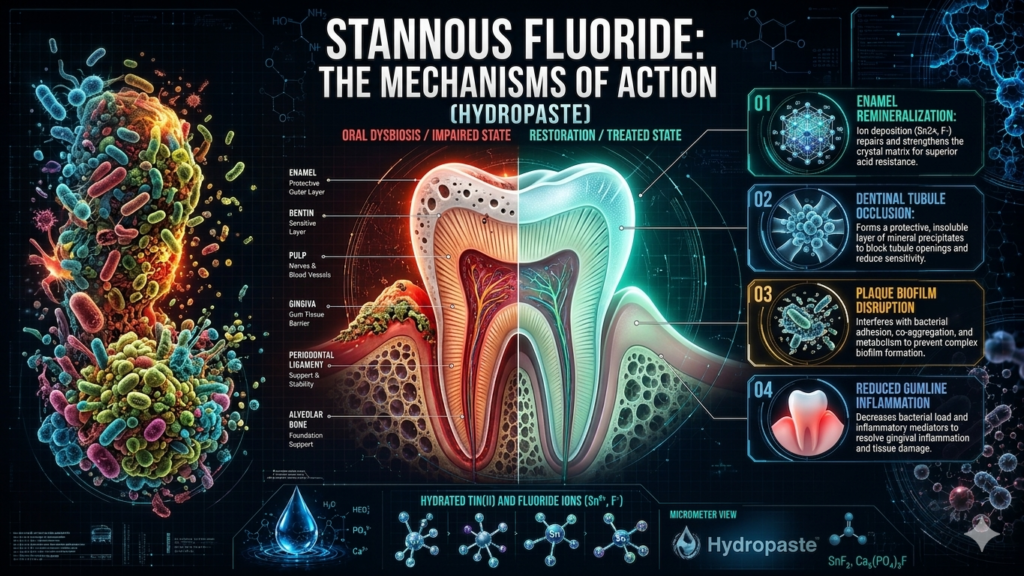
What Is Stannous Fluoride?
Stannous fluoride is a fluoride compound made from tin and fluoride. Chemically, it is usually written as SnF₂. The fluoride part supports enamel remineralization and cavity prevention. The stannous, or tin, part adds extra effects related to plaque, sensitivity, gumline health, and erosion protection.
That dual action is what makes stannous fluoride different from basic sodium fluoride toothpaste.
The 6-Part Stannous Fluoride Mechanism
1. Fluoride-Based Enamel Protection
Stannous fluoride delivers fluoride to the tooth surface. This supports remineralization, reduces mineral loss during acid attacks, and helps enamel become more resistant to future acid stress.
2. Tin-Based Protective Surface Layer
Stannous ions can interact with enamel and dentin surfaces. These interactions may help form protective deposits that reduce acid erosion and support a more resistant tooth surface.
3. Dentinal Tubule Occlusion
For sensitive teeth, stannous fluoride can help physically block open dentinal tubules. This reduces the fluid movement that triggers pain signals.
4. Antimicrobial Biofilm Effects
Stannous fluoride can interfere with bacterial activity in plaque. This does not sterilize the mouth, and it should not. Instead, the goal is to reduce harmful biofilm behavior that contributes to acid production, gingival inflammation, and malodor.
5. Gingival Inflammation Reduction
By affecting plaque and biofilm behavior along the gumline, stannous fluoride can support healthier gums when paired with consistent brushing and interdental cleaning.
6. Oral Malodor Support
Some stannous fluoride formulas may reduce odor-causing bacterial activity. This is why stannous fluoride appears in some “complete care” products positioned for breath, plaque, and gumline health.
Stannous Fluoride Mechanism Chart
| Mechanism | What Happens | User Benefit |
|---|---|---|
| Fluoride delivery | Fluoride reaches enamel and plaque fluid | Cavity prevention and remineralization support |
| Acid-resistance support | Enamel loses minerals more slowly under acid | Better protection against erosion and decay |
| Tin surface interaction | Stannous ions interact with enamel/dentin | Protective surface effects |
| Tubule occlusion | Open dentinal tubules become blocked | Reduced tooth sensitivity |
| Biofilm disruption | Plaque bacteria become less harmful | Less plaque-driven inflammation |
| Gingival support | Gumline plaque activity decreases | Reduced gingivitis risk |
| Malodor reduction | Odor-related bacterial activity may decrease | Fresher breath support |
Stannous Fluoride for Sensitive Teeth

Stannous fluoride for sensitive teeth works through a more physical pathway than many people expect. Sensitivity is often caused by exposed dentin, especially near the gumline. Dentin contains tubules. When those tubules are open, temperature and pressure changes can trigger nerve discomfort.
Stannous fluoride can help by forming deposits over those tubules.
Best Sensitivity Use Cases
Stannous fluoride toothpaste may help with:
Cold sensitivity
Air sensitivity
Sweet sensitivity
Gumline sensitivity
Sensitivity after scaling
Sensitivity from exposed dentin
Sensitivity linked with plaque accumulation
Mild sensitivity from acid erosion
When Sensitivity Is Not a Toothpaste Problem
A toothpaste should not be used to mask warning signs. See a dentist if sensitivity is sharp, worsening, one-sided, linked to biting, lingering after temperature exposure, or associated with swelling, cracks, bleeding, or visible decay.
Stannous Fluoride for Gingivitis and Gumline Health
Stannous fluoride gingivitis toothpaste is popular because gumline problems are often biofilm problems. Plaque accumulates along the margin where tooth meets gum. If not removed, it can trigger inflammation, bleeding, tenderness, and bad breath.
Stannous fluoride helps by influencing plaque bacteria and biofilm behavior. This makes it different from fluoride ingredients that mainly focus on enamel.
The ADA notes that toothpastes may include ingredients for reducing gingivitis, tartar buildup, enamel erosion, sensitivity, whitening, or bad breath in addition to fluoride’s anticavity role. (ADA)
Best Gumline Use Cases
Stannous fluoride toothpaste may be useful for:
Bleeding gums from plaque
Gumline sensitivity
Plaque buildup near the gumline
Early gingivitis
Bad breath related to plaque
Orthodontic gumline plaque
Exposed root sensitivity
Still Needed: Mechanical Cleaning
Stannous fluoride does not replace brushing technique, flossing, interdental brushes, water flossers, tongue cleaning, or professional cleanings. It supports the routine. It does not perform the routine.
Stannous Fluoride vs Sodium Fluoride
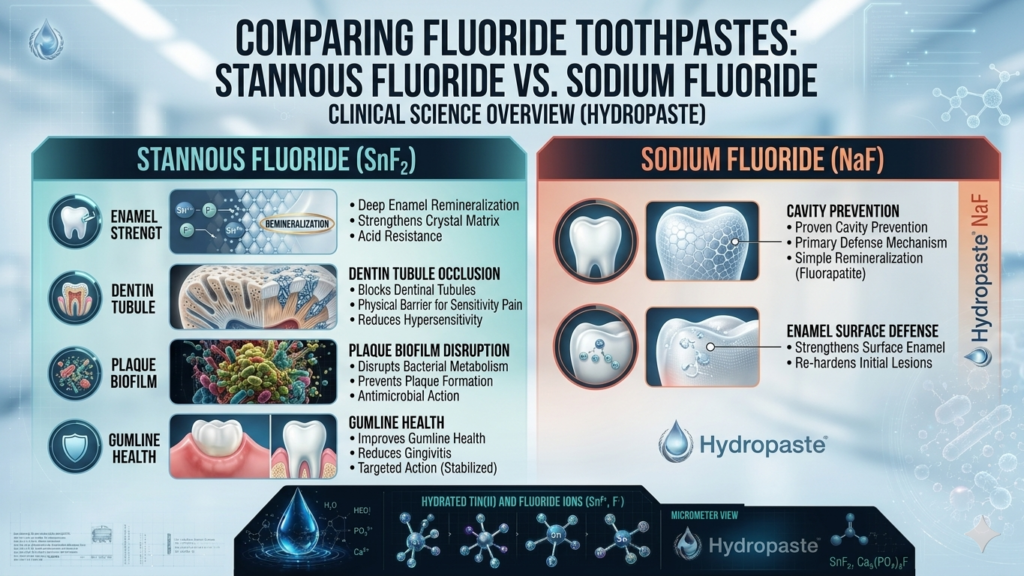
Sodium fluoride is a strong anticavity ingredient. Stannous fluoride is also anticavity, but it adds more effects.
Stannous Fluoride vs Sodium Fluoride Comparison Chart
| Category | Stannous Fluoride | Sodium Fluoride |
|---|---|---|
| Main fluoride benefit | Enamel remineralization and cavity prevention | Enamel remineralization and cavity prevention |
| Sensitivity support | Strong through tubule occlusion | Limited unless combined with other sensitivity agents |
| Plaque support | Stronger | Lower |
| Gingivitis support | Stronger | Lower |
| Acid erosion protection | Stronger in stabilized/bioavailable formulas | Moderate |
| Breath support | Possible through biofilm effects | Not a major role |
| Staining risk | Possible, reduced in modern formulas | Low |
| Taste concerns | Possible metallic taste in some formulas | Usually milder |
| Best user | Sensitivity + gumline + cavity concerns | Standard cavity prevention |
Which One Should You Choose?
Choose sodium fluoride if you want simple, affordable cavity prevention and do not have major sensitivity or gumline concerns.
Choose stannous fluoride if you want cavity protection plus sensitivity, plaque, gingivitis, or gumline support.
Stannous Fluoride vs Hydroxyapatite
Hydroxyapatite and stannous fluoride both appear in enamel repair conversations, but they serve different users.
Hydroxyapatite provides tooth-like mineral particles that can fill microscopic defects and block tubules. Stannous fluoride delivers fluoride plus tin-based effects for enamel, sensitivity, plaque, and gumline health.
Comparison Chart
| Category | Stannous Fluoride | Hydroxyapatite |
|---|---|---|
| Main mechanism | Fluoride + tin-based surface and biofilm effects | Tooth-like mineral particle deposition |
| Fluoride-free | No | Usually yes |
| Enamel remineralization | Strong | Strong potential |
| Sensitivity support | Strong | Strong |
| Gumline support | Stronger | Lower |
| Plaque control | Stronger | Lower |
| White spot support | Useful | Useful |
| Best user | Cavity risk + sensitivity + gingivitis | Fluoride-free enamel support + sensitivity |
| Main concern | Staining/taste in some formulas | Formula quality and concentration vary |
Stannous Fluoride vs Calcium Phosphate Systems
Calcium phosphate systems supply or stabilize enamel minerals. Stannous fluoride changes the mouth’s acid, biofilm, sensitivity, and enamel protection profile.
Comparison Chart
| Category | Stannous Fluoride | Calcium Phosphate Systems |
|---|---|---|
| Main role | Multi-benefit fluoride active | Mineral supply/delivery |
| Best for | Sensitivity, gingivitis, plaque, cavities | White spots, mineral support, sensitivity |
| Fluoride-free | No | Sometimes |
| Gumline benefit | High | Low to moderate |
| Sensitivity benefit | High | Moderate to high depending on system |
| White spot relevance | Moderate to high | High |
| Product types | Toothpaste, rinse in some markets | Toothpaste, creams, gels, mousse |
For mineral-delivery science, see calcium phosphate systems.
Stannous Fluoride for Enamel Erosion
Enamel erosion is not the same as tooth decay. Decay is driven largely by bacterial acids produced within dental plaque, while erosion is the direct chemical loss of tooth mineral caused by acids that do not necessarily originate from bacteria. Common sources include citrus fruits, soda, sports drinks, wine, vinegar-heavy foods and gastric reflux.
Understanding the enamel remineralization vs erosion cycle helps explain why erosion-prone teeth require more than conventional cavity prevention. When acid exposure repeatedly outpaces salivary buffering and mineral recovery, the enamel surface can remain softened long enough for cumulative tissue loss to develop.
Stannous fluoride may be particularly useful in erosion-focused oral care because tin-containing deposits can form on the tooth surface and improve resistance to subsequent acid dissolution. This protective effect does not rebuild enamel that has already been physically lost, but it may help reduce further mineral removal when combined with lower acid frequency, adequate saliva flow and gentle brushing habits.
Best Erosion Use Cases
Stannous fluoride may be worth considering for:
Frequent acidic drink intake
Reflux-related enamel wear
Post-whitening sensitivity
Smooth, shiny enamel wear
Cold sensitivity from acid-softened enamel
Root sensitivity from exposed dentin
Routine Tip
Do not brush immediately after acidic exposure. Rinse with water, allow saliva to buffer the mouth, and brush later with a soft toothbrush.
Where Stannous Fluoride Appears
1. Stannous Fluoride Toothpaste
This is the main category. It is commonly marketed for sensitivity, gum health, plaque control, enamel protection, and “complete care.”
2. Stannous Fluoride Sensitivity Toothpaste
These formulas emphasize tubule occlusion and gumline comfort. They often compete with potassium nitrate and hydroxyapatite sensitivity toothpastes.
3. Stannous Fluoride Gum Health Toothpaste
These products focus on plaque, gingivitis, bleeding gums, and gumline cleaning. They may be best for users with both sensitivity and gum inflammation.
4. Stannous Fluoride Whitening Toothpaste
Some modern formulas combine stannous fluoride with stain-control systems. These are designed to reduce the older concern that stannous fluoride may stain teeth.
5. Stabilized Stannous Fluoride Systems
Modern stannous fluoride formulas use stabilization technologies to keep tin ions bioavailable while improving taste, appearance, and stain control. Stabilization is one of the reasons newer stannous fluoride toothpastes are more commercially successful than older versions.
What to Look for in a Stannous Fluoride Toothpaste
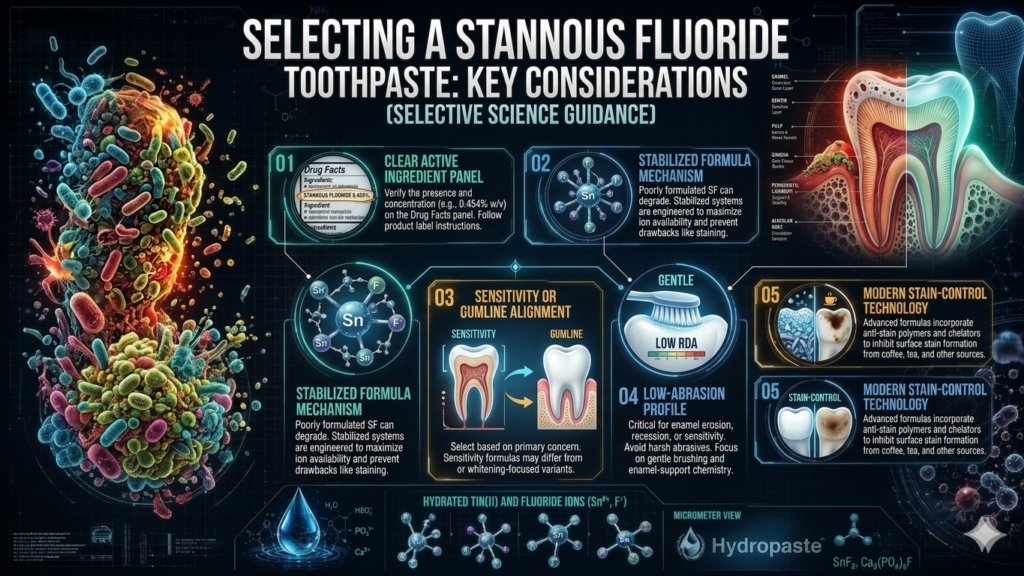
Clear Active Ingredient
Look for “stannous fluoride” on the active ingredient panel. A common concentration in many U.S. toothpastes is 0.454% stannous fluoride, but always follow the product label.
Stabilized Formula
Stannous fluoride can be unstable if poorly formulated. Stabilized systems are designed to improve performance and reduce drawbacks.
Sensitivity or Gumline Positioning
Choose based on your main concern. A gum-focused stannous fluoride toothpaste may differ from a whitening-focused or sensitivity-focused formula.
Low-Abrasion Profile
If you have enamel erosion, recession, or sensitivity, avoid harsh whitening abrasives. Enamel support requires chemistry and gentle brushing.
Stain-Control Technology
Modern formulas often include ingredients to reduce stain formation. This matters if you drink tea, coffee, wine, or have a history of surface staining.
What Stannous Fluoride Products Usually Cost
Stannous fluoride toothpaste usually costs more than basic sodium fluoride toothpaste but less than many specialty gels or professional treatments.
Cost Chart
| Product Type | Typical Cost Level | Best For |
|---|---|---|
| Basic sodium fluoride toothpaste | Low | Standard cavity prevention |
| Standard stannous fluoride toothpaste | Low to mid | Cavity + sensitivity + gumline support |
| Premium stannous fluoride toothpaste | Mid | Stabilized formula, gum health, sensitivity |
| Stannous fluoride whitening toothpaste | Mid | Stain control plus sensitivity/gum benefits |
| Prescription fluoride toothpaste | Mid to professional | High caries risk under dentist guidance |
| Professional desensitizing treatment | Professional cost | Severe sensitivity or exposed dentin |
Best Value Strategy
Stannous fluoride is often a good value for people who would otherwise need separate products for cavities, sensitivity, plaque, and gumline inflammation. If your only concern is ordinary cavity prevention, a standard fluoride toothpaste may be more economical. If your concern is fluoride-free enamel support, hydroxyapatite may be a better category fit.
Risks and Limitations
1. Tooth Staining
Older stannous fluoride formulas were more associated with extrinsic staining. Modern stabilized products are designed to reduce this issue, but some users may still notice staining, especially with coffee, tea, wine, smoking, or plaque buildup.
2. Metallic Taste
Some users dislike the taste of stannous fluoride. Newer formulas are generally better, but taste remains product-specific.
3. It Is Not Fluoride-Free
People looking for fluoride-free remineralizing toothpaste should choose hydroxyapatite or another fluoride-free mineral system instead.
4. It Cannot Repair an Open Cavity
Stannous fluoride can support early enamel remineralization and help prevent decay progression, but it cannot fill a cavity or restore missing enamel structure.
5. Gum Disease Still Needs Dental Care
Stannous fluoride may help gingivitis linked to plaque, but periodontitis, deep pockets, pus, loose teeth, recession, and persistent bleeding require dental evaluation.
6. Sensitivity May Signal a Bigger Problem
If sensitivity is severe, localized, or lingering, do not rely on toothpaste alone. Cracks, cavities, failing fillings, exposed roots, and pulp inflammation need professional diagnosis.
7. Children Need Proper Use
As with other fluoride toothpastes, children should use age-appropriate amounts and avoid swallowing. Parents should follow product directions and pediatric dental advice.
Trends & Latest Tech in Stannous Fluoride Toothpaste
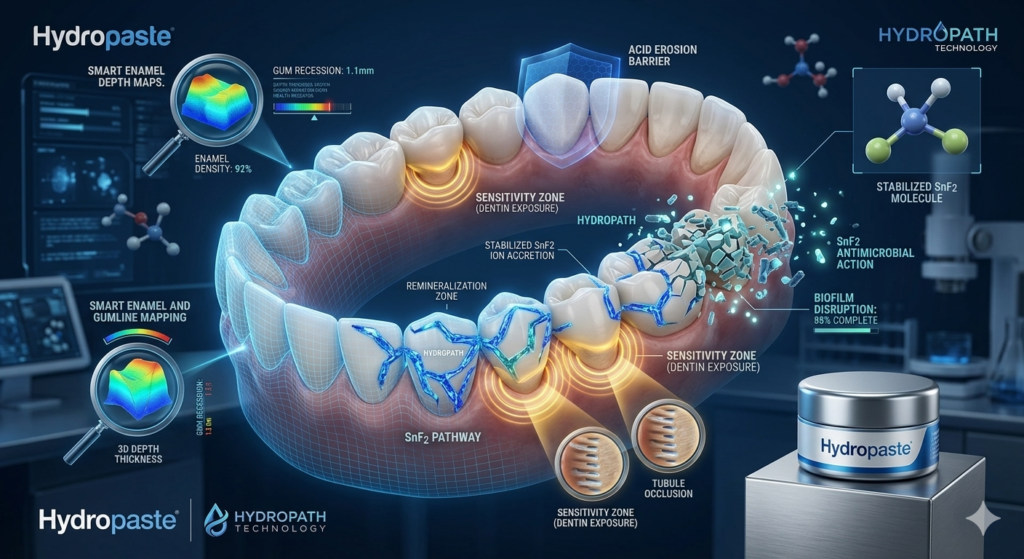
Stabilized Stannous Fluoride
Stability is the main technological challenge. Stannous ions are useful but reactive. Modern formulas use stabilizing systems to maintain bioavailability and reduce staining or taste issues.
Stannous Fluoride + Nitrate + Phosphate Systems
Newer formulas are exploring combinations that support sensitivity, tin stability, mineral delivery, and gumline effects. Some trade and clinical discussions describe stabilized stannous fluoride systems with nitrate and phosphates as an emerging direction for hypersensitivity, plaque, gingivitis, and malodor care. (Decisions in Dentistry)
Gumline-Specific Toothpastes
Commercial oral care is shifting from “cavity only” toothpaste toward gumline-focused formulas. Stannous fluoride is one of the strongest ingredients for this category because it addresses plaque, gingivitis, sensitivity, and enamel protection together.
Sensitivity + Whitening Hybrids
A major consumer problem is wanting whiter teeth without making sensitivity worse. Stannous fluoride whitening formulas are trying to balance stain removal, enamel protection, and tubule occlusion.
Erosion Protection Positioning
As acidic drinks and reflux-related enamel wear become more common topics, expect more stannous fluoride products to market acid erosion protection.
For future-facing enamel technologies beyond conventional actives, biomimetic mineral repair compounds explores next-generation tooth repair systems.
Upcoming Models in Stannous Fluoride Oral Care
1. Personalized Gumline Toothpaste
Future stannous fluoride products may be marketed by user profile: bleeding gums, sensitivity, plaque buildup, dry mouth, acid erosion, orthodontic gumline risk, or post-cleaning sensitivity.
2. Stannous Fluoride + Hydroxyapatite Hybrids
Some future products may combine fluoride-tin chemistry with biomimetic mineral particles. This could appeal to users who want enamel repair, tubule occlusion, and gumline support in one formula.
3. Smarter Stain-Control Systems
Future formulas will likely improve stain resistance while preserving stannous fluoride’s antimicrobial and sensitivity benefits.
4. Oral Microbiome-Aware Formulas
Rather than broadly “killing bacteria,” future stannous fluoride products may be designed to reduce harmful biofilm activity while respecting a healthier oral microbial balance.
5. Enamel-Erosion Protocol Kits
Stannous fluoride may appear in multi-step routines for erosion-prone users, including low-abrasion toothpaste, mineral rinse, pH tracking, and soft-bristle brushing guidance.
Charts & Tables
Stannous Fluoride Use Case Matrix
| User Situation | Stannous Fluoride Relevance | Why |
|---|---|---|
| Sensitive teeth | High | Helps occlude dentinal tubules |
| Bleeding gums from plaque | High | Supports plaque and gingivitis control |
| Frequent cavities | High | Provides fluoride-based anticavity support |
| Acid erosion | High | Helps reduce acid-related enamel loss |
| Bad breath from plaque | Moderate to high | May reduce odor-related biofilm activity |
| Fluoride-free preference | Low | Contains fluoride |
| White spots | Moderate | Supports remineralization but not the only option |
| Heavy staining history | Moderate | Choose modern stain-control formulas |
Stannous Fluoride vs Other Toothpaste Actives
| Ingredient | Best Known For | Best User |
|---|---|---|
| Stannous fluoride | Cavities, sensitivity, plaque, gingivitis | Gumline + sensitivity users |
| Sodium fluoride | Cavity prevention | Standard fluoride users |
| Potassium nitrate | Sensitivity nerve calming | Sensitivity without gumline plaque focus |
| Hydroxyapatite | Biomimetic enamel support | Fluoride-free sensitivity users |
| Calcium phosphate | Mineral delivery | White spots and early mineral support |
| Bioactive glass | Tubule occlusion and mineral release | Sensitivity-focused users |
| Zinc compounds | Breath/plaque support | Malodor and plaque users |
Buying Checklist for Stannous Fluoride Toothpaste
| Feature | Why It Matters |
|---|---|
| Lists stannous fluoride as active ingredient | Confirms the correct fluoride type |
| Stabilized formula | Helps preserve performance and reduce drawbacks |
| Sensitivity claim | Useful for exposed dentin/tubules |
| Gingivitis or gum health claim | Useful for gumline plaque users |
| Stain-control system | Important for coffee/tea/wine users |
| Low-abrasion profile | Important for enamel erosion and recession |
| Clear age directions | Needed for child safety |
| No exaggerated repair claims | More scientifically credible |
When Stannous Fluoride Is the Better Choice
Stannous fluoride may be the better choice when a user has more than one oral care problem at the same time.
Choose Stannous Fluoride If You Have:
Sensitivity near the gumline
Bleeding gums from plaque
Frequent plaque buildup
Cavity risk
Acid erosion risk
Bad breath linked to plaque
Exposed dentin
Orthodontic gumline challenges
Recession-related sensitivity
Choose Sodium Fluoride If You Have:
Basic cavity-prevention needs
No major gumline issue
No sensitivity
Budget-first toothpaste preference
A preference for simpler taste and lower stain risk
Choose Hydroxyapatite If You Want:
Fluoride-free enamel support
Biomimetic mineral repair
Sensitivity support without fluoride
Surface smoothing
A tooth-like mineral approach
Choose Calcium Phosphate If You Want:
White spot mineral support
Mineral delivery systems
CPP-ACP or bioactive glass
A professional-style remineralization add-on
Practical Stannous Fluoride Routine
Morning Routine
Brush for two minutes with a stannous fluoride toothpaste. Focus on the gumline without scrubbing aggressively. Use a soft toothbrush and light pressure.
After Acidic Drinks or Reflux
Rinse with water and allow saliva to recover before brushing. This protects softened enamel from abrasion.
Night Routine
Night brushing is especially valuable because saliva flow decreases during sleep. Stannous fluoride before bed may support enamel protection, tubule occlusion, and gumline plaque control during a lower-saliva period.
Gumline Routine
If gums bleed, brush gently but consistently. Add floss, interdental brushes, or a water flosser. Bleeding often improves when plaque is controlled, but persistent bleeding needs a dentist.
Sensitivity Routine
Use the toothpaste daily for several weeks. Sensitivity products often need consistent contact before full benefit is felt.
Readers looking for practical oral care guidance for sensitivity, white spots, gumline health and daily mineral protection, should visit the Hydropaste homepage.
FAQs
What are the main stannous fluoride effects on teeth?
The main stannous fluoride effects on teeth include enamel remineralization support, cavity prevention, acid erosion protection, dentinal tubule occlusion, and sensitivity relief. It delivers fluoride for enamel repair while the tin component supports protective surface effects and biofilm control.
This makes stannous fluoride different from basic fluoride toothpaste. It is not only an anticavity ingredient. It is often used when the user also has sensitivity, plaque, gumline inflammation, or erosion risk.
Is stannous fluoride good for sensitive teeth?
Yes, stannous fluoride can be good for sensitive teeth because it may block exposed dentinal tubules. These tubules transmit cold, heat, air, and sweet triggers toward the nerve. When stannous fluoride deposits help occlude the tubules, sensitivity may decrease.
It works best when sensitivity is related to exposed dentin, gum recession, enamel wear, or post-cleaning sensitivity. If pain is sharp, localized, or lingering, a dentist should check for decay, cracks, failing fillings, or nerve inflammation.
Is stannous fluoride better than sodium fluoride?
Stannous fluoride may be better than sodium fluoride when the user needs more than ordinary cavity prevention. Sodium fluoride is effective for anticavity protection, but stannous fluoride adds sensitivity relief, plaque control, gingivitis support, and acid erosion protection.
For simple cavity prevention, sodium fluoride may be enough. For sensitivity plus gumline plaque or gingivitis, stannous fluoride is often the better fit.
Does stannous fluoride stain teeth?
Stannous fluoride can cause extrinsic staining in some users, especially older or poorly stabilized formulas. Modern stabilized stannous fluoride toothpastes are designed to reduce staining and improve taste.
Staining risk may be higher in people who drink coffee, tea, or red wine, smoke, have heavy plaque buildup, or skip professional cleanings. Choosing a modern stain-control formula and maintaining good brushing habits can reduce the risk.
Can stannous fluoride help bleeding gums?
Stannous fluoride may help bleeding gums when bleeding is caused by plaque-related gingivitis. It supports plaque control and gingival health, especially when used with proper brushing and interdental cleaning.
However, bleeding gums can also signal periodontitis, medical conditions, medication effects, pregnancy-related gum changes, or poor-fitting dental work. If bleeding continues, worsens, or comes with swelling or loose teeth, dental evaluation is needed.
People Also Ask
What is stannous fluoride toothpaste used for?
Stannous fluoride toothpaste is used for cavity prevention, enamel protection, tooth sensitivity, plaque control, gingivitis support, and sometimes breath support. It is often marketed as a multi-benefit toothpaste because it affects enamel, dentin, and gumline plaque.
It is especially useful for people who have sensitivity and gumline concerns at the same time.
How long does stannous fluoride take to work for sensitivity?
Some people may notice sensitivity improvement within days, but more consistent results usually require several weeks of daily use. Tubule occlusion and surface protection depend on repeated contact.
If sensitivity does not improve after regular use, or if it is severe and localized, the problem may not be ordinary dentin sensitivity. A dentist should check for decay, cracks, bite problems, exposed roots, or pulp irritation.
Is stannous fluoride safe for daily use?
Stannous fluoride toothpaste is generally considered safe for daily use when used as directed. As with all fluoride toothpastes, children should use age-appropriate amounts and avoid swallowing.
Some users may experience taste issues, mild irritation, or staining. If discomfort occurs, switch products or ask a dentist for guidance
Does stannous fluoride rebuild enamel?
Stannous fluoride does not rebuild missing enamel. It supports remineralization of early enamel mineral loss and helps protect enamel from future acid damage. If the enamel surface is intact, it may help strengthen weakened areas.
If a cavity has already formed, stannous fluoride cannot fill the hole. Dental treatment is required to restore lost tooth structure.
Should I use stannous fluoride or hydroxyapatite toothpaste?
Choose stannous fluoride if your main concerns are cavities, sensitivity, plaque, gingivitis, gumline inflammation, or acid erosion. Choose hydroxyapatite if you want fluoride-free enamel support, biomimetic mineral repair, and sensitivity relief without fluoride.
Some users may benefit from both categories at different times, but people with high cavity risk should ask a dentist before replacing fluoride toothpaste entirely.
Editorial Insights
Stannous fluoride effects make it one of the most useful ingredients in modern toothpaste because it reaches beyond a single dental problem. Sodium fluoride is excellent for basic cavity prevention. Hydroxyapatite is compelling for fluoride-free mineral repair. Calcium phosphate systems help supply minerals for early enamel support. But stannous fluoride occupies the practical middle ground where many real users live: sensitive teeth, gumline plaque, enamel stress, early gingivitis, acid exposure, and cavity risk all at the same time.
Its strength comes from dual chemistry. Fluoride supports enamel remineralization and acid resistance. Tin-related actions help with tubule occlusion, plaque behavior, gingival inflammation, and erosion protection. That combination explains why stabilized stannous fluoride toothpaste has become a major category for sensitivity and gum health.
The best way to position this cluster page on Hydropaste is as the fluoride-plus science layer: not just what fluoride does for enamel, but what stannous fluoride does for the whole tooth-gum interface. It belongs exactly between enamel remineralization, sensitivity care, plaque control, and modern therapeutic toothpaste selection.