Tooth Polish Explained: Micro Abrasive Polishing in Modern Hydroxyapatite Oral Care
Amazon Affiliate Disclosure
HydroPaste may earn commissions from qualifying purchases through affiliate links, including Amazon affiliate links. This does not change your price. Product references are included for reader education, comparison, and oral-care decision support. Dental conditions, sensitivity, gum bleeding, enamel defects, and persistent discoloration should be evaluated by a qualified dental professional.
Updated: June 2026
Why Tooth Polish Is Becoming a Smarter Whitening Concept
Most people think brighter teeth come only from whitening strips, peroxide gels, blue-light kits or whitening toothpastes. But tooth brightness is not only a color issue. It is also a surface issue.
A tooth with a smoother enamel surface reflects light more evenly. A tooth with roughened enamel, plaque film, surface stains, micro-scratches, or retained pigment looks duller even when its natural shade has not changed very much. That is where tooth polish becomes important.
Modern tooth polish is not just about scrubbing stains away. In the best oral-care systems, it is a controlled surface-refinement process that helps remove external discoloration, smooth enamel texture, support natural reflectivity, and reduce the tendency for new stains to attach. When paired with hydroxyapatite oral care, micro-abrasive polishing shifts from a basic cosmetic step into a more advanced enamel-support strategy.
At HydroPaste, the focus is not aggressive whitening at any cost. The goal is brighter-looking teeth through smarter enamel care: surface polishing, mineral support, stain management, sensitivity awareness, and product selection that respects the tooth structure.
This guide explains how micro-abrasive polishing works, what tooth polish does, how it differs from whitening, which products fit into a safer routine, and when at-home polishing should be avoided.
Quick Jump
| Need | Jump Link | Best For |
|---|---|---|
| What tooth polish means | Go to section | Readers new to polishing |
| Teeth polishing explained | Go to section | Understanding the basic process |
| What tooth polish does | Go to section | Stain, smoothness, brightness |
| Micro-abrasive polishing science | Go to section | Enamel-safe polishing logic |
| Hydroxyapatite and polishing | Go to section | Mineral support and surface repair |
| Tooth polish vs whitening | Go to section | Comparing polishing and bleaching |
| Tooth powder options | Go to section | Powders, texture, stain lifting |
| Whitening strips and tools | Go to section | Strips, pens, non-peroxide systems |
| Brand and product analysis | Go to section | Comparing whitening systems |
| Condition-based stain care | Go to section | Coffee, smoking, yellow teeth, sensitivity |
| Safe abrasivity and RDA | Go to section | Avoiding enamel stress |
| At-home routine | Go to section | Practical routine |
| Product selection framework | Go to section | Buying direction |
| FAQs | Go to section | Q&A |
What Is Tooth Polish?
Tooth polish refers to the controlled smoothing and cleaning of the tooth surface to reduce external stains, refine enamel texture, and improve how teeth reflect light.
In simple terms, tooth polish helps teeth look cleaner, brighter, and smoother by addressing what sits on the surface rather than changing the deep internal shade of the tooth.
That distinction matters. Whitening products usually work by chemically oxidizing stains. Polishing products work by physically reducing the stain layer, surface roughness, or film that makes teeth look dull.
A good tooth polish system may help with:
- Coffee and tea stain buildup
- Food pigment stains
- Nicotine-related surface discoloration
- Plaque-related dullness
- Rough enamel texture
- Post-cleaning smoothness
- Natural shine
- Better stain resistance over time
Tooth polish is not a miracle eraser. It cannot fully change naturally dark dentin, remove all intrinsic discoloration, or replace professional whitening for deep stains. Its real strength is surface management.
What Is Teeth Polishing?
Teeth polishing is a controlled process that uses fine polishing particles, pastes, powders, or professional tools to clean and smooth the enamel surface.
In a dental office, polishing is often performed after scaling. A clinician may use a rotating rubber cup, brush, or air-polishing device with a polishing paste or powder. The goal is to remove surface stains and leave the tooth feeling smooth.
At home, teeth polishing is milder. It usually comes from low-abrasion toothpaste, tooth powder, polishing toothpaste, whitening toothpaste, or enamel-supporting formulas designed for repeated use.
The difference is control.
Professional polishing is stronger and done occasionally. At-home polishing is gentler and should be designed for routine safety.
What Does Tooth Polish Do?
To understand why tooth polish matters, think of enamel like a glossy ceramic surface. When the surface is smooth, it reflects light cleanly. When it is rough, stained, filmed, or scratched, it scatters light and looks dull.
Tooth polish works on three main levels.
1. Surface Stain Removal
Tooth polish helps lift discoloration caused by coffee, tea, tobacco, wine, berries, sauces, and other pigments that cling to enamel irregularities.
These are called extrinsic stains because they sit on the outside of the tooth. They are usually easier to improve than intrinsic stains, which are deeper inside the tooth structure.
2. Enamel Smoothing
Polishing reduces microscopic roughness on the enamel surface. This matters because rough surfaces hold pigment, plaque, and film more easily.
A smoother surface can make the teeth feel cleaner and may help slow the return of surface stains.
3. Light Reflection Improvement
When enamel is smoother, light reflects more evenly. This can make teeth look brighter without bleaching.
This is why polishing often creates an immediate “clean” or “freshly detailed” appearance even when no peroxide whitening has taken place.
Micro-Abrasive Polishing Science
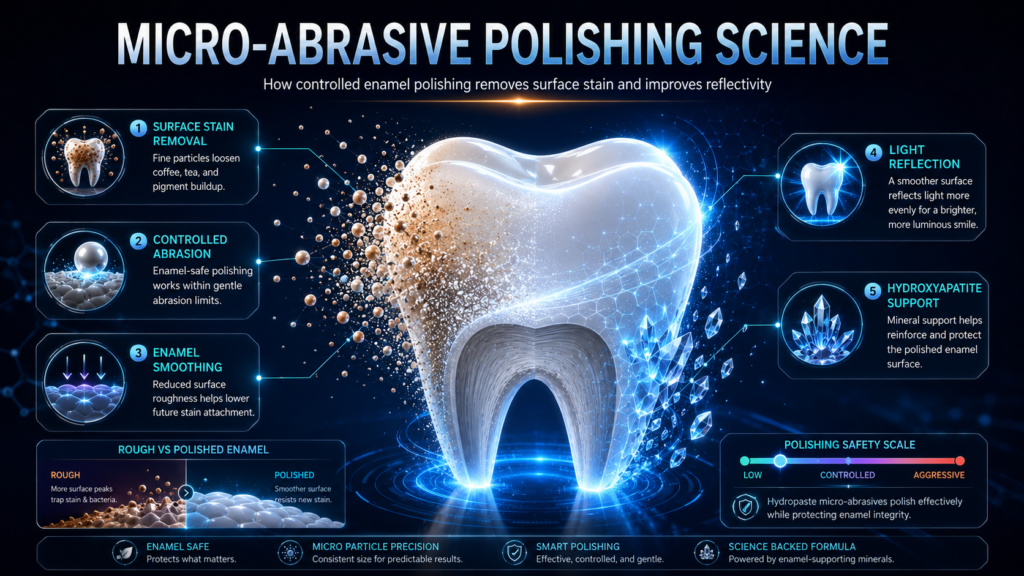
Micro-abrasive polishing uses very fine particles to refine the tooth surface without relying on harsh scrubbing. The goal is not to grind enamel down. The goal is controlled stain disruption and surface smoothing.
For readers who want the deeper technical explanation, HydroPaste’s micro-abrasive polishing science guide explains enamel abrasion, polishing behavior, stain types, surface texture, safe abrasivity ranges, and the difference between polishing and whitening.
The Surface-Level Mechanism
Micro-abrasive polishing works in a sequence:
| Step | What Happens | Why It Matters |
|---|---|---|
| Stain disruption | Fine particles loosen pigment from enamel texture | Helps reduce coffee, tea, tobacco, and food stains |
| Film removal | Plaque-related surface film is reduced | Teeth feel smoother and cleaner |
| Texture refinement | Microscopic roughness is gently reduced | Less surface area for new stains to cling |
| Reflectivity improvement | Enamel reflects light more evenly | Teeth may appear brighter without bleaching |
| Mineral support | Hydroxyapatite can help fill micro-irregularities | Supports a smoother, more resilient surface |
The ideal polishing product is not the roughest product. It is the one that produces surface improvement without unnecessary enamel stress.
Extrinsic vs Intrinsic Stains: Why Polishing Works for Some Stains Better Than Others
Not all tooth discoloration is the same.
Some stains sit on the surface. Others come from inside the tooth.
| Stain Type | Where It Exists | Common Causes | Does Polishing Help? |
|---|---|---|---|
| Extrinsic stain | Outer tooth surface | Coffee, tea, tobacco, food pigments, plaque film | Often yes |
| Intrinsic stain | Inside enamel or dentin | Aging, trauma, medication history, developmental changes | Limited effect |
| Dehydration shade change | Temporary optical change | Whitening products, dry mouth, enamel dehydration | Polishing is not the main fix |
| Tartar-related discoloration | Hardened plaque deposits | Mineralized plaque | Requires professional cleaning |
| Restoration discoloration | Fillings, crowns, bonding | Material aging or margin stain | Depends on restoration type |
This is why some people see fast improvement from polishing while others do not. If the dullness is mostly surface stain, polishing can be useful. If the color is coming from deeper dentin, peroxide whitening or professional evaluation may be needed.
Hydroxyapatite and Tooth Polish
Hydroxyapatite changes the way tooth polishing can be understood.
Traditional polishing focuses on removal: remove stain, remove film, smooth roughness. Hydroxyapatite adds a second idea: replenish the surface.
Hydroxyapatite is a calcium phosphate mineral closely related to the mineral structure of enamel. In oral-care formulations, it is used to support enamel surface repair, reduce microscopic defects, and improve the smooth feel of teeth.
For a deeper enamel-focused foundation, see HydroPaste’s enamel remineralization guide, which explains how mineral support fits into long-term tooth strength and sensitivity care.
Why Hydroxyapatite Fits Micro-Abrasive Polishing
Micro-abrasive polishing gently reduces surface stain and roughness. Hydroxyapatite may then help support the surface by depositing into micro-irregularities.
That creates a better strategy than polishing alone:
- Lift external stain.
- Smooth the enamel surface.
- Support mineral replenishment.
- Improve light reflection.
- Reduce the need for repeated aggressive whitening.
The Polish-and-Repair Model
| Traditional Polishing | Hydroxyapatite-Supported Polishing |
|---|---|
| Focuses mainly on stain removal | Combines stain removal with mineral support |
| Can leave surface feeling clean | Can support a smoother enamel feel over time |
| Cosmetic-first approach | Cosmetic plus enamel-support approach |
| Depends on abrasive control | Depends on abrasive control and remineralizing ingredients |
| May be too harsh if poorly formulated | Better suited to gentle, repeatable routines when well formulated |
This is the future of tooth polish: not stronger scrubbing, but more intelligent surface management.
Tooth Polishing vs Whitening
Tooth polishing and tooth whitening are often grouped together, but they are not the same.
Whitening changes color chemistry. Polishing changes surface texture and stain presence.
| Feature | Tooth Polishing | Tooth Whitening |
|---|---|---|
| Main mechanism | Mechanical stain removal and surface smoothing | Chemical stain oxidation |
| Common ingredients/tools | Fine abrasives, polishing agents, hydroxyapatite, tooth powders | Peroxide gels, strips, pens, whitening trays |
| Best for | Surface stains, roughness, dullness | Deeper yellowing and embedded stains |
| Speed | Immediate clean feel, gradual brightness | Faster visible shade change |
| Sensitivity risk | Usually lower when gentle | Can be higher, especially with peroxide |
| Enamel role | Smooths and may support reflectivity | May temporarily dehydrate enamel |
| Best user | Stain-prone, sensitivity-aware, maintenance-focused | Users wanting stronger shade change |
Polishing does not replace whitening. It reduces the need for aggressive whitening by improving the tooth surface and removing external dullness.
Safe Abrasivity and RDA
Abrasivity is one of the most important issues in tooth polish.
Every polishing product has to create friction. Without friction, it cannot remove stain. But too much friction, too often, with too much pressure, can become a problem.
The key is balance.
What Makes a Polishing Product Safer?
A safer polishing product is usually designed around:
- Fine particle size
- Controlled abrasivity
- Smooth particle behavior
- Gentle brushing technique
- Soft-bristle toothbrushes
- Limited use frequency if the formula is stronger
- Mineral support ingredients
- Avoidance of harsh DIY scrubs
Why Aggressive DIY Polishing Is Risky
Some people use baking soda, charcoal, salt, lemon, or homemade abrasive mixtures to “polish” teeth. These can be unpredictable.
The risk is not only the ingredient itself. It is the combination of particle hardness, pressure, frequency, brushing time, enamel condition, gum recession, and existing sensitivity.
If enamel is already thin or exposed dentin is present, aggressive polishing can make teeth feel sharper, more sensitive, or more vulnerable to staining.
Tooth Powder and At-Home Tooth Polisher
Tooth powders are becoming popular again because they feel direct, simple, and stain-focused. Many users like the polished feel they create, especially when dealing with coffee, tea, or surface dullness.

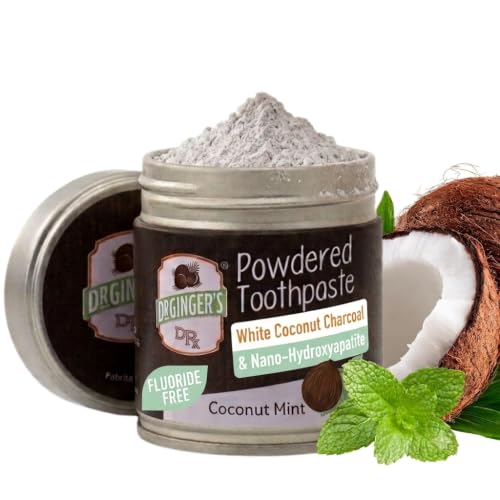
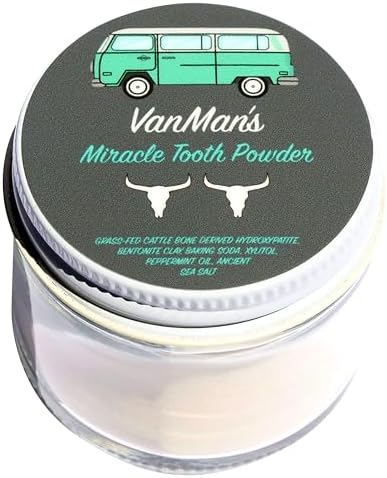
For readers comparing practical powder options, HydroPaste’s Best Tooth Powder guide covers whitening powders, clinical vs natural formulas, activated charcoal analysis, and remineralizing tooth powder options.
What Tooth Powder Can Do Well
| Strength | Why It Helps |
|---|---|
| Surface stain lifting | Powder texture can help loosen external pigment |
| Polished feel | Teeth may feel smoother after use |
| Simple formulation | Some users prefer fewer ingredients |
| Whitening maintenance | Useful for stain-prone users between deeper whitening cycles |
| Routine flexibility | Can be used occasionally instead of every brushing session |
What Tooth Powder Cannot Do
Tooth powder cannot rebuild lost enamel, reverse cavities, remove deep intrinsic stains, or replace dental cleaning. It also needs careful use. A powder that feels powerful may not be ideal for sensitive teeth, gum recession, or daily aggressive brushing.
Whitening Tools and Polishing Alternatives
Whitening tools sit next to polishing in the broader brightness conversation. Some people need polishing. Some need whitening. Some need both, but in a careful sequence.
For readers comparing whitening systems, HydroPaste’s whitening tools guide explains whitening strips, pens, peroxide vs non-peroxide approaches, and enamel-safe whitening systems.
Whitening Strips vs Tooth Polish
Whitening strips use active whitening agents to change stain chemistry. Tooth polish uses surface refinement to reduce external discoloration and improve reflectivity.
A strip may create a faster shade change. A polish may create a smoother, cleaner, more natural brightness effect.
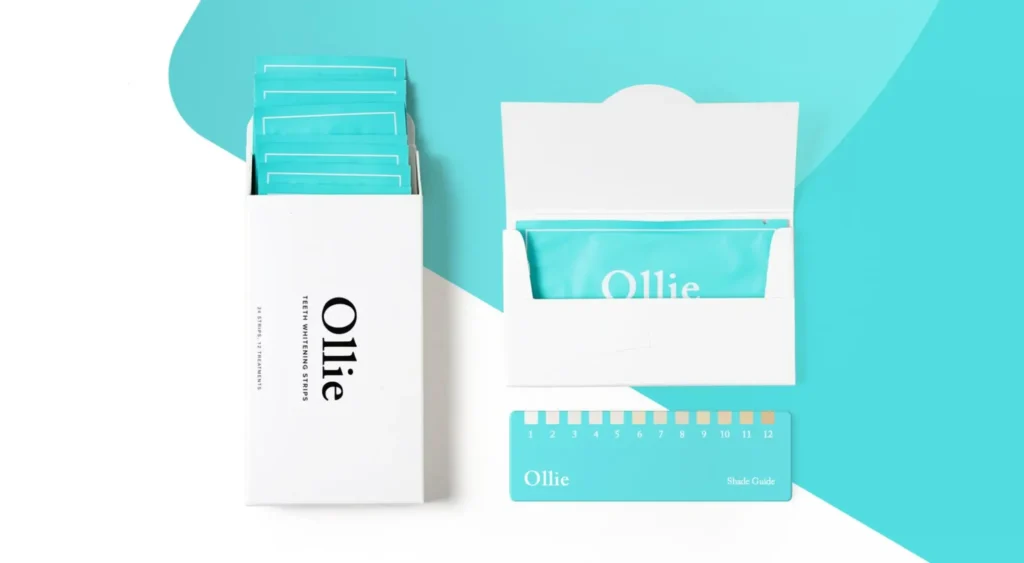
Ollie-style whitening strips represent the modern attempt to reduce peroxide aggression while maintaining visible whitening outcomes. However, even reduced-peroxide systems still rely on chemical stain oxidation.
HydroPaste’s Ollie whitening strips review is useful for readers comparing gentler whitening strips with non-bleaching polishing routines.
Whitening Pens and Non-Hydroxyapatite Alternatives
Some users prefer whitening pens because they are convenient, targeted, and easy to apply. For comparison, HydroPaste also reviews non-hydroxyapatite whitening options such as the Colgate Optic White Pen, which fits the peroxide-based whitening pen category.
Another comparison point is Colgate Max White, which represents a more conventional whitening toothpaste direction. These products can be useful for readers who want to compare hydroxyapatite-oriented enamel support with traditional whitening formats.
When Whitening Tools Make More Sense Than Polishing
Whitening tools may be a better direction when:
- The discoloration is deeper than surface stain
- Teeth are naturally darker due to dentin shade
- The user wants a stronger shade change
- Polishing has improved smoothness but not enough brightness
- A dentist has confirmed enamel and gum conditions are suitable
When Polishing Makes More Sense Than Whitening
Polishing may be a better direction when:
- Stains are mostly from coffee, tea, tobacco, or food pigments
- Teeth feel rough or film-coated
- Sensitivity is a concern
- The user wants maintenance instead of aggressive whitening
- The goal is natural brightness rather than dramatic shade change
Brand Analysis and Product Comparison
The whitening and polishing category is crowded. Some products rely on peroxide. Some rely on abrasives. Some use color correction. Some use optical effects. Some combine polishing with enamel-support ingredients.
For a deeper product comparison path, HydroPaste’s whitening brand analysis guide compares at-home whitening kits, dentist whitening vs home products, premium systems, and color-correction approaches.

One example is HydroPaste’s Miltodent toothpaste color correction review, which explores a non-peroxide visual whitening route.
Color Correction vs Micro-Abrasive Polishing
Color correction and polishing can both make teeth look brighter, but they work differently.
| Method | How It Works | Best For | Limitation |
|---|---|---|---|
| Color correction | Uses optical tones to counter yellow appearance | Temporary visual whitening | Does not physically remove much stain |
| Micro-abrasive polishing | Removes surface stain and smooths enamel | Coffee, tea, plaque-related dullness | Limited effect on deep intrinsic stains |
| Peroxide whitening | Oxidizes deeper stains | Stronger shade change | Higher sensitivity risk for some users |
| Hydroxyapatite polishing | Combines surface refinement with mineral support | Sensitivity-aware brightness maintenance | Requires consistent use |
A smart oral-care strategy does not ask which product is “best” in isolation. It asks which method matches the stain type, enamel condition, sensitivity risk, and desired result.
Condition-Based Polishing Care
The reason many whitening routines fail is that users choose products by promise instead of problem type.
Yellow teeth, coffee stains, smoking stains, post-cleaning maintenance, and sensitivity-safe whitening each need different thinking.
HydroPaste’s condition-based polishing care guide helps readers match stain type and tooth condition to safer polishing and whitening strategies.
Common Tooth Brightness Problems
| Concern | Likely Pattern | Better Direction |
|---|---|---|
| Yellow teeth | Could be dentin shade, enamel thinning, plaque film, or surface stain | Identify stain type before choosing whitening |
| Coffee and tea stains | Usually extrinsic stain attached to enamel texture | Micro-abrasive polishing and stain-control routine |
| Smoking stains | Often stubborn extrinsic staining | Professional cleaning plus careful maintenance |
| Post-cleaning dullness | Surface quickly collects new film | Daily hydroxyapatite and low-abrasion maintenance |
| Sensitivity with whitening | Enamel stress, dentin exposure, or peroxide response | Gentler whitening, polishing, mineral support |
| Rough teeth | Plaque, tartar, enamel texture, or stain film | Professional evaluation if roughness persists |
Condition-based care prevents over-treatment. Someone with coffee stains may not need the strongest whitening strips. Someone with deep intrinsic discoloration may not get enough improvement from polishing alone. Someone with sensitivity needs a completely different decision path.
What Do Dentists Use to Polish Teeth?
In clinical settings, dentists and hygienists often polish teeth after plaque and tartar removal. The tools and materials vary, but the process is controlled.
They may use:
- Low-speed polishing handpieces
- Rubber cups
- Polishing brushes
- Prophylaxis paste
- Air-polishing systems
- Fine powders designed for clinical use
Professional polishing is different from at-home polishing because it is performed with visibility, training, and control. A dental professional can decide whether polishing is appropriate, which paste to use, and how much pressure is safe.
This is especially important for people with:
- Gum recession
- Exposed dentin
- Enamel erosion
- Tooth sensitivity
- Heavy tartar
- Restorations
- Veneers
- Crowns
- Active gum inflammation
At-home products should never try to imitate professional tools aggressively.
Does Polishing Teeth Damage Enamel?
When properly performed, teeth polishing should not meaningfully damage healthy enamel. Problems arise when polishing becomes too frequent, too abrasive, too forceful, or poorly matched to the person’s enamel condition.
Polishing Is More Risky When:
- A person brushes aggressively
- High-abrasion products are used daily
- DIY scrubs are used repeatedly
- Teeth are already sensitive
- Gum recession exposes softer root surfaces
- Enamel is eroded by acid
- The person uses hard-bristle brushes
- Whitening and polishing are stacked too aggressively
Polishing Is Safer When:
- Products are low-abrasion
- Brushing pressure is light
- A soft toothbrush is used
- Hydroxyapatite or remineralizing support is included
- Stronger polishing is occasional, not constant
- Professional advice is sought for sensitivity or enamel concerns
The goal is not maximum abrasion. The goal is minimum necessary polishing for visible surface improvement.
How to Polish Teeth at Home
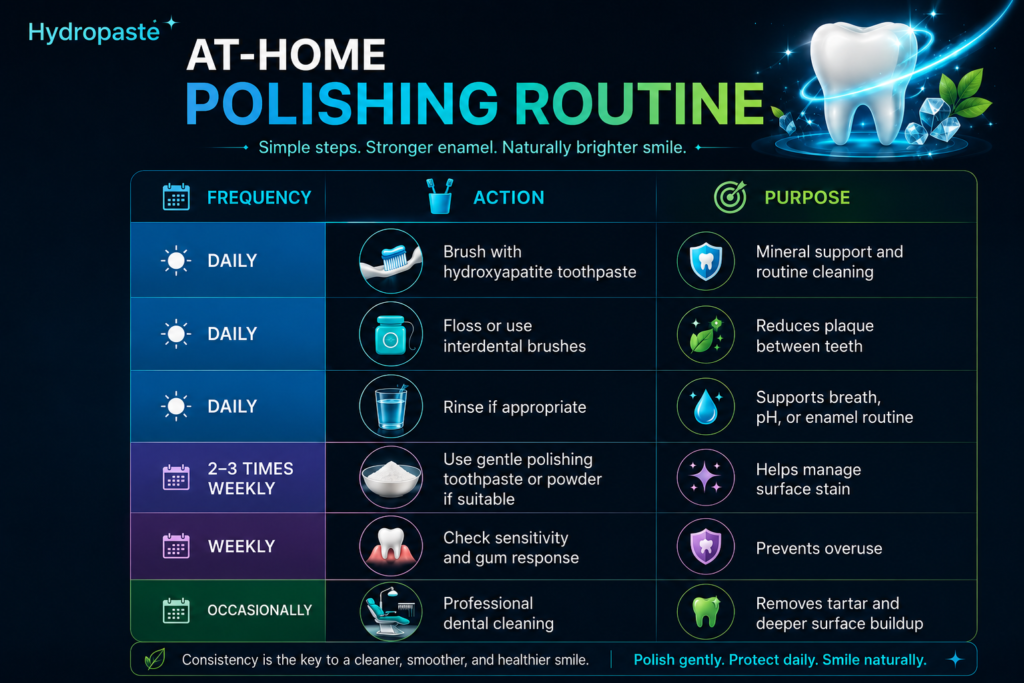
Home tooth polishing should be gentle, structured, and patient. You are not trying to recreate a dental office polishing session. You are trying to keep the enamel surface clean, smooth, and stain-resistant over time.
A Safer At-Home Polishing Routine
| Frequency | Action | Purpose |
|---|---|---|
| Daily | Brush with hydroxyapatite toothpaste | Mineral support and routine cleaning |
| Daily | Floss or use interdental brushes | Reduces plaque between teeth |
| Daily | Rinse if appropriate | Supports breath, pH, or enamel routine |
| 2–3 times weekly | Use gentle polishing toothpaste or powder if suitable | Helps manage surface stain |
| Weekly | Check sensitivity and gum response | Prevents overuse |
| Occasionally | Professional dental cleaning | Removes tartar and deeper surface buildup |
Practical Technique
Use a soft-bristle toothbrush. Apply light pressure. Brush for two minutes. Avoid scrubbing the gumline aggressively. If using powder, use only the recommended amount. Do not combine multiple strong whitening or polishing products in the same session.
What to Avoid
Avoid aggressive baking soda scrubs, lemon juice mixtures, salt scrubbing, hard toothbrushes, charcoal overuse, or daily high-abrasion polishing if you already have sensitivity.
Home polishing should feel controlled, not harsh.
The HydroPaste Polishing Framework
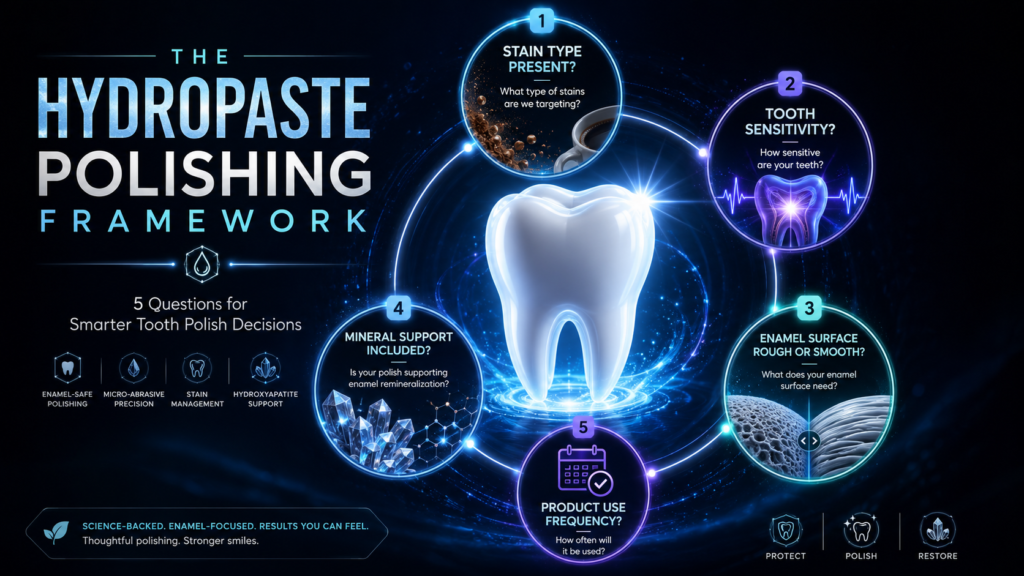
A strong tooth polish strategy should never begin with the product. It should begin with the tooth surface.
Most people choose whitening and polishing products by promise: “removes stains,” “whitens fast,” “smooths enamel,” or “professional results at home.” The problem is that tooth discoloration does not come from one cause. A coffee stain, a rough enamel surface, yellow dentin, plaque film, tartar buildup, smoking stain, and sensitivity-related enamel wear all need different decisions.
The HydroPaste Polishing Framework is a practical five-part method for choosing the right micro-abrasive polishing product, tooth powder, whitening system, or hydroxyapatite-based enamel support routine. Instead of asking, “What is the strongest tooth polish?” it asks a smarter question: “What does this tooth surface actually need?”
A well-matched polishing plan should answer these five questions before recommending any product.
1. What Type of Stain Is Present?
The first step in any micro-abrasive polishing routine is identifying the stain type. This matters because tooth polish works best on surface-level discoloration, not every kind of tooth color change.
Surface stains, also called extrinsic stains, sit on the outer enamel layer. These are commonly caused by coffee, tea, red wine, tobacco, dark sauces, berries, plaque film, and everyday pigment buildup. Because these stains attach to the enamel surface, they often respond well to gentle polishing toothpaste, tooth powder, professional cleaning, or enamel-safe polishing systems.
Deep discoloration, also called intrinsic staining, is different. It may come from inside the tooth structure, age-related dentin darkening, past trauma, medication-related staining, enamel thinning, or developmental enamel changes. Micro-abrasive polishing may make the surface cleaner, but it may not create a dramatic shade change if the color is coming from inside the tooth.
That is why a person with coffee stains may get visible improvement from tooth polish, while someone with naturally darker dentin may need a whitening system or professional guidance.
| Stain Type | Common Signs | Better Direction |
|---|---|---|
| Coffee and tea stain | Brown, yellow, or dull surface tint | Gentle tooth polish or micro-abrasive polishing |
| Plaque-related dullness | Teeth feel coated or lose shine quickly | Brushing, flossing, polishing support |
| Smoking stains | Yellow-brown surface staining, often stubborn | Professional cleaning plus maintenance polishing |
| Tartar-related discoloration | Hard, rough deposits near gums | Dental cleaning first |
| Intrinsic discoloration | Tooth looks dark from within | Whitening or professional assessment |
| Enamel thinning | Teeth look more yellow despite cleaning | Remineralization and sensitivity-safe care |
The HydroPaste approach is simple: polish what is on the surface, support what is in the enamel, and do not expect a polishing product to solve a discoloration problem it was never designed to treat.
2. How Sensitive Are the Teeth?
Tooth sensitivity changes the entire polishing strategy.
A product that feels effective for one person may feel too sharp, gritty, or irritating for someone with enamel erosion, gum recession, exposed dentin, or whitening-related sensitivity. This is especially important with tooth powders, charcoal formulas, aggressive whitening toothpaste, and high-abrasion stain removal products.
Sensitivity is not only a comfort issue. It is a signal. It may suggest that enamel is thin, dentin is exposed, gums have receded, the tooth surface is acid-weakened, or the oral-care routine is too aggressive.
Before using a stronger tooth polish product, ask:
- Do teeth hurt with cold water?
- Does brushing near the gumline feel sharp?
- Do whitening strips cause zingers or aching?
- Are gums receding?
- Does the tooth feel sensitive after acidic foods?
- Has sensitivity increased since using whitening toothpaste or powder?
If the answer is yes, the polishing routine should become more conservative.
For sensitive teeth, the better direction is usually a low-abrasion hydroxyapatite toothpaste, gentle brushing pressure, soft bristles, and limited use of polishing products. The goal is to rebuild routine stability before adding stain-removal intensity.
A sensitivity-safe polishing strategy does not mean avoiding brightness. It means earning brightness gradually without pushing the enamel surface beyond its tolerance.
3. Is the Enamel Surface Rough or Smooth?
The texture of enamel affects how bright teeth look and how quickly stains return.
Rough enamel holds more pigment. It gives stains more places to cling. It can also trap plaque film, making teeth feel less clean even after brushing. Smooth enamel reflects light more evenly, which can make teeth appear brighter without changing their internal color.
This is one of the main reasons tooth polishing is valuable. It improves the surface condition that controls stain retention and light reflection.
A rough-feeling tooth surface may come from:
- Plaque film
- Tartar buildup
- Acid erosion
- Aggressive brushing
- Abrasive product overuse
- Enamel defects
- Stain accumulation
- Poor polishing maintenance
- Rough restoration margins
But not all roughness should be handled at home. If the rough area is hard, raised, or near the gumline, it may be tartar. Tartar cannot be removed safely with normal brushing or tooth powder. It needs professional cleaning.
If the surface is dull but not hardened, a gentle micro-abrasive polishing routine may help. If the surface is sensitive, chalky, or eroded, mineral support should come first.
| Enamel Feel | Possible Meaning | Best Next Step |
|---|---|---|
| Smooth but stained | Surface pigment | Gentle polishing may help |
| Fuzzy by evening | Plaque film accumulation | Improve brushing and interdental cleaning |
| Hard rough deposits | Tartar | Professional dental cleaning |
| Sharp sensitivity near gums | Gum recession or dentin exposure | Avoid aggressive polishing |
| Chalky or dull enamel | Mineral weakness or acid exposure | Hydroxyapatite and remineralization support |
| Stains return quickly | Surface roughness or frequent pigment exposure | Polishing plus stain-control habits |
A strong tooth polish system should make enamel feel smoother, not scraped. If teeth feel raw, sensitive, or over-cleaned, the routine is too aggressive.
4. Is Mineral Support Included?
Polishing alone is a removal strategy. It removes stain, film, and surface buildup. That can be useful, but it is incomplete.
Modern enamel care should also ask what happens after polishing.
This is where hydroxyapatite becomes important. Hydroxyapatite is a mineral used in enamel-support oral care because it can help reinforce the tooth surface, support remineralization, and improve the smooth feel of enamel. In a micro-abrasive polishing routine, hydroxyapatite adds a repair-support dimension.
A polishing product without mineral support may leave teeth feeling cleaner, but it does not necessarily help rebuild the surface environment. A hydroxyapatite-supported routine can pair gentle stain removal with enamel surface care.
Think of it as a two-step logic:
- Polish: Reduce surface stains and roughness.
- Support: Help replenish and smooth the enamel surface with minerals.
This is especially valuable for users who want brighter-looking teeth but are cautious about peroxide whitening, sensitivity, or harsh abrasive products.
A strong enamel-safe polishing routine may include:
- Hydroxyapatite toothpaste for daily brushing
- Gentle polishing toothpaste or tooth powder used only as directed
- Alcohol-free rinse if dryness or sensitivity is present
- Water rinsing after coffee, tea, or acidic drinks
- Soft-bristle brushing technique
- Professional cleaning when tartar is present
The key idea is balance. Tooth polish should not behave like sandpaper. It should work as part of a surface refinement and mineral support system.
5. How Often Will the Product Be Used?
Frequency matters as much as ingredients.
A product that is suitable once or twice a week may be too much for daily use. A polishing powder that feels impressive after one use may become irritating if used aggressively every morning. A whitening toothpaste may be fine for maintenance but too abrasive if paired with hard brushing and whitening strips.
This is why the HydroPaste Polishing Framework separates daily enamel care from occasional stain management.
Daily products should be gentle, enamel-supportive, and sustainable. Occasional products can be more stain-focused, but they should still be used with control.
| Use Frequency | Product Direction | Purpose |
|---|---|---|
| Daily | Hydroxyapatite toothpaste | Mineral support and routine cleaning |
| Daily | Floss or interdental brushes | Plaque control between teeth |
| Daily or as needed | Gentle rinse | Breath, pH, or enamel support |
| 2–3 times weekly | Gentle polishing toothpaste or powder | Surface stain management |
| Weekly | Sensitivity and gum check | Prevent overuse |
| Occasionally | Professional dental cleaning | Tartar and deeper surface buildup removal |
The mistake many users make is treating polishing like a daily whitening shortcut. That can lead to sensitivity, gum irritation, or enamel stress, especially if the product is gritty or brushing pressure is high.
A smarter approach is to build a routine with layers:
- Daily: protect and clean.
- Weekly: polish and monitor.
- Occasionally: get professional cleaning.
- Always: adjust based on sensitivity.
The best tooth polish routine should be strong enough to improve the surface but gentle enough to repeat safely over time.
HydroPaste Polishing Decision Matrix
Use this decision matrix before choosing a tooth polish, tooth powder, whitening toothpaste, or hydroxyapatite polishing routine.
| Question | If Yes | If No |
|---|---|---|
| Are the stains mostly from coffee, tea, wine, or food pigments? | Micro-abrasive polishing may help | Look for deeper discoloration causes |
| Are the teeth sensitive? | Start with low-abrasion hydroxyapatite care | Gentle polishing may be suitable |
| Does the tooth surface feel rough? | Identify plaque, tartar, or enamel texture | Focus on maintenance and stain prevention |
| Is the product mineral-supportive? | Better for enamel-conscious routines | Use carefully and avoid overuse |
| Will the product be used daily? | Choose very gentle formulas | Occasional polishing can be more stain-focused |
| Is there tartar buildup? | See a dental professional first | At-home polishing may support maintenance |
| Are gums receding or irritated? | Avoid aggressive abrasives | Proceed cautiously with soft brushing |
For broader product comparisons across enamel care and whitening categories, readers can also explore HydroPaste’s Best Ever oral-care guide, which helps compare product directions by use case rather than marketing hype.
The Core Rule: Match the Polish to the Problem
The HydroPaste Polishing Framework turns tooth polish from a guessing game into a structured decision.
If the issue is surface stain, polish gently.
If the issue is sensitivity, support enamel first.
If the issue is roughness, identify whether it is plaque, tartar, or enamel texture.
If the issue is deep discoloration, do not expect polishing alone to perform like whitening.
If the product will be used often, choose the gentlest effective option.
The strongest tooth polish routine is not the most abrasive routine. It is the routine that improves brightness while protecting enamel, respecting sensitivity, and supporting long-term oral health.
Common Misunderstandings About Tooth Polish
“Tooth Polish Always Wears Down Enamel”
Not necessarily. Properly formulated polishing products are designed to remove surface stain with controlled abrasivity. The risk comes from overuse, harsh formulas, aggressive brushing, and weakened enamel.
“Tooth Polish Is the Same as Whitening Toothpaste”
Not always. Whitening toothpaste may use abrasives, chemical agents, optical effects, or stain-control ingredients. Tooth polish is more specifically about surface refinement and stain removal.
“The Grittier It Feels, the Better It Works”
A gritty feel does not automatically mean better results. Large or harsh particles may create more risk than benefit. Effective polishing should feel controlled, not sandpaper-like.
“Polishing Can Replace Professional Cleanings”
No. Polishing can help manage surface stain, but it cannot remove hardened tartar, diagnose gum disease, or replace professional dental evaluation.
“Hydroxyapatite Makes Abrasion Irrelevant”
Hydroxyapatite can support enamel surface repair, but it does not make poor product choice harmless. Abrasivity, pressure, and frequency still matter.
Tooth Polish in a Complete Oral-Care Routine
A polished-looking smile comes from routine layering, not one product.
Daily Foundation
- Brush with a hydroxyapatite toothpaste.
- Clean between teeth.
- Avoid brushing immediately after acidic foods or drinks.
- Rinse with water after coffee, tea, wine, or acidic beverages.
- Keep the mouth hydrated.
- Use a gentle mouthwash if appropriate.
Stain-Control Layer
- Use a gentle polishing product only as directed.
- Avoid stacking multiple whitening products.
- Track sensitivity.
- Reduce stain exposure patterns when possible.
- Schedule professional cleaning when buildup becomes rough or visible.
Enamel-Support Layer
- Use remineralizing toothpaste.
- Avoid harsh DIY abrasives.
- Keep brushing pressure light.
- Support saliva flow.
- Address dry mouth if present.
- Seek dental advice for erosion or sensitivity.
The best routine is not the most complicated one. It is the one that removes stain, protects enamel, and stays sustainable.
Product Category Comparison
| Category | Main Purpose | Strength | Caution |
|---|---|---|---|
| Hydroxyapatite toothpaste | Daily enamel support | Good for routine remineralization and smoothness | Not a dramatic whitening product |
| Tooth powder | Surface stain management | Can create a polished feel | Must be used gently |
| Whitening strips | Stronger shade change | Effective for deeper whitening goals | May cause sensitivity |
| Whitening pens | Targeted convenience | Easy spot application | Results vary by formula |
| Color-correction toothpaste | Optical brightness | Quick visual effect | Temporary and cosmetic |
| Professional polishing | Deep surface cleaning | Controlled by clinician | Not for constant repetition |
| Charcoal powder | Aggressive stain-focused appeal | Can feel powerful | Abrasivity concerns if overused |
Who Should Be Careful With At-Home Tooth Polishing?
At-home polishing is not ideal for everyone.
Be cautious if you have:
- Tooth sensitivity
- Gum recession
- Exposed roots
- Enamel erosion
- Thin enamel
- Recent dental work
- Veneers or bonding
- Crowns with stained margins
- Active gum bleeding
- Dry mouth
- Acid reflux
- Eating disorder history affecting enamel
- Pain when brushing
If any of these apply, start with professional advice before using abrasive products.
Best Use Cases for Micro-Abrasive Polishing
Micro-abrasive polishing is most useful when the problem is surface-related.
Strong Fit
- Coffee stains
- Tea stains
- Mild tobacco stains
- Plaque film dullness
- Stain-prone enamel texture
- Post-cleaning maintenance
- Natural brightness maintenance
- Non-peroxide whitening preference
Weak Fit
- Deep internal tooth discoloration
- Tetracycline-related stains
- Severe fluorosis
- Dark dentin shade
- Old restoration discoloration
- Tartar buildup
- Active decay
- Gum disease-related discoloration
Understanding this saves money and reduces frustration.
The Future of Tooth Polish: From Cosmetic Scrub to Enamel Surface Engineering
Tooth polish is becoming more advanced because consumers are asking better questions.
They no longer want only “whiter teeth.” They want whiter-looking teeth without unnecessary sensitivity. They want smooth enamel, healthier texture, stain resistance, mineral support, and products that fit long-term oral health.
The future of tooth polish will likely move in four directions:
1. Lower-Abrasion Whitening Maintenance
Brands will continue moving away from harsh daily scrubbing and toward lower-abrasion systems designed for repeat use.
2. Hydroxyapatite-Enhanced Polishing
More formulas will combine polishing particles with hydroxyapatite or other enamel-supporting minerals to create a polish-and-repair effect.
3. Better Stain-Type Matching
Products will become more specific: coffee stain formulas, smoker stain systems, sensitivity-safe brightness products, post-cleaning maintenance routines, and non-peroxide optical whitening options.
4. Professional-Home Hybrid Care
The strongest future model is not dentist vs home care. It is professional cleaning supported by smarter daily maintenance.
That is where micro-abrasive polishing fits best: not as an aggressive shortcut, but as a controlled part of a full enamel care system.
Editorial Insight: Tooth Polish Is Not Just About Shine
Tooth polish is becoming a structural oral-care concept because it sits between cosmetic whitening and enamel maintenance.
Whitening asks, “How can we change tooth color?”
Polishing asks, “How can we improve the surface that controls brightness, stain retention, and light reflection?”
Hydroxyapatite-supported polishing asks an even better question: “How can we brighten the surface while supporting the mineral structure underneath?”
That is the real shift.
The smartest tooth polish routine does not chase harshness. It uses controlled micro-abrasive action, gentle technique, enamel-supporting minerals, and careful product selection to keep teeth brighter, smoother, and better protected over time.
For more oral-care education, product comparisons, and enamel-focused guidance, visit HydroPaste.
FAQs
What is tooth polish used for?
Tooth polish is used to remove surface stains, smooth enamel texture, reduce plaque-related dullness, and improve how teeth reflect light. It is most useful for extrinsic stains caused by coffee, tea, food pigments, tobacco, and surface film.
It does not work the same way as peroxide whitening. Polishing improves the outer surface, while whitening changes stain chemistry. A good tooth polish routine can make teeth look naturally brighter without relying on aggressive bleaching.
Does tooth polish whiten teeth?
Tooth polish can make teeth appear whiter by removing surface stains and smoothing enamel. However, it does not deeply bleach the tooth like peroxide whitening strips or professional whitening gels.
If discoloration is mostly external, polishing may create a noticeable brightness improvement. If the tooth color is deeper or intrinsic, polishing alone may not deliver the desired shade change.
Is micro-abrasive polishing safe for enamel?
Micro-abrasive polishing can be safe when the product is properly formulated and used gently. The key factors are abrasivity level, brushing pressure, frequency, enamel condition, and whether mineral-supporting ingredients are included.
It becomes risky when people overuse abrasive powders, brush aggressively, use hard toothbrushes, or apply DIY scrubs to already sensitive or eroded enamel.
Is tooth powder better than whitening toothpaste?
Tooth powder is not automatically better than whitening toothpaste. Tooth powder may be useful for surface stain removal and a polished feel, while whitening toothpaste may use abrasives, stain-control agents, chemical ingredients, or optical brighteners.
The better choice depends on sensitivity, stain type, enamel condition, and how often the product will be used. For many people, a hydroxyapatite toothpaste for daily use plus occasional gentle polishing is a safer strategy than daily aggressive whitening.
What is the difference between tooth polishing and teeth whitening?
Tooth polishing removes surface stains and smooths enamel texture. Teeth whitening changes tooth color through chemical stain oxidation, usually with peroxide.
Polishing is better for stain maintenance, coffee and tea marks, rough texture, and natural brightness. Whitening is better for deeper shade change. Some users may benefit from both, but they should not be stacked aggressively without considering sensitivity.
Can I polish my teeth at home?
Yes, but at-home tooth polishing should be gentle. Use low-abrasion products, soft toothbrushes, light pressure, and avoid harsh DIY scrubs. Tooth powders and polishing toothpaste should be used according to directions, not as a forceful daily sanding routine.
If you have sensitivity, gum recession, enamel erosion, veneers, crowns, or dental bonding, ask a dentist before using abrasive products.
How often should I use a tooth polishing product?
Frequency depends on the product and your enamel condition. Many gentle polishing products are used a few times per week, while daily toothpaste should be less abrasive and more focused on enamel support.
If sensitivity increases, gums feel irritated, or teeth begin to feel sharp or rough, reduce use and seek professional guidance.
Does hydroxyapatite help after polishing?
Hydroxyapatite may support the enamel surface by helping fill microscopic irregularities and improving smoothness. This makes it useful after gentle polishing because polishing removes surface stain while hydroxyapatite supports mineral replenishment.
The combination creates a more balanced approach than abrasive stain removal alone.
Are charcoal tooth powders safe for polishing?
Charcoal tooth powders vary widely. Some may feel effective because they are gritty, but that does not automatically make them enamel-safe. Overuse or aggressive brushing can be risky, especially for sensitive teeth, gum recession, or exposed dentin.
If using charcoal powder, choose carefully, use lightly, and avoid making it your main daily polishing method.
Should I whiten or polish my teeth first?
If teeth have heavy surface stain or plaque film, polishing or professional cleaning may improve brightness before whitening. Whitening works better when the tooth surface is clean. However, if deep discoloration is the main issue, whitening may be needed after surface buildup is addressed.
For sensitivity-prone users, start with enamel support and gentle polishing before moving into stronger whitening systems.