Science of Enamel Remineralization: How Teeth Repair Early Mineral Loss
Amazon Affiliate Disclosure
Hydropaste.com may earn a commission when readers purchase qualifying oral care products through affiliate links, including links to Amazon. This does not change the price you pay and does not influence our editorial standards. Product recommendations, comparisons, and educational guidance are written to help readers understand enamel remineralization science and make informed oral care decisions.
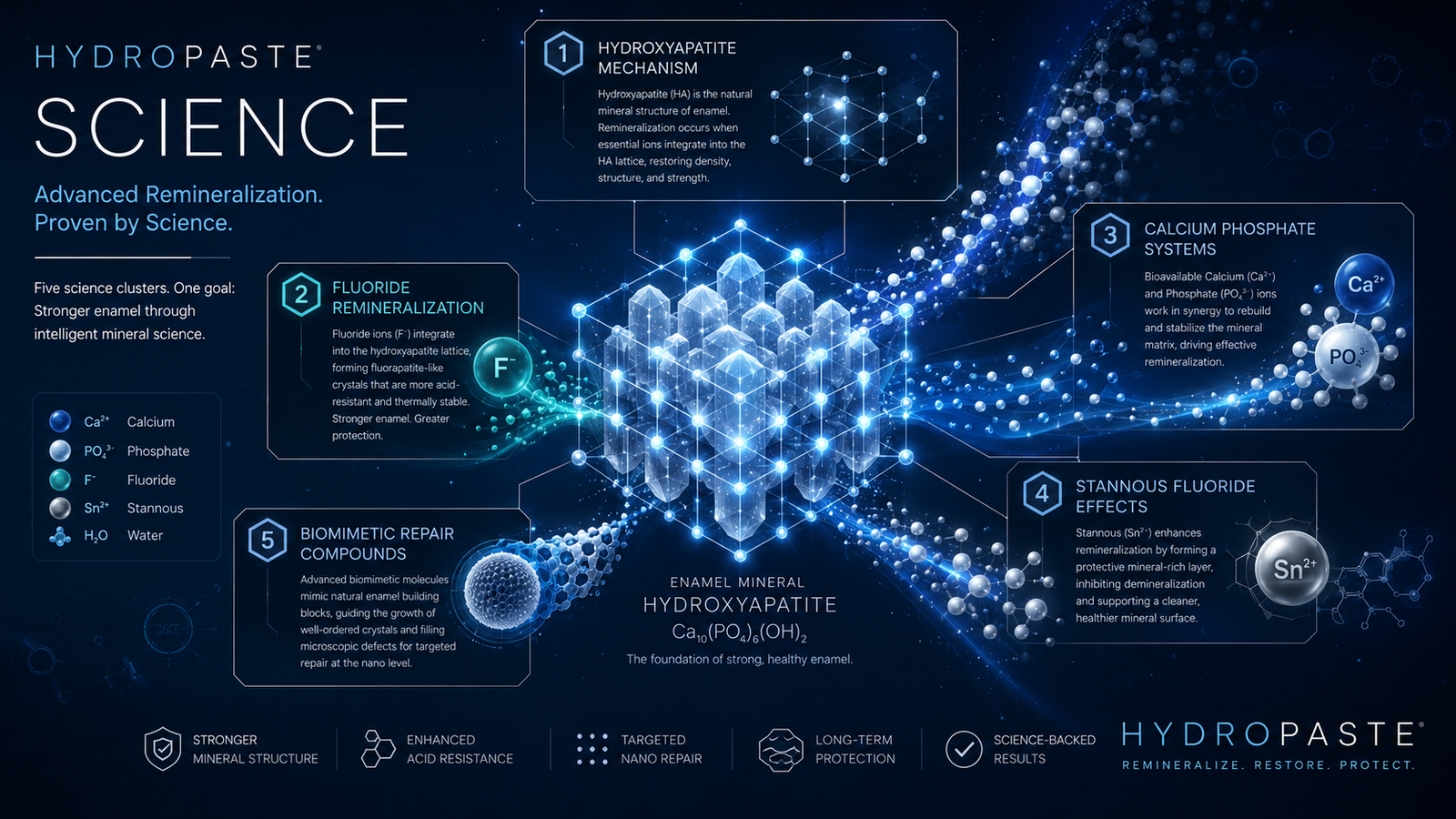
Enamel remineralization science explains how teeth recover from early mineral loss before a weak spot becomes a cavity. At the surface level, the process sounds simple: minerals leave enamel during acid attacks and return when saliva, fluoride, hydroxyapatite, calcium phosphate, and oral care compounds help rebuild the crystal structure. In reality, enamel repair is a constant microscopic negotiation between acid, saliva, diet, plaque bacteria, pH, minerals, and the active ingredients in toothpaste.
This page is the scientific foundation of the Enamel Remineralization pillar on Hydropaste. It explains how mineral repair works, why hydroxyapatite and fluoride behave differently, where calcium phosphate systems fit, how stannous fluoride adds a soft-tissue advantage, and what biomimetic mineral repair compounds may change next.
For readers who want the product and ingredient layer, the Hydropaste homepage connects this science to practical oral care decisions, including enamel-safe toothpaste, sensitivity support and daily remineralization routines.
Recent reviews continue to support fluoride as a major caries-prevention standard, while newer reviews show growing clinical evidence for hydroxyapatite-based oral care as a fluoride-free remineralization option. (PMC)
For readers comparing ingredient systems, the main Enamel Remineralization Hub explains how daily toothpaste, saliva, diet and pH balance work together.
Find the Right Enamel Science Section
Choose your main concern and jump directly to the most relevant part of this enamel remineralization science guide.
What This Guide Is For
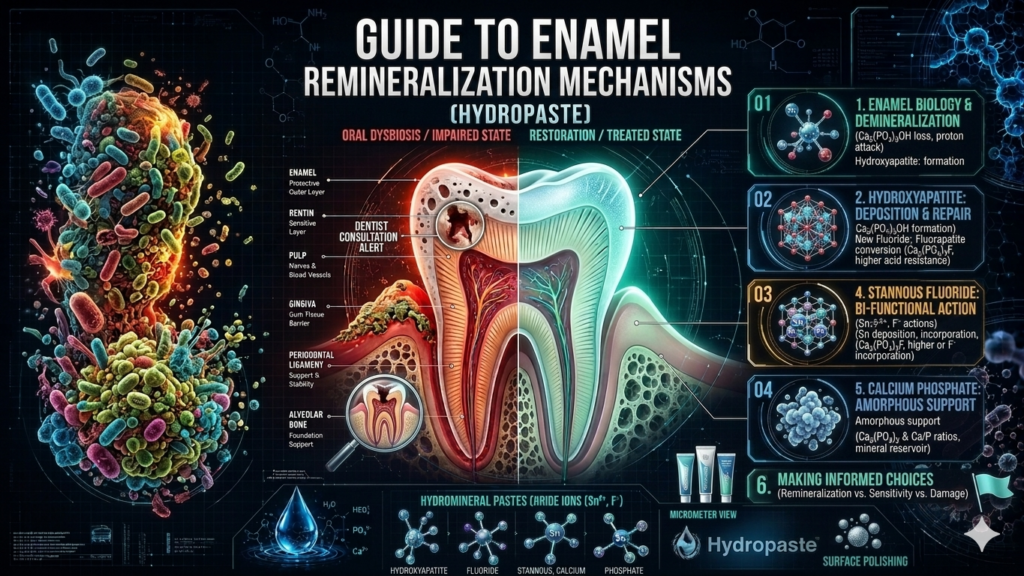
This guide is built for readers who want to understand why enamel remineralization products work, not just which toothpaste looks promising on a shelf.
It is designed to help you:
Understand the biology behind enamel repair
Compare hydroxyapatite, fluoride, calcium phosphate, and stannous fluoride
Recognize which ingredients match your enamel concern
Separate surface polishing from true mineral support
Know when a toothpaste is enough and when a dentist should examine the tooth
Make better decisions when buying remineralizing toothpaste, sensitivity toothpaste, or enamel repair products
Who Needs Enamel Remineralization Science?
You need this guide if your oral care problem is more specific than “I want whiter teeth.”
People With White Spot Lesions
White spots are often early signs of mineral loss. They can appear after braces, frequent snacking, dry mouth, acidic drinks, poor plaque control, or aggressive whitening. These areas may still be reversible if the enamel surface has not collapsed into a cavity.
People With Tooth Sensitivity
Sensitivity often comes from exposed dentin, enamel thinning, gum recession, or open dentinal tubules. Remineralizing ingredients do not work like painkillers. They support mineral deposition, tubule occlusion, and surface strengthening over repeated use.
People Who Want Fluoride-Free Enamel Support
Hydroxyapatite toothpaste has become one of the most searched alternatives for people who want enamel repair support without fluoride. Current clinical evidence has expanded for hydroxyapatite in caries prevention and early lesion remineralization, though product quality, concentration, particle behavior, and brushing consistency still matter. (ScienceDirect)
People With High Acid Exposure
Coffee, citrus, soda, sports drinks, reflux, vomiting, wine, and frequent low-pH foods can push enamel toward demineralization. Remineralization science helps explain why brushing immediately after acid exposure may not be ideal and why saliva recovery matters.
Parents Comparing Children’s Toothpaste Ingredients
Children’s enamel is still maturing after eruption. Parents often compare fluoride toothpaste, hydroxyapatite toothpaste, and low-abrasion formulas. The goal is not just cavity prevention but safe daily use, correct dosage, and age-appropriate brushing supervision.
Adults Investing in Premium Oral Care
Many premium toothpastes use language such as “repair,” “restore,” “rebuild,” or “biomimetic.” This guide helps readers judge those claims by mechanism, not marketing.
Benefits of Understanding Enamel Remineralization Science
1. Better Ingredient Choices
Once you understand the mechanism, toothpaste labels become easier to read. Fluoride supports acid-resistant fluorapatite-like mineral formation and reduces demineralization. Hydroxyapatite provides tooth-like mineral particles that can integrate with or deposit on weakened enamel surfaces. Calcium phosphate systems supply mineral ions that may support the local remineralization environment.
2. Earlier Intervention
Early enamel mineral loss can often be managed before it becomes a drilled cavity. The key is catching the problem while the enamel surface remains intact. Remineralization is most realistic for early, non-cavitated lesions.
3. Reduced Sensitivity
Hydroxyapatite and stannous fluoride are often discussed for sensitivity because they can help block microscopic pathways that transmit temperature, air, and touch stimuli toward the nerve. Stannous fluoride also has evidence for plaque, gingivitis, and sensitivity-related benefits. (PMC)
4. Stronger Daily Prevention
Enamel repair is not a single treatment. It is a daily pH and mineral balance system. Toothpaste, saliva, diet timing, plaque control, and brushing technique all interact.
5. Smarter Product Comparisons
A “remineralizing toothpaste” can mean many things. Some products rely on fluoride. Some use nano-hydroxyapatite. Some use calcium phosphate complexes. Some combine desensitizing and antibacterial effects. Understanding the science helps readers compare products by function.
The Core Science: How Enamel Remineralization Works
Enamel Is Strong, But Not Alive
Enamel is the hardest tissue in the human body, but it does not regenerate like skin or bone. It has no blood supply and no living cells inside it. That means enamel cannot “grow back” once a cavity forms.
But early mineral loss is different.
Before a cavity opens, enamel may lose calcium and phosphate from its crystal structure while still keeping a mostly intact surface. This is the window where remineralization can help.
Demineralization vs Remineralization
Enamel is mostly made of hydroxyapatite crystals, a calcium phosphate mineral. When plaque bacteria metabolize sugars, they produce acids. When acidic conditions drop the oral pH enough, minerals begin leaving enamel. That is demineralization.
Remineralization happens when minerals return to the enamel surface and subsurface. Saliva supplies calcium and phosphate. Toothpaste ingredients can improve the mineral environment, make enamel more acid-resistant, or deliver tooth-like mineral particles.
Simple View of the Process
Demineralization to Remineralization
Follow the enamel mineral cycle from acid attack and mineral loss to early lesion formation, remineralization support, or cavitation when the surface breaks down.
Acid attack
Plaque acids pull minerals from enamel.
Less frequent sugar, better plaque control.
Educational note: remineralization is most realistic before enamel collapses into an open cavity. Once cavitation occurs, toothpaste cannot rebuild missing tooth structure and dental treatment is required.
| Stage | What Happens | What Helps |
|---|---|---|
| Acid attack | Plaque acids pull minerals from enamel | Less frequent sugar, better plaque control |
| Mineral loss | Calcium and phosphate leave crystal structure | Saliva buffering, pH recovery |
| Early lesion | White spot or weakened area appears | Fluoride, hydroxyapatite, calcium phosphate |
| Remineralization | Minerals redeposit into weakened enamel | Consistent toothpaste use, low-acid habits |
| Cavitation | Surface breaks down into a cavity | Dentist treatment required |
The Critical pH Window
Enamel is under pressure when the mouth stays acidic for long periods. The issue is not only what you eat but how often the pH drops. A person who sips sweet coffee for three hours may expose enamel to more repeated acid stress than someone who drinks it with a meal and then lets saliva recover.
This is why enamel remineralization science is not just an ingredient story. It is a timing story.
The best remineralizing toothpaste cannot fully compensate for constant acid exposure, dry mouth, heavy plaque, or abrasive brushing.
Remineralization vs Erosion Cycle: When Mineral Loss Becomes Tooth Wear
Enamel is exposed to repeated periods of mineral loss and mineral recovery throughout the day. Acids from plaque activity, foods, drinks or gastric reflux can pull calcium and phosphate from the tooth surface, while saliva helps neutralize the environment and return minerals to enamel that remains structurally intact. The outcome depends less on one isolated acid exposure than on whether the mouth receives enough uninterrupted recovery time before the next challenge begins.
The crucial distinction is that remineralization and erosion are not exact opposites. Remineralization can strengthen softened enamel and support the repair of early, non-cavitated mineral loss. Erosion describes progressive chemical dissolution in which enamel thickness and natural tooth contours are physically lost. Once that structure disappears, toothpaste and saliva may help protect what remains, but they cannot recreate the missing enamel volume.
Understanding the complete remineralization vs erosion cycle explains why acidic-drink frequency, saliva flow, reflux, brushing timing and mineral-delivery ingredients must be considered together. Remineralizing toothpaste can improve the recovery side of the equation, but lasting protection also requires reducing the frequency and duration of the acid attacks driving the cycle toward erosion.
Hydroxyapatite Enamel Repair: The Biomimetic Route
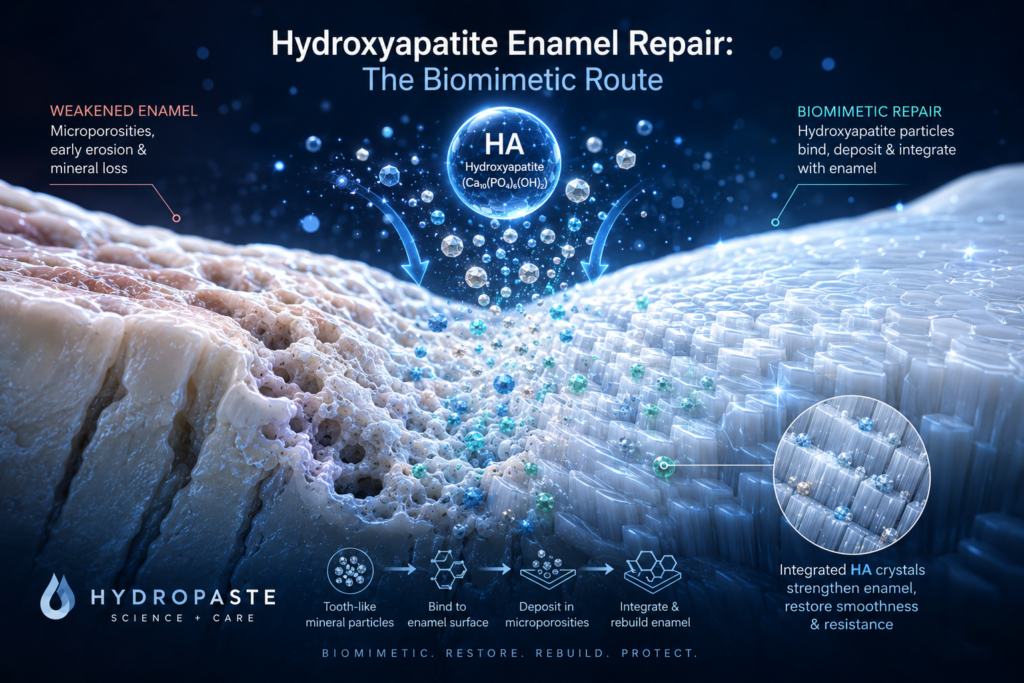
Hydroxyapatite enamel repair is one of the most important trends in modern toothpaste science. Hydroxyapatite is not foreign to teeth. It is the main mineral family that gives enamel and dentin their structure.
The appeal is simple: instead of only changing the chemistry around enamel, hydroxyapatite provides tooth-like mineral particles that can bind to, deposit on, or integrate with weakened enamel surfaces.
How Hydroxyapatite Works
Hydroxyapatite particles can support enamel in several ways:
They can fill microscopic surface irregularities
They can help smooth rough enamel texture
They can support mineral deposition in early lesions
They can reduce sensitivity by blocking exposed dentinal tubules
They can create a more enamel-like surface layer over time
Nano-hydroxyapatite receives attention because smaller particles have a larger surface area and may interact more effectively with microscopic enamel defects. A 2026 in-vitro comparison reported stronger early-lesion remineralization from nanohydroxyapatite toothpaste compared with microcrystalline hydroxyapatite and fluoride under that study’s conditions, though lab findings should not be treated as identical to long-term real-world outcomes. (MDPI)
Best Use Cases for Hydroxyapatite
Hydroxyapatite toothpaste may be especially relevant for:
Fluoride-free enamel support
Tooth sensitivity
White spot appearance support
Mild acid-wear support
Children’s oral care when parents prefer fluoride-free options
Daily enamel maintenance for low-to-moderate risk users
Where It Fits in the Hydropaste Ecosystem
The hydroxyapatite mechanism guide explains why tooth-like mineral particles are becoming one of the most searched fluoride-free enamel repair options.
Fluoride Remineralization Science: The Traditional Gold Standard
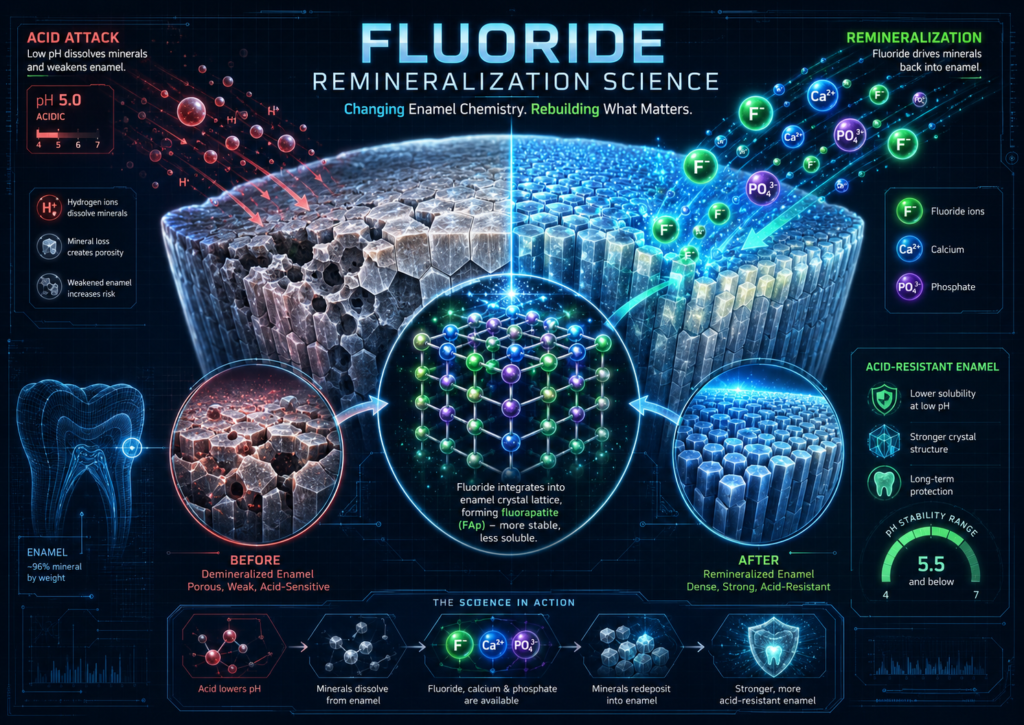
A Hydropaste science illustration showing how fluoride supports enamel remineralization by helping calcium and phosphate return to weakened enamel and form a stronger, more acid-resistant mineral structure.Fluoride remineralization science remains central to cavity prevention. Fluoride does not simply “coat” the tooth. It influences enamel chemistry and helps make the tooth surface more resistant to future acid attack.
How Fluoride Supports Enamel
Fluoride can:
Promote remineralization of early enamel lesions
Inhibit mineral loss during acid exposure
Support formation of more acid-resistant mineral phases
Interfere with bacterial acid production under certain conditions
Enhance the protective effect of saliva minerals
Fluoride’s strength is its long track record in public health, toothpaste, varnishes, rinses, and professional dental care. A 2025 systematic review found fluorinated agents more effective than non-fluoride agents for artificially induced white spot lesion remineralization in the studies analyzed. (PMC)
Best Use Cases for Fluoride
Fluoride toothpaste may be especially appropriate for:
High cavity risk
Frequent sugar exposure
Orthodontic patients
People with a history of decay
Dry mouth patients
Patients advised by dentists to use fluoride varnish or prescription toothpaste
Fluoride Is Not One Ingredient
Different fluoride compounds behave differently. Sodium fluoride, sodium monofluorophosphate, amine fluoride, and stannous fluoride are not identical in how they interact with plaque, enamel, and soft tissues.
Readers who want the traditional cavity-prevention pathway should continue to fluoride remineralization science for a deeper look at acid resistance and mineral recovery.
Calcium Phosphate Systems: Mineral Supply and Delivery
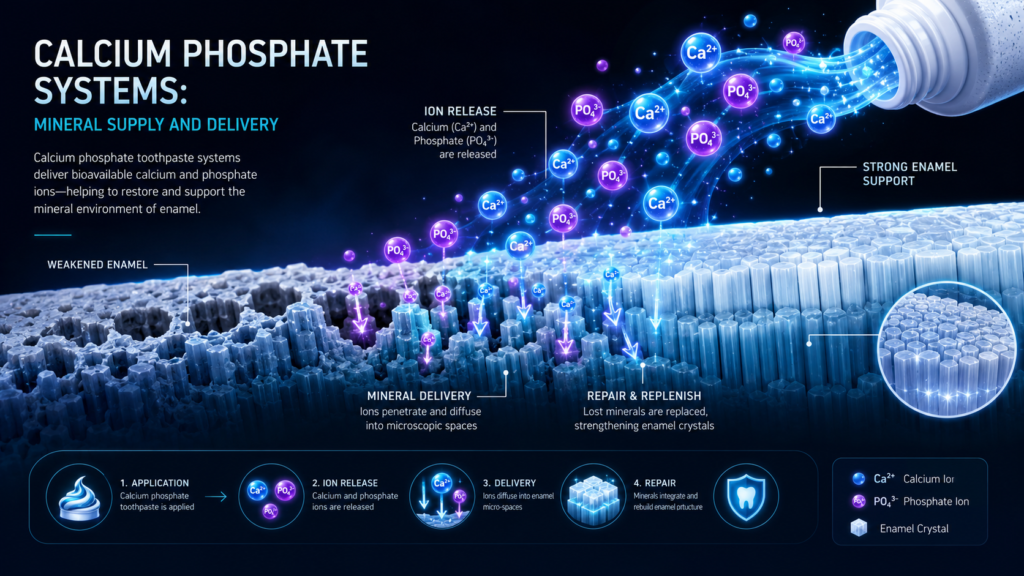
A dental science infographic showing how calcium phosphate toothpaste systems deliver calcium and phosphate ions to weakened enamel, helping support mineral replenishment, enamel repair and remineralization.Calcium phosphate toothpaste systems aim to support the mineral environment around enamel. Since enamel is built from calcium and phosphate minerals, these systems try to deliver the raw materials needed for repair.
Why Calcium and Phosphate Matter
Saliva naturally contains calcium and phosphate. When the mouth is healthy, saliva helps buffer acids and restore minerals after meals. But when saliva is reduced, plaque is heavy, or acid exposure is frequent, the mouth may struggle to maintain a favorable mineral balance.
Calcium phosphate systems attempt to increase local mineral availability.
Common Calcium Phosphate Approaches
| System Type | Purpose | Typical Use |
|---|---|---|
| Amorphous calcium phosphate | Supplies calcium/phosphate ions | Enamel support, sensitivity formulas |
| CPP-ACP | Stabilizes calcium phosphate using casein phosphopeptide | Professional and specialty products |
| Functionalized calcium phosphate | Improves mineral delivery or retention | Advanced toothpaste systems |
| Hydroxyapatite | Tooth-like calcium phosphate mineral | Biomimetic enamel support |
Who May Benefit
Calcium phosphate systems may appeal to people with early enamel weakness, post-orthodontic white spots, sensitivity, low saliva flow, or acid erosion risk. They are not a substitute for dental treatment when a cavity is already open.
For mineral delivery beyond fluoride and hydroxyapatite, calcium phosphate systems explains how calcium and phosphate availability supports enamel balance.
Stannous Fluoride Effects: Enamel, Plaque, Gumline, Sensitivity
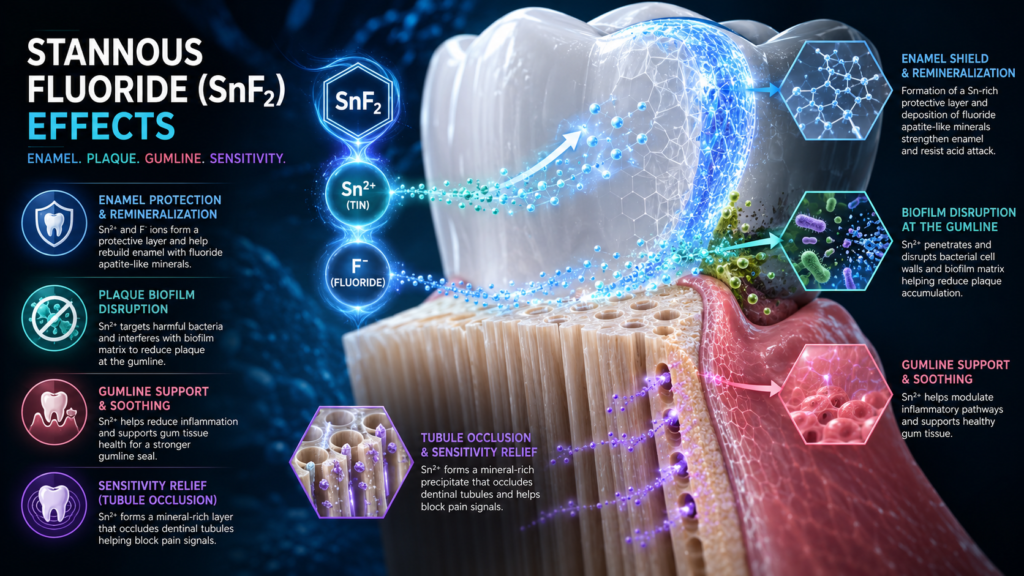
A high-tech dental science infographic showing how stannous fluoride supports enamel protection, plaque biofilm disruption, gumline health, and sensitivity relief through fluoride and tin-related chemistry.Stannous fluoride is different from standard sodium fluoride because it brings both fluoride and tin-related chemistry into oral care. It is often used in toothpastes designed for sensitivity, gum health, plaque control, and cavity protection.
Why Stannous Fluoride Matters
Stannous fluoride can support:
Enamel remineralization
Caries prevention
Plaque control
Gingivitis reduction
Sensitivity relief
Tubule occlusion
Oral malodor control in some formulations
A 2025 review describes stannous fluoride toothpastes as clinically relevant for gingivitis and other oral health outcomes, while earlier systematic work also supports its role in plaque and gingival inflammation control. (PMC)
Best Use Cases for Stannous Fluoride
Stannous fluoride may be a strong option for readers who have:
Sensitivity at the gumline
Bleeding gums with plaque buildup
Cavity risk plus gingivitis risk
Bad breath related to plaque accumulation
Exposed dentin or recession-prone areas
Trade-Offs
Older stannous fluoride formulas were associated with staining concerns, though modern stabilized formulas are designed to reduce that issue. Some users may still prefer hydroxyapatite if they want fluoride-free enamel support, while others may prefer stannous fluoride when gumline inflammation and sensitivity are major concerns.
If sensitivity, plaque and gumline inflammation are part of the concern, stannous fluoride effects provides the most relevant science-focused next step.
Biomimetic Mineral Repair Compounds: The Next Layer of Enamel Science
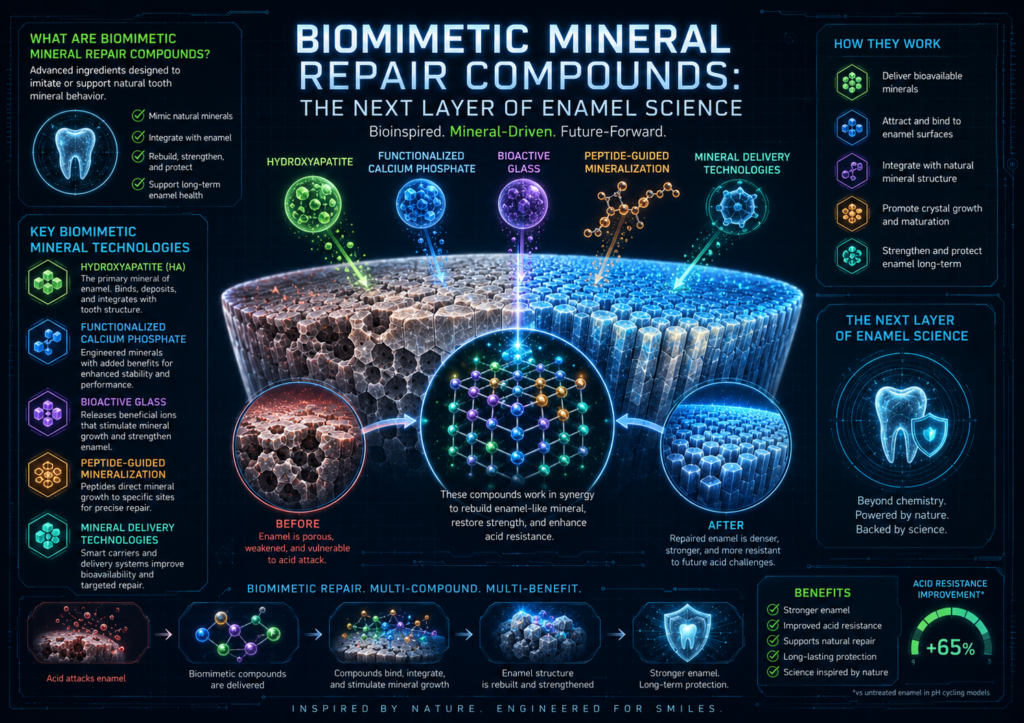
Biomimetic tooth repair compounds are designed to imitate or support the way natural tooth minerals behave. This category includes hydroxyapatite, functionalized calcium phosphate, bioactive glass, peptide-guided mineralization concepts, and other mineral delivery technologies.
What “Biomimetic” Means in Toothpaste
In enamel science, biomimetic does not mean magical enamel regrowth. It means the compound is designed to resemble, interact with, or support natural tooth mineral structure.
A biomimetic compound may:
Bind to enamel-like surfaces
Deliver calcium and phosphate
Fill microscopic defects
Support smoother mineral deposition
Reduce sensitivity by sealing tubules
Improve surface resistance over repeated use
Why This Category Is Growing
Consumers are asking more specific questions:
Can toothpaste repair enamel naturally?
Is hydroxyapatite better than fluoride?
What is the best toothpaste for early enamel loss?
Can enamel remineralize without fluoride?
What ingredient helps white spots after braces?
Those questions are driving interest in next-generation mineral repair systems.
The future-facing category belongs in biomimetic mineral repair compounds, where enamel repair moves from simple toothpaste claims toward advanced mineral design.
Saliva and Tooth Remineralization: The Natural Mineral Repair System
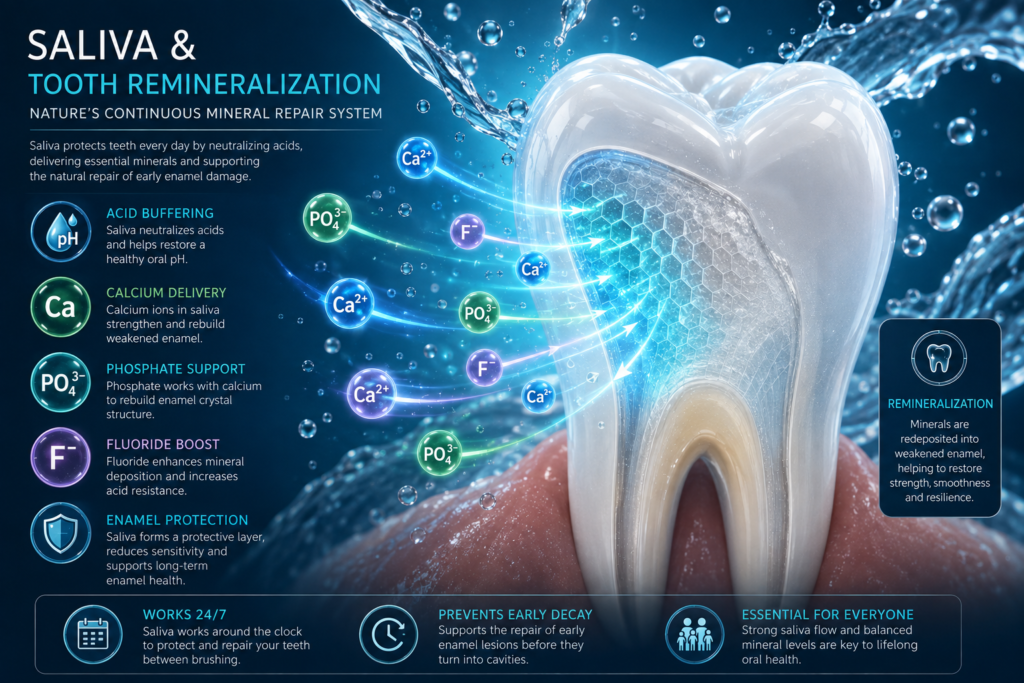
Scientific infographic illustrating saliva and tooth remineralization, including acid buffering, calcium and phosphate transport, fluoride-supported mineral repair, pH recovery, and the strengthening of early enamel lesions.
Saliva and tooth remineralization describe the continuous biological process through which the mouth neutralizes acids, restores lost minerals, and helps protect enamel between brushing sessions.
Saliva is not simply moisture. It is the fluid environment that determines whether weakened enamel continues losing minerals or begins recovering them. Calcium and phosphate dissolved in saliva can move toward partially demineralized enamel, while fluoride from toothpaste or other topical sources can support faster mineral deposition and improve resistance to future acid exposure.
What Saliva Does for Tooth Enamel
In enamel science, saliva functions as a mineral transport and pH-control system. It cannot regrow missing enamel or repair a physical cavity, but it can support the remineralization of early mineral loss while the enamel framework remains intact.
Healthy saliva may:
- Dilute sugars and dietary acids
- Buffer plaque acids and restore oral pH
- Deliver calcium and phosphate to weakened enamel
- Carry low levels of fluoride around tooth surfaces
- Support the acquired enamel pellicle
- Reduce the time enamel remains chemically softened
- Help stabilize early noncavitated white spot lesions
Why Saliva Remineralization Matters
Individuals are asking increasingly specific oral-care questions:
- How does saliva protect teeth?
- Can saliva reverse early tooth decay?
- Which minerals in saliva rebuild enamel?
- Does dry mouth prevent tooth remineralization?
- How does remineralizing toothpaste work with saliva?
These questions reflect a broader shift in enamel care. Tooth protection is no longer viewed only as something that happens during brushing. Mineral repair continues throughout the day, but only when saliva has enough flow, buffering capacity, mineral availability, and uninterrupted recovery time.
The science of saliva and tooth remineralization therefore belongs at the center of modern enamel care. Toothpaste can provide fluoride, hydroxyapatite, calcium-phosphate compounds, or other active ingredients, but saliva creates the biological environment in which those technologies must function.
Hydroxyapatite vs Fluoride vs Calcium Phosphate vs Stannous Fluoride
Enamel Remineralization Ingredient Comparison Chart
Enamel Remineralization Ingredient Comparison
Compare the major enamel remineralization systems by function, best-fit use case, strengths, and limitations. Use the filters to find the ingredient pathway that best matches sensitivity, white spots, fluoride-free care, cavity risk, or future repair technology.
Hydroxyapatite
Tooth-like mineral repair support
Fluoride-free users, sensitivity, early enamel weakness
Biomimetic, enamel-like mineral, sensitivity support
Product quality and concentration vary
Nano-hydroxyapatite
Smaller hydroxyapatite particles
White spots, surface defects, sensitivity
High surface area, strong biomimetic appeal
Long-term clinical evidence still developing by product type
Fluoride
Acid-resistant remineralization support
High cavity risk, decay prevention
Strong evidence base, widely recommended
Requires correct dose; some users avoid fluoride
Stannous fluoride
Fluoride + plaque/gumline/sensitivity support
Sensitivity, gingivitis risk, plaque control
Multi-benefit oral care active
Some formulas may cause staining or taste concerns
Calcium phosphate systems
Mineral ion support
Enamel weakness, low mineral environment
Supports calcium/phosphate availability
Often works best as part of a broader routine
Bioactive glass
Mineral release and surface support
Sensitivity and remineralization concepts
Releases calcium/phosphate under oral conditions
Less common in mainstream toothpaste
Peptide-guided mineral systems
Directed mineral formation concept
Future enamel repair technology
Highly targeted repair potential
Emerging category, limited consumer access
| Ingredient/System | Main Function | Best For | Strengths | Limitations |
|---|---|---|---|---|
| Hydroxyapatite | Tooth-like mineral repair support | Fluoride-free users, sensitivity, early enamel weakness | Biomimetic, enamel-like mineral, sensitivity support | Product quality and concentration vary |
| Nano-hydroxyapatite | Smaller hydroxyapatite particles | White spots, surface defects, sensitivity | High surface area, strong biomimetic appeal | Long-term clinical evidence still developing by product type |
| Fluoride | Acid-resistant remineralization support | High cavity risk, decay prevention | Strong evidence base, widely recommended | Requires correct dose; some users avoid fluoride |
| Stannous fluoride | Fluoride + plaque/gumline/sensitivity support | Sensitivity, gingivitis risk, plaque control | Multi-benefit oral care active | Some formulas may cause staining or taste concerns |
| Calcium phosphate systems | Mineral ion support | Enamel weakness, low mineral environment | Supports calcium/phosphate availability | Often works best as part of a broader routine |
| Bioactive glass | Mineral release and surface support | Sensitivity and remineralization concepts | Releases calcium/phosphate under oral conditions | Less common in mainstream toothpaste |
| Peptide-guided mineral systems | Directed mineral formation concept | Future enamel repair technology | Highly targeted repair potential | Emerging category, limited consumer access |
Use this comparison as an educational guide. For deeper context, connect here with enamel remineralization hub, hydroxyapatite mechanism, fluoride remineralization science, and biomimetic mineral repair compounds.
Decision Framework: Which Ingredient Fits Which User?
Choose the Right Remineralization Starting Point
Select the user situation that best matches your enamel concern. The tool will recommend a better starting point, explain why it fits, and suggest the next practical step.
Pick your main situation
7 visibleFrequent cavities Fluoride or stannous fluoride
Strong cavity-prevention tradition.
Start with a daily fluoride toothpaste; consider stannous fluoride if sensitivity, plaque, or gumline concerns are also present.
Educational note: this tool is for ingredient direction, not diagnosis. Cavities, pain, bleeding gums, severe sensitivity, or children with high decay risk should be evaluated by a dentist.
Charts & Tables
Enamel Remineralization Pathway
| Step | Biological Event | Oral Care Strategy |
|---|---|---|
| 1 | Plaque bacteria produce acid | Reduce sugar frequency and clean plaque |
| 2 | pH drops | Allow saliva recovery between meals |
| 3 | Calcium and phosphate leave enamel | Use remineralizing toothpaste |
| 4 | Early lesion forms | Support mineral return before cavitation |
| 5 | Saliva buffers acids | Hydrate and manage dry mouth |
| 6 | Minerals redeposit | Use fluoride, hydroxyapatite, or calcium phosphate |
| 7 | Surface becomes more resistant | Maintain daily routine |
Remineralization Ingredient Strength Map
| Ingredient | Enamel Repair Support | Cavity Prevention | Sensitivity Support | Gumline Support | Fluoride-Free |
|---|---|---|---|---|---|
| Hydroxyapatite | High | Moderate to High | High | Moderate | Yes |
| Nano-hydroxyapatite | High | Moderate to High | High | Moderate | Yes |
| Fluoride | High | High | Moderate | Low to Moderate | No |
| Stannous fluoride | High | High | High | High | No |
| Calcium phosphate | Moderate to High | Moderate | Moderate | Low | Usually |
| Bioactive glass | Moderate | Moderate | High | Low | Usually |
Commercial Intent Product Categories
| Product Category | Typical Buyer Intent | What to Look For |
|---|---|---|
| Hydroxyapatite toothpaste | Fluoride-free enamel repair | Nano or micro HAp, low abrasion, daily-use formula |
| Fluoride toothpaste | Cavity prevention | 1000–1450 ppm fluoride for standard adult toothpaste, dentist guidance for children |
| Stannous fluoride toothpaste | Sensitivity + gums + cavities | Stabilized formula, anti-plaque claims, sensitivity support |
| Remineralizing gel | Higher-touch enamel support | Dentist-recommended use, non-abrasive formula |
| Sensitivity toothpaste | Pain reduction | Tubule occlusion, potassium nitrate, stannous fluoride, hydroxyapatite |
| Kids remineralizing toothpaste | Safe family use | Age-appropriate dose, mild flavor, supervision instructions |
Costs: What Enamel Remineralization Products Usually Cost
Costs vary by country, brand, concentration, and whether the product is over-the-counter or professional.
Typical Cost Ranges
| Product Type | Typical Price Range | Notes |
|---|---|---|
| Standard fluoride toothpaste | Low | Most affordable daily option |
| Premium stannous fluoride toothpaste | Low to mid | Often sold for gum and sensitivity benefits |
| Hydroxyapatite toothpaste | Mid to high | Often positioned as premium enamel repair |
| Nano-hydroxyapatite toothpaste | Mid to high | Price depends on formulation and brand |
| Remineralizing gel | Mid to high | Often used as add-on support |
| Dentist fluoride varnish | Professional cost | Applied in clinic |
| Prescription high-fluoride toothpaste | Professional/prescription cost | For high caries risk under dental guidance |
How to Think About Value
A more expensive toothpaste is not automatically better. The value depends on:
Active ingredient quality
Consistency of daily use
Abrasivity level
Sensitivity needs
Cavity risk
Dry mouth status
Diet and acid exposure
Whether the product matches your actual problem
For many users, the biggest improvement comes from choosing the right ingredient category and using it consistently, not from chasing the most expensive tube.
Risks and Limitations
1. Remineralization Cannot Heal an Open Cavity
Once enamel collapses and a cavity forms, toothpaste cannot rebuild the missing tooth structure. Remineralization is most useful for early, non-cavitated enamel lesions.
2. Whitening Products Can Increase Sensitivity
Some whitening products may irritate sensitive teeth or worsen discomfort when enamel is already stressed. A remineralizing toothpaste can support the surface, but it cannot cancel out every whitening-related issue.
3. Abrasive Toothpaste Can Work Against Enamel Goals
A toothpaste can contain good active ingredients and still be too abrasive for some users. People with erosion, recession, sensitivity, or aggressive brushing habits should pay attention to abrasion and technique.
4. Fluoride Requires Correct Use
Fluoride is effective when used appropriately. Children need supervision to reduce swallowing risk, and people using prescription fluoride should follow dental instructions.
5. Dry Mouth Can Undermine Remineralization
Saliva is central to enamel repair. If dry mouth is caused by medication, mouth breathing, dehydration, autoimmune disease, or medical treatment, toothpaste alone may not solve the problem.
6. Acid Habits Can Overpower Mineral Support
Frequent sipping, grazing, reflux, and acidic drinks can keep enamel under constant mineral stress. Remineralization needs recovery time.
Trends & Latest Tech in Enamel Remineralization Science
Nano-Hydroxyapatite Toothpaste
Nano-hydroxyapatite continues to grow because it aligns with the natural mineral structure of teeth. Current evidence suggests hydroxyapatite has become a serious fluoride-free option for enamel remineralization and caries prevention, though not all formulas should be treated as identical. (ScienceDirect)
Hybrid Fluoride + Hydroxyapatite Concepts
Some emerging formulas combine fluoride with hydroxyapatite or other calcium phosphate systems. The logic is to support both acid resistance and mineral deposition.
Low-Abrasion Remineralizing Toothpaste
More consumers are realizing that enamel repair is not only about the active ingredient. Abrasion, brushing force, and surface smoothness matter. Expect more formulas built around gentle polishing and mineral repair.
Sensitivity-First Enamel Repair
Tooth sensitivity is becoming a major commercial category. Hydroxyapatite, stannous fluoride, potassium nitrate, and bioactive mineral systems are often positioned for users who feel cold, sweet, or air sensitivity.
Biomimetic Dental Materials
The future of enamel care will likely involve materials that behave more like natural mineral systems: better adhesion, better ion release, better tubule sealing, and more precise surface repair.
Upcoming Models: Where Enamel Remineralization Is Heading
1. Personalized Enamel Risk Profiles
Future oral care may become more personalized. Instead of choosing toothpaste by flavor or whitening claim, users may choose formulas based on cavity risk, saliva flow, oral pH, sensitivity pattern, diet, and microbiome profile.
2. Smart Toothpaste and Sensor-Based Oral Care
As connected toothbrushes and saliva testing develop, oral care may move toward feedback loops. Users could eventually track brushing pressure, acid exposure, plaque risk, and remineralization routines in a more measurable way.
3. Peptide-Guided Mineral Repair
Peptide-based approaches are being explored for their ability to guide mineral formation. The promise is more targeted repair of early enamel defects, although this remains more advanced science than everyday mainstream toothpaste.
4. Better Post-Orthodontic White Spot Systems
White spots after braces are a major aesthetic and dental concern. Future products may combine hydroxyapatite, fluoride, calcium phosphate, and low-abrasion polishing for better post-orthodontic enamel recovery.
5. Multi-Active Formulas
The next generation of enamel products will likely combine several benefits in one formula: remineralization, sensitivity support, plaque management, gumline protection, and low abrasivity.
Practical Buying Framework: How to Choose a Remineralizing Toothpaste
Step 1: Identify the Main Problem
Do not start with the ingredient. Start with the concern.
White spots? Choose enamel repair support.
Sensitivity? Choose tubule occlusion and surface repair.
Cavity risk? Prioritize fluoride or dentist-guided prevention.
Gumline bleeding? Consider stannous fluoride and plaque control.
Fluoride-free preference? Compare hydroxyapatite formulas.
Acid erosion? Choose low-abrasion remineralizing support and reduce acid frequency.
Step 2: Match the Ingredient
| Main Concern | Ingredient Direction |
|---|---|
| Early enamel weakness | Hydroxyapatite, fluoride, calcium phosphate |
| High cavity risk | Fluoride, stannous fluoride |
| Fluoride-free enamel care | Hydroxyapatite |
| Sensitivity | Hydroxyapatite, stannous fluoride, potassium nitrate |
| Gumline plaque/inflammation | Stannous fluoride |
| Acid erosion | Low-abrasion remineralizing toothpaste |
Step 3: Check the Formula Quality
Look for:
Clear active ingredient listing
Low-abrasion positioning
Daily-use safety
No overpromised “enamel regrowth” claims
Age-appropriate directions
Sensitivity or cavity-risk match
Transparent brand education
Step 4: Use It Correctly
Brush twice daily. Spit, but avoid aggressive rinsing immediately after brushing if the goal is to leave active ingredients on the tooth surface. Use a soft toothbrush, light pressure, and consistent brushing time.
FAQs
What is the science behind enamel remineralization?
Enamel remineralization is the process of returning minerals such as calcium, phosphate, and fluoride-supported compounds into weakened enamel before a cavity forms. The tooth surface is constantly exposed to acid from plaque bacteria, food, drinks, and low saliva flow. When the mouth becomes acidic, minerals leave enamel. When saliva buffers the acid and minerals become available again, those minerals can redeposit.
Toothpaste ingredients improve this process in different ways. Fluoride helps enamel become more acid-resistant. Hydroxyapatite provides tooth-like mineral particles that can support surface repair. Calcium phosphate systems help supply mineral building blocks. Stannous fluoride adds cavity protection while also supporting plaque control, sensitivity relief, and gumline health.
The key point is that remineralization works best on early enamel mineral loss, not on open cavities.
Is hydroxyapatite toothpaste good for enamel remineralization?
Hydroxyapatite toothpaste can be a strong option for enamel remineralization, especially for people looking for fluoride-free enamel support. Hydroxyapatite is chemically similar to the mineral structure of teeth, which is why it is often described as biomimetic.
It may help smooth rough enamel, fill microscopic surface defects, reduce sensitivity, and support mineral deposition in early enamel lesions. Research interest has grown because hydroxyapatite offers a tooth-like repair pathway rather than relying only on fluoride chemistry. Recent reviews report expanding evidence for hydroxyapatite oral care in caries prevention and early lesion support. (ScienceDirect)
However, not every hydroxyapatite toothpaste is equal. Particle size, concentration, formulation, abrasivity, and brushing consistency all matter.
Can enamel remineralize naturally without toothpaste?
Enamel can remineralize naturally to some extent through saliva. Saliva buffers acids, supplies calcium and phosphate, helps wash away food debris, and supports the mineral balance around teeth. This is why dry mouth increases cavity risk and why frequent snacking can overwhelm enamel repair.
But saliva alone may not be enough when acid exposure is high, plaque is heavy, enamel is already weakened, or the person has a history of cavities. Remineralizing toothpaste gives the mouth additional support through fluoride, hydroxyapatite, calcium phosphate, or other active systems.
Natural remineralization works best when supported by low sugar frequency, good brushing, hydration, enough saliva, and enamel-safe toothpaste.
What is the best remineralizing toothpaste ingredient for sensitive teeth?
For sensitive teeth, the best ingredient depends on why the tooth is sensitive. Hydroxyapatite can help by filling microscopic defects and supporting tubule occlusion. Stannous fluoride can also reduce sensitivity while supporting cavity prevention and gumline health. Potassium nitrate is another common sensitivity ingredient, though it works more through nerve desensitization than mineral repair.
If sensitivity comes from gum recession, enamel erosion, cracked teeth, grinding, or an exposed root surface, toothpaste may help but should not replace dental evaluation. Sudden, sharp, one-sided, or worsening sensitivity needs professional assessment.
How long does enamel remineralization take?
Enamel remineralization is gradual. Some users may notice sensitivity improvement within days or weeks, but visible white spot improvement or measurable mineral recovery usually takes longer. The timeline depends on lesion depth, saliva flow, diet, toothpaste ingredient, brushing consistency, plaque control, and acid exposure.
A realistic view is to think in weeks to months, not overnight repair. If a product claims to rebuild lost enamel instantly, treat that claim carefully. Toothpaste can support early mineral repair, but it cannot regrow missing enamel structure after a cavity has formed.
People Also Ask
Can toothpaste really repair enamel?
Toothpaste can support repair of early mineral loss, but it cannot rebuild missing enamel once a cavity has opened. The word “repair” should be understood scientifically. Remineralizing toothpaste helps restore minerals to weakened enamel surfaces or early subsurface lesions. It may also smooth roughness, reduce sensitivity, and make enamel more resistant to acid.
Fluoride, hydroxyapatite, calcium phosphate, and stannous fluoride all support enamel in different ways. The best results come when toothpaste is paired with low acid exposure, good plaque control, and consistent use.
Is fluoride better than hydroxyapatite for enamel remineralization?
Fluoride has the longer public-health history and remains a major standard for cavity prevention. Hydroxyapatite is newer in consumer awareness but increasingly supported as a fluoride-free enamel remineralization option. Recent evidence suggests hydroxyapatite can help prevent caries and support early enamel lesions, while fluoride remains especially strong for high-cavity-risk users. (ScienceDirect)
The better choice depends on the user. High cavity risk often points toward fluoride or stannous fluoride. Fluoride-free preference, sensitivity, or biomimetic enamel support may point toward hydroxyapatite.
What minerals rebuild tooth enamel?
The main minerals involved in enamel remineralization are calcium and phosphate. Fluoride can help by encouraging more acid-resistant mineral formation and reducing mineral loss during acid attacks. Hydroxyapatite provides a tooth-like calcium phosphate mineral that can support enamel surface repair.
In practical oral care, the most relevant mineral systems are fluoride compounds, hydroxyapatite, nano-hydroxyapatite, calcium phosphate systems, and bioactive mineral technologies.
Can white spots on teeth be remineralized?
Some white spots can improve if they are early, non-cavitated enamel lesions. These spots often appear when minerals have been lost beneath the enamel surface, creating a chalky or opaque appearance. Remineralizing toothpaste, fluoride treatment, hydroxyapatite, calcium phosphate support, better plaque control, and reduced acid exposure may help.
However, not every white spot is the same. Some are caused by fluorosis, developmental enamel defects, trauma, or deeper structural changes. If the white spot is persistent, spreading, rough, or paired with sensitivity, a dentist should examine it.
Is nano-hydroxyapatite safe for daily toothpaste use?
Nano-hydroxyapatite is widely used in modern fluoride-free toothpaste formulas and is valued because it resembles natural tooth mineral. Current interest is driven by its potential to support enamel remineralization and sensitivity relief. Still, safety and performance depend on formulation quality, particle characteristics, concentration, and intended use.
For daily use, readers should choose reputable products, follow label directions, supervise children, avoid swallowing toothpaste, and consult a dentist for high cavity risk, active decay, or ongoing sensitivity.
Editorial Conclusion: The Future of Enamel Repair Is Mineral Intelligence
The science of enamel remineralization is moving beyond a simple fluoride-versus-fluoride-free debate. The better question is: what mineral system matches the biology of the problem?
Fluoride remains deeply important for cavity prevention and acid resistance. Hydroxyapatite brings a biomimetic approach that appeals to readers looking for tooth-like mineral repair and sensitivity support. Calcium phosphate systems help explain the mineral supply side of enamel recovery. Stannous fluoride offers a practical bridge between enamel protection, gumline health, plaque control, and sensitivity relief. Biomimetic compounds point toward a future where toothpaste becomes more precise, more functional, and more personalized.
The smartest enamel strategy is not chasing a single miracle ingredient. It is building a daily environment where enamel loses fewer minerals, receives better mineral support, and has enough time between acid attacks to recover. That is the real science behind remineralization—and the reason this sub-pillar belongs at the center of Hydropaste’s enamel education system.