Fluoride Remineralization Science: How Fluoride Strengthens Enamel and Helps Reverse Early Mineral Loss
Amazon Affiliate Disclosure
Hydropaste.com may earn a commission from qualifying purchases made through affiliate links, including Amazon links. This does not change the price you pay. Our editorial content is built around enamel science, ingredient function, oral care risk profiles, and practical product selection rather than commission value.
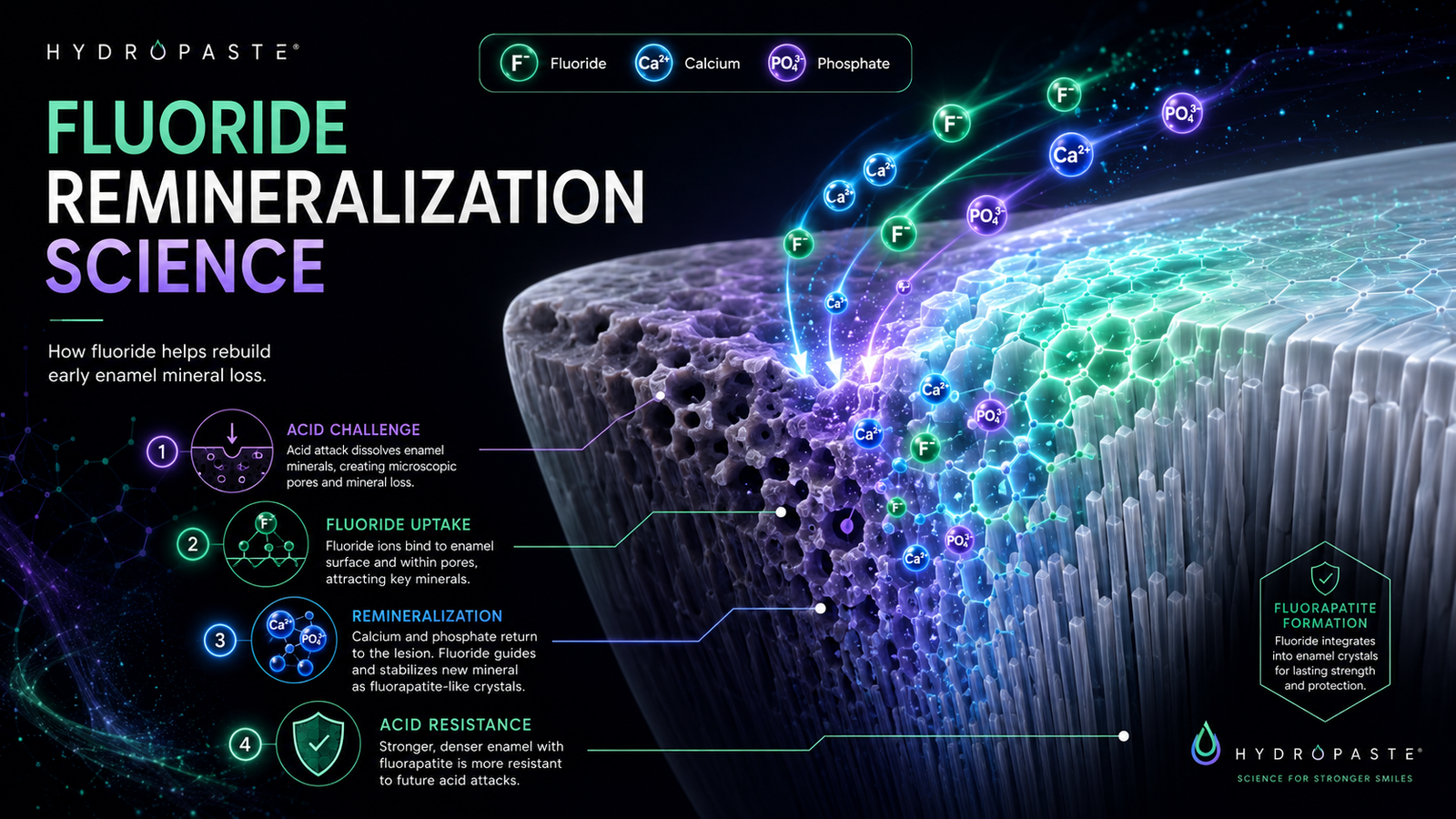
Fluoride remineralization science explains why fluoride remains one of the most important ingredients in modern cavity prevention, enamel repair, and early tooth decay control. While many people think fluoride simply “hardens teeth,” the real mechanism is more precise. Fluoride changes the mineral behavior of enamel during acid attacks, helps calcium and phosphate return to weakened crystal structures, reduces demineralization, and makes the tooth surface more resistant to future acid exposure.
This science belongs under the enamel remineralization science hub on Hydropaste. It focuses specifically on fluoride: how it works, why it has remained central in dental care, how fluoride toothpaste differs from fluoride varnish or prescription fluoride, how it compares with hydroxyapatite, and when a fluoride-based approach may be more appropriate than a fluoride-free remineralizing toothpaste.
The American Dental Association describes fluoride as safe and effective for preventing tooth decay, and its toothpaste guidance states that fluoride strengthens teeth and helps remineralize enamel in the early stages of decay. (ADA)
Quick Picks
| Reader Goal | Best Section | What You’ll Learn |
|---|---|---|
| Understand how fluoride repairs early enamel damage | Fluoride Remineralization Mechanism | How fluoride supports mineral return |
| Compare fluoride with hydroxyapatite | Fluoride vs Hydroxyapatite | Acid resistance vs biomimetic repair |
| Choose between sodium fluoride and stannous fluoride | Types of Fluoride in Toothpaste | Ingredient differences |
| Learn about white spot lesions | Fluoride for White Spot Lesions | When early lesions can improve |
| Understand high-fluoride products | Prescription Fluoride and Varnish | Dentist-guided options |
| Check safety concerns | Risks and Limitations | Fluorosis, swallowing, overuse |
| Estimate product cost | Costs | OTC toothpaste, varnish, prescription paste |
| Learn future trends | Trends & Latest Tech | Hybrid formulas and smart oral care |
What This Guide Is For
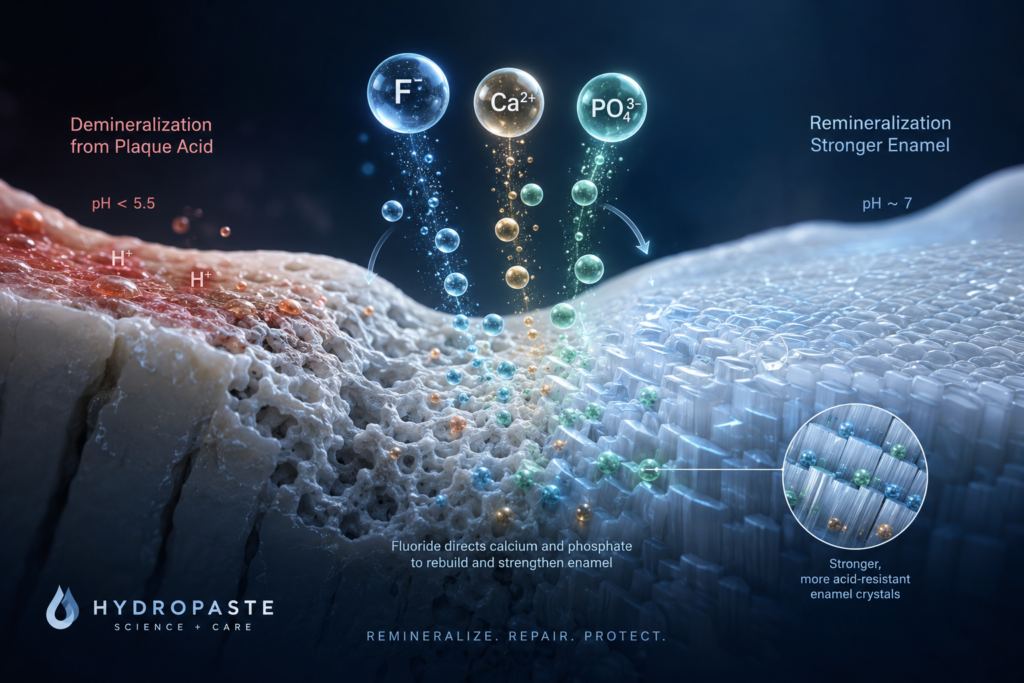
This guide is for readers who want to understand fluoride enamel remineralization beyond surface-level claims. It explains why fluoride is used in toothpaste, why dentists recommend it for cavity risk, how it interacts with saliva minerals, and why it is not the same thing as hydroxyapatite or calcium phosphate.
This page is designed to help you:
Understand fluoride’s role in enamel repair
Compare sodium fluoride, stannous fluoride, and sodium monofluorophosphate
Know when fluoride toothpaste is enough and when professional fluoride may be needed
Evaluate fluoride toothpaste for white spot lesions, sensitivity, and high cavity risk
Compare fluoride with fluoride-free remineralizing toothpaste
Avoid overuse and understand child safety considerations
Choose products based on risk profile rather than marketing language
The broader mineral-repair framework is covered in enamel remineralization science, while the main Enamel Repair Hub explains how fluoride fits into the full system of saliva, pH, diet, plaque control, and daily toothpaste use.
Who Needs Fluoride Remineralization Science?
People With Frequent Cavities
Fluoride is especially relevant for people who repeatedly develop cavities. Frequent decay usually means the mouth is spending too much time in a demineralizing state. Fluoride helps tilt the balance back toward mineral protection by reducing enamel dissolution and supporting remineralization.
People With White Spot Lesions
White spot lesions are early enamel demineralization areas. They often appear after braces, around plaque-retentive zones, or in people with frequent sugar exposure. Fluoride-based approaches are commonly discussed as a standard strategy for preventing and managing white spot lesions, although lesion depth, surface integrity, and oral hygiene determine outcomes. (Springer Link)
Orthodontic Patients
Braces, aligners, attachments, and retainers can create plaque traps. Fluoride toothpaste, fluoride mouth rinses, or professional fluoride may be recommended depending on risk. The goal is to prevent mineral loss around brackets and along the gumline.
People With Dry Mouth
Saliva naturally buffers acid and supplies minerals. When saliva is reduced by medication, mouth breathing, dehydration, autoimmune conditions, or medical treatment, enamel loses an important defense layer. Fluoride can help, but dry mouth often needs a broader strategy.
Children and Teens at Cavity Risk
Fluoride can be highly useful in pediatric cavity prevention, but dosage and supervision matter. Children should use age-appropriate amounts of toothpaste, avoid swallowing, and follow dentist guidance when fluoride supplements, varnish, or prescription products are considered. The American Academy of Pediatric Dentistry’s 2025 best-practice document frames fluoride as an aid for preventing and controlling dental caries in pediatric care. (AAPD)
Adults Comparing Fluoride-Free and Fluoride Toothpaste
Many adults now compare fluoride toothpaste with hydroxyapatite toothpaste. Fluoride remains a strong option for high cavity risk, while hydroxyapatite appeals to people who want fluoride-free mineral support. The right choice depends on risk level, preferences, dental history, and oral environment.
Benefits of Fluoride Remineralization
1. Supports Early Enamel Repair
Fluoride plays a supportive role in early-stage enamel remineralization by enhancing the redeposition of calcium and phosphate ions into areas of subsurface demineralization. This process is most effective when the enamel surface is still intact, allowing mineral exchange to occur within the existing crystal structure rather than replacing lost tooth structure. In this way, fluoride helps stabilize weakened enamel and slows progression of early decay.
For a deeper look at how these mineral systems interact in enamel repair, see Calcium and Phosphate Minerals.
2. Makes Enamel More Acid-Resistant
Fluoride can become incorporated into enamel mineral structures and support acid-resistant mineral formation. This helps enamel tolerate future acid challenges better than unprotected hydroxyapatite alone.
3. Reduces Demineralization During Acid Attacks
Fluoride in plaque fluid and saliva can reduce the rate at which enamel minerals dissolve during low-pH conditions. The CDC explains that fluoride concentrated in plaque and saliva inhibits demineralization and enhances remineralization of early carious lesions. (CDC)
4. Helps Prevent Cavities
Fluoride’s main public-health value is cavity prevention. It is used in toothpaste, varnishes, mouth rinses, gels, foams, drinking water systems, and prescription-strength products.
5. Works With Saliva Minerals
Fluoride does not work alone. It works best when saliva supplies calcium and phosphate. That is why hydration, saliva flow, and reduced acid frequency matter.
6. Supports High-Risk Dental Care Plans
For people with repeated cavities, exposed roots, orthodontic appliances, dry mouth, or high sugar frequency, fluoride can be part of a more intensive prevention plan.
The Core Fluoride Remineralization Mechanism
Demineralization Comes First
Enamel is mostly made of calcium phosphate crystals. When plaque bacteria feed on sugars and refined carbohydrates, they produce acids. These acids lower the pH around the tooth and pull calcium and phosphate out of enamel.
If this happens occasionally, saliva can often repair the damage. If it happens frequently, the enamel becomes porous, chalky, sensitive, and eventually cavitated.
Fluoride Changes the Balance
Fluoride helps shift the balance away from mineral loss and toward mineral repair. Its mechanism has several layers:
It reduces enamel mineral dissolution during acid exposure
It helps calcium and phosphate redeposit into weakened enamel
It supports formation of more acid-resistant mineral phases
It can form calcium fluoride-like reservoirs on the tooth surface
It can interfere with bacterial acid activity under certain conditions
A review in StatPearls summarizes fluoride’s role as strengthening enamel, enhancing remineralization, and reducing acid-induced demineralization. (NCBI)
The 5-Part Fluoride Mechanism
1. Fluoride Concentrates in Plaque and Saliva
After brushing with fluoride toothpaste, some fluoride remains in saliva, plaque fluid, and on the tooth surface. This low-level fluoride availability matters because enamel is not attacked once a day. It faces repeated acid challenges.
2. Fluoride Reduces Enamel Dissolution
When pH drops, fluoride can reduce how quickly enamel minerals dissolve. This means acid attacks become less damaging.
3. Fluoride Helps Minerals Return
Fluoride encourages calcium and phosphate to redeposit into partially demineralized enamel. This is the heart of fluoride remineralization science.
4. Fluoride Supports More Acid-Resistant Mineral
Fluoride can support formation of fluoridated apatite-like mineral, which is more resistant to acid than standard hydroxyapatite. This does not turn the whole tooth into a different material, but it can improve surface resistance where remineralization occurs.
5. Fluoride Reservoirs Extend Protection
Topical fluoride can form calcium fluoride-like deposits on the enamel surface. These deposits can act as fluoride reservoirs, releasing fluoride during acid attacks when enamel needs protection most.
Fluoride Remineralization Pathway Chart
| Stage | What Happens | Fluoride’s Role |
|---|---|---|
| Plaque acid forms | Bacteria produce acid after sugar exposure | Fluoride helps reduce acid damage |
| pH drops | Enamel begins losing calcium and phosphate | Fluoride slows mineral dissolution |
| Early lesion forms | Enamel becomes porous but surface may remain intact | Fluoride supports mineral return |
| Calcium and phosphate redeposit | Saliva minerals re-enter weakened enamel | Fluoride accelerates remineralization |
| Acid-resistant mineral forms | Surface becomes more stable | Fluoride improves future acid resistance |
| Protection repeats | Fluoride remains in plaque/saliva reservoirs | Helps during later acid attacks |
Types of Fluoride in Toothpaste
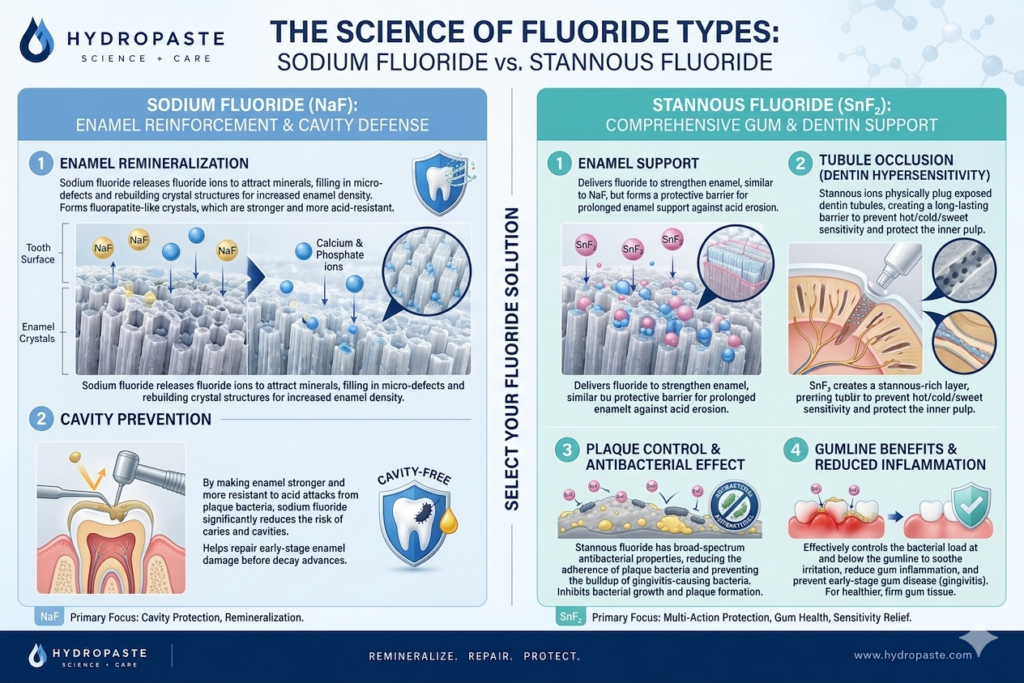
Not all fluoride toothpastes are the same. The fluoride compound affects stability, taste, compatibility, sensitivity support, plaque behavior, and gumline benefits.
Sodium Fluoride
Sodium fluoride is one of the most common fluoride forms in toothpaste. It is widely used for cavity prevention and enamel remineralization. It provides fluoride ions that support the remineralization process.
Sodium Monofluorophosphate
Sodium monofluorophosphate is another common anticavity fluoride ingredient. It is often used in toothpaste formulas because it can be compatible with certain abrasive systems.
Stannous Fluoride
Stannous fluoride provides fluoride plus tin-related effects. It is often used in toothpastes aimed at cavities, sensitivity, plaque, gingivitis, and gumline protection. A 2025 review concluded that stannous fluoride toothpastes show beneficial effects in gingivitis treatment and discussed mechanisms related to caries, hypersensitivity, and gingival health. (PMC)
Sodium Fluoride vs Stannous Fluoride vs Monofluorophosphate
| Fluoride Type | Main Role | Best For | Strengths | Limitations |
|---|---|---|---|---|
| Sodium fluoride | Cavity prevention and enamel remineralization | General fluoride toothpaste users | Common, effective, widely available | Less gum/sensitivity benefit than stannous fluoride |
| Sodium monofluorophosphate | Anticavity protection | Standard toothpaste formulas | Compatible with many formulas | Depends on formula activation and delivery |
| Stannous fluoride | Cavities, sensitivity, plaque, gingivitis | Gumline sensitivity and high plaque risk | Multi-benefit active | Taste or staining concerns in some users |
| Prescription sodium fluoride | High fluoride exposure under guidance | High caries risk | Stronger dentist-directed prevention | Not for casual unsupervised use |
| Fluoride varnish | Professional topical fluoride | Children, high-risk adults, exposed roots | Long contact time | Requires dental visit |
Fluoride Toothpaste for Enamel Repair
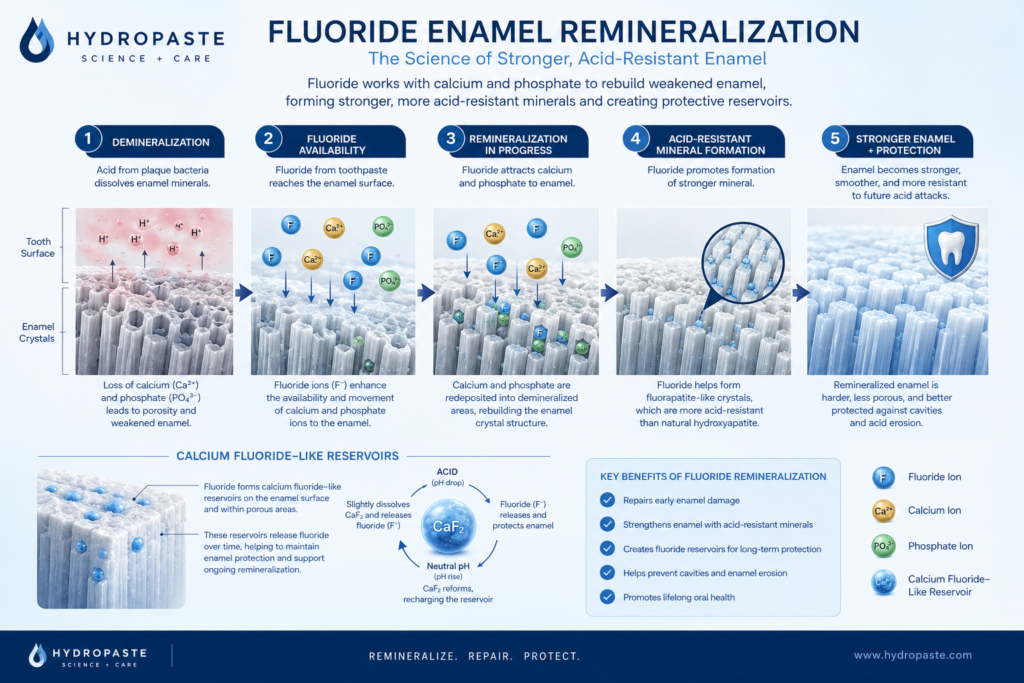
Fluoride toothpaste is the most common daily fluoride delivery system. It works because it is used repeatedly, spreads across enamel, reaches plaque fluid, and leaves behind low-level fluoride after brushing.
What to Look For
A good fluoride toothpaste should have:
A recognized fluoride compound
A cavity-prevention claim
Daily-use directions
Appropriate fluoride level for the user
Low-abrasion positioning if enamel is worn
Sensitivity support if dentin is exposed
Child-safe instructions when used by children
The ADA notes that anticaries toothpastes use fluoride-containing compounds such as sodium fluoride, sodium monofluorophosphate, and stannous fluoride, and that ADA-accepted anticaries toothpastes must contain fluoride. (ADA)
Fluoride for White Spot Lesions
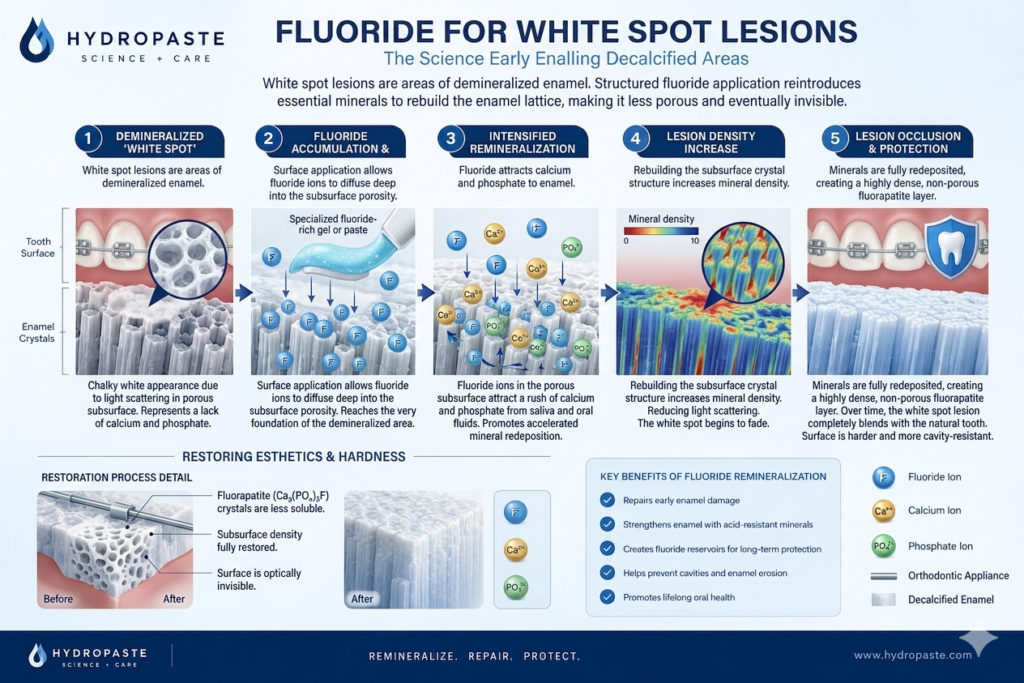
White spot lesions are one of the most important use cases for fluoride remineralization science. These early lesions occur when enamel loses minerals but has not yet collapsed into a cavity.
How Fluoride Helps White Spots
Fluoride can help by:
Reducing further demineralization
Encouraging mineral redeposition
Strengthening the lesion surface
Supporting acid-resistant mineral formation
Working with calcium and phosphate from saliva
Realistic Expectations
Fluoride can help early white spots, but results depend on the lesion. Some white spots are shallow and responsive. Others are deep, old, developmental, or caused by fluorosis rather than active demineralization.
Professional options such as fluoride varnish, resin infiltration, microabrasion, whitening balance, or restorative treatment may be needed for cosmetic or advanced cases.
Fluoride vs Hydroxyapatite: Different Mechanisms, Different Strengths
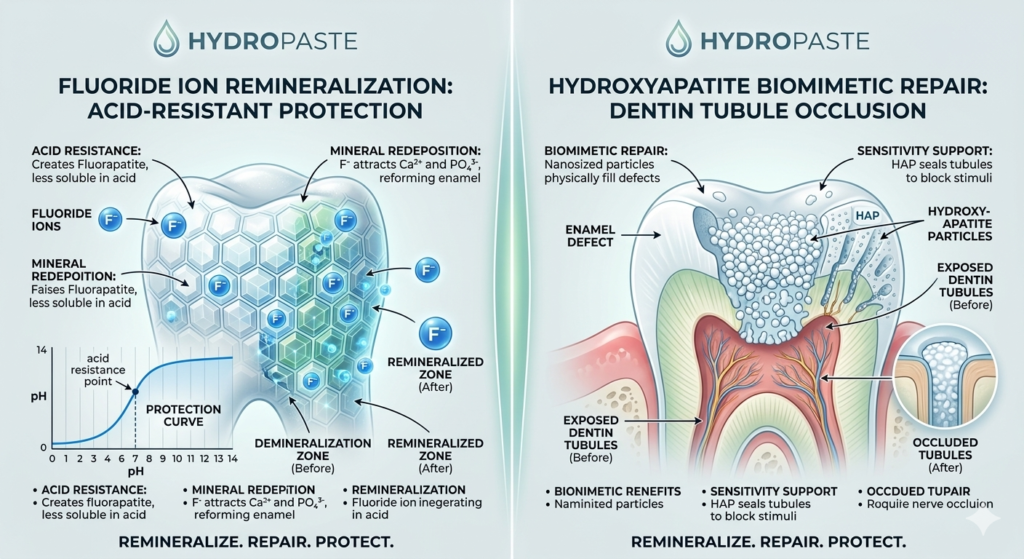
Fluoride and hydroxyapatite both support enamel remineralization, but they act through fundamentally different biological pathways. Fluoride primarily enhances acid resistance by modifying the mineral phase of enamel, while hydroxyapatite provides biomimetic calcium-phosphate particles that can directly integrate into enamel micro-defects and help occlude exposed dentinal tubules, supporting sensitivity relief and structural repair.
For a deeper comparison of their mechanisms, see ha vs fluoride.
Fluoride vs Hydroxyapatite Comparison Chart
| Category | Fluoride | Hydroxyapatite |
|---|---|---|
| Main mechanism | Acid-resistant remineralization chemistry | Tooth-like mineral deposition |
| Best for | High cavity risk and traditional caries prevention | Fluoride-free enamel support and sensitivity |
| Sensitivity support | Moderate; stronger as stannous fluoride | Strong through tubule occlusion |
| White spot support | Strong for early lesions | Strong potential for early lesions |
| Evidence history | Long-established public-health and clinical use | Growing evidence base |
| Fluoride-free | No | Usually yes |
| Best user | Frequent cavities, orthodontic risk, dry mouth | Fluoride-avoidant users, sensitivity, mild enamel roughness |
Which Is Better?
The better choice depends on risk. A person with frequent cavities, dry mouth, orthodontic plaque traps, or exposed roots may benefit more from fluoride. A person who wants fluoride-free daily mineral support may prefer hydroxyapatite.
Many readers should not frame this as a fight. Fluoride is strong for acid resistance and cavity prevention. Hydroxyapatite is strong for biomimetic surface support and sensitivity. Some future formulas may combine both.
For the biomimetic pathway, read hydroxyapatite mechanism.
Fluoride vs Calcium Phosphate Systems
Calcium phosphate systems supply or stabilize calcium and phosphate minerals near enamel. Fluoride helps those minerals become more protective and acid-resistant.
How They Work Together
Fluoride needs calcium and phosphate to remineralize enamel effectively. Saliva usually provides those minerals. Calcium phosphate systems may help when the oral environment needs extra mineral support.
Comparison Table
| Category | Fluoride | Calcium Phosphate Systems |
|---|---|---|
| Main role | Enhances remineralization and acid resistance | Supplies or stabilizes mineral ions |
| Best for | Cavity prevention and early lesion repair | Mineral support and enamel balance |
| Works through | Fluoride ions, plaque/saliva reservoirs, acid resistance | Calcium/phosphate delivery |
| Common forms | Sodium fluoride, stannous fluoride, varnish | CPP-ACP, ACP, TCP, bioactive glass |
| Best together? | Often yes | Often yes |
For deeper mineral-delivery science, see calcium phosphate systems.
Where Fluoride Shows Up
1. Standard Fluoride Toothpaste
This is the daily-use foundation for most people. It is affordable, widely available, and appropriate for routine cavity prevention when used correctly.
2. Stannous Fluoride Toothpaste
This is often the best fluoride category for people who also have sensitivity, plaque, gingivitis, or gumline issues.
3. Fluoride Mouthwash
Fluoride rinses may help people with orthodontic appliances, cavity risk, or hard-to-clean areas. They should not replace brushing and flossing.
4. Fluoride Varnish
Fluoride varnish is applied professionally and stays in contact with teeth longer than toothpaste. It is often used for children, high-risk adults, exposed roots, and early lesions.
5. Prescription High-Fluoride Toothpaste
Prescription fluoride toothpaste is usually recommended for people with high caries risk, radiation-related dry mouth, root cavities, orthodontic risk, or repeated decay.
6. Fluoridated Drinking Water
Community water fluoridation is a public-health strategy used in many areas. It is separate from toothpaste and depends on local regulation, water supply, and public health policy.
Costs: What Fluoride Remineralization Products Usually Cost
Fluoride is one of the most affordable enamel-protection strategies. Costs rise when products become professional, prescription-strength, or specialized for sensitivity and gumline care.
Fluoride Cost Chart
| Product Type | Typical Cost Level | Best For |
|---|---|---|
| Standard fluoride toothpaste | Low | Daily cavity prevention |
| Premium fluoride toothpaste | Low to mid | Sensitivity, whitening, enamel support |
| Stannous fluoride toothpaste | Low to mid | Cavities + sensitivity + gumline support |
| Fluoride mouthwash | Low to mid | Add-on cavity prevention |
| Fluoride varnish | Professional cost | High-risk users and children |
| Prescription fluoride toothpaste | Mid to professional | Dentist-guided high-risk care |
| Custom trays with fluoride gel | Higher | Severe dry mouth or high-risk cases |
Best Value Strategy
For most people, the best value is consistent use of a well-formulated fluoride toothpaste twice daily. For high-risk users, professional fluoride may save money over time by reducing future fillings, root cavities, emergency visits, and sensitivity-related treatments.
Risks and Limitations
Fluoride Cannot Repair an Open Cavity
Fluoride supports remineralization of early enamel lesions. It cannot rebuild a tooth after the surface collapses. Cavities, cracks, infections, and deep decay require dental care.
Children Need Supervised Use
Children should use age-appropriate toothpaste amounts and avoid swallowing. Excess fluoride intake during tooth development can contribute to dental fluorosis, which may appear as white streaks or mottling on developing teeth.
Prescription Fluoride Is Not for Casual Use
High-fluoride toothpaste and gels should be used under dental direction. More fluoride is not always better. The goal is correct exposure for the user’s risk level.
Fluoride Controversy Requires Context
Fluoride has become a public debate topic in some countries, especially around water fluoridation and supplements. For toothpaste, the mainstream dental position remains that fluoride toothpaste is effective when used correctly. Recent U.S. public discussion has focused more on systemic fluoride supplements and water policy than on ordinary adult fluoride toothpaste use. (AP News)
Dry Mouth and Diet Can Overpower Fluoride
Fluoride helps, but constant acid exposure, frequent sugar intake, severe dry mouth, heavy plaque, and acidic sipping habits can still overwhelm enamel.
Abrasion Still Matters
A toothpaste can contain fluoride and still be too abrasive for someone with erosion, recession, or exposed dentin. Enamel repair requires both chemistry and gentle mechanics.
Trends & Latest Tech in Fluoride Remineralization Science
Stannous Fluoride Resurgence
Stannous fluoride is becoming more prominent because it addresses more than cavities. It supports enamel protection, plaque control, gingivitis reduction, and sensitivity relief in one active system. This makes it commercially powerful for users who have both enamel and gumline concerns. (PMC)
Fluoride + Hydroxyapatite Hybrid Formulas
Some brands are exploring formulas that combine fluoride’s acid resistance with hydroxyapatite’s biomimetic mineral deposition. This may become a major category for users who are not strictly fluoride-free.
White Spot Lesion Management
Orthodontic white spots continue to drive interest in remineralization technologies. Fluoride remains central, but hydroxyapatite, resin infiltration, calcium phosphate systems, and combination approaches are increasingly compared in white spot research. (PMC)
Lower-Abrasion Enamel Toothpaste
Consumers are becoming more aware that enamel protection is not just about fluoride concentration. Low-abrasion formulas are important for people with sensitivity, acid wear, recession, and exposed dentin.
Risk-Based Fluoride Use
The future of fluoride is likely more personalized: standard fluoride for routine users, stannous fluoride for gumline/sensitivity users, prescription fluoride for high-risk users, and fluoride-free hydroxyapatite for people with lower caries risk who prefer biomimetic alternatives.
Upcoming Models in Fluoride Oral Care
1. Personalized Fluoride Protocols
Future fluoride recommendations may depend on saliva flow, cavity history, oral pH, orthodontic status, root exposure, diet, and microbiome risk rather than one-size-fits-all advice.
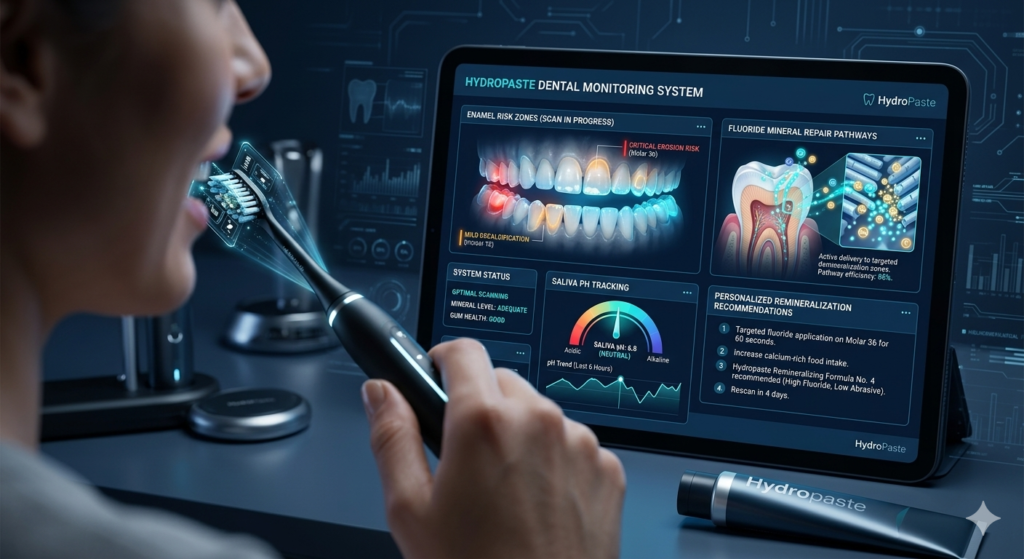
2. Smart Toothbrush Integration
Connected toothbrushes may eventually track missed areas and recommend targeted fluoride use for high-risk zones such as molars, gumline margins, and orthodontic plaque traps.
3. Fluoride + Mineral Delivery Systems
Expect more formulas combining fluoride with calcium phosphate, hydroxyapatite, bioactive glass, or other mineral delivery systems.
4. Post-Orthodontic Remineralization Kits
White spot lesions after braces may drive home-care systems that combine fluoride toothpaste, mineral gel, low-abrasion polishing, and professional monitoring.
5. Enamel Repair Products With Risk Labels
Instead of vague claims like “strengthens enamel,” future products may be marketed by risk type: dry mouth, braces, root cavities, sensitivity, post-whitening, or acid erosion.
Charts & Tables
Fluoride Remineralization Mechanism
| Mechanism | Scientific Meaning | Practical Benefit |
|---|---|---|
| Inhibits demineralization | Slows mineral loss during acid attacks | Less enamel breakdown |
| Enhances remineralization | Helps calcium and phosphate return | Early lesion repair support |
| Forms acid-resistant mineral | Supports fluoridated apatite-like surfaces | Better acid resistance |
| Creates fluoride reservoirs | Calcium fluoride-like deposits release fluoride | Longer protection |
| Affects bacterial metabolism | Can reduce acid production under certain conditions | Less plaque acid stress |
| Works with saliva | Uses calcium/phosphate from saliva | Better mineral balance |
Fluoride Product Decision Matrix
| User Type | Best Fluoride Option | Why |
|---|---|---|
| Average adult | Standard fluoride toothpaste | Affordable daily prevention |
| Frequent cavities | Prescription fluoride or dentist-guided protocol | Higher protection needed |
| Braces or aligners | Fluoride toothpaste + rinse if advised | Plaque traps increase risk |
| Sensitivity + gumline plaque | Stannous fluoride toothpaste | Multi-benefit support |
| Children at risk | Age-appropriate fluoride with supervision | Prevents decay while limiting swallowing |
| Dry mouth | Fluoride toothpaste + professional guidance | Saliva deficiency increases risk |
| Exposed roots | Fluoride varnish or prescription paste | Root surfaces decay faster |
Fluoride vs Other Enamel Ingredients
| Ingredient | Main Strength | Best User |
|---|---|---|
| Fluoride | Acid-resistant remineralization | Cavity-prone users |
| Stannous fluoride | Cavities + gumline + sensitivity | Plaque and sensitivity users |
| Hydroxyapatite | Tooth-like mineral deposition | Fluoride-free enamel support users |
| Nano-hydroxyapatite | Surface defect filling and tubule occlusion | Sensitivity and white spot users |
| Calcium phosphate | Mineral availability | Enamel mineral support users |
| Bioactive glass | Mineral release and tubule support | Sensitivity-focus |
When Fluoride Is the Better Choice
Fluoride may be the better starting point when the main concern is decay risk rather than general enamel wellness.
Fluoride Is Often Stronger For:
Repeated cavities
High sugar frequency
Orthodontic plaque traps
Dry mouth
Exposed root surfaces
Children with caries risk
Patients advised to use prescription toothpaste
People with early active caries lesions
Hydroxyapatite May Be Preferred For:
Fluoride-free preference
Mild sensitivity
Surface smoothing
Biomimetic mineral support
Lower cavity risk users
Users who dislike fluoride toothpaste
Parents seeking dentist-approved fluoride-free options
Stannous Fluoride May Be Preferred For:
Sensitivity plus plaque
Gingivitis risk
Gumline inflammation
Bad breath linked to plaque
Root sensitivity
Cavity risk with soft-tissue concerns
For the soft-tissue and sensitivity-focused fluoride category, continue to stannous fluoride effects.
Practical Fluoride Routine
Morning Routine
Brush for two minutes with fluoride toothpaste. Use a soft toothbrush and light pressure. Spit out the excess foam. Avoid aggressive rinsing immediately after brushing if the goal is to keep fluoride in contact with the tooth surface.
After Meals
Rinse with water after acidic or sugary foods. Let saliva recover before brushing, especially after citrus, soda, energy drinks, wine, vinegar-heavy foods, or reflux episodes.
Night Routine
Night brushing is critical because saliva flow decreases during sleep. Fluoride toothpaste before bed helps leave protective fluoride in the mouth during a lower-saliva period.
High-Risk Add-On
If cavities keep returning, ask a dentist about fluoride varnish, prescription-strength toothpaste, dry mouth treatment, diet timing, or a customized prevention plan.
FAQs
What is fluoride remineralization science?
Fluoride remineralization science explains how fluoride helps weakened enamel recover minerals before a cavity forms. When acids pull calcium and phosphate from enamel, fluoride helps slow mineral loss and encourages those minerals to return. It also supports formation of more acid-resistant mineral at the tooth surface.
Fluoride works best when the enamel lesion is early and non-cavitated. Once a cavity opens, fluoride can help protect surrounding tooth structure, but it cannot rebuild the missing tooth.
How does fluoride toothpaste repair early enamel damage?
Fluoride toothpaste repairs early enamel damage by leaving fluoride in saliva, plaque fluid, and on the tooth surface after brushing. When acid attacks occur, that fluoride helps reduce mineral loss and supports calcium and phosphate returning to weakened enamel.
The effect is gradual. Fluoride toothpaste is not a one-time repair treatment. It works through repeated daily exposure, especially when combined with good plaque control, low sugar frequency, and enough saliva.
Is stannous fluoride better than sodium fluoride for enamel remineralization?
Stannous fluoride and sodium fluoride both support cavity prevention and enamel remineralization, but stannous fluoride offers broader benefits. It can help with sensitivity, plaque, gingivitis, and gumline concerns in addition to fluoride-based enamel protection.
Sodium fluoride is a strong general anticavity ingredient. Stannous fluoride may be a better choice when the user has sensitivity, bleeding gums, gumline plaque, or exposed dentin. For a purely cavity-prevention routine, either may be appropriate depending on the formula and dental advice.
Can fluoride reverse white spots on teeth?
Fluoride can help remineralize some white spot lesions if they are early and the enamel surface is still intact. It helps by reducing further mineral loss and supporting calcium-phosphate redeposition.
However, not all white spots are the same. Some are deep, old, developmental, fluorosis-related, or cosmetic rather than active decay. If a white spot does not improve with oral hygiene and remineralization, a dentist may recommend resin infiltration, microabrasion, whitening balance, or another professional treatment.
Is fluoride toothpaste safe for daily use?
Fluoride toothpaste is considered safe for daily use when used as directed. Adults usually brush with a pea-sized amount or according to product directions. Children need supervision to avoid swallowing excess toothpaste.
The main safety issue is overexposure during tooth development, which can contribute to dental fluorosis. This is why children should use age-appropriate amounts and why prescription fluoride products should be used only under dental guidance.
People Also Ask
Does fluoride rebuild enamel?
Fluoride does not rebuild lost enamel the way bone heals after a fracture. It helps remineralize early weakened enamel by supporting mineral redeposition and improving acid resistance. If the enamel surface is intact, fluoride can help strengthen that area.
If enamel has already broken into a cavity, fluoride cannot fill the hole. Dental treatment is needed to restore lost structure.
What type of fluoride is best for tooth decay prevention?
The best fluoride type depends on the user. Sodium fluoride is widely used and effective for general cavity prevention. Sodium monofluorophosphate is also common in anticavity toothpaste. Stannous fluoride may be better when tooth decay risk is paired with sensitivity, plaque, or gumline inflammation.
High-risk users may need prescription fluoride toothpaste or professional fluoride varnish. The best choice should match cavity history, age, dry mouth status, exposed roots, and dental advice.
How long does fluoride take to remineralize enamel?
Fluoride begins working after brushing by increasing fluoride availability in saliva and plaque fluid. However, meaningful remineralization usually requires consistent use over weeks or months. White spot improvement, sensitivity reduction, and enamel strengthening depend on lesion depth, saliva flow, diet, brushing habits, and plaque control.
Fluoride is best understood as a daily prevention and repair-support system, not an instant enamel treatment.
Should I rinse after brushing with fluoride toothpaste?
Many dental professionals advise spitting out toothpaste after brushing rather than rinsing heavily with water immediately. The reason is simple: rinsing can wash away fluoride that would otherwise remain on teeth and in saliva for longer contact.
A light spit-and-leave approach is especially useful at night, when saliva flow decreases and enamel may benefit from longer fluoride exposure.
Is fluoride or hydroxyapatite better for cavities?
Fluoride is usually the stronger first choice for people with high cavity risk because it has a long history in caries prevention and acid-resistant remineralization. Hydroxyapatite may be useful for fluoride-free enamel support, sensitivity, and surface repair.
For frequent cavities, dry mouth, exposed roots, orthodontic appliances, or repeated fillings, fluoride is often the more appropriate foundation. For lower-risk users who prefer fluoride-free oral care, hydroxyapatite may be a reasonable alternative.
Editorial Insight
Fluoride remineralization science is not about coating teeth with a protective paint. It is about changing the chemistry of enamel under pressure. Every day, enamel moves through cycles of mineral loss and mineral repair. Fluoride helps the repair side win more often.
Its value comes from several overlapping actions: slowing demineralization, helping calcium and phosphate return, supporting acid-resistant mineral formation, creating fluoride reservoirs, and strengthening the tooth’s response to future acid attacks. That is why fluoride remains central in cavity prevention, white spot management, orthodontic care, dry mouth risk, exposed root protection, and high-risk dental prevention.
At the same time, fluoride is not the only mineral story. Hydroxyapatite offers biomimetic surface support. Calcium phosphate systems supply mineral-building blocks. Stannous fluoride expands fluoride’s role into sensitivity and gumline care. Biomimetic compounds point toward a future where enamel repair becomes more personalized.
The Hydropaste.com homepage connects enamel science with practical toothpaste decisions for sensitivity, white spots, acid wear, and daily mineral protection.