
Oral Microbiome Balance: The Complete Guide to Healthier Breath, Gums, Enamel and Daily Oral Flora in 2026
Updated July, 2026.
Amazon Affiliate Disclosure
Hydropaste.com participates in affiliate programs, including the Amazon Services LLC Associates Program. This means we may earn a small commission when you buy through qualifying links on this page, at no extra cost to you. Our editorial recommendations are written to help readers understand oral care science, ingredient quality, daily routine design, and product suitability before making a purchase.
Why Oral Microbiome Balance Is Becoming the New Standard in Oral Care
Oral microbiome balance is the next major shift in dental care because the mouth is not a sterile surface to be disinfected into silence. It is a living ecosystem. Every tooth, gumline, tongue surface, cheek, and saliva layer contains microbial communities that can either protect your mouth or push it toward plaque overgrowth, gum inflammation, bad breath, dry mouth, sensitivity, and enamel stress.
THE SHIFT FROM KILLING BACTERIA TO BALANCING THEM
For decades, oral care was described in very simple language: kill germs, whiten teeth, freshen breath. That philosophy built the popularity of antiseptic mouthwash formulas—especially those containing alcohol or harsh oxidizers. The mouth does need bacterial control, but it also needs microbial balance. A healthy oral microbiome is not the absence of bacteria. It is the presence of the right microbial relationships, supported by saliva, mineral availability, pH stability, gentle cleaning, enamel-safe ingredients, and routines that avoid harsh disruption.
This is where alcohol free mouthwash powered by hydroxyapatite changes everything.
This pillar page is the main Hydropaste guide to oral microbiome balance. It connects the science of oral flora with practical routines, product decisions, ingredient comparisons, and problem-solving guides. For a broader view of modern oral care, start from the Hydropaste homepage and use this page as your central map for microbiome-friendly dental care.
Quick Picks: Jump to the Section You Need
| Need | Best Section |
|---|---|
| I am new to the topic | Microbiome 101 |
| I have bad breath | Microbiome Imbalance Problems |
| My gums feel inflamed | Dysbiosis and Gum Health |
| I want a safer mouthwash | Restoration Tools |
| I want product comparisons | Product Guides & Reviews |
| I need a complete routine | Routine Systems |
| I want ingredient science | Ingredient Science |
What This Guide Is For
This guide is designed to help readers understand how the oral microbiome works, why it becomes imbalanced, and how to choose oral care products that support a healthier bacterial environment without abandoning cavity prevention, gum care, breath control, or enamel repair.
It is especially useful if you are comparing:
- alcohol-free mouthwash vs antiseptic mouthwash
- hydroxyapatite toothpaste vs fluoride toothpaste
- probiotics for oral health vs traditional breath products
- prebiotic toothpaste vs standard toothpaste
- tongue cleaning vs mouthwash for bacterial control
- daily oral microbiome routines vs aggressive whitening systems
This page also acts as the central pillar for the Hydropaste Oral Microbiome Balance category. Each section introduces a topic and links deeper into dedicated articles.
Who Needs Oral Microbiome Balance Support?
Oral microbiome care is not only for people with severe dental problems. It is useful for anyone who wants a healthier mouth over time, especially those who experience recurring symptoms even after brushing regularly.
You may benefit from a microbiome-friendly oral care strategy if you have:
- persistent bad breath despite brushing
- plaque buildup that returns quickly
- bleeding or irritated gums
- dry mouth or thick saliva
- sensitivity after whitening
- recurring cavities
- a coated tongue
- mouth dryness from medications
- post-antibiotic oral changes
- frequent use of harsh antiseptic rinses
- a desire to use gentler daily oral care products
A key point: oral microbiome balance does not replace dental treatment. If you have pain, swelling, deep pockets, loose teeth, pus, fever, spreading infection, or unexplained bleeding, you need professional dental care. Microbiome support works best as a daily maintenance strategy, not as a substitute for diagnosis.
Benefits of Oral Microbiome Balance
1. Fresher Breath That Is Not Just Perfumed
Most bad breath products mask odor with mint, menthol, or strong flavoring. Microbiome-focused breath care looks deeper. It asks why odor-producing bacteria are thriving on the tongue, between teeth, near the gumline, or in dry-mouth conditions.
A balanced approach may include tongue cleaning, hydration, saliva support, gentle rinsing, flossing, and low-disruption formulas. For more targeted guidance, read Bad Breath Microbiome Cause.
2. Better Gum Comfort
Gum inflammation is often linked to plaque biofilm, bacterial imbalance, immune response, and poor interdental cleaning. A microbiome-friendly gum strategy focuses on reducing harmful bacterial load without aggressively stripping the mouth every day.
That usually means consistent brushing, interdental cleaning, tongue care, alcohol-free rinsing, mineral support, and avoiding products that leave the mouth dry or irritated. Explore the deeper guide on Gum Inflammation and Bacterial Dysbiosis.
3. Improved Plaque Control
Plaque is not just “dirt” on teeth. It is a structured biofilm. Once plaque matures, it becomes more difficult to remove and can create acidic or inflammatory micro-environments around teeth and gums.
Microbiome balance does not mean letting plaque stay. It means removing plaque mechanically while choosing products that support pH, minerals, and soft-tissue comfort. The practical explanation continues in Plaque Overgrowth Explained.
4. Enamel-Supportive Daily Care
A healthy oral microbiome works closely with saliva and minerals. When the mouth becomes acidic, dry, or heavily colonized by acid-producing bacteria, enamel can become more vulnerable. This is where hydroxyapatite, fluoride, xylitol, and saliva-friendly routines enter the conversation.
For a mineral-focused path, see Hydroxyapatite and Microbiome Repair.
5. A Gentler Long-Term Routine
Many people damage their oral comfort by overcorrecting: brushing too hard, rinsing too often with harsh formulas, whitening aggressively, or using multiple strong products at once. Microbiome balance encourages a quieter, more strategic routine.
The best routine is not the most intense. It is the one you can repeat daily without drying the mouth, irritating the gums, or making sensitivity worse.
Microbiome 101: Understanding the Oral Ecosystem
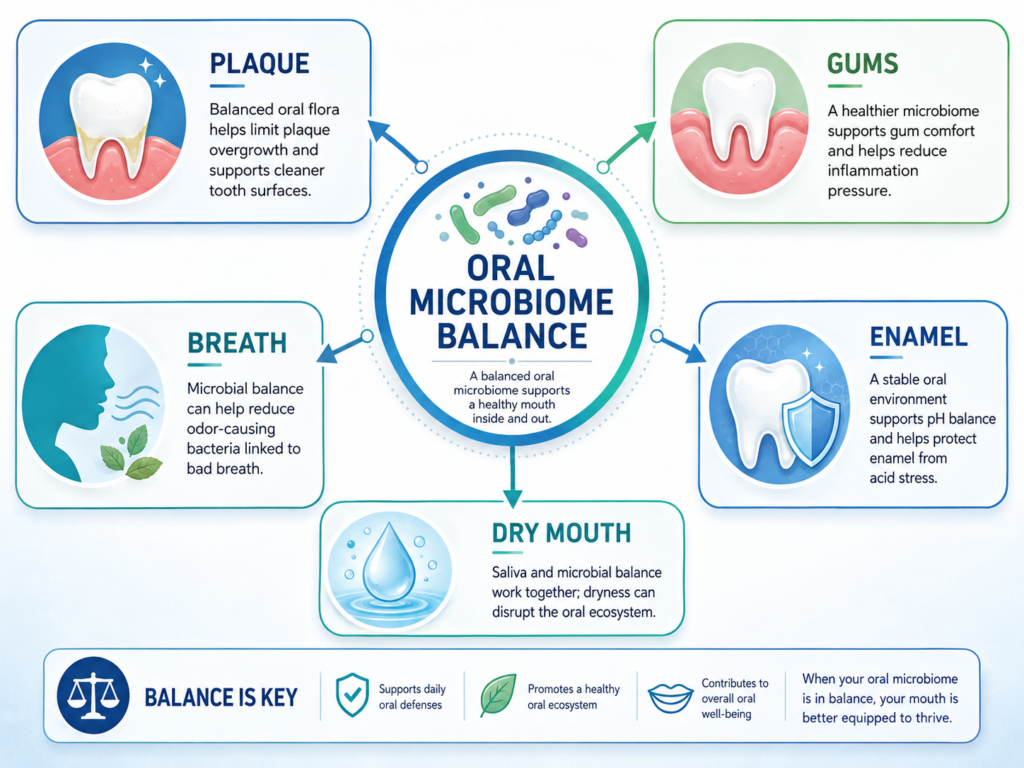
What Is the Oral Microbiome?
The oral microbiome is the community of microorganisms living in the mouth. It includes bacteria, fungi, viruses, and other microbial life forms that interact with teeth, gums, saliva, tongue surfaces, and soft tissues.
A healthy oral microbiome helps maintain balance. A disrupted microbiome can allow acid-producing, odor-producing, or inflammation-associated organisms to dominate. Start with What Is Oral Microbiome? for a beginner-friendly explanation.
Good Bacteria vs Bad Bacteria in the Mouth
The mouth is not divided into perfectly good and bad organisms. The more accurate idea is ecological behavior. Some bacteria become harmful when conditions favor overgrowth, acidity, dryness, or biofilm maturity.
For example, a microbe that exists harmlessly in one environment may become problematic when saliva is low, sugar exposure is frequent, or plaque is not removed. This is why balance matters more than total elimination. Learn more in Good Bacteria vs Bad Bacteria in Mouth.
Oral Microbiome and Tooth Decay Link
Tooth decay is strongly influenced by acid production, sugar frequency, plaque biofilm, enamel mineral loss, saliva quality, and bacterial patterns. When acid-producing bacteria dominate and the mouth does not recover its pH quickly, enamel loses mineral faster than it can rebuild.
That is why a decay-prevention routine should combine mechanical cleaning, mineral support, diet awareness, and microbiome-friendly product selection. Read Oral Microbiome and Tooth Decay Link.
Oral Microbiome and Gum Disease Explained
Gum disease is not only about bacteria being present. It is about the interaction between biofilm, immune response, inflammation, and tissue breakdown. When plaque biofilm remains near the gumline, the body may respond with inflammation. Over time, this can progress from gingival irritation to deeper periodontal problems.
For the full breakdown, visit Oral Microbiome and Gum Disease Explained.
Microbiome Imbalance Problems
Bad Breath and Microbial Odor
Bad breath often comes from volatile sulfur compounds produced by bacteria on the tongue, gum pockets, tonsil areas, or dry-mouth surfaces. Mint alone does not correct the microbial environment. A better strategy includes tongue scraping, interdental cleaning, hydration, saliva support, and appropriate rinsing.
Gum Inflammation and Bacterial Dysbiosis
Dysbiosis means microbial imbalance. Around the gums, dysbiosis can encourage inflammation, bleeding, tenderness, and persistent plaque. The goal is not to sterilize the gums but to reduce harmful biofilm pressure while supporting a healthier oral environment.
Plaque Overgrowth Explained
Plaque becomes more difficult to manage when it matures into organized biofilm. The more stable the biofilm becomes, the more it can shelter bacteria and influence local pH. Daily disruption with brushing and interdental cleaning is still the foundation.
Dry Mouth and Microbiome Collapse
Saliva is one of the mouth’s most important defense systems. It buffers acids, carries minerals, helps wash away debris, and supports microbial balance. Dry mouth can shift the ecosystem toward odor, plaque, irritation, and decay risk.
Read the deeper guide on Dry Mouth and Microbiome Collapse.
Post-Antibiotic Oral Flora Disruption
After antibiotics, some people notice changes in breath, taste, tongue coating, dryness, or oral comfort. Antibiotics can affect microbial communities beyond the original infection target. A recovery routine may include gentle oral hygiene, hydration, tongue care, probiotic discussion with a clinician, and avoiding harsh overuse of antiseptic products.
Explore Post-Antibiotic Oral Flora Disruption.
Microbiome Restoration Tools
Microbiome-Friendly Mouthwashes
A microbiome-friendly mouthwash should freshen breath and support plaque control without leaving the mouth feeling stripped, burned, or dry. Many people do better with alcohol-free formulas, pH-conscious rinses, mineral-supporting mouthwashes, or products designed for daily use rather than aggressive short-term antiseptic treatment.
Read Microbiome-Friendly Mouthwashes.
Hydroxyapatite and Microbiome Repair
Hydroxyapatite is valued because it supports enamel mineralization and can fit into gentler oral care routines. It does not frame oral health as a war against all bacteria. Instead, it supports the tooth surface while routine cleaning and saliva help maintain balance.
HOW HYDROXYAPATITE MOUTHWASH SUPPORTS GINGIVITIS RECOVERY
If you’re searching for a mouthwash for gingivitis, the goal should not be just reducing bacteria—it should be restoring the environment that prevents inflammation.
Hydroxyapatite-based rinses help by:
- Coating exposed dentin and reducing sensitivity
- Lowering plaque adhesion (a key trigger for gingivitis)
- Supporting gum healing without chemical irritation
This makes them a smarter long-term solution compared to harsh antiseptics.
What is the best mouthwash for gingivitis and bleeding gums?
The best mouthwash for gingivitis is one that reduces plaque while supporting gum healing without irritation. Alcohol-free formulations with hydroxyapatite and mild antibacterial agents help lower inflammation, protect enamel and promote healthier gum tissue—without the dryness caused by harsh antiseptic mouthwash.
For Hydropaste readers comparing enamel repair and microbiome support, Hydroxyapatite and Microbiome Repair is a key cluster page.
Probiotics for Oral Health
Oral probiotics are designed to introduce or support beneficial strains that may help with breath, gum comfort, plaque patterns, and oral ecosystem balance. They are not magic tablets, and results vary by strain, dosage, consistency, and the person’s baseline oral condition.
If you are researching tablets, lozenges, gums, or probiotic oral care systems, begin with Probiotics for Oral Health.
Prebiotic Toothpaste Explained
A prebiotic toothpaste is designed to support favorable oral conditions rather than simply suppress everything. Ingredients such as xylitol, arginine, and pH-supportive systems are commonly discussed in this category.
Learn more in Prebiotic Toothpaste Explained.
Alcohol-Free vs Antiseptic Mouthwash
This is one of the most important comparison points in modern oral care. Antiseptic mouthwash can have a place, especially when recommended by a dentist for specific conditions. But daily long-term use of strong antiseptic products may not be ideal for every person.
WHY TRADITIONAL MOUTHWASHES FALL SHORT
Alcohol-Based Formulas
- Kill broad-spectrum bacteria aggressively
- Cause dryness (reducing saliva, your natural defense system)
- Lead to rebound bacterial overgrowth
Hydrogen Peroxide Mouthwash
- Oxidizes bacteria but also irritates soft tissue
- Can disrupt long-term microbiome stability
- Overuse may weaken enamel structure
Conventional Antiseptic Mouthwash
- Designed for short-term infection control
- Not ideal for daily microbiome maintenance
- Often prioritizes sterilization over ecosystem health
The issue is not effectiveness—it’s overcorrection.
THIS IS WHY ALCOHOL FREE MOUTHWASH IS ESSENTIAL FOR MICROBIOME HEALTH
An alcohol free mouthwash is not just a gentler option—it is foundational for microbiome preservation.
Key Advantages:
1. Preserves Saliva Function
Saliva is your body’s natural antimicrobial system. Alcohol dries it out, while alcohol-free formulas support it.
2. Maintains Bacterial Diversity
Healthy diversity prevents dominance of harmful species.
3. Reduces Chronic Inflammation
Gentle formulations avoid irritation of gum tissue.
4. Safe for Daily, Long-Term Use
Unlike aggressive antiseptics, it supports continuous balance.
For daily oral microbiome maintenance, many users prefer alcohol-free mouthwash, mineral-supporting rinses, or gentler breath-control products. Compare the options in Alcohol-Free vs Antiseptic Mouthwash.
Product Guides & Reviews
The Hydropaste product guides are designed for readers who want practical buying help after understanding the science. The goal is to compare oral care products by formula logic, use case, sensitivity profile, breath support, gum comfort, and daily routine fit.
Best Mouthwash for Microbiome Balance
The best mouthwash for microbiome balance should support fresh breath, soft-tissue comfort, plaque control, and daily use without unnecessary harshness.
HOW TO CHOOSE THE BEST MOUTHWASH FOR MICROBIOME BALANCE
Instead of asking “which kills the most bacteria”, the better question is:
Which supports the healthiest ecosystem?
Selection Criteria:
1. Zero Alcohol Content
Non-negotiable for microbiome preservation.
2. Hydroxyapatite Presence
Prefer nano or biomimetic forms.
3. pH-Neutral or Alkalizing Formula
Avoid acidic rinses.
4. No Harsh Oxidizers (e.g., high peroxide levels)
Minimize disruption.
5. Minimal Synthetic Additives
Simpler formulas reduce irritation risk.
Alkalizing Mouthwash Systems
These go beyond neutral—they actively shift oral pH.
Characteristics:
- Hydroxyapatite + alkalizing minerals
- Designed to counter acidity (key driver of decay)
- Support beneficial bacterial growth
Best For:
- Acid reflux sufferers
- High sugar diet correction
- Preventing enamel erosion
Are alkalizing mouthwashes worth it?
Yes—alkalizing mouthwashes can be worth it, but only when used in the right context. They work by raising oral pH, making the environment less favorable for acid-producing bacteria that contribute to cavities and gum disease. This supports a healthier microbiome rather than disrupting it.
Key takeaway:
Alkalizing mouthwashes are valuable for pH control and microbiome balance, but they should complement—not replace—a complete oral care routine.
Therapeutic Hybrid Mouthwashes
What are therapeutic hybrid mouthwashes and are they effective?
Therapeutic hybrid mouthwashes combine hydroxyapatite with mild antibacterial agents to deliver both protection and microbiome balance. Unlike traditional antiseptic mouthwash, they reduce harmful bacteria without fully disrupting beneficial species, making them effective for managing early gum issues while still supporting enamel repair.
Characteristics:
- Balanced antimicrobial activity
- Reduced reliance on alcohol or peroxide
- Targeted support for gum issues
Best For:
- Early-stage gingivitis
- Transitioning from antiseptic mouthwash
- Users needing both protection and balance
Best Toothpaste for Healthy Oral Flora
A microbiome-aware toothpaste should clean effectively while supporting enamel, pH, and gum comfort. Hydroxyapatite, fluoride, xylitol, arginine, and low-irritation flavoring systems may all be relevant depending on the user. Read Best Toothpaste for Healthy Oral Flora.
Best Probiotic Oral Care Products
Probiotic oral care products can include lozenges, gums, tablets, rinses, and toothpaste systems. The most important buying questions are strain specificity, intended outcome, consistency, and whether the product fits your daily routine. Continue with Best Probiotic Oral Care Products.
Best Tongue Cleaners for Bacterial Control
The tongue is a major reservoir for odor-producing bacteria and coating. A tongue cleaner can be one of the simplest upgrades for bad breath and microbial control. Read Best Tongue Cleaners for Bacterial Control.
Best Electric Brush for Microbiome Health
An electric toothbrush can help disrupt plaque more consistently than manual brushing for many users. The microbiome angle is not about vibration alone; it is about reliable biofilm removal without aggressive brushing pressure. Compare options in Best Electric Brush for Microbiome Health.
Best Hydroxyapatite Mouthwashes
Hydroxyapatite mouthwashes are becoming a serious requirement for people who want more than a minty rinse. Traditional mouthwashes have usually centered around “fresh breath” and “germ killing”, but the modern oral care customer is looking for something more intelligent: enamel support, sensitivity comfort, alcohol-free freshness, pH balance, and a routine that does not disrupt the oral microbiome every morning and night.
That is where hydroxyapatite mouthwash earns its place inside an oral microbiome balance routine. Hydroxyapatite is a calcium phosphate mineral closely related to the mineral structure of tooth enamel. In toothpaste, it is usually discussed for remineralization and sensitivity support. In mouthwash, the value proposition is slightly different: a rinse can help carry mineral-supporting ingredients across the mouth, around the gumline, between teeth, and over enamel surfaces that may not receive enough contact from brushing alone.
The best hydroxyapatite mouthwash should not be judged by one ingredient only. A formula can include hydroxyapatite and still be poorly designed if it contains irritating flavor oils, unnecessary harshness, or a mouthfeel that discourages daily use. A high-quality mineral-supporting rinse should feel gentle, leave the mouth hydrated, pair well with hydroxyapatite toothpaste and support breath without creating a “burn equals clean” sensation.
For readers researching the top hydroxyapatite mouthwashes, the most important buying criteria include:
- Hydroxyapatite type and positioning: Is hydroxyapatite a meaningful feature or just a label claim?
- Alcohol-free formula: Does the rinse avoid drying the mouth?
- Xylitol or pH support: Does it help create a more enamel-friendly oral environment?
- Sensitivity suitability: Does it feel comfortable for users with exposed dentin, gum recession, or whitening sensitivity?
- Microbiome compatibility: Does it support daily oral flora balance instead of relying only on aggressive antimicrobial action?
- Flavor intensity: Is the taste clean and repeatable, or too sharp for twice-daily use?
- Routine fit: Can it be used alongside brushing, flossing, tongue cleaning, and enamel repair toothpaste?
A strong hydroxyapatite mouthwash comparison should also separate daily maintenance rinses from treatment-style rinses. Some people need a dentist-recommended antiseptic for a specific gum issue. Others simply need an alcohol-free, mineral-supporting mouthwash that helps with breath, enamel comfort, and dry-mouth-prone routines.
The article explains when hydroxyapatite mouthwash is most useful and it may be a smart choice for users who already brush with hydroxyapatite toothpaste, people who want a fluoride-free oral care routine, those dealing with sensitivity after whitening, and readers who dislike the sting of alcohol-based rinses. It may also appeal to users who want a microbiome-friendly mouthwash that supports enamel without feeling medicinal.
This editorial angle remains balanced. Hydroxyapatite mouthwash can be useful, but it should not be positioned as a miracle rinse. It does not replace brushing, flossing, professional cleanings, cavity treatment, periodontal care, or dry mouth diagnosis. Its real strength is as a supportive daily layer: a mineral-focused rinse that may help users build a gentler, more enamel-aware, microbiome-conscious oral care routine.
Oral Microbiome Balance Tools
| Tool | Best For | Microbiome Value | Watch-Outs | Ideal User |
|---|---|---|---|---|
| Alcohol-free mouthwash | Daily breath and rinse support | Lower dryness risk than alcohol-heavy formulas | Not all alcohol-free rinses are equally gentle | Daily users, dry-mouth prone users |
| Antiseptic mouthwash | Short-term bacterial suppression | Can reduce bacterial load when appropriate | May be too aggressive for casual overuse | Dentist-guided treatment plans |
| Hydroxyapatite toothpaste | Enamel support and sensitivity-friendly routines | Supports tooth surface without harsh antimicrobial framing | Formula quality varies | Sensitivity, enamel-focused users |
| Probiotic lozenges | Breath and flora support | May support beneficial strain exposure | Strain and consistency matter | Users with recurring breath or flora disruption |
| Xylitol gum or mints | Saliva and pH support | Helps create a less acid-friendly environment | Must be sugar-free and used consistently | Snackers, dry-mouth prone users |
| Tongue scraper | Odor control | Reduces tongue coating and bacterial reservoir | Over-scraping can irritate tissue | Bad breath and coated tongue users |
| Electric toothbrush | Biofilm disruption | Better plaque consistency for many users | Too much pressure can irritate gums | Plaque-prone users |
Alcohol Free Mouthwash vs Antiseptic Mouthwash: Which Is Better for Oral Microbiome Balance?
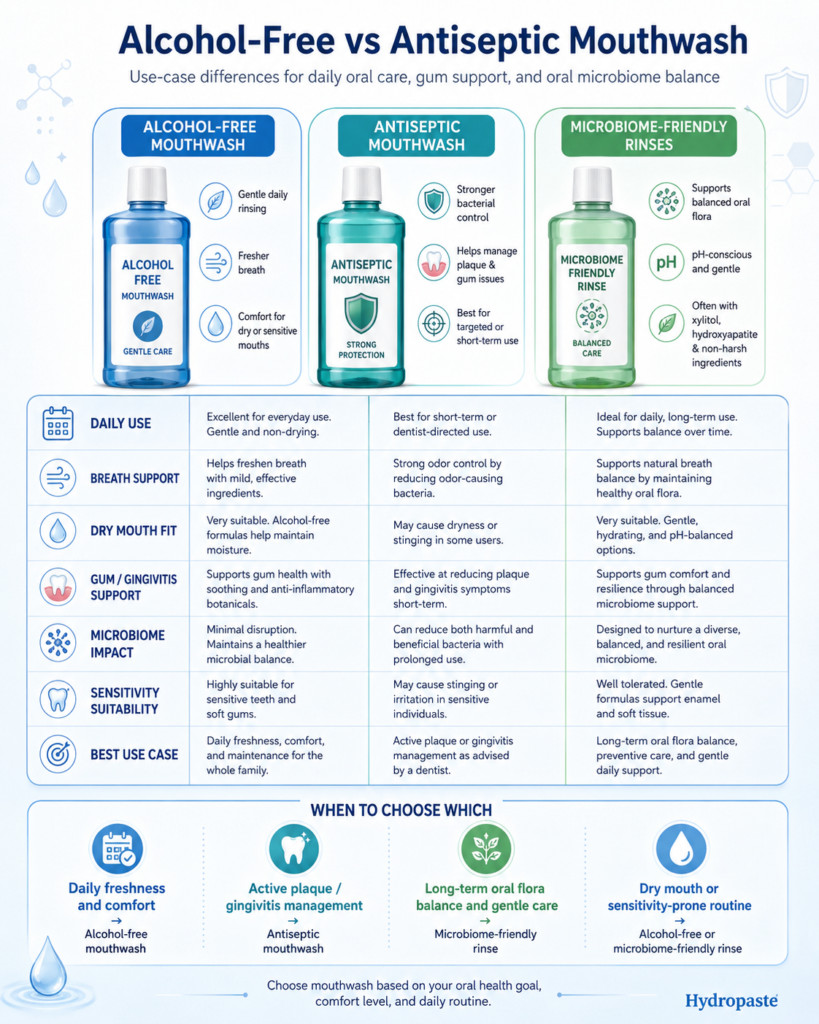
| Feature | Alcohol Free Mouthwash | Antiseptic Mouthwash |
|---|---|---|
| Daily comfort | Usually better for routine use | Can feel intense or drying |
| Breath support | Good when combined with tongue cleaning | Strong short-term odor reduction |
| Microbiome friendliness | Often better suited for maintenance | Better suited for targeted bacterial suppression |
| Gum irritation risk | Usually lower | Depends on formula and frequency |
| Best use case | Daily oral microbiome maintenance | Dentist-directed or short-term use |
| Sensitivity fit | Often better | May bother sensitive users |
| Dry mouth fit | Usually preferred | May worsen dryness in some users |
Editorial take: For most daily routines, alcohol-free mouthwash is the better starting point for oral microbiome balance. Antiseptic rinses can be useful, but they should be treated like targeted tools rather than casual lifestyle products.
The Best Mouthwash
The definition of the best mouthwash is evolving.
It is no longer the strongest antibacterial formula.
It is the one that:
- Protects enamel
- Supports beneficial bacteria
- Maintains long-term balance
Hydroxyapatite-based, alcohol free mouthwash stands at the center of this transition—bridging science, safety, and sustainability in oral care.
How do I restore oral microbiome balance?
To restore oral microbiome balance, switch to an alcohol free mouthwash, avoid overuse of harsh antiseptics and use hydroxyapatite-based products that support enamel and pH stability. Consistent oral hygiene, proper hydration, and limiting sugar intake also help beneficial bacteria thrive.
To see it step-by-step how, read our full article: How do I restore oral microbiome balance?
Routine Systems: How to Build a Microbiome-Friendly Oral Care Routine
The 7-Day Microbiome Reset
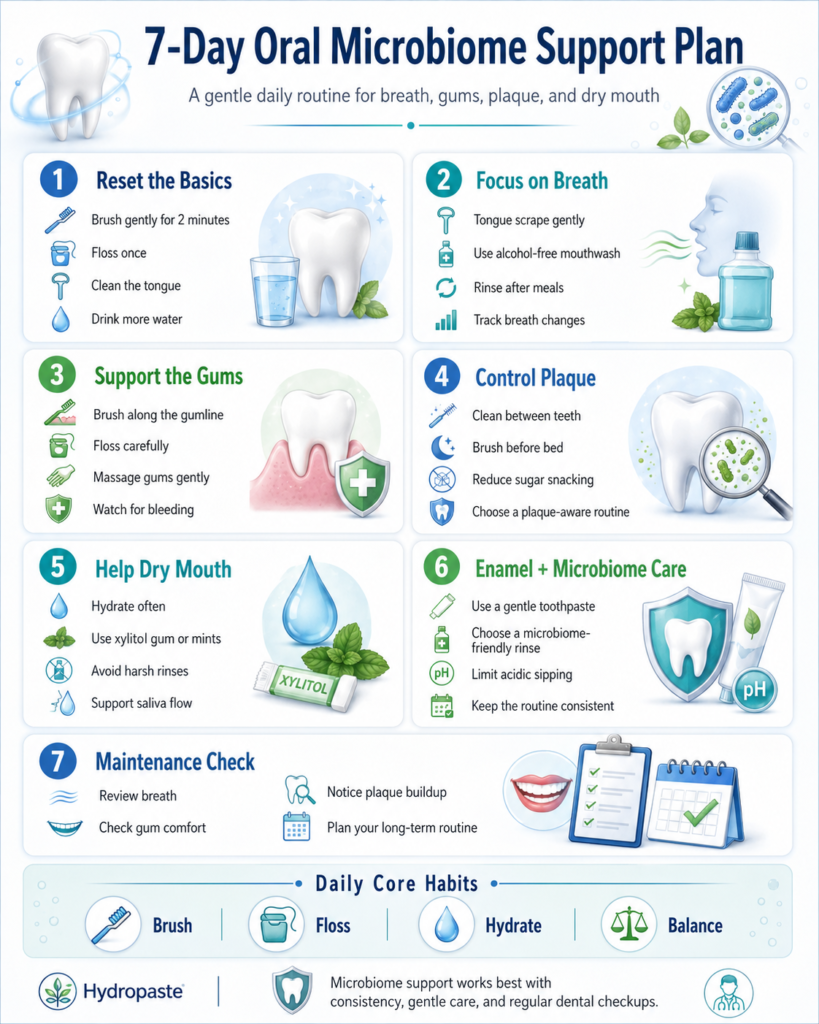
Description: Routine-based visual for Hydropaste readers showing a seven-day microbiome support plan for breath, gums, plaque, and dry mouth.
A microbiome reset does not mean extreme detoxing. It means removing routine stressors and rebuilding consistency.
A practical reset may include:
- Brush twice daily with a gentle, enamel-supporting toothpaste.
- Clean between teeth once daily.
- Use a tongue cleaner gently once daily.
- Switch to an alcohol-free mouthwash if your current rinse burns or dries your mouth.
- Reduce frequent sugar exposure.
- Hydrate consistently.
- Track breath, gum comfort, dryness, and plaque return.
For a complete schedule, use Microbiome Reset 7-Day Plan.
Daily Oral Microbiome Maintenance Routine
A strong daily routine should be boring in the best way. It should be repeatable, non-irritating, and effective.
Morning routine:
- Brush gently for two minutes.
- Clean the tongue if coated.
- Use an alcohol-free rinse if needed.
- Hydrate before coffee or acidic drinks.
Night routine:
- Floss or use interdental brushes.
- Brush with mineral-supporting toothpaste.
- Avoid rinsing aggressively after brushing if using a toothpaste that benefits from surface contact.
- Use mouthwash at a separate time if it interferes with toothpaste ingredients.
Read Daily Oral Microbiome Maintenance Routine.
Morning vs Night Microbiome Care Strategy
Morning care is about breath, freshness, and removing overnight buildup. Night care is about biofilm disruption, mineral support, and giving the mouth a stable environment during sleep.
If you can only be meticulous once per day, make it nighttime. Saliva naturally drops during sleep, so plaque, acidity, and dryness can become more influential overnight. See Morning vs Night Microbiome Care Strategy.
Whitening Without Damaging Microbiome
Whitening can be compatible with oral microbiome balance if it is not overused and if sensitivity is managed. The problem is not whitening itself; the problem is stacking whitening strips, abrasive toothpaste, harsh rinses, and aggressive brushing at the same time.
For readers who want brighter teeth without pushing the mouth into irritation, enamel stress, or microbiome disruption, Hydropaste’s guide to micro-abrasive polishing explains how stain removal, surface polishing, whitening support and enamel-safe cosmetic care can be approached more strategically.
A better strategy is to separate whitening cycles from recovery days and use mineral-supporting products between whitening sessions. Read Whitening Without Damaging Microbiome.
Sensitivity-Safe Microbiome Routine
Sensitive users should avoid routines that burn, foam aggressively, scrub heavily, or leave tissues dry. A sensitivity-safe microbiome routine should emphasize gentle brushing, hydroxyapatite or sensitivity-supportive toothpaste, alcohol-free rinsing, and low-abrasion formulas.
Visit Sensitivity-Safe Microbiome Routine.
Ingredient Science: What Actually Matters?
Chlorhexidine vs Natural Microbiome Balance
Chlorhexidine is a powerful dental antiseptic and can be useful when prescribed or recommended for specific short-term needs. It is not the same as a daily wellness rinse. Long-term casual use may cause staining, taste changes, or microbial disruption concerns.
Read Chlorhexidine vs Natural Microbiome Balance.
Essential Oils and Microbiome Effects
Essential oil mouthwashes can provide strong breath and plaque-control benefits, but some users find them intense. The key is concentration, formula design, alcohol content, and personal tolerance. A rinse can be effective and still not be ideal for every mouth.
Explore Essential Oils and Microbiome Effects.
Fluoride Impact on Oral Bacteria
Fluoride is primarily known for enamel protection and cavity prevention. Its relationship with bacteria is more nuanced than simple “kills bacteria.” Many fluoride toothpastes remain important for cavity-prone users, while hydroxyapatite formulas appeal to those looking for mineral-focused alternatives.
Read Fluoride Impact on Oral Bacteria.
Xylitol and Beneficial Bacteria Growth
Xylitol is one of the most discussed microbiome-friendly oral care ingredients because it supports a less cavity-friendly environment, especially when used consistently in gum, mints, toothpaste, or rinses. It is especially useful after meals or snacks when brushing is not practical.
Learn more in Xylitol and Beneficial Bacteria Growth.
Trends & Latest Tech in Oral Microbiome Care
1. Mineral-First Oral Care
Hydroxyapatite toothpaste and hydroxyapatite mouthwash are gaining attention because they fit the new consumer preference for enamel support, sensitivity comfort, and gentler daily routines. Instead of only promising “fresh breath,” mineral-first formulas speak to enamel resilience and long-term oral ecology.
2. Probiotic Oral Care Systems
Oral probiotics are moving from niche supplements into mainstream breath, gum, and daily oral care conversations. Lozenges and chewable formats are especially popular because they stay in the mouth longer than swallowed capsules.
3. Prebiotic Toothpaste
Prebiotic oral care focuses on creating better conditions for a healthier microbial balance. Xylitol, arginine, pH-supportive systems, and low-irritation formulas are all part of this trend.
4. Alcohol-Free Daily Rinses
The strongest consumer shift in mouthwash is away from burn-as-proof thinking. More readers now understand that a burning rinse is not automatically a better rinse. Alcohol-free mouthwash fits daily use, dry-mouth concerns, sensitivity needs, and microbiome-friendly positioning.
5. Smart Brushing and Pressure Control
Electric toothbrushes with pressure sensors, app coaching, gum protection modes, and brushing coverage feedback can help users remove biofilm without damaging gums. The future of brushing is not more force; it is better feedback.
6. Saliva-Support Oral Care
Dry mouth is no longer treated as a minor inconvenience. Saliva-support products, pH-balancing rinses, sugar-free xylitol gum, hydration reminders, and mouth-moisturizing systems are becoming more important for microbiome stability.
Upcoming Models and Product Directions to Watch
The next generation of oral microbiome products will likely move in several directions:
| Product Direction | What It May Offer | Why It Matters |
|---|---|---|
| Hydroxyapatite mouthwash upgrades | Mineral support with breath control | Bridges enamel care and microbiome maintenance |
| Probiotic lozenges by use case | Breath, gum, dry mouth, post-antibiotic support | More targeted than generic probiotics |
| Smart electric brushes | Pressure tracking and plaque mapping | Helps users remove biofilm without overbrushing |
| Prebiotic toothpaste | Xylitol, arginine, pH support | Supports a healthier oral environment |
| Low-abrasion whitening systems | Whitening with recovery support | Reduces sensitivity and irritation risk |
| Saliva-focused products | Hydration, pH buffering, dry-mouth support | Helps prevent microbiome collapse |
Cost Guide: What Oral Microbiome Balance Products Usually Cost
| Product Type | Typical Budget Range | Premium Range | Buying Advice |
|---|---|---|---|
| Alcohol-free mouthwash | $6–$12 | $15–$30 | Check ingredients, not just flavor |
| Hydroxyapatite toothpaste | $8–$15 | $18–$30 | Look for formula quality and sensitivity fit |
| Oral probiotic lozenges | $15–$30 | $35–$60 | Strain specificity matters |
| Tongue scraper | $5–$12 | $15–$30 | Stainless steel lasts longer |
| Electric toothbrush | $30–$80 | $120–$300+ | Pressure sensor is worth prioritizing |
| Xylitol gum or mints | $4–$10 | $12–$20 | Use after meals for consistency |
| Dry mouth rinse | $7–$14 | $15–$25 | Avoid formulas that feel drying |
A microbiome-friendly routine does not need to be expensive. The highest-return upgrades are usually flossing consistency, tongue cleaning, alcohol-free rinsing, and choosing a toothpaste that matches your enamel and sensitivity needs.
Risks, Mistakes and When to Be Careful
Overusing Harsh Mouthwash
Using a strong antiseptic rinse multiple times per day without dental guidance can leave some users with dryness, irritation, altered taste, or a disrupted oral environment.
Ignoring Gum Bleeding
Bleeding gums should not be normalized. If bleeding continues despite gentle brushing and interdental cleaning, it may indicate gingivitis, periodontal disease, brushing trauma, medication effects, or another issue that needs evaluation.
Treating Dry Mouth as Only a Comfort Problem
Dry mouth can increase breath issues, plaque accumulation, irritation, and decay risk. If it is persistent, especially after medication changes, medical treatment, or chronic dehydration, it deserves attention.
Whitening Too Aggressively
Whitening products can increase sensitivity when overused. A microbiome-friendly whitening plan should include recovery days, gentle toothpaste, and avoidance of harsh rinses during whitening cycles.
Believing “Natural” Always Means Better
Natural ingredients can still irritate tissue, disrupt comfort, or trigger sensitivity. Essential oils, strong flavors, baking soda-heavy formulas, charcoal powders, and acidic products should be judged by performance and tolerance, not only by label language.
Practical Framework: The Hydropaste Oral Microbiome Balance Method
Step 1: Remove the Daily Disruptors
Look for products or habits that may be making things worse: harsh rinses, aggressive brushing, frequent sugar sipping, dehydration, abrasive whitening toothpaste, or skipping interdental cleaning.
Step 2: Rebuild Mechanical Control
Brush gently, clean between teeth, and manage tongue coating. Microbiome balance starts with biofilm control.
Step 3: Support Saliva and pH
Hydrate, use xylitol when useful, avoid constant snacking, and choose products that do not dry the mouth.
Step 4: Add Mineral Support
Use hydroxyapatite or fluoride toothpaste depending on your needs, risk profile, and dentist guidance.
Step 5: Personalize by Problem
- Bad breath: tongue cleaning, interdental cleaning, alcohol-free rinse
- Dry mouth: hydration, saliva-support rinse, xylitol, medication review
- Gum inflammation: plaque control, gentle brushing, dental evaluation
- Sensitivity: low-abrasion toothpaste, hydroxyapatite, avoid harsh whitening
- Post-antibiotic changes: gentle routine, hydration, probiotic discussion
FAQ: Oral Microbiome Balance
What is the best mouthwash for oral microbiome balance?
The best mouthwash for oral microbiome balance is usually alcohol-free, non-drying, comfortable for daily use, and designed to support breath without aggressively stripping the mouth. For many users, the ideal rinse includes pH-conscious formulation, gentle breath support, and ingredients that do not leave the mouth irritated.
A strong antiseptic mouthwash may be useful in certain dental situations, but it is not always the best daily maintenance option. If your mouthwash burns, dries your mouth, worsens sensitivity, or makes your breath rebound quickly, it may not be the right fit for your oral microbiome routine.
How do you restore oral microbiome naturally after bad breath?
Restoring the oral microbiome after bad breath starts with identifying where odor is coming from. Common sources include tongue coating, gumline plaque, food debris between teeth, dry mouth, tonsil areas, and frequent sugar exposure.
A practical routine includes brushing twice daily, cleaning between teeth, gently scraping the tongue, drinking enough water, using xylitol gum after meals, and switching to an alcohol-free mouthwash. If bad breath persists despite good hygiene, a dentist should check for gum disease, cavities, infections, dry mouth causes, or digestive and medical contributors.
Is hydroxyapatite toothpaste good for oral microbiome balance?
Hydroxyapatite toothpaste can fit well into an oral microbiome balance routine because it supports the tooth surface without relying on a harsh antimicrobial concept. Its main appeal is enamel and sensitivity support, especially for users who want a mineral-focused toothpaste.
The toothpaste still needs to be part of a complete routine. Hydroxyapatite does not replace flossing, tongue cleaning, dental care, or diet awareness. It works best when paired with gentle brushing, consistent plaque control, and saliva-friendly habits.
Are probiotics for oral health worth using?
Probiotics for oral health may be worth considering for people dealing with recurring bad breath, post-antibiotic oral changes, gum discomfort, or microbiome-focused routines. The most important details are the strain, format, intended outcome, and consistency of use.
Oral probiotic lozenges are often more relevant than standard swallowed capsules because they remain in contact with the mouth. Still, probiotics should not be viewed as a cure for cavities, gum disease, or infection. They are best used as a support tool within a complete oral hygiene system.
Can alcohol free mouthwash reduce bad breath without damaging oral flora?
Alcohol-free mouthwash can help reduce bad breath while being gentler for daily use, especially when combined with tongue cleaning and interdental care. Many bad breath cases are linked to tongue coating, dry mouth, and bacterial activity in areas brushing misses.
The key is choosing a rinse that supports freshness without causing dryness or irritation. If bad breath returns quickly after rinsing, the underlying issue may not be the mouthwash; it may be plaque, tongue coating, gum inflammation, dry mouth, cavities, or tonsil-related odor.
Below are 10 SEO-optimized FAQs written for publishing inside your mouthwash / oral microbiome / gingivitis content section.
What is the best mouthwash for gingivitis and bleeding gums?
The best mouthwash for gingivitis is not always the strongest-tasting one. Gingivitis is usually driven by plaque buildup along the gumline, bacterial biofilm, poor interdental cleaning, and an inflammatory response in the gum tissue. A mouthwash can help, but it works best as a support tool, not as the main treatment. Brushing technique, flossing, interdental brushes, tongue cleaning, and professional dental cleaning matter more than simply rinsing with a powerful formula.
For mild gum inflammation, an alcohol-free mouthwash with anti-plaque ingredients may be enough to support daily gum health. For more active gingivitis, a dentist may recommend a stronger antiseptic mouthwash for short-term use. Chlorhexidine mouthwash is often used in clinical settings, but it is not typically meant for casual long-term use because it may cause staining, taste changes, and oral flora disruption when overused.
| Gingivitis Need | Mouthwash Type to Consider | Best Use Case | Watch-Out |
|---|---|---|---|
| Mild gum redness | Alcohol-free anti-plaque mouthwash | Daily gum support | Must still floss daily |
| Bleeding gums | Dentist-recommended antiseptic mouthwash | Short-term bacterial control | Do not self-treat persistent bleeding |
| Bad breath with gum inflammation | Antibacterial or zinc-based rinse | Odor and plaque support | Breath may return if plaque remains |
| Sensitive gums | Alcohol-free gentle mouthwash | Daily comfort | Avoid burning formulas |
| Post-cleaning gum support | Dentist-guided rinse | Healing support | Follow dental instructions |
The most reliable approach is to choose a mouthwash based on the severity of the gum problem. If gums bleed for more than a week despite gentle brushing and cleaning between the teeth, the issue may be more than surface irritation. A dental exam is important because gingivitis can progress into periodontal disease if plaque and tartar remain below the gumline.
Is antiseptic mouthwash good for daily use?
Antiseptic mouthwash can be useful, but daily use depends on the formula, strength, purpose, and the condition of your mouth. The phrase “antiseptic mouthwash” usually refers to a rinse designed to reduce bacteria more aggressively than a basic breath-freshening mouthwash. This can be helpful when plaque, gum inflammation, or post-procedure bacterial control is the priority. However, stronger is not always better for everyday oral microbiome balance.
A daily mouthwash should support the mouth without leaving it dry, irritated, or overly stripped. Some antiseptic rinses are appropriate for routine use when they are formulated for daily plaque control, while others are better reserved for short-term use under dental guidance. The key is to separate “daily maintenance mouthwash” from “therapeutic antiseptic mouthwash.”
| Mouthwash Category | Daily Use Suitability | Main Benefit | Main Risk |
|---|---|---|---|
| Alcohol-free daily mouthwash | High | Freshness, comfort, routine support | May be less powerful for active gum infection |
| Essential oil antiseptic mouthwash | Moderate | Plaque and breath control | Can feel intense for sensitive users |
| Chlorhexidine mouthwash | Low unless prescribed | Strong bacterial suppression | Staining, taste changes, microbiome disruption |
| Hydrogen peroxide mouthwash | Limited / occasional | Oxygenating and stain-support role | Irritation if overused |
| Fluoride mouthwash | High for cavity-prone users | Enamel support | Should match age and fluoride needs |
For a healthy daily routine, many people are better served by an alcohol-free mouthwash or a gentle anti-plaque rinse. Strong antiseptic mouthwash should be used more strategically, especially if you already struggle with dry mouth, burning sensations, oral sensitivity, or taste disturbances.
Is hydrogen peroxide mouthwash safe for gums?
Hydrogen peroxide mouthwash can be safe when used correctly, at appropriate concentrations, and for the right purpose. It is often used because it releases oxygen, creates a foaming effect, and may help with surface debris, temporary breath freshness, and some stain-related concerns. However, it should not be treated as a casual high-frequency rinse without limits.
The main issue with hydrogen peroxide mouthwash is irritation. If the concentration is too strong, or if it is used too often, it may cause gum tenderness, burning, dryness, altered taste, or soft-tissue irritation. People sometimes assume that more bubbling means more healing, but bubbling is simply part of the peroxide reaction. It does not automatically mean the rinse is repairing gum tissue.
| Use Pattern | Risk Level | Editorial Guidance |
|---|---|---|
| Occasional use with a properly formulated product | Low to moderate | Usually tolerated by many users |
| Daily long-term use without dental advice | Moderate | May irritate gums or oral lining |
| Homemade strong peroxide dilution | High | Easy to over-concentrate |
| Use on ulcers or open sores | High | Can sting and delay comfort |
| Use for persistent gum bleeding | High | Needs dental evaluation |
Hydrogen peroxide mouthwash is not the best first choice for long-term gingivitis care. If the goal is gum health, plaque control and professional cleaning matter more. If the goal is whitening support, peroxide-based products may have a place, but they should be used carefully and not combined with harsh brushing, abrasive toothpaste, and strong antiseptic rinses all at once.
What is the difference between antiseptic mouthwash and hydrogen peroxide mouthwash?
Antiseptic mouthwash and hydrogen peroxide mouthwash overlap in some uses, but they are not the same category. An antiseptic mouthwash is usually designed to reduce or control oral bacteria. It may use ingredients such as essential oils, cetylpyridinium chloride, chlorhexidine, or other antibacterial agents. Hydrogen peroxide mouthwash, on the other hand, is built around an oxygen-releasing ingredient that can help with foaming, debris lifting, temporary freshness, and certain whitening-support routines.
The decision depends on the problem. If your main concern is plaque and gingivitis, an antiseptic mouthwash may be more relevant. If your main concern is temporary mouth freshness, mild stain support, or oxygenating action, hydrogen peroxide mouthwash may be considered. But neither should replace mechanical cleaning.
| Feature | Antiseptic Mouthwash | Hydrogen Peroxide Mouthwash |
|---|---|---|
| Main purpose | Bacterial control | Oxygenating rinse, freshness, stain-support |
| Best for | Plaque, gingivitis support, breath | Occasional freshness, whitening-support routines |
| Daily use | Depends on formula | Usually better limited unless product says otherwise |
| Gum sensitivity risk | Formula-dependent | Can irritate if overused |
| Microbiome impact | Can be disruptive if too strong | Can irritate soft tissue if misused |
| Best supervised by dentist? | Yes for stronger types | Yes if used for gum problems |
A smart oral care routine may use neither of these every day if the mouth is already sensitive or dry. For daily maintenance, an alcohol-free mouthwash, fluoride rinse, xylitol rinse, hydroxyapatite rinse, or gentle anti-plaque formula may be a better long-term match.
What is the best mouthwash for bad breath and gingivitis together?
The best mouthwash for bad breath and gingivitis should address both odor-producing bacteria and gumline plaque pressure. Bad breath often comes from the tongue, interdental areas, gum inflammation, dry mouth, or trapped food debris. Gingivitis usually begins when plaque biofilm remains along the gumline. A mouthwash can reduce odor and support bacterial control, but it cannot remove tartar or fully clean between teeth on its own.
For bad breath plus gingivitis, look for a mouthwash that supports plaque control, has an antibacterial or anti-plaque system, and does not dry the mouth. Alcohol-free formulas are often better for people whose bad breath is linked to dry mouth because dryness can make odor worse.
| Problem Combination | Best Mouthwash Direction | Additional Step Needed |
|---|---|---|
| Bad breath + bleeding gums | Anti-plaque alcohol-free rinse | Flossing and dental cleaning |
| Bad breath + coated tongue | Zinc or antibacterial rinse | Tongue scraping |
| Bad breath + dry mouth | Alcohol-free moisturizing rinse | Hydration and saliva support |
| Gingivitis + sensitivity | Gentle gum-health mouthwash | Soft brushing technique |
| Persistent odor despite mouthwash | Dentist evaluation | Check gum pockets, cavities, tonsils, dry mouth |
A strong routine would look like this: brush gently twice daily, clean between teeth nightly, scrape the tongue lightly, use a suitable mouthwash, and schedule a professional cleaning if bleeding or odor persists. The best mouthwash is the one that supports the full system, not the one that covers symptoms for fifteen minutes.
Can mouthwash cure gingivitis without flossing?
Mouthwash cannot reliably cure gingivitis without cleaning between the teeth. Gingivitis is strongly linked to plaque biofilm, especially near the gumline and between teeth where toothbrush bristles often do not reach well. A rinse can reduce bacterial activity in the mouth, but it cannot physically remove sticky plaque deposits from tight spaces the way floss, interdental brushes, or water flossers can.
This is one of the biggest misunderstandings in oral care. People often upgrade to the strongest mouthwash while keeping the same weak cleaning routine. The result is temporary freshness, but the gumline problem remains.
| Habit | Effect on Gingivitis | Importance |
|---|---|---|
| Brushing twice daily | Removes plaque from broad tooth surfaces | High |
| Flossing or interdental cleaning | Cleans between teeth and under contact points | Very high |
| Mouthwash | Supports bacterial control and breath | Moderate |
| Tongue cleaning | Helps bad breath and coating | Moderate |
| Professional cleaning | Removes tartar that home care cannot remove | Very high |
If gums bleed, start with gentler but more complete cleaning, not harder brushing. A soft toothbrush, proper technique, nightly interdental cleaning, and an appropriate mouthwash can work together. If bleeding continues, tartar or periodontal issues may be present, and mouthwash alone will not fix that.
What ingredients should I look for in the best mouthwash?
The best mouthwash depends on what you need it to do. A person with cavities needs different support than a person with gingivitis, dry mouth, bad breath, sensitivity, or oral microbiome imbalance. Instead of buying mouthwash by flavor alone, it is better to match the active ingredient to the oral health goal.
| Ingredient / Formula Type | Best For | Why It Matters |
|---|---|---|
| Fluoride | Cavity-prone users | Supports enamel resistance |
| Hydroxyapatite | Enamel and sensitivity routines | Mineral-supporting oral care |
| Cetylpyridinium chloride | Plaque and breath support | Helps reduce bacterial activity |
| Essential oils | Breath and plaque control | Strong freshness and antimicrobial action |
| Zinc compounds | Bad breath | Helps target sulfur-related odor |
| Xylitol | Microbiome-friendly freshness | Supports sugar-free oral environment |
| Baking soda | pH support and clean mouthfeel | Helps neutral-feeling rinse profile |
| Alcohol-free base | Dry mouth and sensitivity | Reduces burn and dryness risk |
| Chlorhexidine | Dentist-directed gum treatment | Strong short-term antiseptic support |
| Hydrogen peroxide | Occasional oxygenating rinse | Can support freshness and mild stain routines |
For daily use, comfort is as important as performance. A mouthwash that burns, dries, or irritates the mouth may not be the best long-term choice even if it feels powerful. The best mouthwash should fit your problem, your sensitivity level, and your routine frequency.
What is the healthiest mouthwash to use daily?
The healthiest mouthwash for daily use is an alcohol free mouthwash that supports the oral microbiome rather than disrupting it. Formulas with hydroxyapatite help strengthen enamel, maintain a neutral pH, and reduce harmful bacteria without affecting beneficial species—making them ideal for long-term oral health.
Is alcohol-free mouthwash better than antiseptic mouthwash?
Alcohol-free mouthwash is often better for daily comfort, dry mouth, sensitivity, and oral microbiome balance, while antiseptic mouthwash may be better when stronger bacterial control is needed. The two categories are not always opposites because some antiseptic mouthwashes are alcohol-free. The real comparison is between gentle daily rinses and stronger treatment-style rinses.
A person with mild breath concerns may not need an intense antiseptic formula. A person with active gingivitis may need a more targeted anti-plaque mouthwash. A person with dry mouth may do poorly with a burning rinse, even if it temporarily freshens breath.
| User Type | Better Starting Choice | Reason |
|---|---|---|
| Dry mouth user | Alcohol-free mouthwash | Less drying and more comfortable |
| Mild bad breath | Alcohol-free breath rinse | Better for daily repeat use |
| Gingivitis symptoms | Anti-plaque / antiseptic mouthwash | More targeted bacterial support |
| Sensitive mouth | Alcohol-free gentle rinse | Lower irritation risk |
| Dentist-treated gum issue | Dentist-recommended antiseptic | Treatment-specific support |
| Oral microbiome focus | Alcohol-free, pH-friendly rinse | Less aggressive daily approach |
For most daily routines, alcohol-free mouthwash is the safer starting point. Antiseptic mouthwash is useful when there is a specific reason to use it, but it should not be chosen only because it feels stronger.
How often should you use hydrogen peroxide mouthwash?
Hydrogen peroxide mouthwash should generally be used cautiously and according to the product directions or a dentist’s advice. It is not something every user needs daily. Overuse may irritate the gums, tongue, cheeks, or throat, especially if the mouth is already dry, inflamed, or sensitive.
The safest editorial guidance is to treat hydrogen peroxide mouthwash as an occasional or short-term tool rather than a default everyday rinse, unless the product is specifically formulated and labeled for daily use.
| Frequency | Suitable For | Caution |
|---|---|---|
| Occasional use | Temporary freshness or stain-support routines | Stop if irritation appears |
| Short-term use | Specific dentist-guided situations | Follow instructions closely |
| Daily unsupervised use | Not ideal for many users | May cause sensitivity or tissue irritation |
| Multiple times per day | Usually not recommended | Higher irritation risk |
| Use with whitening strips | Be careful | Can increase sensitivity burden |
Hydrogen peroxide mouthwash should not be used to self-treat persistent gum bleeding, ulcers, infection, or severe bad breath. Those symptoms may point to gum disease, cavities, dry mouth, tonsil stones, oral infection, or another issue requiring proper diagnosis.
What is the best mouthwash for a healthy oral microbiome?
The best mouthwash for a healthy oral microbiome is usually gentle, alcohol-free, non-drying, and designed for daily balance rather than aggressive sterilization. A healthy mouth is not bacteria-free. It contains a complex oral ecosystem influenced by saliva, pH, minerals, diet, plaque control, tongue coating, and gum health.
A microbiome-friendly mouthwash may include xylitol, hydroxyapatite, fluoride, zinc, mild anti-plaque agents, baking soda, or pH-supportive ingredients depending on the product goal. The best option is one that supports the mouth without causing dryness, burning, or rebound bad breath.
| Microbiome Goal | Mouthwash Feature to Prioritize | Why It Helps |
|---|---|---|
| Fresh breath | Zinc, xylitol, gentle antibacterial support | Targets odor without only masking |
| Enamel support | Fluoride or hydroxyapatite | Helps mineral-focused care |
| Dry mouth comfort | Alcohol-free moisturizing formula | Reduces dryness burden |
| Gum support | Anti-plaque ingredients | Helps manage bacterial load |
| Daily balance | pH-friendly, non-burning formula | Better routine sustainability |
For oral microbiome balance, mouthwash should be viewed as one layer of the routine. The foundation remains gentle brushing, cleaning between teeth, tongue care, hydration, smart product selection, and regular dental visits. The best mouthwash is not the harshest rinse; it is the one that helps the mouth stay clean, comfortable, fresh, and stable over time.
People Also Ask
How long does it take to rebalance the oral microbiome?
Some people notice breath or mouthfeel improvements within a few days after changing their routine, especially if they add tongue cleaning, flossing, hydration, and alcohol-free rinsing. Deeper changes in plaque behavior, gum comfort, and dry mouth patterns may take several weeks.
The timeline depends on the starting point. A person with mild dryness and tongue coating may improve quickly. Someone with gum disease, heavy plaque, cavities, medication-related dry mouth, or post-antibiotic disruption may need professional care plus a longer maintenance plan.
What damages the oral microbiome the most?
The oral microbiome can be disrupted by poor plaque control, frequent sugar exposure, dry mouth, smoking, aggressive antiseptic overuse, dehydration, certain medications, acidic diets, untreated gum disease, and inconsistent oral hygiene.
One of the most overlooked disruptors is dryness. Saliva helps buffer acids, carry minerals, and maintain microbial balance. When saliva drops, the mouth becomes more vulnerable to odor, plaque buildup, irritation, and decay risk.
Should I use mouthwash before or after brushing for microbiome health?
For many routines, mouthwash is best used at a separate time from brushing, especially if your toothpaste contains ingredients that benefit from staying on the teeth. Rinsing immediately after brushing may wash away some toothpaste residue.
A practical approach is to brush morning and night, floss at night, and use mouthwash after lunch, after coffee, or at a different time of day when breath support is needed. If a dentist gives different instructions for a specific treatment rinse, follow that guidance.
Is tongue scraping good for oral microbiome balance?
Tongue scraping can be helpful because the tongue surface can hold odor-producing bacteria, food debris, dead cells, and coating. Gentle tongue cleaning may improve breath and reduce microbial buildup without needing harsher products.
The mistake is scraping too aggressively. The tongue is soft tissue, not tile. Use light pressure, rinse the scraper between passes, and stop if the tongue becomes sore, bleeding, or irritated.
Can whitening damage oral microbiome balance?
Whitening can stress the mouth when overused or combined with abrasive toothpaste, harsh mouthwash, and aggressive brushing. The issue is not only the whitening ingredient; it is the total routine around it.
A microbiome-friendly whitening strategy includes spacing whitening sessions, avoiding harsh rinses during whitening cycles, using sensitivity-supportive toothpaste, and giving the mouth recovery time. If sensitivity or gum irritation appears, pause whitening and rebuild comfort before continuing.
Oral Microbiome Balance Is the Future of Everyday Dental Care
The next era of oral care will not be built around the idea that the cleanest mouth is the most aggressively sterilized mouth. It will be built around balance: cleaner biofilm, healthier gums, stronger enamel, fresher breath, better saliva support, and smarter product selection.
For readers who want to compare microbiome-friendly care with the highest-performing products across enamel repair, whitening, sensitivity, breath control, and daily oral hygiene, Hydropaste’s Best Ever oral care guide brings together the standout formulas, tools, and routines shaping modern dental care.
Oral microbiome balance gives readers a more mature way to think about dental health. It connects what happens on the tongue to breath, what happens near the gumline to inflammation, what happens in saliva to enamel, and what happens inside a daily routine to long-term oral resilience.
Hydropaste’s Oral Microbiome Balance pillar is designed to help readers move from confusion to strategy. Start with the science, identify the imbalance pattern, choose the right tools, then build a routine that feels sustainable every day.
For broader oral care guidance, visit Hydropaste, then continue through the dedicated Enamel Remineralization System to build a complete, microbiome-friendly dental care system.