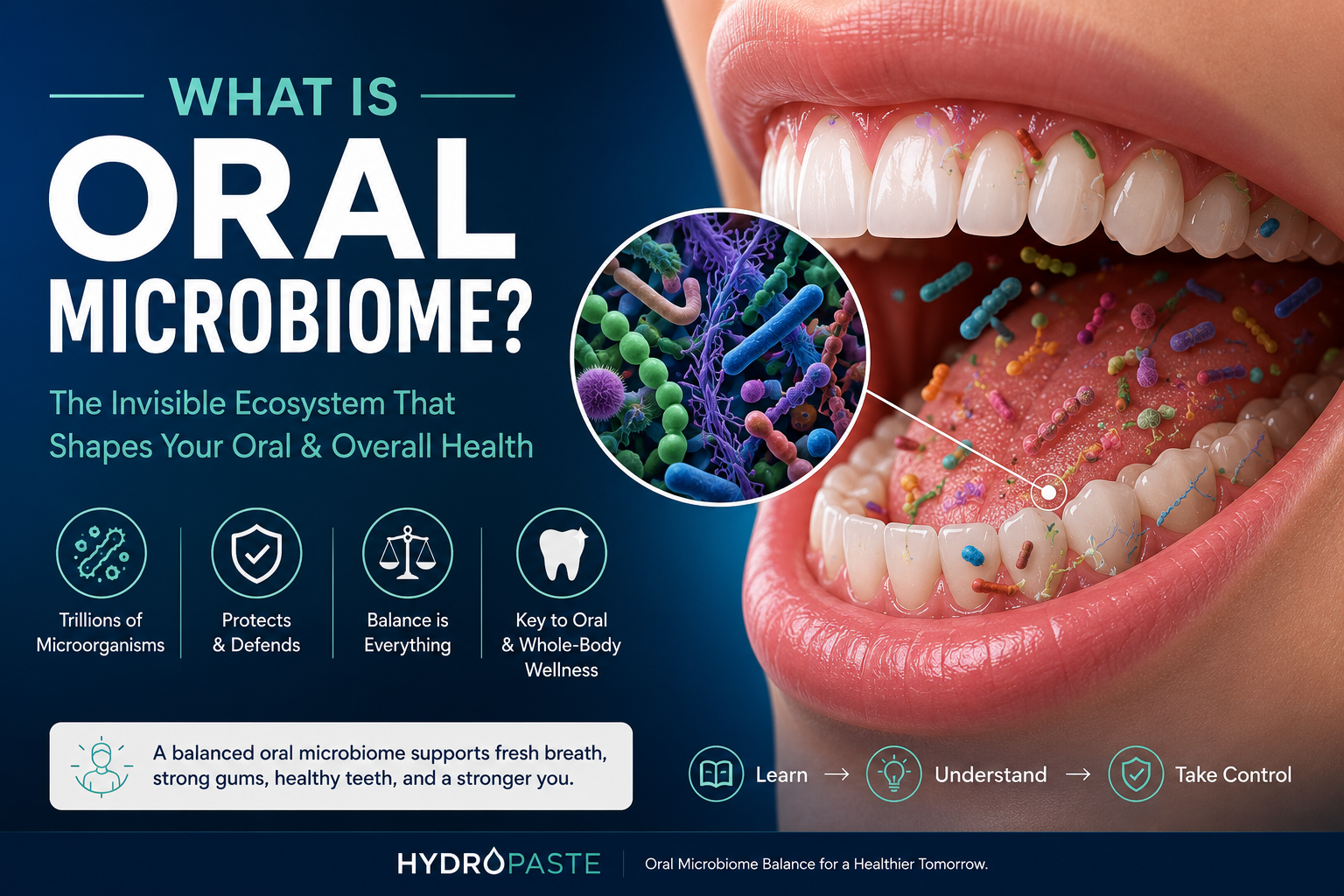
What Is the Oral Microbiome? Mouth Bacteria, Balance & Oral Health Explained
Amazon Affiliate Disclosure: HydroPaste may earn a commission from qualifying purchases made through Amazon affiliate links. This does not change the editorial standards, recommendations, or educational focus of this guide.
The oral microbiome is the living ecosystem of bacteria, fungi, viruses, and other microorganisms that naturally exist inside the mouth. When a person searches “what is oral microbiome,” the simplest answer is this: it is the invisible biological community that lives across the teeth, gums, tongue, saliva, cheeks, and throat — and it plays a major role in breath, plaque, gum comfort, cavity risk, and overall mouth balance.
This is not just a “germs in the mouth” topic. The mouth microbiome is more like a busy city than a dirty surface. Some microbes help maintain balance. Some become harmful only when the environment changes. Some live on the tongue. Some prefer the gumline. Some thrive after frequent sugar exposure. Others are better suited to a neutral, saliva-rich, mineral-supported mouth.
To understand this subject from the beginning, the best place to start is Microbiome 101. For a wider path through routines, product choices, mouth ecology, and daily habits, visit the Oral Microbiome Balance Hub.
Modern dental research increasingly describes the mouth as a set of distinct microbial habitats rather than a single surface. The tongue, gums, teeth, and saliva each support different microbial communities, and biofilms on teeth can contain hundreds of bacterial species plus fungi, viruses, and other organisms.
Quick Jump
- What Is the Oral Microbiome?
- Why the Mouth Has Its Own Microbiome
- Where the Oral Microbiome Lives
- Good Bacteria vs Harmful Bacteria in the Mouth
- Oral Microbiome Balance vs Dysbiosis
- How the Oral Microbiome Affects Teeth, Gums, Breath and Saliva
- The Daily Oral Microbiome Cycle
- What Disrupts the Oral Microbiome?
- How to Support a Healthy Oral Microbiome
- Oral Microbiome vs Gut Microbiome
- The HydroPaste Editorial Framework for Oral Microbiome Thinking
- Comparison Chart: Old Oral Hygiene Thinking vs Microbiome-Aware Oral Care
- Editorial Insights: The Mouth Is an Ecosystem, Not a Battlefield
- FAQs About the Oral Microbiome
- People Also Ask: Oral Microbiome Questions
What Is the Oral Microbiome?
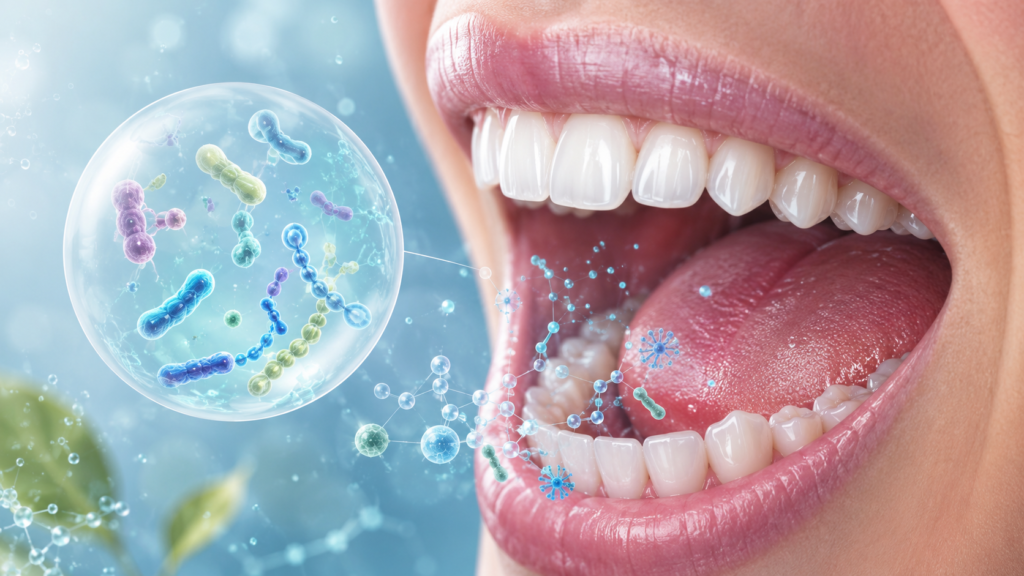
The oral microbiome is the community of microorganisms that live inside the mouth. These microorganisms include bacteria, fungi, viruses, archaea, and other microscopic life forms. They are not randomly scattered. They organize themselves across different mouth surfaces, interact with saliva, respond to food, and build structured communities called biofilms.
A biofilm is a living microbial layer that attaches to a surface. In the mouth, the most familiar version is dental plaque. Plaque is not just leftover food. It is a microbial film that forms when bacteria attach to tooth surfaces and produce a sticky matrix that helps them stay in place. NIDCR describes oral biofilm as a rich microbial community with over 700 distinct species, and imbalance in that community is associated with conditions such as caries and periodontitis.
That means the oral microbiome is not automatically good or bad. It is dynamic. It can protect, irritate, stabilize, acidify, freshen, inflame, repair, or weaken the mouth depending on its balance.
A simple definition
The oral microbiome is the living ecosystem of microbes inside the mouth that helps shape oral health, plaque behavior, gum response, breath quality, and the mouth’s ability to stay balanced.
A more precise definition
The oral microbiome is a site-specific microbial ecosystem composed of bacteria, fungi, viruses, and other microorganisms living in saliva, dental plaque biofilm, tongue coating, gumline spaces, mucosal tissues, and other oral surfaces. Its health impact depends on microbial diversity, ecological balance, saliva flow, pH stability, diet, hygiene habits, immune response, and mineral availability.
The most important idea
The oral microbiome is not something to “kill completely.” A healthy mouth is not sterile. A healthy mouth is balanced.
That is where many older oral-care messages become misleading. The goal is not to attack every microbe as if the mouth were a contaminated countertop. The goal is to reduce harmful buildup, support saliva, protect enamel, clean the gumline, and avoid daily habits that push the ecosystem toward acid, inflammation, odor, or disease-prone biofilm.
| Term | What It Means | Why It Matters |
|---|---|---|
| Oral microbiome | The full microbial ecosystem of the mouth | Shapes teeth, gums, breath, plaque, and oral balance |
| Mouth microbiome | A consumer-friendly phrase for the oral microbiome | Helps people understand the mouth as an ecosystem |
| Biofilm | Structured microbial layer attached to surfaces | Dental plaque is a type of oral biofilm |
| Plaque | Biofilm on teeth and around the gumline | Can become harmful when not disrupted regularly |
| Dysbiosis | Microbial imbalance | Linked with cavity-prone, gum-irritating, or odor-producing conditions |
| Eubiosis | Balanced microbial state | A healthier ecological pattern inside the mouth |
Why the Mouth Has Its Own Microbiome
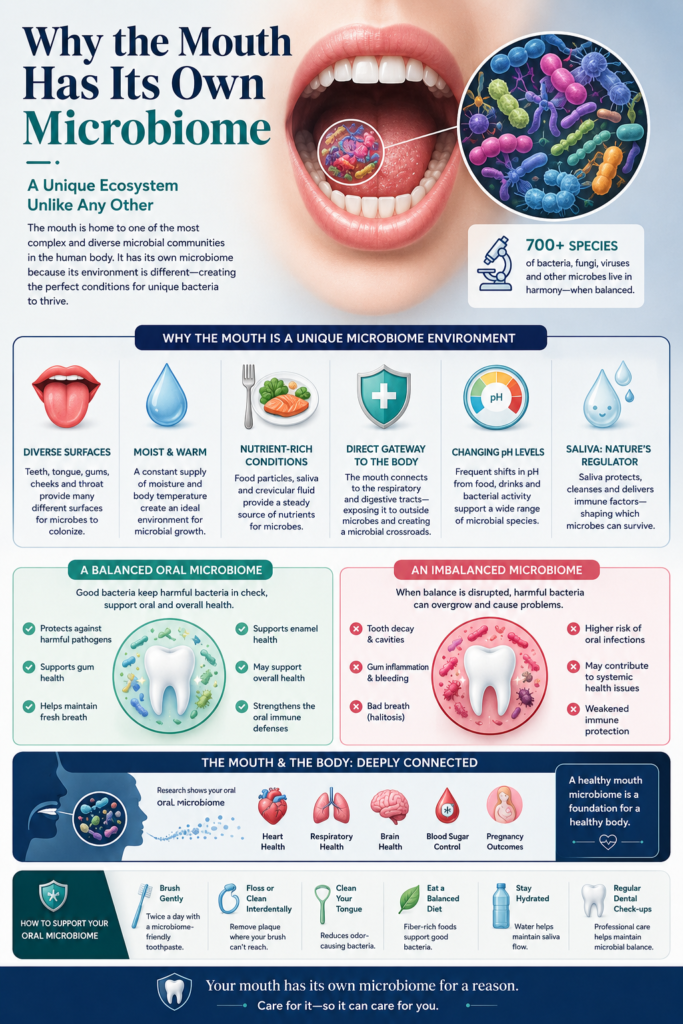
The mouth has its own microbiome because it is one of the most active biological entry points in the body. It receives food, drinks, air, minerals, enzymes, proteins, and environmental exposure every day. It also contains hard surfaces, soft tissues, moisture, oxygen gradients, saliva, temperature stability, and small protected spaces where microbes can attach and organize.
In simple terms, the mouth is an ideal habitat.
It has permanent surfaces like teeth. It has warm moisture. It has regular nutrient exposure. It has sheltered spaces between teeth and under the gumline. It has the tongue, which has a textured surface. It has saliva, which moves constantly but does not sterilize the mouth. It has oxygen-rich and oxygen-poor zones. These differences allow different microbes to specialize.
NIDCR compares the mouth to a world with different habitats, where gums, tongue, and teeth are distinct environments for microbial life.
Why teeth make the oral microbiome different
The mouth is unusual because teeth are hard, non-shedding surfaces. Skin sheds. The gut lining renews. But tooth enamel does not shed in the same way. This gives oral microbes a stable surface where they can attach and form biofilm.
That is why plaque forms on teeth more predictably than many people realize. Even after brushing, a thin protein-rich film from saliva begins coating enamel. Microbes can then attach to that film. With time, diet exposure, and missed cleaning areas, the biofilm becomes thicker and more complex.
Why saliva matters so much
Saliva is one of the main regulators of the oral microbiome. It helps wash away food particles, buffer acids, deliver minerals, lubricate tissues, and carry proteins that influence microbial attachment.
A dry mouth is not just uncomfortable. It changes the ecosystem. When saliva is low, the mouth loses part of its natural balancing system. This can make acid exposure, odor, plaque buildup, and gum irritation more likely.
Why the mouth is never static
The oral microbiome changes throughout the day. Breakfast changes it. Coffee changes it. Mouth breathing changes it. Brushing changes it. Sleep changes it. Stress can indirectly affect it through saliva and habits. A sugary snack changes it more than a neutral meal. A night of dry mouth changes it differently from a day of steady hydration.
This is why oral microbiome balance is not a one-time achievement. It is a daily pattern.
Where the Oral Microbiome Lives
The oral microbiome does not live in one place. It lives across multiple zones, and each zone behaves differently.
The tongue is not the same as the teeth. The gumline is not the same as saliva. The spaces between teeth are not the same as the inside of the cheek. This matters because different oral problems often begin in different habitats.
Bad breath often has a tongue-coating component. Cavities often involve tooth-surface biofilm and acid production. Gum problems often involve plaque near or below the gumline. Dry mouth can influence the whole system.
Main oral microbiome zones
| Oral Zone | Main Microbial Environment | Common Concern When Imbalanced |
|---|---|---|
| Teeth | Hard enamel surfaces where plaque biofilm attaches | Cavities, tartar, enamel stress |
| Gumline | Border between teeth and gums | Gum bleeding, inflammation, periodontal risk |
| Tongue | Textured surface with grooves and coating | Bad breath, coating, taste changes |
| Saliva | Fluid ecosystem carrying microbes and proteins | Dry mouth, pH shifts, odor, mineral imbalance |
| Cheeks and soft tissue | Mucosal surfaces | Irritation, sensitivity, fungal overgrowth risk |
| Between teeth | Tight low-cleaning zones | Plaque retention, cavities, gum irritation |
| Back of mouth | Lower visibility, harder cleaning | Odor, plaque accumulation, missed brushing areas |
Teeth: the biofilm surface
Teeth are the most important surface for plaque behavior because enamel provides a stable attachment point. When plaque is thin and regularly disrupted, it is easier to manage. When it matures, it becomes more organized and harder to remove.
The tooth surface is also where acid-producing bacteria can become a problem. After frequent sugar or refined carbohydrate exposure, certain bacteria produce acids as metabolic byproducts. Repeated acid exposure can shift the enamel environment toward mineral loss.
Gumline: the immune response zone
The gumline is where the body and the biofilm meet most directly. Plaque at the gumline does not only sit there; it can trigger an immune response. The swelling, bleeding, tenderness, or redness that a person notices is often not just “dirty teeth.” It is the body responding to microbial buildup and irritation.
This is one reason gentle, consistent gumline cleaning matters more than aggressive scrubbing. The goal is controlled disruption, not tissue trauma.
Tongue: the breath zone
The tongue has a textured surface that can trap microbes, food compounds, dead cells, and sulfur-producing organisms. For many people, breath quality is closely linked to tongue coating.
This does not mean the tongue should be scraped harshly. It means the tongue should be treated as part of the mouth’s ecosystem, not ignored.
Saliva: the balancing fluid
Saliva is not just moisture. It is a protective fluid that influences pH, minerals, lubrication, microbial movement, and comfort. A person with healthy saliva flow generally has a better chance of maintaining oral microbiome balance than someone with persistent dry mouth.
Good Bacteria vs Harmful Bacteria in the Mouth
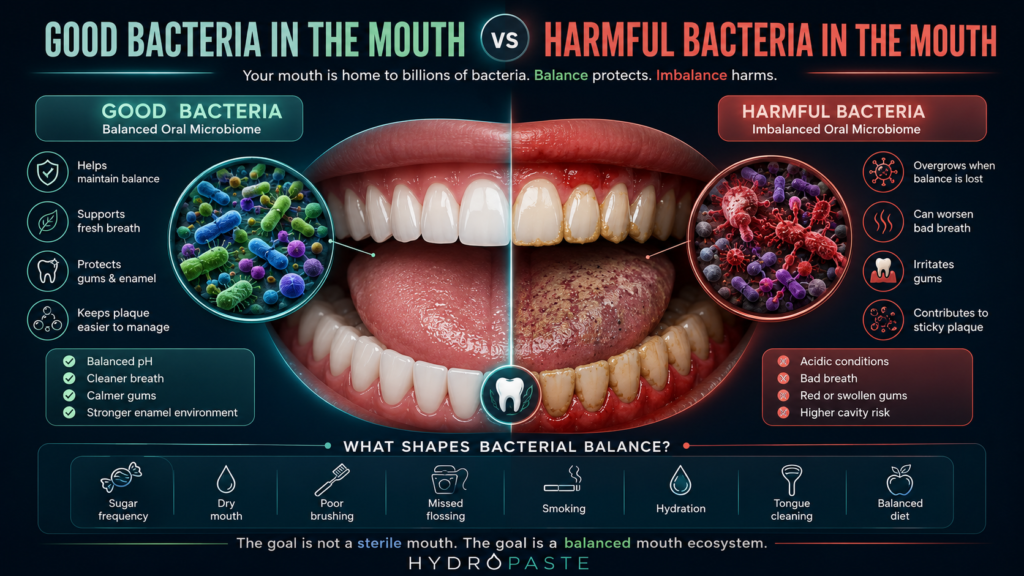
The phrase “good bacteria in mouth” is useful, but it can oversimplify the topic. Oral bacteria are not always permanently good or permanently bad. Many microbes behave differently depending on the environment.
A microbe that is harmless in small numbers may become problematic if the environment favors its growth. A normally balanced biofilm may become acidic after frequent sugar exposure. A mouth with good saliva flow may tolerate occasional dietary stress better than a dry mouth.
The better distinction is not “good bacteria vs bad bacteria”. It is balanced behavior vs harmful dominance.
What helpful oral bacteria may do
Helpful or balanced microbial communities can:
- Compete with more harmful organisms for space
- Help maintain ecological diversity
- Participate in normal nitrate metabolism
- Reduce the chance of a single harmful group dominating
- Coexist with the immune system without triggering constant inflammation
- Help maintain a stable oral environment when saliva and hygiene are strong
What harmful microbial patterns may do
Harmful or imbalanced microbial patterns can:
- Produce acids that stress enamel
- Contribute to plaque thickening
- Increase gumline irritation
- Produce sulfur compounds linked with bad breath
- Thrive in low-oxygen gum pockets
- Become more difficult to manage once biofilm matures
- Push the mouth toward dysbiosis
Better way to think about it
Instead of asking, “How do I kill bad mouth bacteria?” a more microbiome-aware question is:
“How do I make my mouth a less favorable place for harmful microbial patterns and a more stable place for healthy balance?”
That question leads to better habits: daily plaque disruption, interdental cleaning, saliva support, lower sugar frequency, mineral-focused enamel care, tongue cleaning, and regular dental evaluation.
| Old Question | Better Oral Microbiome Question |
|---|---|
| How do I kill mouth bacteria? | How do I reduce harmful buildup while preserving balance? |
| Is all plaque bad? | Is plaque thin, regularly disrupted, and not maturing into harmful biofilm? |
| Is bad breath only from food? | Is tongue coating, dry mouth, or microbial sulfur production involved? |
| Is bleeding normal? | Is the gumline reacting to plaque buildup or irritation? |
| Is strong mouthwash always better? | Is the product supporting daily balance or disrupting the mouth harshly? |
Oral Microbiome Balance vs Dysbiosis
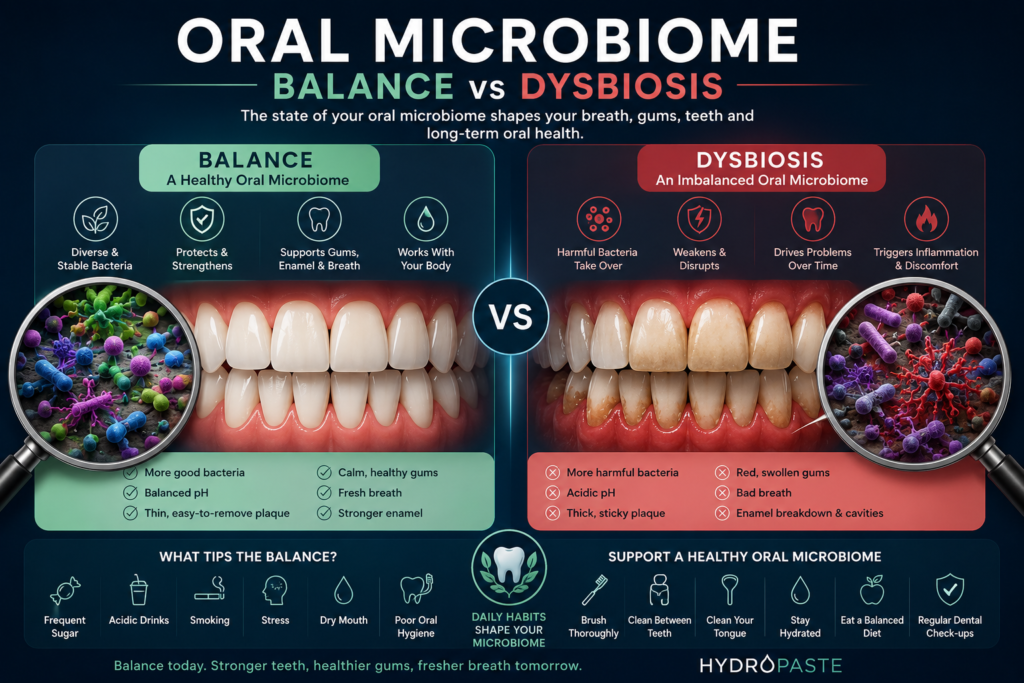
Oral microbiome balance means the mouth’s microbial community is relatively stable, diverse, and not dominated by disease-associated patterns. Dysbiosis means that balance has shifted in a less healthy direction.
Dysbiosis is not the same as having bacteria. Everyone has oral bacteria. Dysbiosis is about imbalance.
Research discussions on oral dysbiosis often connect it with common oral health issues such as cavities, periodontal disease, bad breath, and oral candidiasis. Broader research also explores links between oral microbial imbalance and systemic conditions, though those connections should be interpreted carefully and not reduced to simple cause-and-effect claims.
What oral microbiome balance looks like
A balanced oral environment often has:
- Stable saliva flow
- Less persistent bad breath
- Lower plaque accumulation between cleanings
- Less gum bleeding during normal brushing and flossing
- Better tolerance to normal meals
- Fewer signs of dry mouth
- A cleaner-feeling tongue
- Enamel supported by mineral-aware care
- A routine that disrupts plaque without harsh overcorrection
What dysbiosis may look like
Dysbiosis may show up as:
- Persistent bad breath
- Thick tongue coating
- Frequent plaque buildup
- Gum tenderness or bleeding
- Higher cavity activity
- Dry mouth and sticky saliva
- Sour or metallic taste
- Sensitivity linked with enamel stress
- Recurring irritation despite brushing
These signs do not diagnose the microbiome by themselves. They are signals that the oral environment may need closer attention.
The balance model
Oral microbiome balance depends on four major forces:
| Force | What It Controls | When It Goes Wrong |
|---|---|---|
| Biofilm disruption | Plaque thickness and maturity | Plaque becomes organized, sticky, and harder to remove |
| Saliva support | pH, minerals, moisture, comfort | Dryness, odor, acid vulnerability increase |
| Diet rhythm | Acid exposure and microbial fuel | Frequent sugar exposure favors acid-producing patterns |
| Tissue response | Gum comfort and inflammation | Gumline becomes irritated or reactive |
The key is that these forces interact. A person who eats sugar frequently but has strong saliva and excellent cleaning may respond differently than someone with dry mouth and inconsistent flossing. The oral microbiome is personal because the environment is personal.
How the Oral Microbiome Affects Teeth, Gums, Breath and Saliva
The oral microbiome affects almost every part of daily mouth experience. It influences how clean the mouth feels in the morning, how quickly plaque returns, how the gums respond to flossing, how breath smells, and how enamel handles acid exposure.
Teeth and enamel
The oral microbiome affects teeth mainly through biofilm and acid production. When certain bacteria metabolize sugars and refined carbohydrates, they can produce acids. If acid exposure happens repeatedly, enamel spends more time under mineral stress.
This is where oral care becomes more than brushing harder. Enamel protection depends on plaque control, mineral availability, saliva flow, and diet timing.
A microbiome-aware enamel routine should focus on:
- Removing plaque gently but consistently
- Reducing frequent sugar exposure
- Supporting saliva
- Avoiding overly abrasive habits
- Using enamel-supportive ingredients
- Cleaning between teeth
- Paying attention to dry mouth
Gums and inflammation
The gumline is sensitive to biofilm accumulation. When plaque sits near the gums, the immune system may respond. This can show up as bleeding, puffiness, tenderness, or redness.
A common mistake is treating bleeding gums as a reason to stop cleaning between the teeth. In many cases, the opposite is needed: gentler, more consistent interdental cleaning. However, persistent bleeding should be discussed with a dental professional.
Breath and tongue coating
Bad breath is often influenced by volatile sulfur compounds produced by certain oral microbes, especially when tongue coating, dry mouth, gumline plaque, or trapped food particles are present.
A breath-focused routine should not rely only on strong flavors. Mint can mask odor temporarily. Microbiome-aware breath care looks deeper:
- Clean the tongue gently
- Hydrate consistently
- Clean between teeth
- Address dry mouth
- Reduce plaque stagnation
- Avoid relying on alcohol-heavy rinses if they worsen dryness
- Check for gum or dental issues if odor persists
Saliva and pH
Saliva helps the mouth recover after meals and acid exposure. It buffers acids, moves minerals, and helps maintain comfort. When saliva is low, the microbiome can shift toward less favorable patterns.
Dry mouth can be caused by dehydration, mouth breathing, medications, stress, sleep patterns, caffeine, alcohol, or certain health conditions. Because dry mouth changes the environment, it can influence plaque, breath, enamel, and gum comfort.
The Daily Oral Microbiome Cycle
The oral microbiome follows a daily rhythm. Understanding that rhythm helps a person build better habits.
Morning
The mouth often feels different in the morning because saliva flow decreases during sleep. Less saliva means less washing, less buffering, and more opportunity for odor-producing compounds to accumulate.
Morning breath does not automatically mean poor hygiene. But persistent strong odor, thick coating, or dry mouth may signal that the overnight environment needs attention.
After meals
After eating, oral microbes respond to available nutrients. Sugary and refined carbohydrate foods can lead to more acid production. Acid exposure is not only about the amount of sugar. Frequency matters.
Sipping sweet drinks throughout the day can be more disruptive than having sugar once with a meal because the mouth gets repeated acid challenges.
Afternoon
By afternoon, plaque begins rebuilding even after morning brushing. This is normal. The question is whether it remains thin and manageable or becomes mature and sticky due to poor cleaning, snacking, dryness, and missed interdental spaces.
Night
Night care is critical because saliva flow drops during sleep. Going to bed with food debris, plaque, and sugar exposure gives the microbiome several quiet hours in a low-saliva environment.
That is why evening brushing and interdental cleaning often matter more than people think.
| Time of Day | Microbiome Pattern | Best Habit |
|---|---|---|
| Morning | Lower overnight saliva, breath compounds, tongue coating | Brush, clean tongue gently, hydrate |
| After meals | Nutrient exposure, possible acid production | Rinse with water, avoid constant snacking |
| Afternoon | Plaque returns gradually | Hydrate, reduce sweet sipping |
| Night | Lower saliva during sleep | Brush thoroughly, clean between teeth |
| Overnight | Biofilm has quiet time to mature | Support nasal breathing and avoid sleeping with dry mouth when possible |
What Disrupts the Oral Microbiome?
The oral microbiome is resilient, but it can be disrupted by repeated environmental pressure. Most disruption does not happen from one imperfect day. It happens from patterns.
Frequent sugar exposure
Sugar frequency is one of the most important factors. The problem is not only dessert. It can be sweet coffee, flavored drinks, sticky snacks, sweetened protein bars, juices, sports drinks, and frequent grazing.
The more often fermentable carbohydrates enter the mouth, the more often acid-producing microbial activity can rise.
Dry mouth
Dry mouth changes the entire ecosystem. Without enough saliva, the mouth becomes less able to buffer acids, wash away debris, and maintain mineral flow.
Common dry mouth contributors include:
- Mouth breathing
- Dehydration
- Certain medications
- Alcohol
- Smoking or vaping
- High caffeine intake
- Stress
- Sleep problems
- Some medical conditions
Inconsistent interdental cleaning
A toothbrush does not fully clean between tight tooth contacts. If food particles and plaque remain between teeth, those spaces can become protected microbial zones.
This is why flossing, interdental brushes, or water flossers may be important depending on spacing, gum condition, restorations, and personal comfort.
Harsh overuse of antimicrobial products
Some people try to fix mouth issues by using strong rinses repeatedly. This may help in specific dental situations when recommended professionally, but daily harsh overuse can be counterproductive for some individuals, especially if it worsens dryness or irritation.
A microbiome-aware routine should be strong enough to control plaque but not so harsh that the mouth feels stripped, dry, or inflamed.
Poor tongue care
Ignoring the tongue can leave a major microbial reservoir untouched. Tongue cleaning does not need to be aggressive. A gentle scraper or brush technique can help reduce coating and odor compounds.
Acidic drinks and constant sipping
Sparkling drinks, citrus drinks, energy drinks, kombucha, soda, and acidic flavored waters can increase acid exposure. The issue is often not one drink. It is sipping slowly over a long period.
Smoking and vaping
Smoking and vaping can affect saliva, tissues, immune response, breath, and microbial balance. They can also mask or worsen gum issues.
| Disruptor | Main Effect | Microbiome-Aware Adjustment |
|---|---|---|
| Frequent sugar | More acid-producing activity | Reduce frequency, pair sweets with meals |
| Dry mouth | Less buffering and cleansing | Hydrate, address mouth breathing, discuss medications if relevant |
| Skipped flossing | Protected plaque between teeth | Use floss, interdental brushes, or water flosser |
| Harsh rinses | Possible dryness or irritation | Use thoughtfully, follow dental guidance |
| Tongue coating | Odor reservoir | Clean tongue gently |
| Acid sipping | Repeated enamel stress | Drink with meals, rinse with water |
| Smoking/vaping | Tissue and saliva disruption | Reduce exposure and seek support if needed |
How to Support a Healthy Oral Microbiome
Supporting a healthy oral microbiome is not complicated, but it does require consistency. The goal is to shape the mouth’s environment every day.
1. Disrupt plaque, do not attack the mouth
Brush thoroughly twice daily with a soft toothbrush or suitable electric toothbrush. The goal is to remove plaque from the gumline and tooth surfaces without damaging enamel or gums.
Technique matters more than force. Hard scrubbing can irritate tissue and contribute to abrasion. Gentle precision is better than pressure.
2. Clean between the teeth
The spaces between teeth are a major blind spot. A microbiome-aware routine should include interdental cleaning, especially at night.
Options include:
- Traditional floss
- Floss picks
- Interdental brushes
- Water flossers
- Soft picks
The best option is the one a person can use correctly and consistently.
3. Support saliva
Saliva is a natural balancing system. Support it by drinking water, reducing dry-mouth triggers, chewing sugar-free gum when appropriate, and addressing mouth breathing or medication-related dryness with a professional if needed.
4. Reduce sugar frequency
The mouth can recover from occasional sugar better than constant exposure. Instead of grazing on sweet foods throughout the day, keep sugar exposure more contained.
A practical rule: frequency is more important than perfection.
5. Clean the tongue gently
Tongue cleaning can help reduce coating and odor. Avoid scraping until the tongue feels raw. A few gentle passes are usually enough.
6. Use enamel-supportive oral care
Mineral-aware toothpaste can support enamel-focused care. Hydroxyapatite, fluoride, and other enamel-focused approaches are often discussed in modern oral care because the tooth surface is part of the oral ecosystem.
The microbiome-aware point is not only “what kills bacteria?” but also “what supports the tooth surface while plaque is being controlled?”
7. Avoid unnecessary harshness
A mouth that feels burned, dry, stripped, or irritated after every routine may not be getting “cleaner” in a sustainable way. Strong sensations do not always equal better oral health.
8. See oral health as a system
A complete routine considers:
- Teeth
- Gums
- Tongue
- Saliva
- Diet timing
- Product strength
- Sleep dryness
- Interdental spaces
- Dental checkups
| Routine Layer | Daily Action | Microbiome Purpose |
|---|---|---|
| Brushing | Twice daily | Disrupt plaque on teeth and gumline |
| Interdental cleaning | Usually once daily | Reduce hidden biofilm between teeth |
| Tongue cleaning | As needed, often daily | Reduce coating and odor compounds |
| Hydration | Throughout day | Support saliva and comfort |
| Diet rhythm | Reduce frequent sugar | Lower repeated acid pressure |
| Enamel support | Use suitable toothpaste | Help protect mineral balance |
| Dental visits | Regularly | Detect problems beyond home care |
Oral Microbiome vs Gut Microbiome
The oral microbiome and gut microbiome are connected in the sense that both are microbial ecosystems in the body, but they are not the same.
The oral microbiome lives in the mouth. It deals with oxygen exposure, teeth, saliva, chewing, brushing, and rapid food contact. The gut microbiome lives mostly in the digestive tract and deals with digestion, fermentation, immune signaling, and a very different chemical environment.
A common mistake is assuming that advice for the gut microbiome automatically applies to the mouth. It does not always work that way.
Key differences
| Feature | Oral Microbiome | Gut Microbiome |
|---|---|---|
| Main location | Mouth, teeth, gums, tongue, saliva | Digestive tract |
| Major surfaces | Teeth and soft tissue | Intestinal lining |
| Daily disruption | Brushing, flossing, chewing, saliva | Digestion, motility, diet |
| Main visible issue | Plaque, breath, gums, cavities | Digestion, stool pattern, gut comfort |
| Oxygen exposure | Many oxygen-variable zones | Mostly low-oxygen lower gut |
| Product interaction | Toothpaste, mouthwash, floss, tongue tools | Food, fiber, supplements, medications |
| Balance goal | Control biofilm and support oral tissues | Support digestion and gut ecology |
Why the oral microbiome deserves its own attention
The mouth is the first microbial gateway of the digestive system, but it is also a dental environment. Teeth create a unique challenge because they are hard surfaces that can accumulate biofilm. The gumline creates another challenge because tissue inflammation can begin where biofilm and the immune system interact.
That makes oral microbiome balance practical, not abstract. It affects what a person sees in the mirror and feels every day.
The HydroPaste Editorial Framework for Oral Microbiome Thinking
A useful way to understand the oral microbiome is through the E.C.O. framework:
E = Environment
C = Community
O = Outcome
This framework keeps the topic simple without making it shallow.
E: Environment
The oral environment includes saliva, pH, diet, oxygen, tooth surfaces, gumline spaces, hydration, and cleaning habits.
Change the environment, and microbial behavior changes.
For example:
- Frequent sugar favors acid-producing patterns
- Dry mouth reduces natural buffering
- Poor interdental cleaning allows hidden plaque to mature
- Gentle daily cleaning keeps biofilm more manageable
C: Community
The microbial community includes bacteria, fungi, viruses, and other organisms. A healthy community is not sterile. It is balanced.
A less healthy community may become dominated by acid-producing, odor-producing, or gum-irritating patterns.
O: Outcome
The outcome is what a person notices:
- Fresher or worse breath
- Less or more plaque
- Stable or bleeding gums
- Comfortable or dry mouth
- Lower or higher cavity tendency
- Cleaner or coated tongue
The E.C.O. framework helps explain why oral care products alone cannot do everything. A toothpaste can support the routine. A mouthwash can play a role. A tongue scraper can help. But the full outcome depends on the whole environment.
| E.C.O. Element | Question to Ask | Example |
|---|---|---|
| Environment | What conditions am I creating daily? | Dry mouth, sugar frequency, brushing habits |
| Community | Which microbial patterns are being favored? | Acid producers, odor producers, balanced biofilm |
| Outcome | What signs show up in real life? | Plaque, breath, gums, enamel stress |
Comparison Chart: Old Oral Hygiene Thinking vs Microbiome-Aware Oral Care
Older oral hygiene messaging often treated the mouth like a dirty surface. Modern oral microbiome thinking treats it as a living ecosystem.
This does not mean brushing, flossing, and plaque control are less important. They are still essential. The difference is the reasoning behind them.
| Topic | Old Oral Hygiene Thinking | Microbiome-Aware Oral Care |
|---|---|---|
| Bacteria | All bacteria are bad | Balance matters; harmful dominance is the problem |
| Plaque | Only leftover dirt | Living biofilm that must be disrupted |
| Mouthwash | Stronger burn means better clean | Strength should match need; dryness matters |
| Bad breath | Mostly food odor | Often tongue coating, dry mouth, gumline plaque, sulfur compounds |
| Cavities | Sugar directly makes holes | Sugar feeds acid-producing biofilm that stresses enamel |
| Gum bleeding | Brushing too hard or normal sensitivity | Often gumline inflammation from plaque or irritation |
| Clean feeling | Minty and intense | Smooth teeth, comfortable gums, neutral breath, hydrated mouth |
| Product goal | Kill germs | Support plaque control, enamel, saliva, and balance |
| Routine success | Brushed quickly | Brushed well, cleaned between teeth, tongue managed, saliva supported |
The microbiome-aware model is more mature because it explains why some people brush daily but still struggle with gum issues, breath, or cavities. Their routine may be active, but the ecosystem may still be poorly managed.
Editorial Insights: The Mouth Is an Ecosystem, Not a Battlefield.
The most important shift in oral care is not a new gadget or a single ingredient. It is a change in mental model.
The mouth should not be treated like a battlefield where the only goal is destruction. It should be treated like an ecosystem where the goal is stability.
That does not make plaque harmless. Plaque still needs to be disrupted. Gumline buildup still matters. Sugar frequency still matters. Dry mouth still matters. Cavities and gum disease still require professional care.
But the language of oral care is evolving. “Kill germs” is too blunt for a system that contains helpful, neutral, and harmful microbial patterns living across different habitats. The better goal is controlled cleanliness: remove what should not accumulate, preserve what helps the mouth function, and create daily conditions that make imbalance less likely.
For a person trying to improve oral health, the oral microbiome gives a clearer explanation of why small habits matter.
A glass of water after coffee matters. Night flossing matters. Tongue cleaning matters. Saliva matters. Sugar timing matters. Gentle brushing matters. The right toothpaste matters. The gumline matters. The spaces between teeth matter.
The mouth is not just where oral health problems appear. It is where the conditions for those problems are created or reduced every day.
To explore HydroPaste’s wider oral-care education library, return to the Homepage.
FAQs About the Oral Microbiome
What is oral microbiome in simple words?
The oral microbiome is the community of tiny living organisms inside the mouth. These include bacteria, fungi, viruses, and other microbes that live on the teeth, gums, tongue, saliva, cheeks, and other oral surfaces.
In simple words, the oral microbiome is the mouth’s natural microbial ecosystem.
It is not automatically harmful. A healthy mouth contains microbes. The issue begins when the ecosystem becomes imbalanced, plaque biofilm matures, saliva is low, sugar exposure is frequent, or harmful microbial patterns become dominant.
| Simple Term | Meaning |
|---|---|
| Oral microbiome | The living microbial ecosystem inside the mouth |
| Mouth bacteria | Bacteria that live on oral surfaces |
| Good bacteria in mouth | Microbes that help maintain balance or compete with harmful patterns |
| Bad oral bacteria | Microbes or patterns linked with acid, odor, gum irritation, or disease |
| Oral microbiome balance | A stable mouth ecosystem that supports healthier teeth, gums, breath, and saliva |
A person should not think of the oral microbiome as dirt. It is closer to a garden. A healthy garden still has living organisms, but it must be managed so harmful overgrowth does not take over.
Why is the oral microbiome important for oral health?
The oral microbiome is important because it affects plaque, cavities, gum health, breath, saliva quality, tongue coating, and the way the mouth responds to daily habits.
When the oral microbiome is balanced, the mouth is more likely to feel clean, comfortable, and stable. When it becomes imbalanced, harmful biofilm patterns may contribute to acid production, gum irritation, bad breath, and other oral concerns.
| Oral Health Area | How the Microbiome Matters |
|---|---|
| Teeth | Acid-producing bacteria can stress enamel |
| Gums | Gumline plaque can trigger inflammation |
| Breath | Tongue and gumline microbes can produce odor compounds |
| Saliva | Saliva helps regulate pH and microbial movement |
| Tongue | Coating can hold odor-producing microbes |
| Plaque | Biofilm structure determines how hard buildup is to remove |
The oral microbiome matters because oral health is not only mechanical. Brushing removes plaque, but the reason plaque matters is biological.
Can you improve your oral microbiome naturally?
A person can support a healthier oral microbiome through daily habits that improve the mouth environment. This does not mean permanently changing every microbe in the mouth. It means making the mouth less favorable for harmful patterns.
Useful habits include brushing twice daily, cleaning between teeth, reducing frequent sugar exposure, drinking enough water, cleaning the tongue gently, supporting saliva, avoiding smoking or vaping, and seeing a dental professional regularly.
| Habit | How It Supports the Oral Microbiome |
|---|---|
| Brushing | Disrupts plaque on tooth surfaces |
| Flossing or interdental cleaning | Reduces hidden biofilm between teeth |
| Tongue cleaning | Helps manage coating and breath compounds |
| Hydration | Supports saliva flow |
| Less frequent sugar | Reduces repeated acid-producing events |
| Gentle products | Avoid unnecessary dryness or irritation |
| Dental checkups | Detects issues home care cannot see |
The word “naturally” should not mean ignoring dental care. The most natural support for the oral microbiome is a consistent routine that works with saliva, enamel, and gum tissue rather than against them.
Is the oral microbiome the same as plaque?
No. The oral microbiome and plaque are related, but they are not the same.
The oral microbiome is the full microbial ecosystem of the mouth. Plaque is a specific type of biofilm that forms on teeth and around the gumline.
Plaque is one expression of the oral microbiome, but the microbiome also includes organisms in saliva, tongue coating, soft tissues, and other areas.
| Feature | Oral Microbiome | Plaque |
|---|---|---|
| Meaning | Entire microbial ecosystem in the mouth | Biofilm on teeth and gumline |
| Location | Teeth, gums, tongue, saliva, cheeks, throat | Mainly tooth surfaces and gumline |
| Includes | Bacteria, fungi, viruses, other microbes | Microbes embedded in a sticky matrix |
| Main concern | Balance vs dysbiosis | Buildup, maturity, acid, gum irritation |
| Managed by | Full oral routine and environment | Brushing, flossing, dental cleanings |
Plaque matters because it is where microbial communities become attached and organized. The more mature and protected plaque becomes, the harder it is to manage with casual brushing.
What are signs of an unhealthy oral microbiome?
Signs of possible oral microbiome imbalance may include persistent bad breath, thick tongue coating, frequent plaque buildup, bleeding gums, dry mouth, sour taste, recurring cavities, gum tenderness, or a mouth that feels unclean soon after brushing.
These signs do not prove dysbiosis by themselves, but they suggest that the mouth environment may need attention.
| Possible Sign | What It May Suggest |
|---|---|
| Bad breath | Tongue coating, dry mouth, gumline plaque, sulfur compounds |
| Bleeding gums | Gumline irritation or inflammation |
| Fast plaque buildup | Biofilm returning quickly or missed cleaning zones |
| Dry mouth | Reduced saliva support |
| Sour taste | Acidic mouth environment or reflux-related issues |
| Thick tongue coating | Microbial and debris accumulation |
| Frequent cavities | Repeated enamel stress and acid-producing biofilm |
A persistent issue should be checked professionally. Home routines can support balance, but dental disease needs proper evaluation.
People Also Ask: Oral Microbiome Questions
How do I know if my oral microbiome is balanced?
A balanced oral microbiome usually shows up through stable day-to-day signs: breath is manageable, gums do not bleed easily, plaque does not feel excessive, the mouth does not feel persistently dry, and the tongue does not develop heavy coating quickly.
There is no simple home mirror test that fully maps the oral microbiome. But the mouth gives useful clues.
| Balanced Signal | Possible Imbalance Signal |
|---|---|
| Gums feel calm | Gums bleed or feel puffy |
| Breath stays neutral longer | Breath returns quickly after brushing |
| Teeth feel smooth after cleaning | Plaque feels heavy soon after brushing |
| Saliva feels normal | Mouth feels dry, sticky, or acidic |
| Tongue coating is light | Tongue coating is thick or persistent |
| Fewer new dental issues | Cavities or gum concerns recur |
A professional dental exam is still important because early cavities, tartar, and periodontal pockets may not be obvious at home.
Does mouthwash damage the oral microbiome?
Mouthwash does not automatically damage the oral microbiome. It depends on the formula, frequency, reason for use, and the person’s mouth condition.
Some rinses are designed for short-term therapeutic use. Some are cosmetic breath fresheners. Some are alcohol-free and gentle. Some may feel harsh or drying for certain individuals. The issue is not “mouthwash is bad.” The issue is whether the rinse matches the person’s actual need.
| Mouthwash Type | Possible Role | Watch For |
|---|---|---|
| Cosmetic rinse | Temporary breath freshness | May not address root cause |
| Alcohol-heavy rinse | Strong sensation | Dryness or irritation in some mouths |
| Therapeutic rinse | Specific dental purpose | Should match professional guidance |
| Gentle alcohol-free rinse | Daily comfort support | Still not a substitute for brushing/flossing |
| Fluoride or mineral-focused rinse | Enamel support | Use according to label or dental advice |
A microbiome-aware routine does not rely on mouthwash to replace plaque removal. Brushing and interdental cleaning remain the foundation.
Are there good bacteria in the mouth?
Yes, there are good bacteria in the mouth, but the better phrase is “beneficial microbial balance.” Some oral bacteria help maintain stability by competing with harmful organisms, participating in normal oral chemistry, and coexisting peacefully with the immune system.
However, oral bacteria are context-dependent. A microbe may be harmless in one environment and problematic in another if conditions change.
| Helpful Pattern | Why It Matters |
|---|---|
| Microbial diversity | Reduces dominance of harmful groups |
| Stable saliva-supported community | Helps maintain pH and comfort |
| Lower acid-producing pressure | Supports enamel environment |
| Less inflammatory gumline biofilm | Supports gum comfort |
| Balanced tongue ecology | Helps breath stay fresher |
The goal is not to sterilize the mouth. The goal is to support a stable community where harmful patterns do not dominate.
Can diet change the oral microbiome?
Diet can influence the oral microbiome, especially through sugar frequency, acidity, hydration, and nutrient patterns.
Frequent sugar exposure gives acid-producing bacteria more repeated opportunities to create an acidic environment. Acidic drinks can add direct acid stress. Sticky refined carbohydrates can cling to teeth. On the other hand, water, balanced meals, fibrous foods, and less frequent snacking can support a more stable mouth environment.
| Diet Pattern | Likely Oral Effect |
|---|---|
| Frequent sugary snacks | More repeated acid pressure |
| Sweet drinks sipped slowly | Longer exposure time |
| Sticky refined carbs | More tooth retention |
| Water after meals | Helps rinse and dilute residues |
| Balanced meals | Less constant microbial feeding |
| Crunchy fibrous foods | Can support chewing and saliva flow |
Diet does not replace brushing, but it changes the conditions that oral microbes respond to every day.
What is the best way to support oral microbiome balance?
The best way to support oral microbiome balance is to combine plaque control, saliva support, diet rhythm, tongue cleaning, enamel care, and regular dental evaluation.
No single product can balance the oral microbiome alone. The most effective approach is a complete daily system.
| Step | Action | Why It Helps |
|---|---|---|
| 1 | Brush twice daily | Disrupts plaque biofilm |
| 2 | Clean between teeth | Targets hidden plaque zones |
| 3 | Clean tongue gently | Helps breath and coating |
| 4 | Drink water | Supports saliva |
| 5 | Reduce sugar frequency | Lowers acid-producing pressure |
| 6 | Use suitable toothpaste | Supports enamel-focused care |
| 7 | Avoid harsh overuse | Reduces dryness and irritation risk |
| 8 | Visit a dental professional | Finds problems early |
The best oral microbiome routine is not extreme. It is consistent, gentle, complete, and designed around the mouth as a living ecosystem.