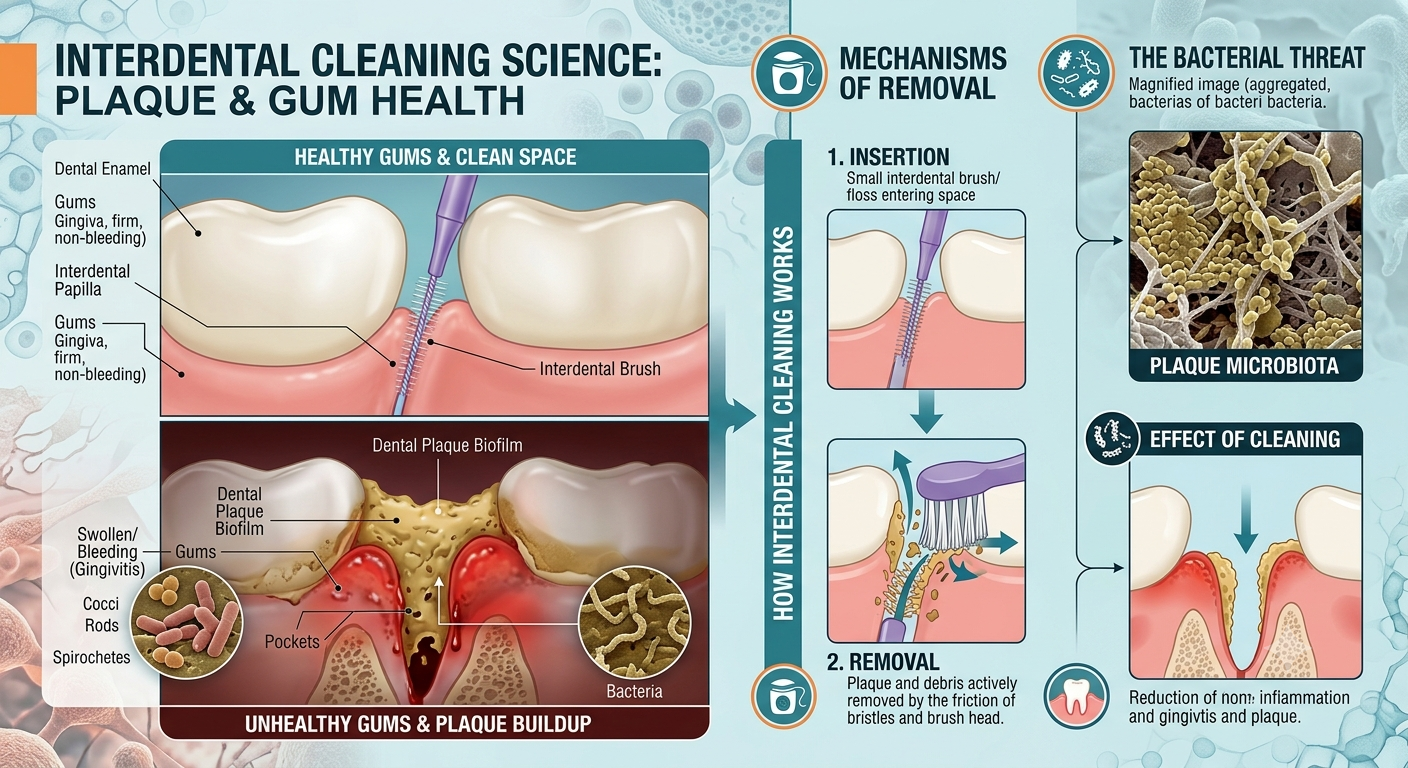
Interdental Cleaning Science: Plaque Control Between Teeth
Amazon Affiliate Disclosure:
Hydropaste may earn commissions from qualifying purchases made through links on this page. This does not change the price you pay or influence our editorial standards.
Updated on July, 2026.
Interdental cleaning science explains one of the most overlooked truths in oral health: a toothbrush can polish the visible surfaces, but the tight spaces between teeth often decide whether plaque stays controlled or turns into gum inflammation, odor, bleeding, and long-term periodontal risk. That is why Hydropaste treats interdental care as a core part of modern oral hygiene, not an optional finishing step. For a broader view of enamel, oral microbiome, and daily care systems, start from the Homepage.
Most people understand brushing. Fewer understand the narrow biological corridor between teeth. These interdental spaces collect food debris, sticky biofilm, saliva proteins, bacteria, and inflammatory byproducts in a way that is different from flat tooth surfaces. The area is harder to see, harder to reach, and easier to ignore until gums start bleeding.
This page explains the science of interdental plaque control in plain English, with enough depth for someone who wants to understand what is happening under the gumline, why one tool may outperform another, and how daily habits shape the oral environment over time.
Quick Jump
Use these quick navigation links to move directly to the section that matches your concern.
| Section | Best For |
|---|---|
| What Is Interdental Cleaning Science? | Understanding the biology between teeth |
| Why Interdental Cleaning Is Important | Learning why brushing alone is incomplete |
| Who Needs Interdental Cleaning Most? | Matching risk factors to cleaning needs |
| How Interdental Plaque Forms Between Teeth | Understanding biofilm accumulation |
| Benefits of Interdental Plaque Control | Seeing the practical oral health advantages |
| Flossing vs Interdental Brush Science | Comparing tools and use cases |
| Interdental Tools: What Each One Is For | Choosing floss, brushes, picks, or water flossers |
| The Gum Disease Connection | Understanding bleeding gums and periodontal risk |
| The Oral Microbiome and Interdental Spaces | Connecting bacteria, breath, and gum balance |
| Latest Research on Interdental Cleaning | Research trends and emerging clinical thinking |
| The Hydropaste Interdental Science Framework | A practical routine-building model |
| Common Mistakes That Reduce Results | Avoiding damage and poor technique |
| How to Build an Evidence-Informed Routine | Creating a daily system |
| Interdental Cleaning for Specific Situations | Braces, implants, crowns, aging gums, and sensitivity |
| FAQs About Interdental Cleaning Science | Detailed Answers |
| Editorial Insights | Future-facing takeaways |
What Is Interdental Cleaning Science?
Interdental cleaning science is the study of how plaque, bacteria, food particles, saliva proteins, inflammation, and mechanical cleaning interact in the spaces between teeth.
The word “interdental” simply means “between teeth.” These spaces include:
| Interdental Area | What Happens There | Why It Matters |
|---|---|---|
| Contact point | Where two teeth touch | Floss may be needed to pass through tight areas |
| Embrasure space | The triangular space below the contact point | Interdental brushes may clean better when there is enough room |
| Gum margin | Where the gum meets the tooth | Plaque here can trigger inflammation and bleeding |
| Subgingival edge | Slightly below the gumline | Biofilm can mature and become harder to disrupt |
| Around restorations | Crowns, bridges, fillings, implants | Irregular surfaces may trap more plaque |
The science matters because interdental areas are not flat. They are curved, narrow, moist, partially sheltered, and constantly exposed to nutrients from saliva and food. This makes them ideal sites for biofilm accumulation.
A toothbrush is designed for broad surfaces. It can sweep the cheek-side, tongue-side, and chewing surfaces of teeth. But toothbrush bristles often fail to enter tight interdental contacts with enough pressure and precision to disrupt the bacterial layer.
That is the main scientific argument for interdental cleaning: it targets the hidden surface area that brushing cannot reliably reach.
Why Interdental Cleaning Is Important
Interdental cleaning is important because gum disease, plaque buildup, and bad breath often begin where daily brushing is weakest: between teeth.
Plaque does not become harmful simply because it exists. The mouth always contains bacteria. The problem begins when plaque stays undisturbed long enough to mature into a sticky, organized biofilm. Mature biofilm behaves less like loose dirt and more like a small microbial city. It has structure, protection, chemical signaling, and resilience.
When plaque sits between teeth, several things can happen:
| Timeline | What May Happen Between Teeth |
|---|---|
| Same day | Food debris and early bacterial film collect |
| 24–48 hours | Biofilm becomes stickier and more organized |
| Several days | Gum tissue may begin reacting with inflammation |
| Ongoing buildup | Bleeding, odor, tartar formation, and deeper irritation may develop |
| Long-term neglect | Periodontal pockets and bone-support issues may become more likely in vulnerable individuals |
The key point is not fear. It is timing.
Interdental cleaning works best when it disrupts biofilm before it becomes mature, mineralized, or inflammatory. Once plaque hardens into tartar, home tools cannot remove it properly. Professional dental cleaning is then required.
Why Brushing Alone Leaves a Gap
Even excellent brushing has a physical limitation. Toothbrush bristles bend over the surface. They do not consistently scrape the sidewalls between teeth. In tight contacts, they may never reach the area where plaque is hiding.
This is why interdental plaque control is not about “doing more.” It is about cleaning a different surface.
A strong routine is not:
Brush harder.
It is:
Brush the broad surfaces, then clean the interdental surfaces with the right tool.
Who Needs Interdental Cleaning Most?
Everyone with natural teeth can benefit from interdental cleaning, but some individuals need it more urgently because their tooth shape, gum condition, dental work, or lifestyle creates more plaque-retentive spaces.
People With Bleeding Gums
Bleeding during flossing or interdental brushing often signals inflamed gum tissue. It does not always mean the tool is harming you. In many cases, it means plaque has been sitting near the gumline and the tissue is irritated.
That said, technique matters. Aggressive snapping, sawing, or forcing a brush into a tight space can damage tissue. Bleeding that persists should be evaluated by a dental professional.
People With Crowns, Bridges, Implants or Fillings
Dental restorations create edges, margins, and contours that may hold biofilm differently than natural enamel. A person with crowns or bridges may need specialized floss, interdental brushes, or water flossers to clean under and around dental work.
People With Braces or Aligners
Orthodontic treatment changes the cleaning environment. Brackets, wires, attachments, and aligner use can increase plaque retention. Interdental cleaning becomes more technical but also more valuable.
People With Food Trapping Between Teeth
Food impaction is not just annoying. It can push against gum tissue and feed biofilm growth. Repeated trapping between the same teeth may suggest spacing, gum recession, restoration shape, or bite-related issues.
People With Gum Recession or Wider Spaces
When gums recede, the triangular space between teeth becomes more open. Floss may still help at the contact point, but interdental brushes often clean the open embrasure more effectively because they fill the space and contact both sidewalls.
People With Dry Mouth
Saliva helps buffer acids, move debris, and support microbial balance. Dry mouth allows plaque to feel thicker and stickier. A person with dry mouth may need extra attention to interdental cleaning and breath freshness support.
People Concerned About Breath
Odor often comes from bacterial metabolism, especially where debris sits undisturbed. Interdental spaces, tongue coating, and dry mouth can all contribute. That is why interdental cleaning, Tongue Scraping, and mouth moisture strategies often work better together than any single product.
How Interdental Plaque Forms Between Teeth
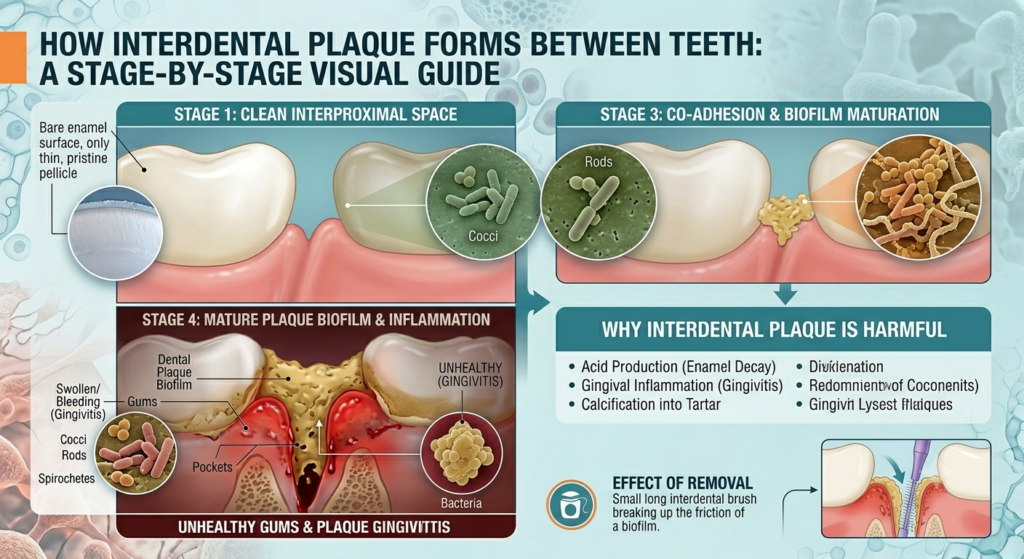
Plaque formation begins with the acquired pellicle, a thin protein film from saliva that coats the tooth surface. Bacteria attach to this film, multiply, and form a layered biofilm.
Between teeth, biofilm can be more persistent because the area is sheltered from chewing friction and less accessible to brushing.
The Biofilm Development Cycle
| Stage | What Happens | Interdental Relevance |
|---|---|---|
| Pellicle formation | Saliva proteins coat enamel | Creates the base layer for bacterial attachment |
| Early colonization | Bacteria attach to the pellicle | Begins even after cleaning |
| Biofilm maturation | Bacteria organize into communities | Harder to disrupt with rinsing alone |
| Inflammatory signaling | Bacterial byproducts irritate gums | Bleeding and swelling may appear |
| Mineralization | Plaque can harden into tartar | Requires professional removal |
Interdental cleaning interrupts this cycle mechanically. It does not sterilize the mouth, and it should not. The goal is not to kill every microbe. The goal is to disturb harmful accumulation before it becomes inflammatory.
Why Rinsing Alone Is Not Enough
Mouthwash can reach interdental spaces, but liquid flow is not the same as physical disruption. Mature plaque is sticky. It clings to enamel and root surfaces. A rinse may reduce loose debris, alter breath temporarily, or support the oral environment, but mechanical cleaning is still the core method for plaque removal.
That is why serious interdental science prioritizes contact: floss contacting the side of the tooth, an interdental brush contacting the walls of an open space, or a water flosser using pulsation and pressure to disturb debris and gingival margin buildup.
Benefits of Interdental Plaque Control
The benefits of interdental plaque control are both immediate and long-term. Some are visible within days. Others matter over years.
1. Cleaner Tooth Surfaces Between Teeth
Interdental cleaning removes plaque from surfaces a toothbrush may miss. This helps reduce the bacterial load near the gumline and around contact points.
2. Better Gum Response
When plaque is consistently disrupted, gum tissue may become less swollen, less reactive, and less likely to bleed during cleaning. The improvement is not magic; it is biology responding to reduced irritation.
3. Lower Risk of Tartar Buildup Between Teeth
Plaque that remains undisturbed can mineralize into calculus. Once hardened, it cannot be brushed or flossed away properly. Interdental cleaning reduces the plaque available to harden.
4. Fresher Breath Support
Bad breath can come from the tongue, dry mouth, gum disease, food debris, and interdental biofilm. Cleaning between teeth reduces one major odor source. For individuals who need on-the-go freshness support, a Mouth Freshner may help complement, not replace, mechanical cleaning.
5. Better Cleaning Around Dental Work
Crowns, bridges, implants, retainers, and orthodontic appliances often need targeted cleaning. Interdental tools help reach contours that brushing alone cannot manage.
6. More Complete Oral Hygiene
Interdental cleaning turns oral care from a surface routine into a full-mouth system. Brushing handles broad coverage. Interdental tools handle hidden surfaces. Tongue care supports breath and microbial balance.
Flossing vs Interdental Brush Science
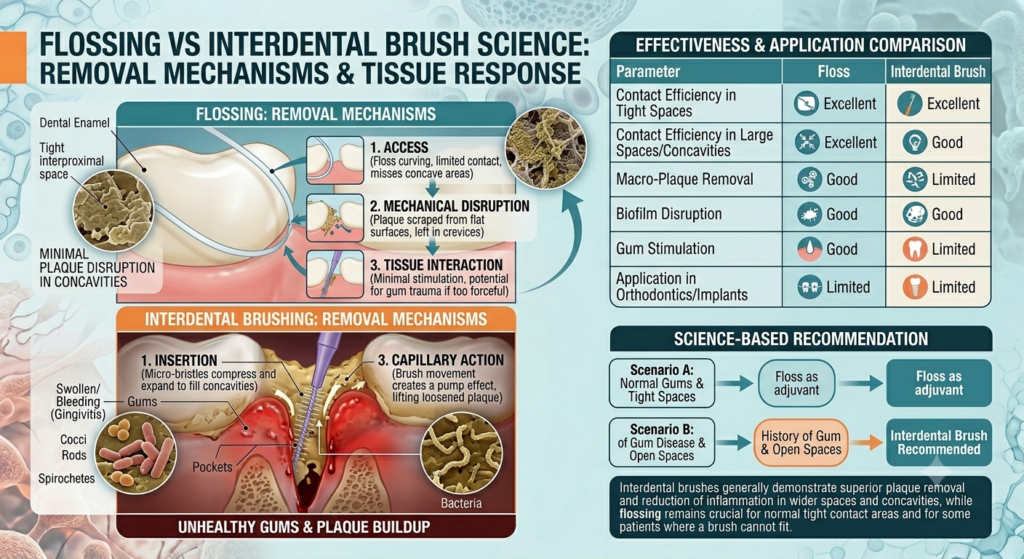
The flossing vs interdental brush debate is often misunderstood. The better question is not “Which tool wins?” The better question is “Which tool fits the space?”
Floss and interdental brushes work differently.
| Tool | Best For | Limitation |
|---|---|---|
| String floss | Tight contacts and narrow spaces | Technique-sensitive; may not fill wider gaps |
| Dental tape | Tight contacts with more comfort | Still requires correct wrapping technique |
| Interdental brush | Open embrasures and gum recession spaces | Can damage gums if forced into tight spaces |
| Rubber interdental pick | Gentle daily debris removal | May not clean as deeply as a properly sized brush |
| Water flosser | Braces, implants, gumline flushing, dexterity limits | Does not scrape tooth walls the same way as contact tools |
| Super floss/threaders | Bridges and orthodontics | Slower, more technical |
When Floss Makes Sense
Floss is most useful when teeth are close together and there is no room for a small interdental brush. Its strength is that it can pass through a tight contact point and wrap around the curved side of each tooth.
Good flossing is not a quick snap between teeth. It requires a C-shape hug around the tooth, gentle motion below the gum margin, and contact with both sides of the space.
When Interdental Brushes Make Sense
Interdental brushes are often better for open spaces because their bristles contact the concave sidewalls more effectively. They are especially relevant when gums have receded or spaces are large enough to accept the brush without force.
The correct brush should slide with mild resistance. If it bends, hurts, or must be pushed hard, it is too large for that space.
When Water Flossers Make Sense
Water flossers use pulsating water to flush debris and disturb plaque near the gumline. They can be useful for people with braces, implants, bridges, limited dexterity, or moderate gum inflammation.
A water flosser should not be viewed as a lazy shortcut. It is a different cleaning technology. For some individuals, it may improve consistency because it is easier to use daily than string floss.
Tool Choice by Space Type
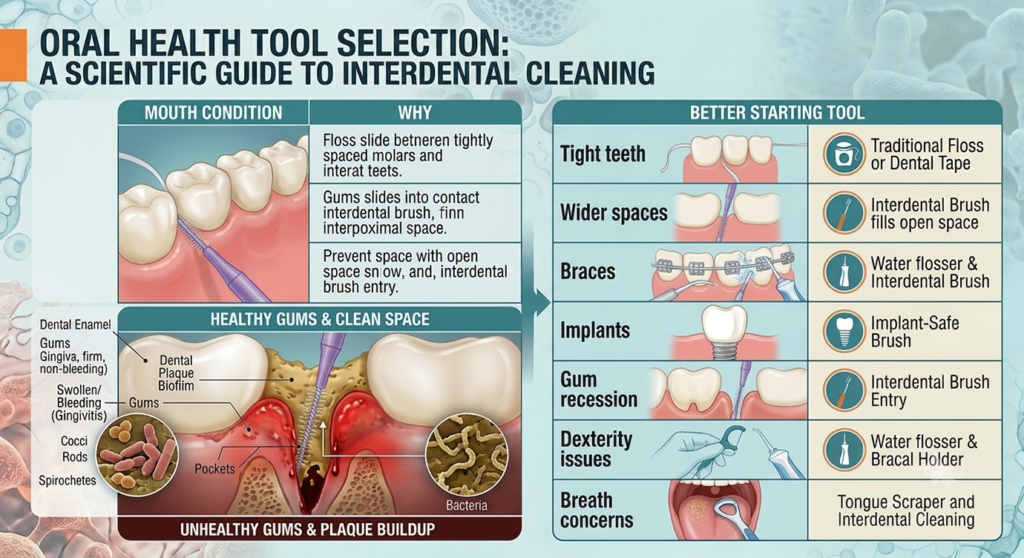
Interdental Tools: What Each One Is For
Interdental tools are not interchangeable. They are designed around different mouth shapes, risk profiles, and habits.
String Floss
String floss is for tight contacts. It works when it wraps around the tooth instead of simply moving up and down in the middle of the gap.
Best for:
| Use Case | Why It Helps |
|---|---|
| Tight teeth | Slides where brushes cannot |
| Contact-point plaque | Scrapes side surfaces |
| Daily maintenance | Low cost and portable |
| Early gumline cleaning | Can reach just below the margin when used gently |
Watch for:
| Mistake | Result |
|---|---|
| Snapping into gums | Tissue trauma |
| Straight up-and-down motion only | Misses tooth curvature |
| Reusing dirty sections | Moves debris between sites |
| Quitting because of early bleeding | May allow inflammation to continue |
Interdental Brushes
Interdental brushes are small bristled brushes designed to pass through the space between teeth. They are most effective when the brush size matches the space.
Best for:
| Use Case | Why It Helps |
|---|---|
| Gum recession | Cleans exposed sidewalls |
| Wider gaps | Fills space better than floss |
| Periodontal maintenance | Helps disrupt plaque near larger embrasures |
| Around bridges and implants | Reaches contours when sized correctly |
The science is simple: contact area matters. If the bristles touch more of the tooth surface, they can remove more plaque.
Rubber Picks
Rubber picks are flexible and often easier for daily use. They may be less intimidating for people who dislike floss.
Best for:
| Use Case | Why It Helps |
|---|---|
| On-the-go cleaning | Portable and simple |
| Sensitive gums | Softer feel than wire brushes |
| Habit-building | Easier entry point for beginners |
| Food removal | Helps after meals |
Rubber picks are useful, but they should be chosen for convenience and comfort rather than assumed to be the strongest plaque-removal method.
Water Flossers
Water flossers are especially useful when the mouth has hardware, inflammation, or areas that are hard to reach.
Best for:
| Use Case | Why It Helps |
|---|---|
| Braces | Flushes around brackets and wires |
| Implants | Cleans around complex contours |
| Bridges | Reaches underneath pontics |
| Limited dexterity | Easier than wrapping floss |
| Gumline debris | Pulsation helps disturb buildup |
Water pressure should be comfortable. More pressure is not automatically better.
Dental Tape
Dental tape is wider and flatter than string floss. It may feel smoother between tight teeth.
Best for:
| Use Case | Why It Helps |
|---|---|
| Tight contacts | Slides more comfortably |
| Sensitive gums | Softer feel |
| Floss beginners | Easier control |
| People who dislike thin floss | Less cutting sensation |
Floss Threaders and Super Floss
These are for complex dental work. They allow cleaning under bridges, around orthodontic wires, and beneath fixed retainers.
Best for:
| Use Case | Why It Helps |
|---|---|
| Fixed bridges | Cleans under false tooth area |
| Braces | Threads under wire |
| Retainers | Reaches plaque traps |
| Implants | Helps around prosthetic contours |
For more product-centered guidance, Hydropaste’s Best teeth tools guide can help compare practical tools for daily use.
The Gum Disease Connection
Gum disease often starts quietly. A person may not feel pain. The first signs may be bleeding, puffiness, tenderness, gumline odor, or a feeling that teeth are not staying clean between dental visits.
The interdental area is a common starting zone because plaque can remain there longer.
From Plaque to Gingivitis
Gingivitis is inflammation of the gums. It is commonly linked to plaque accumulation near the gum margin. In many cases, it can improve when plaque control improves.
The process often looks like this:
| Stage | What You May Notice |
|---|---|
| Plaque accumulation | Fuzzy feeling, trapped food |
| Gum irritation | Slight redness or swelling |
| Bleeding | Blood during flossing or brushing |
| Persistent inflammation | Tenderness, odor, deeper gum pockets |
| Periodontal involvement | Bone and attachment support may be affected |
The earlier the interruption, the easier the recovery tends to be.
Why Bleeding Should Not Be Ignored
Bleeding is information. It may mean the gums are inflamed. It may also mean technique is too aggressive. Either way, it deserves attention.
A reasonable response is not to stop cleaning entirely. A better response is to clean gently, improve consistency, and ask a dental professional if bleeding continues.
Interdental Cleaning and Periodontal Maintenance
People with a history of periodontal disease often have larger interdental spaces, gum recession, and deeper pockets. They may need a more customized tool plan than someone with healthy gums and tight contacts.
This is where the science becomes personal. There is no universal tool that fits every mouth. The right routine depends on anatomy.
The Oral Microbiome and Interdental Spaces
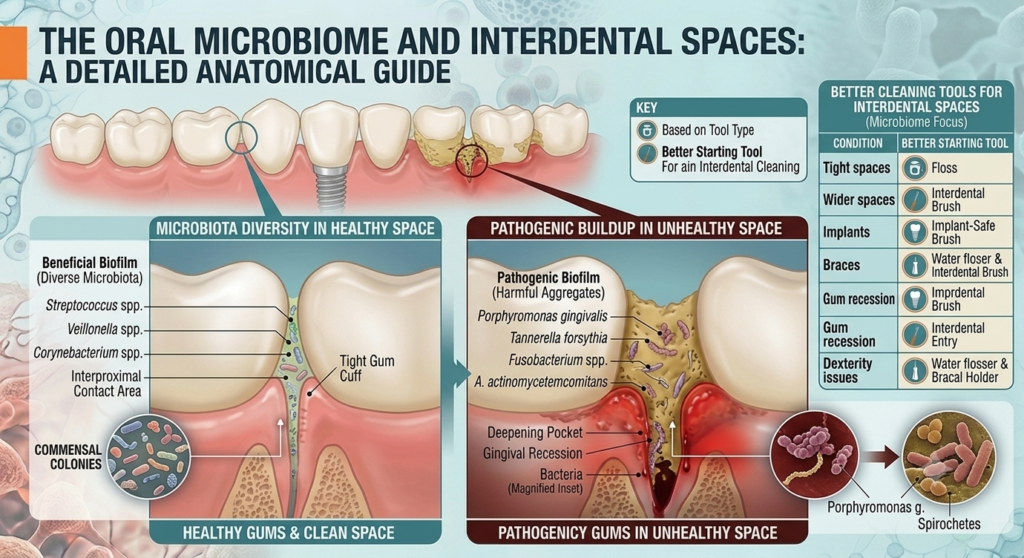
The mouth is not sterile. It should not be sterile. A healthy oral environment contains a diverse microbial community that lives on teeth, gums, tongue, cheeks, and saliva.
The issue is not bacteria alone. The issue is imbalance, stagnation, and mature biofilm in the wrong places.
Interdental spaces are not isolated pockets; they are part of the larger oral ecosystem. When plaque remains between teeth, it can influence bacterial balance across the gums, tongue, saliva, and tooth surfaces. This is why interdental cleaning should be viewed as part of a broader Oral Microbiome Balance strategy, not just a way to remove trapped food.
Interdental Biofilm and Breath
Breath is influenced by several zones:
| Zone | Breath Relevance |
|---|---|
| Tongue coating | Major source of sulfur-like odor |
| Interdental spaces | Trapped debris and anaerobic bacteria |
| Gum pockets | Inflammatory odor and bleeding |
| Dry mouth | Less saliva clearance |
| Dental appliances | Plaque-retentive surfaces |
This is why a breath routine built only around sprays or mints may disappoint. Freshness improves when odor sources are physically managed.
The Tongue-to-Teeth Connection
Tongue bacteria can spread through saliva and contact. A coated tongue can reseed bacteria across the mouth after brushing. Interdental cleaning and tongue scraping therefore support each other.
A complete oral routine usually follows a logic:
| Step | Purpose |
|---|---|
| Interdental cleaning | Disrupt plaque between teeth |
| Brushing | Clean broad surfaces and gumline |
| Tongue cleaning | Reduce coating and odor reservoir |
| Rinse or spray | Support comfort, moisture, or freshness |
The order can vary, but the coverage should not.
Latest Research on Interdental Cleaning
Modern interdental research is moving away from simplistic advice like “floss every day” and toward a more precise question: which interdental method works best for which mouth?
That shift matters because real people have different tooth spacing, gum recession, restorations, dexterity, habits, and risk levels.
1. Tool Fit Matters More Than Tool Loyalty
Recent thinking increasingly supports a patient-centered model. Instead of telling everyone to use the same tool, dental guidance is moving toward matching the tool to the interdental space.
A person with tight contacts may need floss. A person with open embrasures may need interdental brushes. A person with braces or implants may benefit from a water flosser. A person with limited hand control may need handles, holders, or powered devices.
This is more realistic than a one-size-fits-all message.
2. Interdental Brushes Remain Strong for Open Spaces
Research has repeatedly suggested that interdental brushes can be highly effective when they fit properly. The reason is mechanical. Bristles fill the embrasure and contact more surface area.
However, this only applies when there is enough space. Forcing a brush into tight contacts can cause trauma and discourage use.
3. Water Flossers Are Gaining Serious Attention
Water flossers are increasingly being studied for gum health, gingival bleeding, orthodontic cleaning, implants, and people who struggle with traditional floss.
The most practical research insight is not that water flossers replace every tool. It is that they may improve consistency and reach in situations where flossing is difficult or poorly performed.
4. The Floss Debate Is Really a Technique Debate
Floss can work well when used correctly. The problem is that many people do not use it correctly or consistently. A rushed vertical snap between teeth may do very little for plaque along the sidewall.
The science does not say floss is useless. It says technique, anatomy, and adherence determine its value.
5. Interdental Cleaning Is Being Linked to Broader Periodontal Risk Patterns
Recent population-level research continues to examine associations between interdental cleaning habits and periodontal health. These studies cannot prove that one habit alone prevents disease in every person, but they reinforce the idea that interdental cleaning belongs in a serious prevention routine.
6. The Future Is Personalized Interdental Care
The future of interdental science will likely focus on:
| Research Direction | Why It Matters |
|---|---|
| Personalized tool sizing | Better fit, less injury, more plaque removal |
| Microbiome-sensitive routines | Supporting balance rather than over-disinfection |
| Implant-specific cleaning | Rising implant use creates new maintenance needs |
| Orthodontic cleaning systems | Aligners and braces need better home care protocols |
| Behavior design | The best tool is the one a person can use correctly every day |
| Smart oral-care feedback | Sensors and apps may help identify missed areas |
The next generation of interdental care will not be about telling people to “try harder.” It will be about better matching, better coaching, and better routine design.
The Hydropaste Interdental Science Framework
A strong interdental routine can be built around five questions.
1. What Space Are You Cleaning?
Different spaces require different tools.
| Space Type | Tool Logic |
|---|---|
| Tight contact | Floss or tape |
| Open embrasure | Interdental brush |
| Braces | Water flosser plus brush |
| Bridge | Super floss or threader |
| Implant | Implant-safe brush or water flosser |
| Retainer | Threader or water flosser |
2. What Is the Main Problem?
The main concern changes the routine.
| Concern | Likely Focus |
|---|---|
| Bleeding gums | Gentle daily plaque disruption |
| Food trapping | Targeted cleaning after meals |
| Bad breath | Interdental cleaning plus tongue care |
| Gum recession | Correctly sized interdental brushes |
| Braces | Water flosser and small brushes |
| Sensitivity | Softer tools and less force |
| Plaque buildup | More consistent mechanical disruption |
3. What Tool Can You Use Correctly?
A technically excellent tool is useless if it stays in the drawer. The best interdental cleaning tool is effective, safe, and realistic for the person using it.
4. What Does Your Gum Tissue Tell You?
Gums provide feedback. Less bleeding, less puffiness, fresher breath, and fewer trapped-food episodes suggest the routine is moving in the right direction.
Pain, cuts, persistent bleeding, or recession concerns suggest the routine needs adjustment.
5. What Needs Professional Review?
Home care is powerful, but it is not a substitute for dental evaluation. Persistent bleeding, loose teeth, gum recession, pus, deep pockets, or pain require professional attention.
Common Mistakes That Reduce Results
Interdental cleaning fails most often because of poor tool fit, poor technique, or inconsistent timing.
Mistake 1: Snapping Floss Into the Gums
Floss should glide through the contact and curve around the tooth. Snapping can injure the gum papilla and make the habit feel painful.
Mistake 2: Using One Brush Size for Every Space
Different gaps may need different brush sizes. A brush that fits between molars may be too large for front teeth.
Mistake 3: Forcing Interdental Brushes
A brush should not be forced. If it does not pass gently, use floss or a smaller brush.
Mistake 4: Treating Mouthwash as a Replacement
Mouthwash can support freshness or specific therapeutic goals, but it does not replace mechanical plaque disruption.
Mistake 5: Cleaning Only When Food Gets Stuck
Interdental cleaning is not only for removing visible food. It is for disrupting invisible biofilm before it becomes inflammatory.
Mistake 6: Quitting When Gums Bleed
Early bleeding may improve with gentle, consistent cleaning. If bleeding persists or worsens, seek dental guidance rather than abandoning interdental care.
Mistake 7: Ignoring Tooth Shape and Dental Work
Crowns, fillings, bridges, implants, and retainers change the cleaning map. A routine that worked before dental treatment may need updating afterward.
How to Build an Evidence-Informed Routine
A good routine should be simple enough to repeat and precise enough to matter.
Step 1: Map Your Mouth
Notice where food traps, gums bleed, floss shreds, or spaces feel open. These areas need special attention.
Step 2: Choose the Tool by Space
Use floss for tight contacts. Use interdental brushes for open spaces. Use water flossers when hardware, dexterity, or gumline flushing is the main concern.
Step 3: Clean Before Brushing or After Brushing
The exact order matters less than complete coverage. Some people prefer interdental cleaning before brushing because it loosens debris. Others prefer after brushing because it feels like a finishing step.
The best order is the one you will repeat.
Step 4: Use Gentle Pressure
Interdental cleaning should feel controlled, not forceful. Mild gum tenderness may occur when starting, but sharp pain is not normal.
Step 5: Track Gum Feedback for Two Weeks
Look for:
| Positive Sign | Meaning |
|---|---|
| Less bleeding | Inflammation may be reducing |
| Less trapped food | Cleaning is reaching the problem area |
| Fresher breath | Debris and biofilm may be better controlled |
| Less gum puffiness | Tissue response may be improving |
| Easier floss passage | Technique and consistency may be improving |
Step 6: Ask for Sizing Help
A dental hygienist can often identify which interdental brush sizes fit different areas. This is especially useful for gum recession, implants, and periodontal maintenance.
Interdental Cleaning for Specific Situations
Interdental science becomes more useful when applied to real-life oral conditions.
Braces
Braces create plaque traps around brackets and wires. A water flosser can flush debris, while small interdental brushes can clean around brackets. Floss threaders may be needed for contact areas.
Best approach:
| Tool | Role |
|---|---|
| Water flosser | Flushes around wires |
| Interdental brush | Cleans bracket edges |
| Floss threader | Cleans between teeth |
| Soft toothbrush | Cleans gumline and brackets |
Clear Aligners
Aligners cover teeth for long hours. Food or plaque left behind before wearing aligners can sit against enamel and gums. Interdental cleaning becomes especially important before reinserting trays.
Implants
Implants need careful cleaning around the gumline and prosthetic contours. The tissue seal around implants differs from natural teeth, so inflammation around implants deserves close attention.
Use implant-safe tools and avoid aggressive force.
Crowns and Bridges
Crowns have margins. Bridges have spaces beneath artificial teeth. These areas may trap plaque and require super floss, threaders, interdental brushes, or water flossers.
Gum Recession
When gums recede, root surfaces may become exposed. These surfaces can be more sensitive and more vulnerable than enamel. Interdental brushes may work well, but sizing and softness matter.
Tight Teeth
Floss or dental tape is usually the starting point. If floss shreds repeatedly, there may be rough dental work, tight contacts, or calculus that needs professional attention.
Aging Mouths
Aging can bring gum recession, dry mouth, medication-related saliva changes, dexterity limits, restorations, and implants. The routine may need to become more ergonomic and less dependent on perfect finger control.
Interproximal Reduction and Orthodontic Spaces
Some orthodontic treatments involve reshaping tiny amounts of enamel between teeth to create space. This changes the contact area and may alter how interdental cleaning feels. For more on this topic, see Hydropaste’s guide to Interproximal Reduction.
Interdental Cleaning Science Chart
| Scientific Principle | Practical Meaning | Best Daily Response |
|---|---|---|
| Toothbrushes miss tight sidewalls | Brushing alone leaves hidden plaque | Add interdental cleaning |
| Biofilm matures over time | Old plaque is harder to disturb | Clean daily or consistently |
| Tool fit affects results | One tool does not suit every gap | Match tool to space size |
| Gums bleed when inflamed | Bleeding may signal plaque irritation | Clean gently and monitor |
| Rinses do not scrape plaque | Liquid flow has limits | Use mechanical disruption |
| Tongue bacteria can reseed the mouth | Breath issues may have multiple sources | Combine interdental and tongue care |
| Dental work traps plaque differently | Crowns, bridges, and implants need special care | Use targeted tools |
| Consistency beats intensity | Hard scrubbing can injure tissue | Use gentle daily technique |
Best Interdental Cleaning Tools by Need
| Need | Tool Category | What to Look For |
|---|---|---|
| Tight teeth | Waxed floss or dental tape | Smooth glide, shred resistance |
| Gum recession | Interdental brushes | Multiple sizes, soft bristles |
| Braces | Water flosser | Adjustable pressure, orthodontic tip |
| Implants | Implant-safe interdental brush | Gentle wire coating or soft material |
| Breath support | Floss/brush plus tongue scraper | Combined debris and coating control |
| Travel | Rubber picks or floss picks | Compact, easy to carry |
| Dexterity limits | Floss holder or water flosser | Grip-friendly design |
| Sensitive gums | Soft picks or gentle floss | Low trauma, controlled pressure |
How to Know If Your Interdental Routine Is Working
A working routine usually produces subtle changes before dramatic ones.
You may notice:
| Sign | Why It Matters |
|---|---|
| Less bleeding after consistent use | Gum inflammation may be calming |
| Cleaner feeling between molars | Food and plaque are being removed |
| Less odor from trapped areas | Bacterial debris may be lower |
| Fewer swollen gum points | Local irritation may be reduced |
| Easier dental cleanings | Less hardened buildup may form |
| More awareness of problem spots | You can target care better |
Not every improvement is instant. Gum tissue may need time to respond. However, persistent bleeding, pain, swelling, or pus should not be treated as a normal adjustment phase.
FAQs About Interdental Cleaning Science
What is interdental cleaning science and why does it matter for plaque control?
Interdental cleaning science studies how plaque forms between teeth and how different tools disrupt it. It matters because the spaces between teeth are protected from normal brushing. Plaque can mature there, irritate gum tissue, and contribute to bleeding, odor, tartar buildup, and periodontal risk.
The science is practical: toothbrushes clean broad surfaces, while interdental tools clean hidden sidewalls and gumline spaces. A complete routine needs both.
Is flossing or interdental brushing better for gum health?
Neither tool is automatically better for every mouth. Floss is usually better for tight contacts where no brush can fit. Interdental brushes are often better for open spaces because their bristles contact more surface area.
The best choice depends on anatomy. If the space is tight, floss makes sense. If the space is open, a correctly sized interdental brush may clean more effectively. For braces, implants, or dexterity challenges, a water flosser may also be useful.
How often should I clean between my teeth for plaque control?
Most people benefit from cleaning between teeth once daily or at least consistently enough to prevent plaque from maturing. Daily use is especially important for people with bleeding gums, gum recession, braces, implants, bridges, or frequent food trapping.
The goal is not aggressive cleaning. The goal is regular disruption of biofilm before it hardens or triggers inflammation.
Why do my gums bleed when I floss or use interdental brushes?
Bleeding may happen because the gum tissue is inflamed from plaque buildup. It can also happen if the tool is used too aggressively or if an interdental brush is too large for the space.
Gentle consistency often helps inflamed gums improve, but bleeding that continues, worsens, or appears with swelling and pain should be checked by a dental professional.
Can interdental cleaning help with bad breath?
Yes, interdental cleaning can help if odor is coming from trapped food, plaque, or bacteria between teeth. However, bad breath often has multiple sources, including tongue coating, dry mouth, gum inflammation, diet, and dental appliances.
For better breath support, combine interdental cleaning with tongue cleaning, hydration, and appropriate mouth freshness products when needed.
People Also Ask
Why is interdental cleaning important if I already brush twice a day?
Brushing twice a day is essential, but it does not reliably clean the tight sidewalls between teeth. Interdental cleaning reaches the areas where toothbrush bristles often cannot enter. Without it, plaque may remain hidden near the gumline and between contact points.
Think of brushing as cleaning the visible rooms and interdental cleaning as cleaning the narrow hallways where dust collects quietly.
What is the best interdental cleaning tool for plaque removal?
The best interdental cleaning tool depends on the space. Floss works well for tight contacts. Interdental brushes work well for wider spaces. Water flossers help with braces, implants, bridges, and people who struggle with hand control.
A strong routine may use more than one tool because the mouth does not have one uniform gap size.
Are water flossers scientifically useful for interdental plaque control?
Water flossers can be useful, especially for reducing debris and supporting gumline cleaning around braces, implants, bridges, and inflamed gums. They use pulsating water to disturb plaque and flush areas that are difficult to reach.
They are not identical to floss or brushes because they do not scrape tooth walls in the same way. Their value is strongest when they improve reach, comfort, and daily consistency.
Can interdental cleaning reverse gingivitis?
Gingivitis linked to plaque buildup can often improve when plaque is removed consistently and gently. Interdental cleaning helps because it targets plaque near the gumline between teeth, where inflammation frequently begins.
However, if inflammation has progressed beyond gingivitis or tartar is present, professional dental care is needed.
Does interdental cleaning protect the oral microbiome?
Interdental cleaning supports a healthier oral microbiome by disrupting stagnant biofilm without trying to sterilize the mouth. The goal is balance, not total bacterial elimination.
A microbiome-friendly routine uses mechanical cleaning, gentle products, saliva support, and tongue care instead of relying only on harsh antiseptic approaches.
Editorial Insights
Interdental cleaning science is moving toward a smarter, more individualized model. The old message was simple: floss more. The better message is more precise: clean the spaces your toothbrush misses, using the tool that fits your mouth.
That distinction changes everything.
A person with tight contacts may need floss. A person with gum recession may need interdental brushes. A person with braces may need a water flosser. A person with persistent breath issues may need interdental cleaning, tongue cleaning, and moisture support working together.
The most advanced oral-care routine is not the most complicated one. It is the one that understands surface anatomy, biofilm behavior, gum response, and daily human behavior.
For Hydropaste readers, the practical takeaway is clear: interdental cleaning is not a cosmetic extra. It is the science of controlling the hidden zones where plaque, inflammation, and odor often begin. To continue exploring enamel-safe, microbiome-aware oral care systems, return to the Homepage.