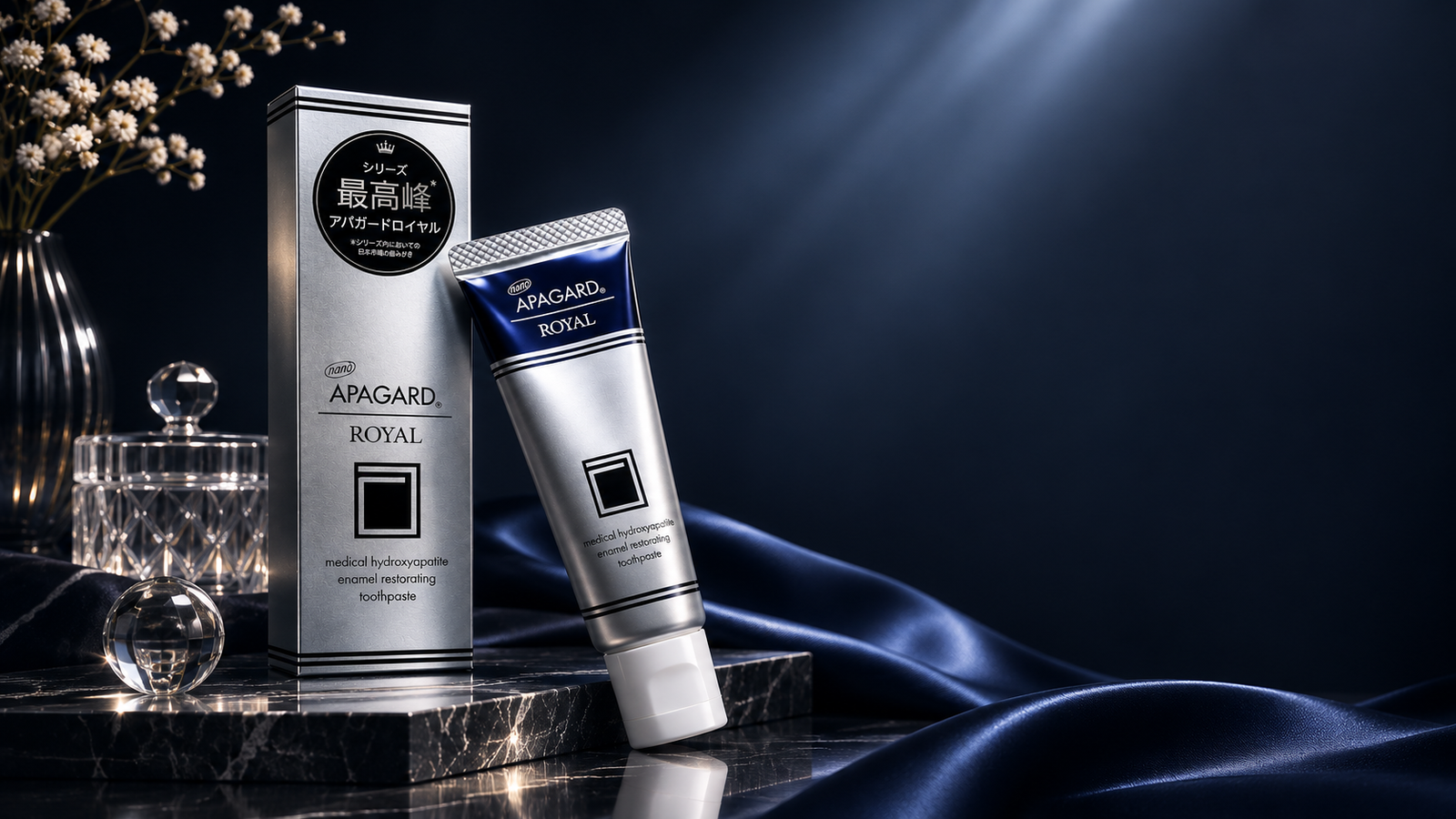
Apagard Premio Toothpaste | Nano-Hydroxyapatite Benefits, Reviews & Apagard Royal Comparison
Amazon Affiliate Disclosure
Hydropaste.com may earn a commission from qualifying purchases made through affiliate links, including Amazon links. This does not affect the price you pay. Our editorial guidance is based on ingredient function, oral care science, user intent, and practical product evaluation rather than commission value.
Updated November, 2026.
Japanese Innovation. Global Standard.
Welcome to Apagard, the originator of modern remineralizing toothpaste. Developed in Japan by Sangi Co. and based on NASA technology, Apagard introduced the dental world to Nano-Hydroxyapatite (n-Ha), the revolutionary mineral that is clinically proven to restore and strengthen enamel.
For decades, Apagard has set the global standard for advanced, fluoride-free protection, trusted by those who demand scientific performance and exceptional quality.
Quick Picks
What is Apagard Premio toothpaste?
Apagard Premio is a premium Japanese remineralizing toothpaste formulated with Nano-Hydroxyapatite (n-Ha), the same enamel-building mineral used in NASA research. It is designed to strengthen enamel, repair micro-damage, reduce sensitivity, and deliver a naturally brighter smile without harsh abrasives.
The Science Behind Apagard’s mHAP Technology
Apagard’s proprietary medical hydroxyapatite (mHAP) is one of the most researched biomimetic materials in dentistry. Unlike generic hydroxyapatite, mHAP is engineered for maximum bioavailability and enamel integration.
Clinical research over decades has shown that nano-hydroxyapatite:
- Integrates directly into enamel to restore mineral density
- Repairs early-stage enamel lesions before they become cavities
- Reduces hypersensitivity by sealing dentinal tubules
- Creates a smoother enamel surface that resists plaque and staining
Because mHAP is structurally identical to natural enamel, it doesn’t just protect—it rebuilds teeth at the microscopic level.
Is Premio safe for daily use?
Apagard Premio is safe for daily brushing. Its formula is fluoride-free, SLS-free, and gentle on enamel, making it suitable for long-term use and for people looking for a clean, science-backed oral-care product.
Is Premio fluoride-free?
Yes. Apagard Premio is 100% fluoride-free. The remineralizing benefits come from nano-hydroxyapatite, an enamel-identical mineral that strengthens teeth without relying on fluoride.
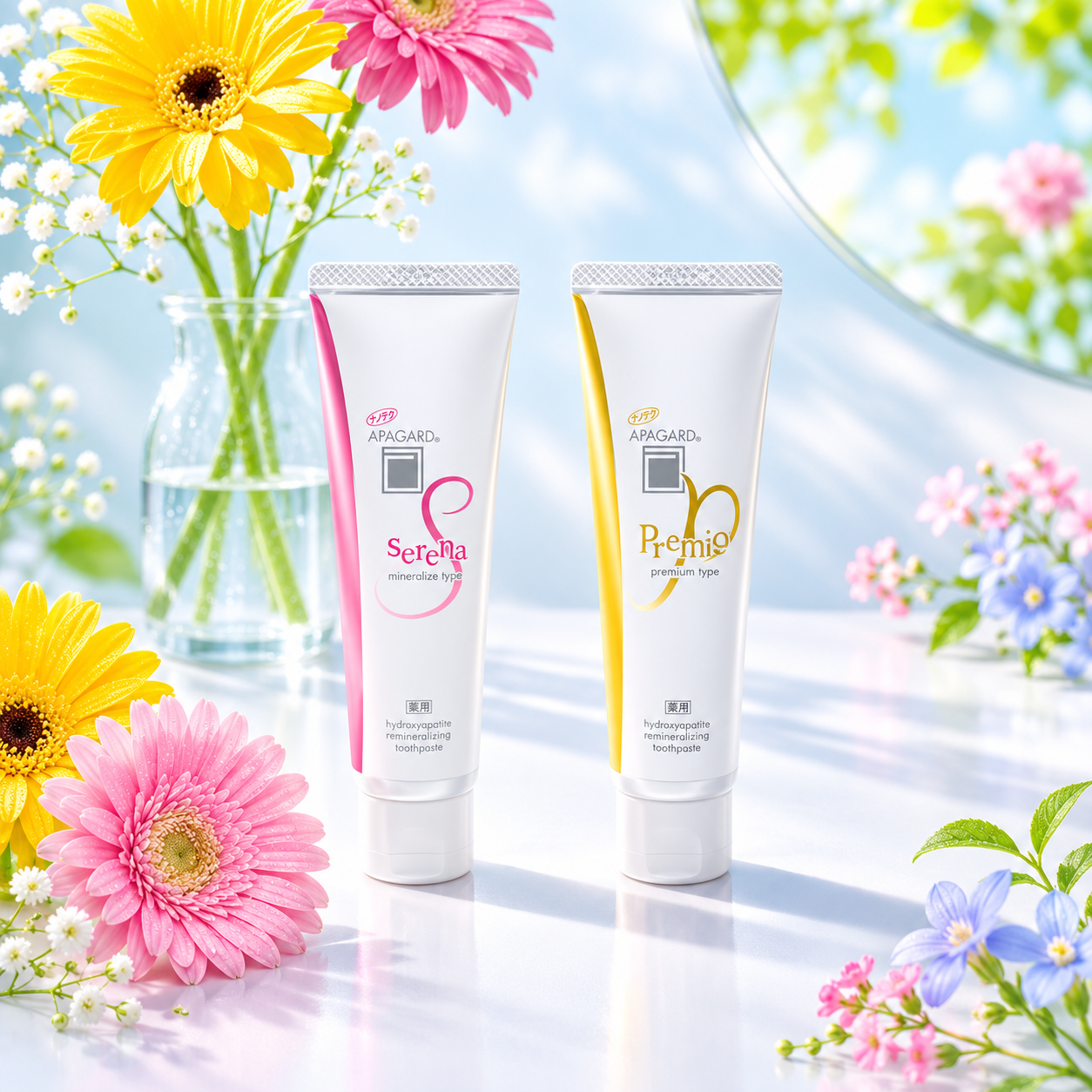
Why Premio Is The Pioneer
Apagard Premio uses proprietary technology to deliver the most effective form of enamel restoration, making it the choice for discerning dental consumers worldwide.
- 🔬 Patented Nano-Hydroxyapatite (mHAP): Apagard’s proprietary form of Nano-Hydroxyapatite, known as mHAP (medical Hydroxyapatite), is a highly effective, biomimetic mineral identical to the compound making up 97% of your enamel. These nano-sized particles penetrate deeply into micro-fissures and defects, actively:
- Remineralizing Enamel
- Smoothing the Tooth Surface
- Reducing Hypersensitivity
- Adsorbing and Removing Plaque
- 🥇 Clinically Proven Results: Backed by decades of research and development in Japanese dental science, Premio has been providing powerful anti-cavity benefits and exceptional tooth restoration since 1980.
- ✨ Best Whitening Toothpaste: By repairing microscopic surface imperfections, Apagard helps restore the natural translucency and luster of the enamel, leading to a visibly brighter, smoother, and healthier-looking smile.
- 🚫 Fluoride-Free Formulation: Enjoy powerful, professional-level protection without the use of fluoride, making it a safe and effective choice for all ages.
How does Nano-Hydroxyapatite in Apagard Premio work?
Nano-Hydroxyapatite binds to weakened areas of tooth enamel, filling microscopic cracks and smoothing the surface. This remineralization process helps restore enamel integrity, reduce sensitivity, and improve overall tooth strength in a way similar to natural mineral deposition.
Shop the APAGARD Premio Advanced Oral Care Range
Explore the full line of Apagard products, each designed with superior mHAP technology for specific needs.
Apagard Premio Toothpaste (Best Premium Whitening Toothpaste of 2026)
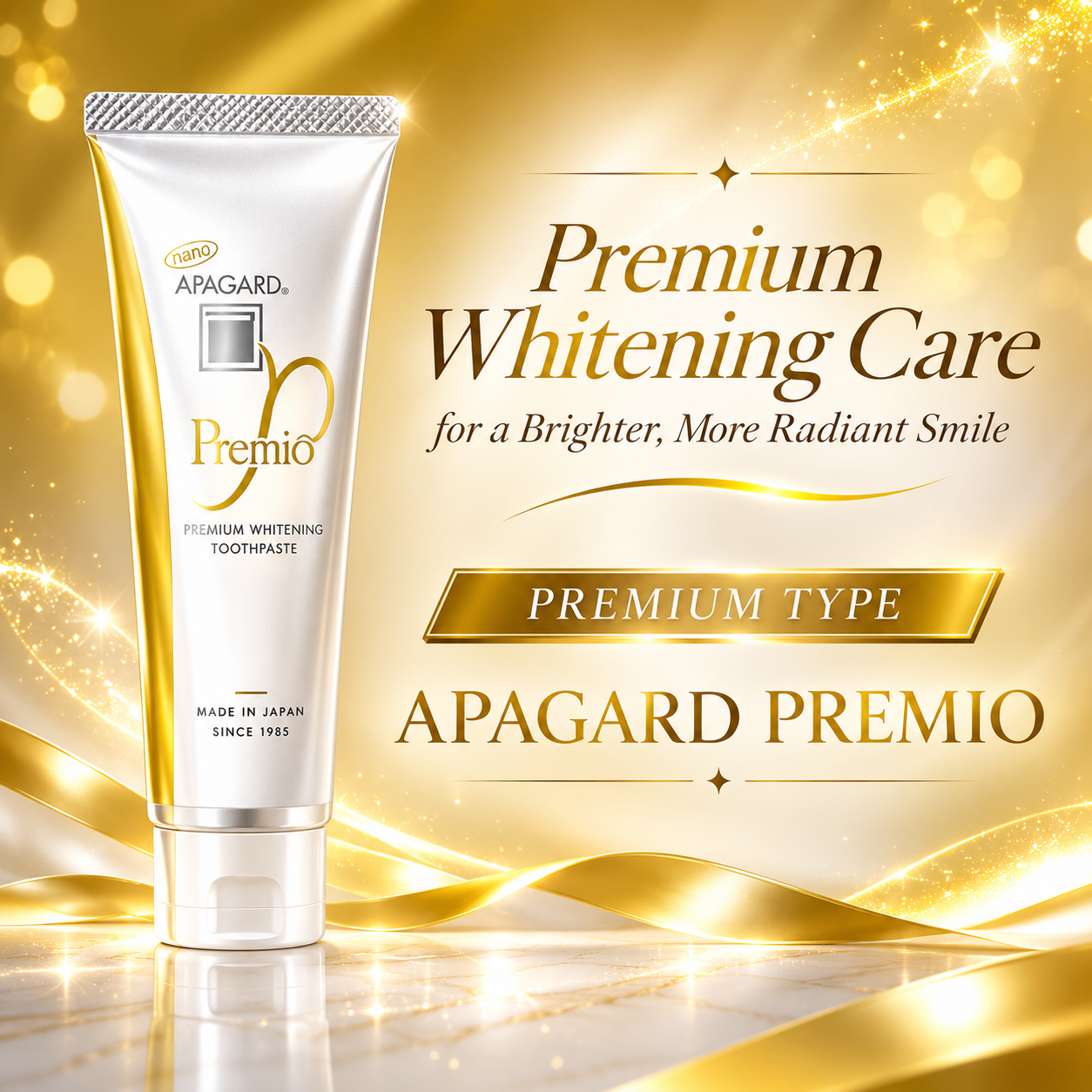
Best For: The Premium Enamel Remineralizer & Natural Pearl-Gloss Whitener
Apagard Premio Toothpaste is a premium Japanese whitening toothpaste formulated with Medical Nano-Hydroxyapatite (mHAP), a biomimetic mineral technology designed to support enamel remineralization, improve surface smoothness, and enhance the natural whiteness of teeth without peroxide bleaching.
As the “premium everyday performer” of the Apagard lineup, Premio contains approximately 1.4 times the nano-hydroxyapatite concentration of Apagard M-Plus and Smokin’, according to manufacturer information. Its fluoride-free formula combines advanced enamel care with xylitol and pearl-derived conchiolin protein for a polished, naturally radiant smile.

- Japan’s Leading Hydroxyapatite Toothpaste is now in the US. APAGARD features Sangi’s original nano-Hydroxyapatite (nano-…
- Cleans Teeth & Helps Remove Surface Plaque. With consistent brushing, APAGARD nano-Hydroxyapatite toothpaste helps remov…
- APAGARD PREMIO, true to its name, offers a premium experience with higher nano-mHAP concentration to deliver greater nat…
The Experience: A refined, creamy texture with a refreshing mint finish. Unlike aggressive whitening treatments, Apagard Premio focuses on daily mineral replenishment and gentle cleaning, leaving teeth feeling exceptionally smooth, clean, and polished.
The Benefit: Its Medical Nano-Hydroxyapatite particles interact with microscopic imperfections in tooth enamel, helping replenish lost minerals and create a smoother surface. This mineral-based approach may improve enamel gloss, reduce sensitivity associated with exposed dentin, and make surface stains less likely to accumulate.
Why Apagard Premio Toothpaste Is One of the Best Whitening Toothpastes of 2026
Unlike peroxide-based whitening products that chemically bleach tooth pigments, Apagard Premio uses nano-hydroxyapatite technology to support enamel mineralization and natural tooth brightness. Its formula also includes silica for cleaning, xylitol for oral care support, and conchiolin for added surface luster.
| Feature | Apagard Premio | Conventional Whitening Toothpastes |
|---|---|---|
| Whitening Method | Enamel mineral support, cleaning, and natural gloss | Surface stain removal or peroxide bleaching |
| Key Ingredient | Medical Nano-Hydroxyapatite (mHAP) | Silica, peroxide, or other whitening agents |
| Enamel Care | Supports remineralization of early mineral loss | Depends on the formulation |
| Sensitivity | May help reduce sensitivity by covering exposed dentinal tubules | Effects vary; some whitening formulas cause sensitivity |
| Fluoride-Free | Yes | Depends on the product |
| Natural Luster | Pearl-derived conchiolin and smoother enamel | Primarily stain removal or bleaching |
| Best Use | Daily whitening maintenance and enamel care | Surface stain removal or shade lightening |
Pro Tip: For the best results with Apagard Premio nano-hydroxyapatite toothpaste, brush gently and thoroughly using a soft-bristled toothbrush. After brushing, spit out the excess toothpaste and rinse lightly rather than vigorously, following Sangi’s product guidance. This helps retain some hydroxyapatite residue in the mouth for continued contact with tooth surfaces.
The Verdict: Apagard Premio is an excellent premium option for people seeking fluoride-free whitening toothpaste, daily enamel remineralization, and naturally glossy teeth. It is particularly appealing to those who prioritize long-term enamel care over rapid chemical bleaching. While it cannot regenerate enamel that has been structurally lost or produce dramatic bleaching results, its mineral-focused formulation makes it a compelling choice for maintaining a healthier-looking, naturally brighter smile.
Is Premio effective for sensitive teeth?
Yes. Apagard Premio is widely recommended for tooth sensitivity because nano-hydroxyapatite seals exposed dentinal tubules and rebuilds enamel. Many users experience relief from sensitivity after consistent use.
Is Apagard Premio really the best whitening toothpaste ?
Apagard Premio provides a natural whitening effect by smoothing and restoring enamel, reducing surface stains, and enhancing light reflection. It does not use harsh bleaching agents, making it ideal for gentle brightening.
Apagard Royal (Best Whitening Toothpaste of 2026)
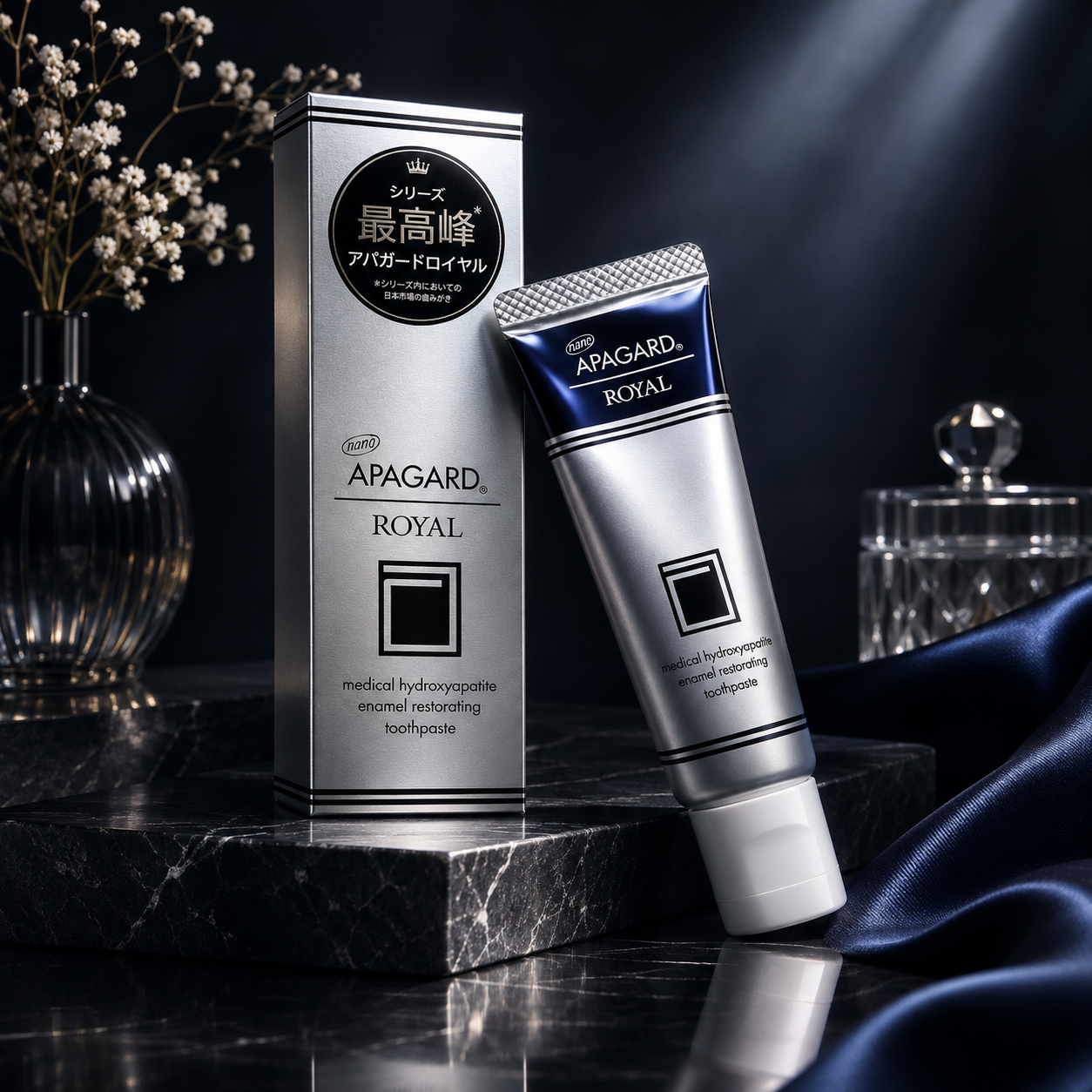
Best For: The Luxury Restorative & Advanced Whitener
As the “crown jewel” of the Apagard lineup, Royal contains the highest concentration of Medical Hydroxyapatite (mHAP) in the world—literally double the amount found in their standard formulas. It doesn’t just clean; it re-builds your teeth.

- W/tracking by JP post
- W/tracking number from JP Post
- Apagard Tooth Polish Royal Toothpaste, Direct From Japan
- The Experience: A silkier, low-foaming, and ultra-smooth texture that feels more like a professional treatment than a standard paste. It leaves the teeth feeling “glass-smooth” to the tongue.
- The Benefit: It utilizes NASA-inspired nanotechnology to fill in microscopic “fissures” in your enamel. By smoothing the surface, it makes it physically impossible for stains and plaque to stick, resulting in a permanent, high-gloss “Pearl” whiteness.
Why “Apagard Royal” is the King of Best Whitening Toothpastes
Unlike standard whitening toothpastes that use grit to “sand down” stains, Apagard Royal whitens through remineralization.
| Feature | Apagard Royal | Most Whitening Pastes |
| Whitening Method | Enamel restoration & pearl gloss | Physical abrasives (silica) |
| Sensitivity | Eliminates it by sealing tubules | Often increases it by thinning enamel |
| Key Ingredient | 2x Times Nano-Hydroxyapatite | Fluoride or Peroxide |
| Luster | Added Pearl Conchiolin for “glow” | Flat matte finish |
Pro Tip: To maximize the mHAP effect, do not rinse vigorously with water after brushing. Just spit out the excess; let the remaining nano-minerals “soak” into your enamel to continue the repair process while you sleep.
Apagard Premio vs BOKA vs Himalaya vs MILTODENT
When comparing remineralizing toothpastes, the key factors are mineral technology, penetration depth, and clinical backing.
| Brand | Core Technology | Fluoride-Free | Enamel Repair Depth | Sensitivity Relief | Whitening Type | Positioning |
|---|---|---|---|---|---|---|
| Apagard | Medical Nano-Hydroxyapatite (mHAP) | ✅ | ⭐⭐⭐⭐⭐ | ⭐⭐⭐⭐⭐ | Enamel restoration | Clinical gold standard |
| BOKA | Nano-hydroxyapatite | ✅ | ⭐⭐⭐⭐⭐ | ⭐⭐⭐⭐⭐ | Natural enamel polish | Everyday premium |
| Himalaya | Herbal extracts | ✅ | ⭐ | ⭐⭐ | Herbal polishing | Natural/basic care |
| MILTODENT | 15% Micro-Hydroxyapatite | ✅ | ⭐⭐⭐ | ⭐⭐⭐⭐ | Optical + mineral | Non-nano safety |
Key Differences Explained
Apagard Premio (Original Clinical Pioneer)
Apagard remains the benchmark because:
- Uses patented mHAP technology
- Backed by decades of Japanese clinical research
- Delivers deep enamel reconstruction, not just protection
BOKA (Modern Consumer Favorite)
BOKA offers:
- Excellent daily-use nano-hydroxyapatite formulas
- Strong balance of safety, performance, and accessibility
- Ideal for long-term maintenance
Himalaya (Herbal Alternative)
Himalaya focuses on:
- Botanical ingredients for gum care
- Freshness and plaque control
- But lacks true enamel-repair capability
MILTODENT (High-Concentration Non-Nano Option)
MILTODENT delivers:
- Strong surface remineralization with 15% MHA
- Safer alternative for users avoiding nano-particles
- Less penetration compared to Apagard’s nano technology
Which Toothpaste Should You Choose?
| Focus | Recommended Brand | Key Mechanism / Benefit |
| Best for clinical-grade enamel repair | Apagard Premio | Premium medical-grade nano-hydroxyapatite ($n\text{-HA}$) to deeply restock lost minerals. |
| Best for daily biomimetic care | BOKA | Gentle, daily-use $n\text{-HA}$ formula designed to safely reduce sensitivity. |
| Best for sustainable nano-repair | Davids (Hydroxi™) | Powered by uncoated, 50nm rod-shaped nano-hydroxyapatite for targeted tubule occlusion. |
| Best for non-nano remineralization | RiseWell | Uses 10% safe-to-swallow micro-hydroxyapatite for clean, effective enamel support. |
| Best for organic pH balancing | ORL Oralcare | Non-nano hydroxyapatite combined with organic xylitol in a perfect 7.0 pH neutral formula. |
Apagard Royal vs Premio: Which Hydroxyapatite Toothpaste Is Better?
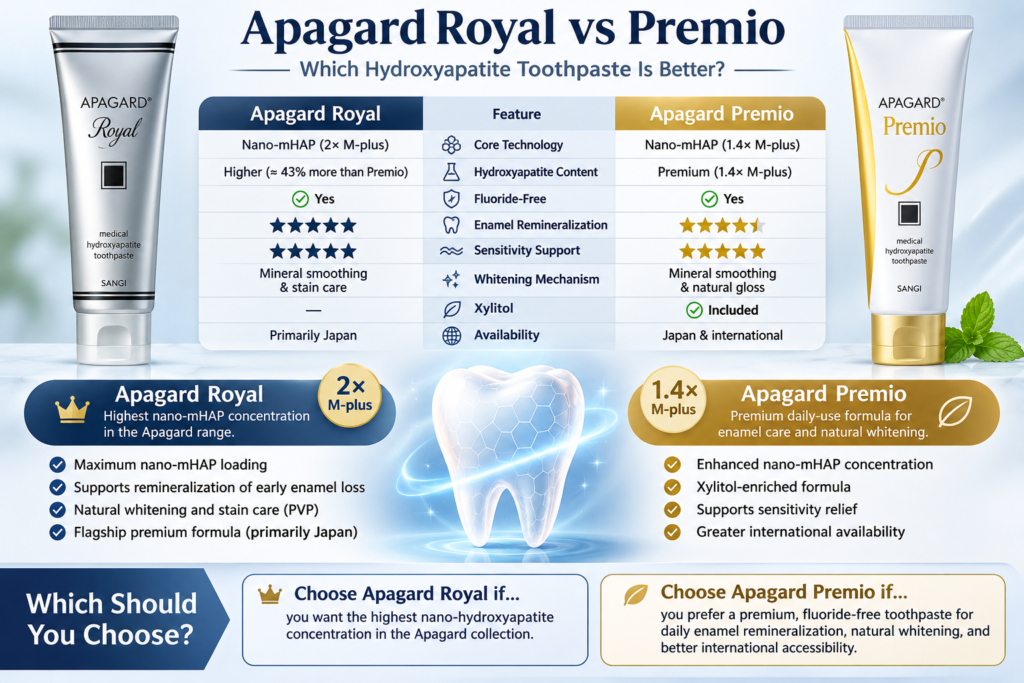
When comparing Apagard Royal vs Premio, the most important differences are nano-hydroxyapatite concentration, enamel remineralization technology, whitening formulation, and everyday accessibility.
Both Japanese toothpastes are developed by Sangi and contain proprietary nano Medical Hydroxyapatite (nano-mHAP), a biomimetic mineral ingredient designed to replenish minerals in early enamel lesions, smooth microscopic surface imperfections, and support natural tooth whiteness.
However, Apagard Royal contains the highest concentration of nano-mHAP in the Apagard range, while Apagard Premio delivers premium remineralizing care in a more widely available formula.
Apagard Royal vs Apagard Premio: Comparison Chart
| Feature | Apagard Royal | Apagard Premio |
|---|---|---|
| Core Technology | Nano Medical Hydroxyapatite (nano-mHAP) | Nano Medical Hydroxyapatite (nano-mHAP) |
| Hydroxyapatite Content | 2× Apagard M-plus | 1.4× Apagard M-plus |
| Fluoride-Free | ✅ Yes | ✅ Yes |
| Enamel Remineralization | Higher mineral loading | Premium mineral support |
| Tooth Sensitivity | Supports dentinal tubule occlusion | Supports dentinal tubule occlusion |
| Whitening Mechanism | Mineral-based enamel smoothing and stain care | Mineral-based enamel smoothing and natural gloss |
| Xylitol | Not listed | ✅ Included |
| SLS | Included | Included |
| Flavor | Mild mint | Light mint |
| Availability | Primarily Japan | Japan and international markets |
| Product Positioning | Flagship high-end formula | Premium daily-use formula |
Hydroxyapatite concentrations are manufacturer-reported relative amounts, not disclosed percentages. Higher mineral content does not automatically establish superior clinical outcomes.
Key Differences Explained
Apagard Royal (Highest Nano-Hydroxyapatite Concentration)
Apagard Royal is Sangi’s flagship remineralizing toothpaste, developed for consumers who prioritize the highest nano-mHAP concentration within the Apagard collection.
Its distinguishing features include:
- Maximum nano-mHAP loading: Contains twice the amount found in Apagard M-plus, approximately 43% more than Premio based on Sangi’s published relative concentrations.
- Mineral-focused enamel care: Supplies hydroxyapatite particles that can interact with microscopic enamel imperfections and support remineralization of early demineralized areas.
- Natural whitening support: Helps maintain smoother, glossier enamel without relying on peroxide bleaching.
- Premium formulation: Includes additional stain-care ingredients such as PVP.
- Exclusive positioning: Primarily distributed through the Japanese domestic market.
Best for: Consumers seeking the highest manufacturer-reported nano-hydroxyapatite content in the Apagard range.
Apagard Premio (Premium Everyday Enamel Remineralization)
Apagard Premio combines Sangi’s established nano-mHAP technology with a formulation positioned for daily enamel maintenance, natural whitening, and cavity prevention.
Its distinguishing features include:
- Enhanced nano-mHAP concentration: Contains 1.4 times the nano-hydroxyapatite found in standard Apagard M-plus.
- Biomimetic enamel support: Helps replenish mineral in early enamel lesions and smooth microscopic surface irregularities.
- Xylitol-enriched formulation: Contains xylitol, a nonfermentable sweetener that does not fuel acid production by plaque bacteria.
- Sensitivity support: Hydroxyapatite particles may help reduce discomfort by covering exposed dentinal tubules.
- Greater accessibility: Available through international distributors, making it more practical for regular use outside Japan.
Best for: Consumers wanting premium Japanese hydroxyapatite toothpaste for everyday enamel remineralization, natural whitening, and long-term oral care.
Which Is Better for Enamel Repair: Apagard Royal or Premio?
Both formulas contain the same category of active remineralizing mineral, but their concentrations differ.
The central distinction is mineral loading rather than a fundamentally different enamel repair mechanism. Royal supplies more nano-mHAP, but the manufacturer has not published enough direct comparative clinical evidence to conclude that Royal repairs enamel faster, penetrates deeper, or prevents more cavities than Premio.
| Oral Care Priority | Recommended Toothpaste | Reason |
|---|---|---|
| Highest nano-mHAP concentration | Apagard Royal | Highest mineral content in the Apagard collection |
| Daily enamel remineralization | Apagard Premio | Premium nano-mHAP formula suitable for regular brushing |
| Fluoride-free cavity prevention | Both | Both use nano Medical Hydroxyapatite |
| Xylitol-containing toothpaste | Apagard Premio | Includes xylitol in its formulation |
| Natural whitening and enamel gloss | Both | Mineral-based smoothing supports natural tooth appearance |
| International availability | Apagard Premio | More accessible through authorized international distributors |
| Flagship Japanese oral care | Apagard Royal | Sangi’s high-end domestic-market formulation |
Final Verdict: Apagard Royal vs Premio
Choose Apagard Royal if your primary objective is obtaining the highest nano-hydroxyapatite concentration offered in Sangi’s Apagard toothpaste range. Its elevated mineral content makes it an attractive premium option, although a superior clinical outcome over Premio has not been established.
Choose Apagard Premio if you prefer a well-developed, fluoride-free nano-hydroxyapatite toothpaste that combines daily enamel remineralization support, natural whitening, xylitol, and greater international accessibility.
Bottom line: Apagard Royal leads in disclosed relative mineral concentration, while Apagard Premio offers the more accessible premium daily-care option. Both can support the remineralization of early enamel mineral loss, but neither can regenerate enamel that has been physically worn away or restore a fully developed cavity.
Nano vs Micro Hydroxyapatite: Why Apagard Leads
Apagard’s advantage comes from particle size precision:
- Nano-hydroxyapatite can penetrate deep into enamel micro-lesions
- Micro-hydroxyapatite mainly coats the surface
This allows Apagard to:
- Repair enamel at a structural level
- Reverse early demineralization
- Deliver longer-lasting sensitivity relief
Our Promise: Restorative Science
“Apagard Premio is the original n-Ha toothpaste, bringing Japanese precision and decades of scientific proof to your daily routine. Experience the proven power of mHAP.”
Real-World Results: What Users Experience
With consistent use of Apagard Premio:
- Week 1–2: Noticeably smoother teeth, reduced sensitivity
- Week 3–4: Improved brightness and enamel texture
- Long-term: Stronger enamel and reduced cavity risk
Unlike abrasive whitening products, results improve progressively as enamel is restored.
The Future of Enamel Repair: Biomimetic Dentistry
Apagard represents a broader shift in dentistry:
- From chemical protection → biological restoration
- From temporary whitening → structural improvement
- From harsh abrasives → enamel-safe polishing
Nano-hydroxyapatite is now considered one of the most promising tools in preventive and regenerative dentistry.
Ready for science-backed enamel restoration? Explore the Apagard collection today!
Frequently Asked Questions (FAQs)
1. Is Apagard Premio Toothpaste better than regular nano-hydroxyapatite toothpaste for enamel remineralization?
Apagard Premio Toothpaste is a premium Japanese fluoride-free toothpaste formulated with Sangi’s proprietary nano-medical hydroxyapatite (nano-mHAP). Its mineral particles are designed to interact with enamel surfaces, fill microscopic irregularities, and support remineralization of early mineral-deficient areas.
Compared with conventional hydroxyapatite formulations, Premio offers a well-established ingredient technology and a higher nano-mHAP concentration than Sangi’s standard products. However, higher concentration alone does not establish superior clinical performance over every competing toothpaste.
Enamel Remineralization Technology Comparison
| Feature | Fluoride Toothpaste | Standard n-HAp Toothpaste | Apagard Premio |
|---|---|---|---|
| Main technology | Fluoride compounds | Hydroxyapatite | Proprietary nano-mHAP |
| Fluoride-free | No | Usually yes | Yes |
| Mineral support | Promotes mineral uptake | Supplies calcium phosphate mineral | Supplies nano-mHAP |
| Early enamel lesions | Supported by clinical evidence | Promising clinical evidence | Formulated for this purpose |
| Surface smoothing | Formula-dependent | Potential benefit | Manufacturer-identified benefit |
| Sensitivity relief | Formula-dependent | Potential benefit | Manufacturer-identified benefit |
| Restores lost enamel thickness | No | No | No |
Best suited for: Adults interested in Japanese nano-hydroxyapatite toothpaste, preventive enamel care, smoother tooth surfaces, and fluoride-free oral hygiene.
Clinical studies support hydroxyapatite as a promising anticaries ingredient, but Premio itself has not been established as universally better than fluoride toothpaste or every alternative n-HAp brand. PubMed+2
2. How does Apagard Premio compare with Boka, RiseWell, Davids and other hydroxyapatite toothpastes in 2026?
Apagard Premio differs from popular hydroxyapatite toothpaste brands through its Japanese nano-mHAP technology, formulation, and ingredient profile. Boka and Davids also offer nano-hydroxyapatite products, while RiseWell provides both micro-hydroxyapatite and nano-hydroxyapatite options.
The best choice depends on whether you prioritize particle type, SLS-free ingredients, taste, availability, or daily enamel maintenance.
2026 Hydroxyapatite Toothpaste Comparison Chart
| Toothpaste | Hydroxyapatite Technology | Notable Difference |
|---|---|---|
| Apagard Premio | Nano-mHAP | Premium Japanese formula with xylitol |
| Apagard Royal | Nano-mHAP | Highest nano-mHAP content in Apagard range |
| Boka | Nano-hydroxyapatite | SLS-free formulations |
| Davids Hydroxi | Rod-shaped nano-hydroxyapatite | SLS-free; recyclable metal tubes |
| RiseWell Signature | 10% micro-hydroxyapatite | Non-nano option |
| RiseWell PRO | Micro + nano-hydroxyapatite | Combination mineral formulation |
Product Selection Chart
Japanese premium enamel care
Apagard Premio
Highest Apagard nano-mHAP content
Apagard Royal
SLS-free nano-hydroxyapatite
Boka / Davids
Prefer non-nano hydroxyapatite
RiseWell Signature
These are ingredient- and preference-based distinctions, not a clinical effectiveness ranking. RiseWell FAQ+3
3. Can Apagard Premio Toothpaste reverse early enamel erosion and white spot lesions?
Apagard Premio Toothpaste may help remineralize early enamel demineralization through its nano-hydroxyapatite formula. However, enamel demineralization and enamel erosion are not identical.
Early demineralization involves mineral loss from enamel that may remain structurally intact, while erosion involves the physical loss of tooth tissue caused by acids. Hydroxyapatite can support mineral deposition but cannot regrow enamel that has been permanently worn away.
Enamel Damage and Remineralization Chart
| Enamel Condition | Remineralization Potential | Recommended Action |
|---|---|---|
| Healthy enamel | Maintenance | Preventive brushing |
| Early mineral loss | Potentially reversible | Remineralizing oral care |
| Non-cavitated white spots | May improve | Dental assessment and remineralization |
| Acid-softened enamel | Some mineral recovery possible | Reduce acid exposure |
| Advanced enamel erosion | Lost structure cannot regrow | Professional evaluation |
| Cavitated tooth decay | Toothpaste cannot rebuild the cavity | Dental restoration |
White spot lesions after orthodontic treatment may benefit from remineralization, although not every white spot responds equally and some require professional treatment. American Dental Association+1
4. What is the best daily routine with Apagard Premio for stronger enamel, natural whitening and sensitivity relief?
For everyday enamel maintenance, use Apagard Premio with a soft-bristled toothbrush and gentle brushing technique. Consistent plaque removal, interdental cleaning, and avoiding frequent acidic exposure are more important than applying excessive toothpaste.
Recommended Daily Oral Care Routine
| Time | Oral Care Step | Purpose |
|---|---|---|
| Morning | Brush with Premio | Plaque removal and mineral care |
| After coffee | Rinse with water | Reduce residual staining compounds |
| After acidic meals | Rinse with water | Reduce acid contact |
| Evening | Clean between teeth | Remove interdental plaque |
| Before bed | Brush gently | Maintain overnight oral hygiene |
Sangi recommends a small strip of Apagard toothpaste, approximately 1–1.5 cm, followed by gentle, thorough brushing and light rinsing. The American Dental Association recommends brushing twice daily for two minutes and cleaning between teeth daily.
Avoid aggressive brushing immediately after acidic beverages, and consult your dentist about fluoride needs if you are cavity-prone.
5. Is Apagard Premio a good fluoride-free toothpaste for sensitive teeth and coffee or tea stains?
Apagard Premio is formulated for enamel smoothness, natural brightness, and sensitivity support. Its nano-hydroxyapatite particles may help cover exposed dentinal tubules, which can contribute to sensitivity associated with cold beverages or temperature changes.
The toothpaste may also help remove some surface discoloration during brushing. However, it does not provide peroxide-style tooth bleaching or guarantee the removal of deeply embedded stains.
Sensitivity and Stain Management Comparison
| Oral Concern | Potential Benefit | Limitation |
|---|---|---|
| Cold sensitivity | May reduce exposed-tubule sensitivity | Not all sensitivity is dentin-related |
| Coffee stains | Helps daily surface cleaning | Deep stains may persist |
| Tea discoloration | May improve surface appearance | Professional cleaning may be needed |
| Yellow teeth | Supports clean, smoother surfaces | Cannot change natural tooth color substantially |
| Acid-related sensitivity | May support mineral care | Does not replace lost enamel |
Because Apagard Premio contains no fluoride, people with recurrent cavities or high decay risk should discuss their preventive routine with a dental professional rather than automatically replacing prescribed fluoride products.
6. What is the difference between Apagard Premio Toothpaste and Apagard Royal for advanced enamel care?
Apagard Premio and Apagard Royal are premium Japanese fluoride-free toothpastes developed by Sangi. Both contain proprietary nano-medical hydroxyapatite, but they occupy different positions within the manufacturer’s product lineup.
Apagard Premio vs Apagard Royal Comparison
| Feature | Apagard Premio | Apagard Royal |
|---|---|---|
| Product positioning | Premium care | Top of Apagard range |
| Nano-mHAP | Yes | Yes, highest in range |
| Fluoride-free | Yes | Yes |
| Xylitol on published ingredient list | Yes | Not listed |
| SLS | Yes | Yes |
| Standard flavor | Light mint | Mild mint |
| Standard listed sizes | 53g, 105g | 40g, 80g, 135g |
| Manufacturer market positioning | International availability | Japanese domestic-market product |
Which is better? Choose Premio for an established premium formulation with xylitol and wider international distribution. Consider Royal if you specifically want Sangi’s highest nano-mHAP formulation. Royal’s higher concentration does not, by itself, prove greater clinical effectiveness.
7. What percentage of nano-hydroxyapatite is in Apagard Premio and Apagard Royal toothpaste?
Sangi does not publicly disclose the exact nano-medical hydroxyapatite percentage in either Apagard Premio or Apagard Royal.
The manufacturer does publish relative concentration information: Premio contains approximately 1.4 times the nano-mHAP of M-Plus and Smokin’, while Royal contains twice the amount found in M-Plus.
Published Relative Hydroxyapatite Concentrations
Relative concentration chart · M-Plus = 1.0
Apagard M-Plus
1.0×
Apagard Premio
1.4×
Apagard Royal
2.0×
Manufacturer-reported formulation ratios, not absolute percentages or measured clinical effectiveness.
A higher mineral percentage does not necessarily produce proportionally stronger teeth or faster remineralization. Formulation, particle characteristics, brushing habits, saliva, and individual cavity risk also matter.
8. Does Apagard Premio Toothpaste contain SLS, fluoride, peroxide or artificial whitening agents?
Apagard Premio Toothpaste is fluoride-free and does not list peroxide among its published ingredients. However, it does contain sodium lauryl sulfate (SLS), a cleansing and foaming ingredient.
Other listed ingredients include nano-hydroxyapatite, xylitol, dicalcium phosphate, silica, glycerin, and conchiolin protein.
| Ingredient | Present? | Main Role |
|---|---|---|
| Nano-hydroxyapatite | Yes | Mineral care |
| Xylitol | Yes | Non-sugar sweetener |
| Sodium lauryl sulfate | Yes | Surfactant |
| Fluoride | No | Not applicable |
| Hydrogen peroxide | Not listed | Not applicable |
| Silica | Yes | Cleaning and polishing |
| Conchiolin protein | Yes | Formulation ingredient |
Consumers with SLS sensitivity or recurring mouth irritation should review the complete ingredient list before purchasing. Sangi
9. Is Apagard Premio suitable for people with braces, clear aligners and orthodontic white spot lesions?
Apagard Premio can be incorporated into an orthodontic oral care routine because its nano-hydroxyapatite technology is designed to support mineralized tooth surfaces.
However, braces create additional plaque-retentive areas, increasing the importance of thorough cleaning and cavity prevention. White spot lesions around brackets are commonly associated with bacterial plaque and early demineralization.
Orthodontic Oral Care Guide
| Situation | Recommended Approach |
|---|---|
| Fixed braces | Clean carefully around brackets |
| Clear aligners | Brush teeth before reinserting clean aligners |
| Early white spots | Obtain a professional assessment |
| High cavity risk | Discuss fluoride and additional prevention |
| Persistent chalky marks | Ask about remineralization or resin infiltration |
Premio may be one component of daily care, but it should not be presented as a proven substitute for all orthodontic fluoride treatments. British Dental Journal
10. Is Apagard Royal worth upgrading to from Apagard Premio for everyday dental protection?
Upgrading from Apagard Premio to Apagard Royal may appeal to people who specifically want the highest nano-mHAP concentration available within the Apagard range.
Nevertheless, both products are designed for everyday mineral-based enamel care. There is insufficient direct comparative clinical evidence to establish that Royal consistently prevents more cavities, whitens teeth faster, or eliminates sensitivity more effectively than Premio.
Upgrade Decision Chart
| Your Priority | Practical Choice |
|---|---|
| Premium daily fluoride-free care | Apagard Premio |
| Highest Apagard nano-mHAP content | Apagard Royal |
| Xylitol-containing formulation | Apagard Premio |
| Easier international sourcing | Apagard Premio |
| Proven superior clinical outcomes | No established winner |
For most buyers, the better investment is the toothpaste they can obtain reliably, tolerate comfortably, and use consistently, alongside an appropriate dental prevention plan.
People Also Ask (PAA): Apagard Premio Toothpaste & Apagard Royal
1. What is Apagard Premio Toothpaste, and how does nano-hydroxyapatite protect enamel?
Apagard Premio Toothpaste is a premium Japanese remineralizing toothpaste manufactured by Sangi. Its signature ingredient, nano-medical hydroxyapatite (nano-mHAP), is a calcium phosphate material chemically similar to the mineral found naturally in human teeth.
Nano-mHAP is designed to support enamel by depositing mineral on weakened surfaces, filling microscopic irregularities, and helping reduce sensitivity associated with exposed dentinal tubules.
Research supports hydroxyapatite as a promising ingredient for preventing dental caries and promoting early enamel remineralization. However, results depend on the complete toothpaste formulation and individual oral health conditions. PubMed
2. Is Apagard Royal better than Apagard Premio for natural teeth whitening?
Apagard Royal contains more nano-medical hydroxyapatite than Apagard Premio, making it Sangi’s highest-concentration Apagard formulation. However, that difference does not automatically translate into superior whitening.
Both products are designed to promote natural tooth brightness through daily cleaning and enamel surface care, rather than peroxide bleaching.
Whitening Method Comparison
| Whitening Approach | Premio | Royal |
|---|---|---|
| Daily surface stain removal | Yes | Yes |
| Nano-mHAP enamel care | Yes | Yes |
| Peroxide bleaching | No | No |
| Changes intrinsic tooth color | Not established | Not established |
| Highest Apagard mineral concentration | No | Yes |
Neither product should be expected to produce the dramatic shade changes associated with professional bleaching.
3. How long does Apagard Premio Toothpaste take to work for enamel remineralization and sensitive teeth?
Apagard Premio may support enamel mineral maintenance and sensitivity management with regular use, but there is no scientifically established timetable guaranteeing visible results from this specific toothpaste.
Sensitivity improvement depends on whether discomfort originates from exposed dentin, enamel wear, gum recession, tooth decay, or another condition.
Expected Response by Oral Concern
| Concern | What to Expect |
|---|---|
| Surface cleanliness | Immediate after brushing |
| Enamel smoothness | May improve with continued use |
| Dentin sensitivity | Improvement varies |
| Early mineral loss | Requires ongoing preventive care |
| Visible white spots | May persist despite remineralization |
| Existing cavity | Cannot be repaired by toothpaste |
Persistent, severe, or worsening sensitivity warrants a dental examination rather than prolonged self-treatment.
4. Can Apagard Premio repair cavities, cracked teeth or permanently damaged enamel?
No toothpaste, including Apagard Premio or Apagard Royal, can reconstruct a cavitated tooth, restore a fractured cusp, or regenerate enamel that has been physically lost.
Nano-hydroxyapatite may support remineralization of early, non-cavitated mineral-deficient areas, but this differs from rebuilding missing tooth structure.
Enamel Repair Decision Chart
Early non-cavitated demineralization
Potential for remineralization
Deep enamel erosion
Mineral care cannot replace lost thickness
Cavities and cracked teeth
Professional dental assessment required
Explore the underlying science in our Enamel Remineralization Science Guide.
5. Is Apagard Royal toothpaste safe to use every day for long-term dental care?
Apagard Royal is designed for regular oral hygiene and contains Sangi’s nano-medical hydroxyapatite formula. Premio is also intended for daily use.
Both are fluoride-free and contain sodium lauryl sulfate, so individuals with sensitivities to specific ingredients should check the complete product label.
Hydroxyapatite has been studied in clinical oral-care research, but long-term cavity prevention should account for personal risk factors, including dietary sugar, dry mouth, previous cavities, and fluoride exposure.
People with elevated cavity risk should consult their dentist before relying exclusively on fluoride-free toothpaste.
6. Can you use Apagard Premio Toothpaste with fluoride toothpaste or fluoride mouthwash?
Yes. Nano-hydroxyapatite and fluoride can both be included in an oral care plan, although using them together does not guarantee better outcomes.
Some people prefer a fluoride toothpaste at one brushing session and a hydroxyapatite toothpaste at another. Others may use a dentist-recommended fluoride rinse separately.
The ideal routine depends on individual cavity risk. The American Dental Association continues to recommend fluoride toothpaste as a standard preventive measure.
Important: Do not assume that combining products eliminates the need for regular professional dental care. American Dental Association
7. Does Apagard Premio help remove dental plaque, prevent bad breath and protect gum health?
Apagard Premio helps remove plaque primarily through brushing, while its formulation includes ingredients associated with oral cleanliness and breath freshness.
Sangi describes nano-mHAP as helping attract and remove plaque-related particles during brushing. However, the toothpaste is not a substitute for interdental cleaning or treatment of gum disease.
Oral Care Benefits
| Goal | Role of Premio |
|---|---|
| Remove plaque | Supports mechanical plaque removal |
| Freshen breath | Contains flavoring and cleansing ingredients |
| Maintain enamel | Nano-mHAP mineral support |
| Improve gum health | Indirect benefit through plaque removal |
| Treat periodontal disease | Not an established treatment |
Persistent bad breath or bleeding gums should be evaluated professionally.
8. Where can you buy genuine Apagard Premio Toothpaste and Apagard Royal in the USA?
Apagard Premio can be purchased through international distributors and retailers carrying Japanese oral care products. Apagard Royal is primarily positioned for Japan’s domestic market, although third-party sellers may offer international shipping.
When purchasing Apagard toothpaste in the United States, prioritize reputable sellers, sealed packaging, recognizable manufacturer information, and clearly stated product sizes.
Apagard Buying Guide
| Purchasing Factor | What to Check |
|---|---|
| Authenticity | Genuine Sangi product details |
| Product variant | Premio or Royal |
| Packaging | Factory-sealed and undamaged |
| Ingredients | Match the intended formulation |
| Seller | Established retailer with return policy |
| Import conditions | Delivery, customs and expiration information |
Avoid assuming that an expensive listing or a claim of extra-high hydroxyapatite concentration proves authenticity.
9. Is nano-hydroxyapatite in Apagard Premio safer than fluoride for children and families?
Hydroxyapatite is a biocompatible mineral widely investigated for dental care, including applications in children’s oral hygiene.
Some clinical trials suggest that hydroxyapatite formulations can provide cavity-prevention benefits comparable to fluoride under the conditions studied. However, this does not establish that Apagard Premio is safer or more effective for every child.
The 2025 systematic review of hydroxyapatite toothpaste reported promising results but included a limited number of eligible studies. Fluoride toothpaste also has a substantial long-term evidence base.
For children, use age-appropriate toothpaste and follow guidance from a pediatric dentist rather than assuming that every adult hydroxyapatite formulation is suitable. PubMed+1
10. Is Apagard Premio Toothpaste worth buying in 2026, or should you choose Apagard Royal?
Apagard Premio remains a credible premium fluoride-free toothpaste option for consumers who prefer Japanese nano-hydroxyapatite technology, everyday enamel care, and a formulation containing xylitol.
Apagard Royal may appeal to buyers seeking the highest nano-mHAP concentration within Sangi’s product range, but a higher concentration does not guarantee proportionally better clinical results.
For most consumers, consistent brushing, effective plaque control, dietary habits, and appropriate cavity-prevention measures matter more than switching between two premium formulations.
Final Buying Comparison
| Priority | Better-Matched Choice |
|---|---|
| Premium Japanese daily toothpaste | Apagard Premio |
| Highest nano-mHAP in Apagard range | Apagard Royal |
| Xylitol in published ingredients | Apagard Premio |
| Avoiding SLS | Neither |
| Seeking peroxide whitening | Neither |
| Treating established cavities | Neither |
| Fluoride-free enamel maintenance | Either, based on needs |
Both products deserve consideration, but neither should be marketed as a guaranteed cure for tooth decay, enamel erosion, or dental sensitivity.