Advanced Guides to Remineralizing Gum, Xylitol & Dental Health
An advanced research center for hydroxyapatite chewing gum, mineral delivery, oral microbiome science, ingredient safety, and evidence-based dental care.
A piece of remineralizing gum can do more than freshen your breath. Depending on its formulation, it may stimulate saliva, support a more favorable oral pH, deliver calcium-phosphate minerals, or introduce ingredients intended to influence the oral microbiome. But these functions are not interchangeable, and the scientific evidence supporting them varies considerably.
Consider what happens after an ordinary lunch.
Your mouth has just experienced a mixture of food particles, carbohydrates, bacterial activity, and changing acidity. Saliva begins restoring the oral environment toward its normal conditions. Chewing sugar-free gum can stimulate that process, but specialized formulas introduce another question: can active ingredients contribute benefits beyond those provided by chewing alone?
That distinction is central to understanding modern dental chewing gum.
Hydroxyapatite formulas introduce calcium-phosphate particles. Xylitol gums rely on a non-cariogenic sweetener and salivary stimulation. Probiotic gums attempt to introduce selected microorganisms, while prebiotic formulations seek to influence the conditions under which oral microbes grow.
A premium-looking package does not establish which mechanism works, how much of an ingredient reaches the teeth, or whether the reported benefit has been demonstrated in humans.
The Hydropaste Advanced Guides Center examines these questions through seven focused areas of dental research. Each addresses a different decision: particle size, active ingredients, remineralizing gum versus toothpaste, microbiome interventions, clinical effectiveness, jaw health, and formulation safety.
The objective is not to identify the most complicated chewing gum. It is to understand which products are biologically plausible, clinically supported, practical for everyday use, and appropriate for a person’s oral-health needs.
Amazon Affiliate Disclosure: Hydropaste participates in the Amazon Associates program and may earn commissions from qualifying purchases made through eligible affiliate links, at no additional cost to you. Affiliate relationships do not determine the scientific conclusions or safety assessments presented in this guide.
Medical information notice: This material is educational and does not replace dental examination, diagnosis, or individualized treatment. Persistent sensitivity, tooth pain, jaw symptoms, and suspected cavities require professional assessment.
Quick Picks: Explore the Advanced Guides
Use this navigation center to reach the relevant section.
| Research interest | Jump directly to |
|---|---|
| Understanding the center | What advanced gum guides are for |
| Choosing a starting point | Who needs advanced dental gum guides |
| Understanding mechanisms | The science behind remineralizing chewing gum |
| Mineral particle research | Nano vs micro hydroxyapatite gum |
| Active-ingredient comparisons | Hydroxyapatite gum vs xylitol gum |
| Daily oral-care routines | Remineralizing gum vs remineralizing toothpaste |
| Oral microbiome research | Probiotic vs prebiotic chewing gum |
| Clinical evidence | Does remineralizing gum really work |
| TMJ and muscle concerns | Chewing gum and jaw health |
| Ingredients and formulation risks | Dental gum ingredients and safety guide |
| Expected outcomes | Benefits and limitations |
| Emerging innovation | Upcoming trends and dental gum technology |
| Comparing formulations | How to choose a dental gum product |
| Common technical questions | Frequently asked questions |
| Related search questions | People Also Ask |
| Long-term perspective | Editorial insights |
What Are Advanced Remineralizing Gum Guides For?
Advanced dental gum guides examine the relationship between chewing-gum formulation, oral physiology, and measurable dental outcomes.
Unlike ordinary product descriptions, they investigate the reasons a formulation might work, the circumstances in which its benefits matter, and the limitations that advertisements frequently leave unexplained.
The wider Chewing gum center introduces the major product categories and their intended applications. This advanced section concentrates on the more technical questions that arise once a person begins comparing ingredients, claims, and research findings.
Four questions every advanced guide should answer
1. What is the proposed mechanism?
An ingredient may neutralize acid indirectly, supply minerals, stimulate saliva, affect microbial metabolism, or act on dentin sensitivity. These are different biological pathways.
2. What has actually been demonstrated?
A laboratory observation showing mineral deposition is not equivalent to a human clinical trial demonstrating fewer cavities.
3. Is the dose and delivery method appropriate?
A formulation may contain an impressive ingredient without releasing a clinically useful quantity during normal chewing.
4. Is the product appropriate for the individual?
A person with a healthy jaw and normal salivary function has different needs from someone with temporomandibular pain, severe dry mouth, dental restorations, or recurrent tooth decay.
These questions establish a consistent method for evaluating products without relying on ingredient popularity.
The five functional categories of dental chewing gum
| Dental gum category | Primary intended mechanism | Main research question |
|---|---|---|
| Sugar-free gum | Stimulates saliva without adding fermentable sugar | How much benefit comes from chewing itself? |
| Xylitol gum | Uses a non-cariogenic sweetener; may influence bacterial activity | Does xylitol provide benefits beyond other sugar-free gums? |
| Hydroxyapatite gum | Introduces calcium-phosphate mineral particles | Can sufficient active material reach vulnerable tooth surfaces? |
| Probiotic gum | Delivers specific living microbial strains | Do introduced organisms produce measurable health benefits? |
| Prebiotic gum | Supplies substrates intended to favor selected microbial activity | Does the ingredient improve the oral ecosystem rather than promote acid production? |
A single formula may belong to more than one category.
For example, a hydroxyapatite gum sweetened with xylitol can simultaneously provide salivary stimulation, a non-cariogenic sweetener, and a proposed mineral-delivery mechanism.
The presence of three mechanisms, however, does not automatically establish three independent clinical benefits.
Who Needs Advanced Dental Gum Guides?
Most people do not need to understand nanoparticle morphology before choosing an ordinary sugar-free chewing gum.
The advanced questions become relevant when someone is trying to address a specific problem, compare specialized formulations, or determine whether a product’s claims justify its cost.
People concerned about early enamel demineralization
Repeated acid exposure can disrupt the balance between mineral loss and mineral recovery at the tooth surface.
Individuals who frequently consume acidic drinks, snack throughout the day, or have been informed by a dentist that they show early enamel changes may be interested in mineral-supporting products.
Their priority should be reducing harmful exposures, maintaining effective fluoride-based or professionally recommended remineralization care, and understanding whether gum offers a useful additional intervention.
Established cavities, visible structural loss, and significant erosion are not reliably repaired by chewing gum.
People experiencing tooth sensitivity
Exposed dentin can cause discomfort during contact with cold drinks, airflow, or certain foods.
Hydroxyapatite is of interest because calcium-phosphate particles may contribute to blocking exposed dentinal tubules under suitable conditions.
However, sensitivity has several possible causes, including recession, abrasion, decay, cracks, and grinding. A product should not be used to mask symptoms that need investigation.
Individuals with reduced saliva or dry-mouth symptoms
Saliva performs several protective functions: lubrication, acid buffering, clearance of food residues, and support for mineral balance.
Sugar-free gum may help some people whose salivary glands can respond to chewing.
It is less useful when salivary function is severely impaired, and it cannot treat the underlying causes of xerostomia.
People comparing expensive oral-care products
Some specialized gums cost substantially more than ordinary sugar-free alternatives.
The question is not simply whether a product contains an innovative ingredient. It is whether that ingredient offers an outcome relevant to the person, at a justified cost.
Clinicians, researchers, and oral-care product developers
Professionals investigating mineral delivery, oral microbiome modification, controlled release, or formulation safety require more precise distinctions.
For them, particle characterization, clinical endpoints, release kinetics, ingredient stability, and regulatory classification matter as much as consumer-facing claims.
The Science Behind Remineralizing Chewing Gum
Remineralization is not the same process as applying a protective coating or polishing a tooth.
Tooth enamel contains mineral crystals composed primarily of calcium-phosphate hydroxyapatite. Under acidic conditions, mineral can dissolve from the enamel surface and subsurface structure. When the environment becomes more favorable, calcium and phosphate ions may be incorporated into partially demineralized enamel.
The process is dynamic.
Understanding the mineral balance
A practical way to conceptualize the system is:
Net mineral balance = Mineral recovery during favorable conditions − Mineral loss during acid challenges
This is a conceptual model rather than a clinical calculation.
The direction of the balance depends on factors including:
- Frequency and duration of acidic exposure
- Salivary flow and buffering capacity
- Available calcium and phosphate
- Fluoride exposure and other protective ingredients
- Plaque composition and bacterial metabolism
- Length of time the tooth remains in a favorable environment
A gum that improves one variable may still be insufficient if the remaining conditions are unfavorable.
Saliva is the first active ingredient
The strongest general argument for sugar-free gum is salivary stimulation.
Chewing activates the muscles and sensory pathways involved in salivary secretion. Increased saliva helps dilute and clear acids while supplying buffering compounds and naturally occurring mineral ions.
The American Dental Association describes evidence that chewing sugar-free gum for approximately 20 minutes after meals can contribute to cavity prevention.
This benefit does not require nanoparticles, probiotics, or a premium mineral formulation.
It begins with the physiological response to chewing.
What happens when minerals are added?
A remineralizing chewing gum may introduce calcium-containing or phosphate-containing compounds into the mouth.
Potential mechanisms include:
- Release of mineral-containing material into saliva.
- Interaction between the released material and tooth surfaces.
- Support for local calcium-phosphate availability.
- Deposition or retention of particles under suitable conditions.
- Possible effects on exposed dentinal tubules or early mineral lesions.
Each step introduces uncertainty.
An ingredient’s presence in the gum does not prove that it reaches enamel in a usable form. Nor does a mineral coating necessarily demonstrate repair of subsurface enamel.
The exposure problem
Specialized gum is a temporary delivery system.
During chewing, active ingredients may dissolve, detach from the gum base, disperse into saliva, adhere to oral tissues, or be swallowed.
Only part of the ingredient placed into the original formulation may contact the intended dental surface.
This creates an important distinction:
Ingredient loading is not equivalent to delivered dose. Delivered dose is not equivalent to retained dose. Retained dose is not equivalent to clinical effectiveness.
The most useful formulation studies therefore examine release profiles and measurable oral outcomes rather than ingredient percentages alone.
Nano vs Micro Hydroxyapatite Gum
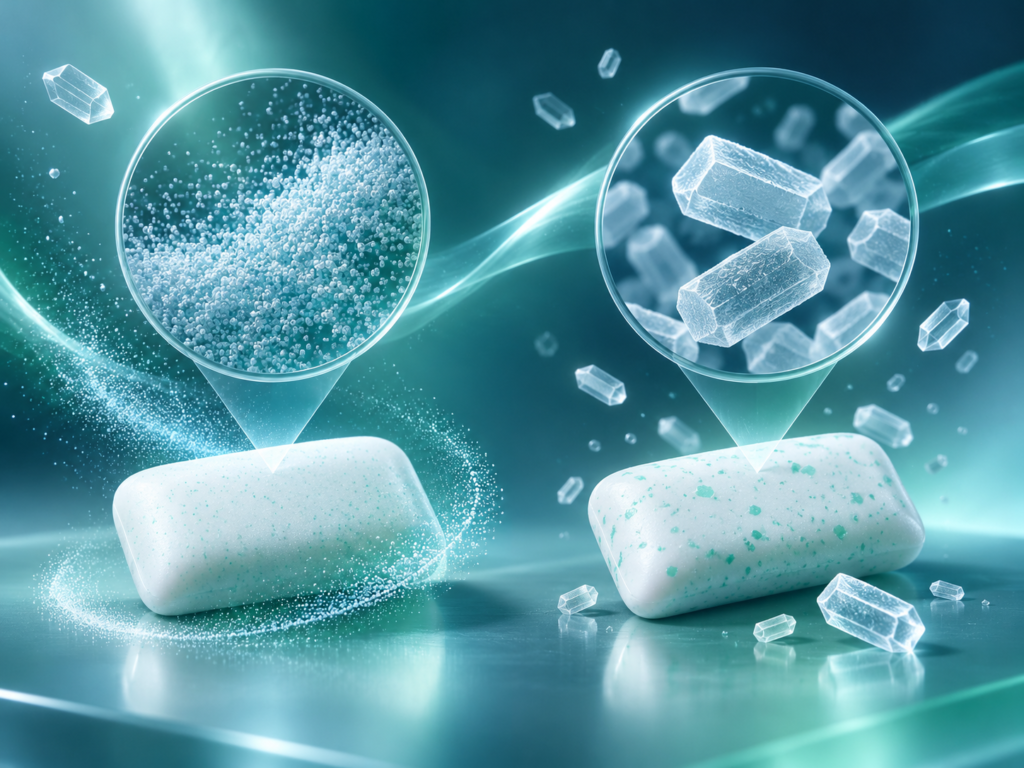
Hydroxyapatite is chemically related to the principal mineral component of tooth enamel.
Its potential use in dental gum reflects the idea that a calcium-phosphate material may support surface interactions, mineral availability, or dentin desensitization.
One of the most debated formulation questions concerns nano-hydroxyapatite versus micro-hydroxyapatite gum.
What is nano-hydroxyapatite?
Nano-hydroxyapatite, often abbreviated n-HAp, consists of hydroxyapatite particles with nanoscale dimensions.
Particles in this range can exhibit a high surface-area-to-mass ratio and different interaction characteristics compared with larger particles.
This makes nanoscale material interesting for dental formulations.
But particle size is only one variable. Shape, aggregation, surface chemistry, purity, and the surrounding formulation may substantially influence performance.
What is micro-hydroxyapatite?
Micro-hydroxyapatite refers to hydroxyapatite material with larger, generally micrometer-scale particles or structures.
Its potential behavior may differ in terms of surface contact, suspension, aggregation, and deposition.
A larger particle is not necessarily ineffective. Likewise, smaller particles are not automatically more effective.
Nano vs micro hydroxyapatite comparison
| Characteristic | Nano-hydroxyapatite gum | Micro-hydroxyapatite gum |
|---|---|---|
| Particle scale | Nanoscale dimensions | Generally larger, micrometer-scale dimensions |
| Surface area per mass | Often higher for smaller primary particles | Generally lower, depending on morphology |
| Tooth-surface interaction | Potential for close surface interactions | Depends on particle size, shape, and formulation |
| Dispersion behavior | Can be strongly affected by aggregation | May involve different dispersion and sedimentation behavior |
| Safety assessment | Requires attention to particle-specific properties and exposure | Requires ingredient-specific and formulation-specific assessment |
| Human gum evidence | Limited | Limited |
| Proven clinical superiority | Not established | Not established |
Why particle size is an incomplete comparison
Suppose two products each contain 10 mg of hydroxyapatite.
One uses a nanoparticle material with a narrow particle-size distribution. The other contains a larger material that disperses readily during chewing.
The nominal dose is identical, but the amount released, distribution in saliva, and interaction with teeth could differ.
Neither formulation can be declared superior without relevant comparative testing.
The same principle applies to particle shape.
Rod-shaped, spherical, aggregated, and needle-shaped particles cannot be treated as interchangeable simply because they share the name hydroxyapatite.
Safety and regulatory considerations
The European Commission’s Scientific Committee on Consumer Safety issued a final opinion in June 2025 assessing specified nano-hydroxyapatite materials in toothpaste and mouthwash.
For the particular material specifications assessed, the committee supported safety at concentrations up to 29.5% in toothpaste and 10% in mouthwash, subject to the opinion’s conditions.
These figures should not be interpreted as a blanket approval for all hydroxyapatite materials.
Most importantly, the assessment concerned specified oral cosmetic applications; it does not establish that a chewing-gum formulation, which may involve intentional ingestion of released ingredients, has been independently assessed or authorized for the same use.
A responsible evaluation should examine the applicable food regulations, material identity, purity, particle shape, and expected exposure.
For a more detailed examination of particle behavior, release considerations, and formulation decisions, read Nano vs Micro Hydroxyapatite Gum.
Hydroxyapatite Gum vs Xylitol Gum
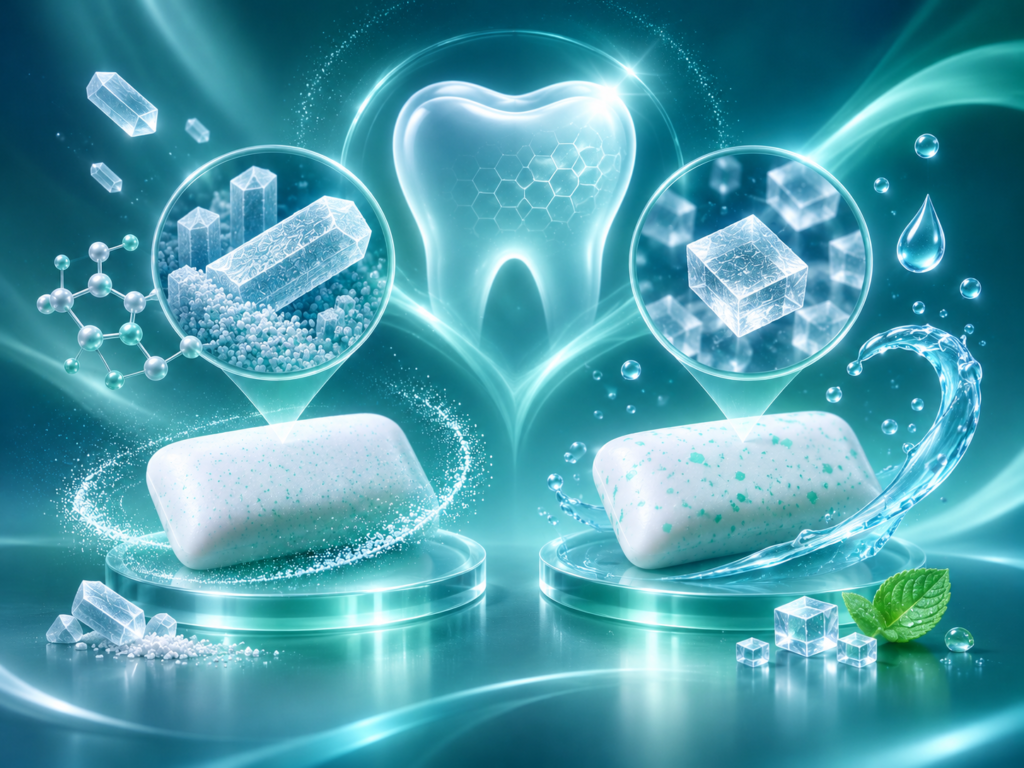
Hydroxyapatite gum and xylitol gum are often discussed as competing types of dental chewing gum.
Scientifically, they are better understood as formulations emphasizing different mechanisms.
Hydroxyapatite is a calcium-phosphate material.
Xylitol is a sugar alcohol used as a sweetener that oral bacteria generally cannot ferment in the same way as ordinary sugar.
Both ingredients may be incorporated into a sugar-free chewing-gum base.
How hydroxyapatite gum is intended to work
Hydroxyapatite gum attempts to introduce mineral-containing material into the oral environment.
Its proposed benefits may include supporting mineral interactions at the tooth surface or reducing dentin sensitivity.
However, demonstrations of hydroxyapatite activity in toothpaste or laboratory experiments do not establish the same degree of benefit in gum.
The delivery system matters.
How xylitol gum works
Xylitol provides sweetness without acting as an ordinary fermentable sugar for major acid-producing plaque bacteria.
In addition, chewing stimulates saliva, which helps create conditions less favorable to sustained plaque acidity.
Some research suggests xylitol may offer additional benefits for caries prevention, but the evidence isolating its effect from the general effect of chewing sugar-free gum remains uncertain.
The ADA notes that the evidence for xylitol as an additional caries-preventive treatment is limited.
Hydroxyapatite vs xylitol gum comparison
| Evaluation | Hydroxyapatite gum | Xylitol gum |
|---|---|---|
| Main active ingredient | Calcium-phosphate mineral | Sugar alcohol sweetener |
| Primary proposed benefit | Mineral delivery and potential desensitization | Non-cariogenic sweetness and possible additional effects on plaque |
| Saliva stimulation | Yes, through chewing | Yes, through chewing |
| Direct mineral ingredient | Yes | Not inherently |
| Clinical evidence for gum-specific benefits | Limited, including a sensitivity trial | Broader sugar-free gum evidence; additional xylitol-specific benefit remains uncertain |
| Formulation questions | Dose, release, morphology, safety | Xylitol content, other sweeteners, tolerance |
| Main practical consideration | Product-specific evidence | A straightforward sugar-free gum option |
Can hydroxyapatite and xylitol work together?
There is no inherent reason these ingredients must be used separately.
A combined formulation could include:
- Xylitol for sweetness without ordinary sugar fermentation
- Hydroxyapatite for proposed mineral-related activity
- A gum base providing sustained chewing
- Flavors and other ingredients supporting acceptable use
The theoretical appeal is clear.
Whether the combination produces a clinically meaningful advantage over a suitable conventional sugar-free gum is a separate question requiring controlled research.
An additional ingredient does not guarantee an additive effect.
For formulation-specific comparisons and evidence interpretation, explore Hydroxyapatite vs Xylitol Gum.
Remineralizing Gum vs Remineralizing Toothpaste
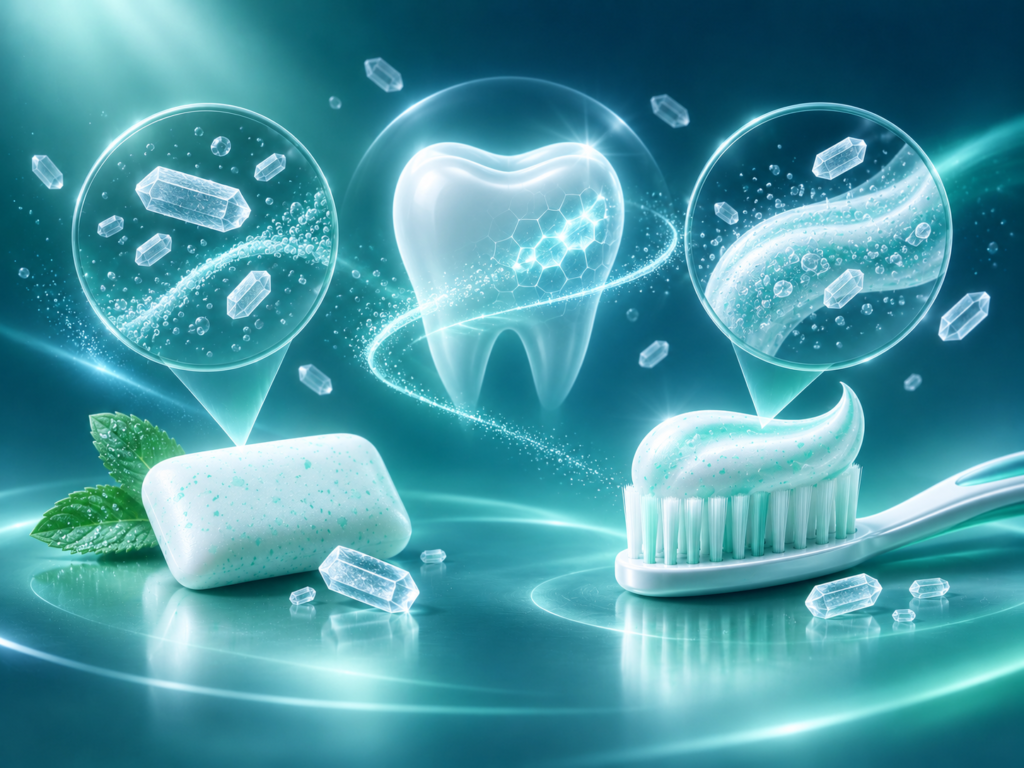
Remineralizing chewing gum and remineralizing toothpaste are not equivalent delivery systems.
Both may be formulated with ingredients intended to support dental mineral balance, but their established roles, exposure conditions, and clinical evidence differ.
Toothpaste offers a structured daily treatment
Toothbrushing physically disrupts and removes plaque while exposing teeth to the active ingredients in the toothpaste.
Fluoride toothpaste has an established role in preventing tooth decay and supporting remineralization of early enamel lesions.
Hydroxyapatite toothpastes have also been investigated for remineralization and sensitivity-related outcomes, although results depend on formulation and study conditions.
The advantage of toothpaste is that it is incorporated into a predictable, repeated oral-hygiene procedure.
Gum provides an additional period of salivary stimulation
Chewing gum may be used at times when brushing is inconvenient, such as after meals away from home.
Its established mechanism is increased saliva flow.
Specialized gum may also carry mineral ingredients, but gum-specific evidence remains substantially less developed than the evidence for standard preventive toothpastes.
Remineralizing gum vs toothpaste
| Factor | Remineralizing gum | Remineralizing toothpaste |
|---|---|---|
| Main use | Optional supplemental oral care | Routine oral hygiene |
| Mechanical plaque removal | Does not replace brushing | Toothbrushing provides mechanical plaque disruption |
| Saliva stimulation | Primary practical benefit | Not a principal mechanism |
| Mineral-delivery opportunity | Depends on release during chewing | Depends on formulation and brushing exposure |
| Typical timing | After meals or as appropriate | Usually morning and evening |
| Role in established cavity prevention | Adjunctive | Fluoride toothpaste is a foundational measure |
| Suitable as a replacement for brushing | No | Not applicable |
Why contact time requires careful interpretation
Longer contact is not always equivalent to better performance.
A piece of gum may remain in the mouth longer than toothpaste is brushed onto teeth, but this does not mean its active ingredient remains available for the entire chewing period.
Much of a soluble ingredient may be released early.
The critical measure is not simply how long gum is chewed, but how much of the intended ingredient remains accessible to the tooth surface during that time.
A practical daily sequence
Morning: Brush with an appropriate fluoride toothpaste or another dental-professional-recommended formulation.
After meals: Sugar-free gum may provide a convenient period of salivary stimulation when appropriate.
Evening: Clean between the teeth and brush thoroughly before bed.
People with dry mouth, high caries risk, orthodontic appliances, or significant sensitivity may require an individualized routine.
The purpose of gum is to complement preventive care, not replace it.
Explore the different exposure mechanisms in Remineralizing Gum vs Remineralizing Toothpaste.
Probiotic vs Prebiotic Chewing Gum
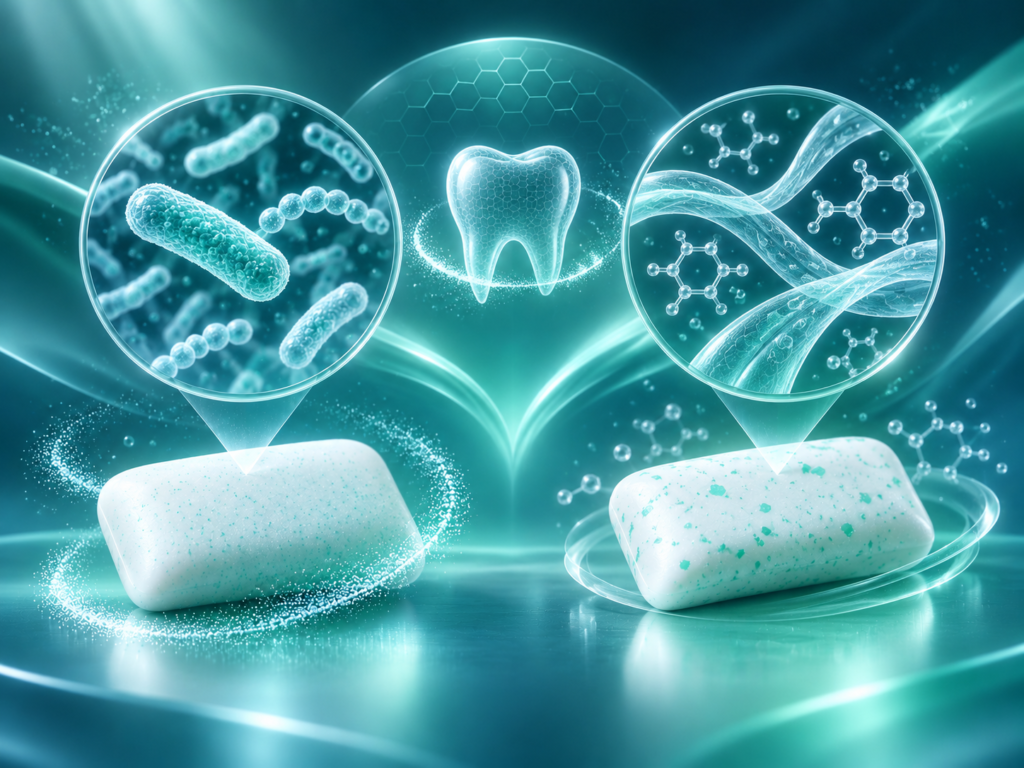
The oral microbiome contains a complex community of bacteria and other microorganisms.
Some organisms participate in healthy oral ecosystems. Others, under suitable environmental conditions, contribute to acid production, inflammatory processes, or malodor.
The emerging field of microbiome-focused chewing gum attempts to influence this ecosystem.
Two approaches attract particular attention: probiotics and prebiotics.
What is probiotic chewing gum?
Probiotic chewing gum contains selected living microorganisms intended to provide a health benefit when administered in an adequate amount.
The organism’s identity matters.
A product claiming to contain probiotics should ideally identify the specific strain, not merely a broad bacterial genus.
Its viability, dose, stability, delivery, and demonstrated health effects also matter.
A strain that shows promise in one oral-health study cannot automatically transfer its benefits to another strain or delivery format.
What is prebiotic chewing gum?
Prebiotic chewing gum contains an ingredient intended to be selectively utilized by microorganisms in a way that confers a health benefit.
The term requires more than simply adding a fiber or botanical ingredient.
In oral-care research, the central question is whether the supplied substrate encourages beneficial microbial activity without providing an undesirable advantage to acid-producing organisms.
A substance considered prebiotic in the gastrointestinal environment is not automatically an effective oral prebiotic.
Probiotic vs prebiotic gum comparison
| Question | Probiotic chewing gum | Prebiotic chewing gum |
|---|---|---|
| What is introduced? | Selected living microorganisms | Ingredients intended for selective microbial utilization |
| Main mechanism | Direct microbial delivery | Modification of microbial nutrient availability |
| Key formulation challenge | Viability and delivery of the specific strain | Demonstrating selective, beneficial utilization |
| Important label information | Full strain designation, dose, viability | Ingredient identity, concentration, supporting evidence |
| Evidence required | Human trials of the strain and formulation | Evidence of meaningful microbial and health effects |
| Main uncertainty | Persistence and clinical benefit | Whether the proposed selectivity occurs in the mouth |
What newer research reveals
A randomized clinical trial published in March 2026 investigated sugar-free gum containing Heyndrickxia coagulans SNZ1969 in 52 healthy adults over four weeks.
The researchers reported that the organism could be detected in dental plaque during use and that the intervention produced modest, temporary changes in plaque microbial composition.
An August 2026 secondary analysis of the same study examined volatile sulfur compounds related to oral malodor. It did not establish a statistically significant additional reduction in these compounds compared with placebo gum.
These findings illustrate an important distinction: changing the microbial composition of plaque is not necessarily equivalent to producing a meaningful improvement in breath, gum health, or cavity outcomes.
Why microbiome balance is not bacterial elimination
A healthy mouth is not sterile.
The objective of microbiome-focused oral care is not to remove every microorganism, but to support conditions associated with health.
Frequent sugar exposure, inadequate plaque control, reduced salivary flow, and persistent acidic conditions can all affect microbial ecology.
A sophisticated chewing gum cannot compensate fully for an unfavorable oral environment.
For a closer examination of strains, substrates, clinical endpoints, and formulation challenges, read Probiotic vs Prebiotic Chewing Gum.
Does Remineralizing Gum Really Work?
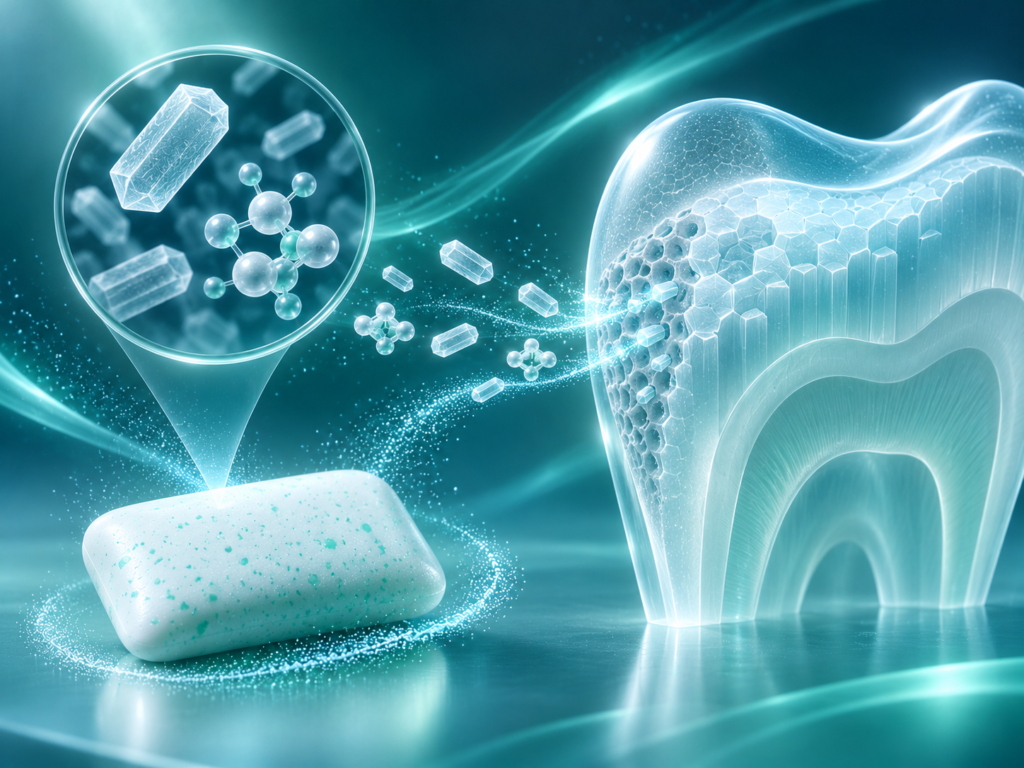
This question requires separating demonstrated outcomes from proposed mechanisms.
Sugar-free gum can support oral health through salivary stimulation. Some specialized mineral gums have shown promising results in limited clinical research. However, there is not sufficient evidence to conclude that remineralizing gum generally repairs established cavities or replaces standard preventive dental care.
Evidence from clinical hydroxyapatite gum research
A controlled, double-blind clinical study published in 2014 by Porciani and colleagues evaluated a sugar-free gum containing calcium hydroxyapatite and dicalcium phosphate dihydrate.
The study included 100 participants who completed the trial.
Over two weeks, the active gum group showed statistically significant improvements in measured dentin hypersensitivity compared with the control gum group.
The finding is relevant because it investigates a mineral-containing gum directly rather than extrapolating entirely from toothpaste research.
Nevertheless, it was a short-duration trial examining sensitivity outcomes.
It did not demonstrate that hydroxyapatite chewing gum prevents new cavities over years, rebuilds lost enamel structure, or performs better than every other remineralization treatment.
What counts as evidence of remineralization?
The word remineralization can describe different experimental observations.
Laboratory evidence: Mineral gain, changes in microhardness, microscopy findings, or altered mineral composition in controlled enamel samples.
Short-term human evidence: Changes in sensitivity, plaque acidity, saliva characteristics, or measurements of early enamel lesions.
Long-term clinical evidence: Fewer new or progressing carious lesions, supported by appropriate clinical trials and follow-up.
Each evidence level answers a different question.
A favorable laboratory result is useful for explaining a mechanism but does not guarantee a clinically important benefit.
Evidence confidence chart
The following chart is a qualitative editorial assessment of how confidently different outcomes can be discussed. It is not a formal systematic-review grading or a numerical meta-analysis.
| Intervention or claim | Evidence confidence | Appropriate interpretation |
|---|---|---|
| Fluoride toothpaste for caries prevention | Strong | Established preventive care |
| Sugar-free gum as a salivary-stimulation adjunct | Supported | Useful supplementary measure |
| Xylitol offering benefits beyond other sugar-free gums | Uncertain | Additional advantage has not been consistently established |
| Mineral-containing gum reducing dentin sensitivity | Preliminary | Encouraging limited clinical findings |
| Hydroxyapatite gum preventing future cavities | Insufficient | Requires stronger long-term gum-specific trials |
| Probiotic gum improving clinically meaningful oral outcomes | Emerging | Strain- and outcome-specific research needed |
| Remineralizing gum rebuilding established cavities | Not established | Should not be claimed as a treatment |
Five signs of stronger product evidence
A convincing clinical claim should answer five questions.
Population: Who participated? Healthy adults, children, people with sensitivity, or individuals at high cavity risk?
Comparison: Was the product tested against no gum, ordinary sugar-free gum, another active gum, or established dental treatment?
Outcome: Did researchers measure actual dental health or only a laboratory marker?
Duration: Was the study long enough to assess the advertised benefit?
Reproducibility: Have independent researchers reported similar findings?
An ingredient can have a plausible mechanism, encouraging laboratory evidence, and limited clinical support simultaneously.
Understanding those distinctions is more valuable than assigning every product a simple effective-or-ineffective label.
Read the full clinical interpretation in Does Remineralizing Gum Really Work?.
Chewing Gum and Jaw Health
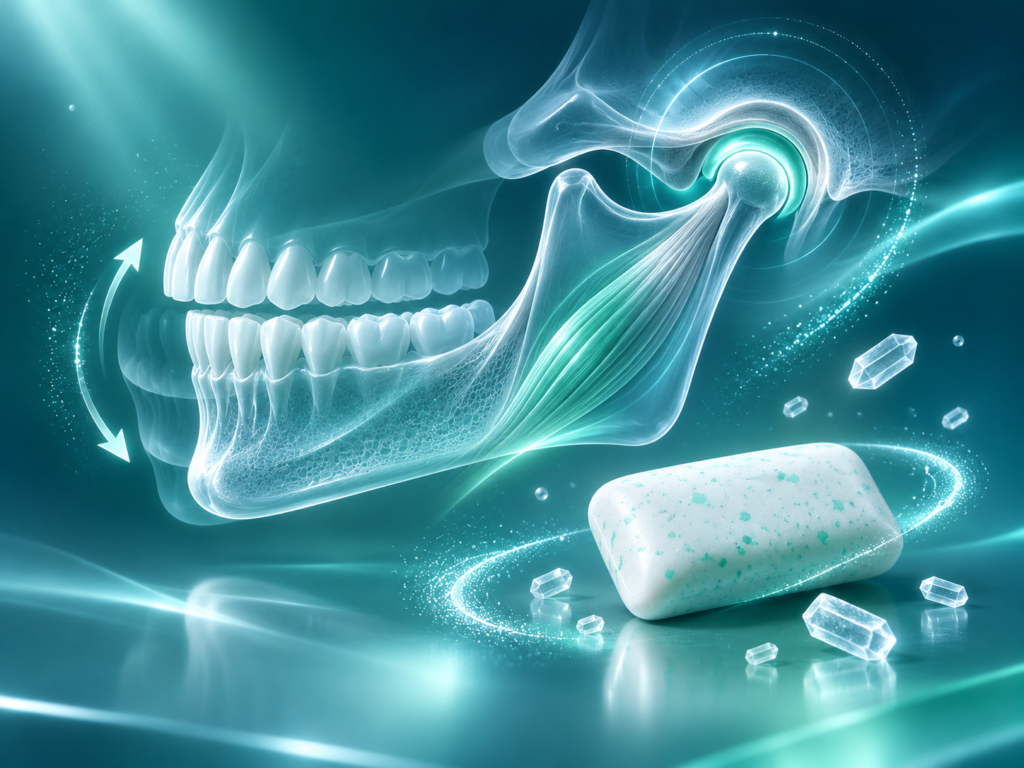
Chewing activates the masseter, temporalis, and other muscles involved in jaw movement.
It also places repeated functional demands on the temporomandibular joints, which connect the lower jaw to the skull.
For many healthy individuals, ordinary gum chewing is well tolerated.
But greater chewing intensity or duration is not necessarily associated with better oral-health outcomes.
Is chewing gum good or bad for the jaw?
The answer depends on the individual, the gum’s resistance, and the pattern of use.
Some people can chew ordinary gum without discomfort. Others experience muscle fatigue, jaw soreness, headaches, or worsening symptoms of an existing temporomandibular disorder.
Research examining gum chewing and temporomandibular symptoms has produced mixed findings, and observational associations do not by themselves establish causation.
Why hard gum is different from ordinary gum
Gum that offers substantial chewing resistance requires greater muscular effort.
Although resistance chewing is sometimes marketed for jawline development, increasing muscle workload should not be confused with improving joint health.
For a person with jaw pain, clenching, bruxism, or an existing TMJ disorder, high-resistance chewing can be particularly inappropriate.
Jaw-health considerations
| Individual situation | Practical consideration |
|---|---|
| Healthy jaw without symptoms | Ordinary sugar-free gum may be tolerated |
| Jaw fatigue during chewing | Reduce or stop chewing and assess symptoms |
| Existing TMJ pain or dysfunction | Seek professional advice before regular gum use |
| Frequent clenching or grinding | Avoid treating gum as a jaw-training exercise |
| Recent dental treatment | Follow the treating dentist’s instructions |
| Loose restorations or vulnerable dental work | Avoid sticky chewing products until assessed |
When chewing gum should be stopped
Persistent or increasing pain, locking, restricted jaw opening, or significant changes in jaw function deserve clinical evaluation.
Gum should not be continued simply because it contains an ingredient associated with oral-health benefits.
The potential advantage of mineral delivery does not outweigh a recurring mechanical problem.
For the relationship between chewing intensity, temporomandibular disorders, muscle function, and daily habits, explore Chewing Gum and Jaw Health.
Dental Gum Ingredients and Safety Guide
A chewing-gum ingredient list contains more than active dental compounds.
It typically includes a gum base, sweeteners, flavoring substances, softeners, and sometimes minerals, vitamins, microorganisms, or botanical extracts.
Understanding the entire formulation is necessary because products with the same headline ingredient can have substantially different compositions.
Sugar and non-cariogenic sweeteners
The most important initial distinction is whether the gum contains fermentable sugars.
Ordinary sucrose-containing gum can supply carbohydrates that plaque bacteria metabolize into acids.
Sugar-free gum generally uses alternatives such as xylitol, sorbitol, mannitol, or other approved sweeteners.
These sweeteners are not identical in composition, sweetness, or digestive tolerance.
Ingredient assessment table
| Ingredient or category | Intended function | Main consideration |
|---|---|---|
| Xylitol | Sweetness without ordinary sugar fermentation | Amount, combined sweeteners, gastrointestinal tolerance |
| Sorbitol | Sweetening and texture | Excessive consumption may cause digestive discomfort |
| Mannitol | Sweetener and formulation component | Tolerance and total polyol intake |
| Hydroxyapatite | Proposed mineral delivery | Particle identity, purity, exposure, clinical substantiation |
| Calcium-phosphate salts | Mineral source | Solubility, release, dose, and oral availability |
| Probiotic strains | Microbial delivery | Exact strain, viability, storage, clinical evidence |
| Prebiotic ingredients | Intended microbial modulation | Demonstrated oral effects and metabolic consequences |
| Acids and flavoring agents | Taste and stability | Finished-product acidity and erosive potential |
| Gum base | Chewable structure | Composition, material safety, release characteristics |
| Botanical extracts | Flavor or additional proposed activity | Allergenicity, dose, and evidence |
A sugar-free label does not tell the whole story
Sugar-free is a valuable starting point, but it is not a complete evaluation.
A formulation may be sugar-free while containing acidic flavoring ingredients or additives that affect how it should be used.
Likewise, a mineral-containing product might be marketed for enamel support even though its full release profile has not been adequately documented.
Finished-product properties are often more relevant than a single ingredient considered in isolation.
How much hydroxyapatite is actually in the gum?
Consider a hypothetical 2 g piece of gum advertised as containing 0.75% hydroxyapatite by weight.
The calculation is:
2,000 mg × 0.0075 = 15 mg hydroxyapatite per piece
That is the nominal formulation quantity.
It does not establish that 15 mg is released into saliva, remains in the mouth, or contacts tooth surfaces.
For product comparisons, manufacturers should ideally distinguish ingredient loading from measured release.
Safety does not depend on particle size alone
When evaluating hydroxyapatite, relevant factors include:
- Raw-material identity and impurity specifications
- Particle dimensions and shape
- Surface treatment or coatings
- Aggregation behavior
- Expected dose and route of exposure
- Manufacturing controls and product consistency
- Applicable food-safety requirements
Safety conclusions from a toothpaste study should not automatically be transferred to an intentionally chewable, partially ingestible product.
Additional precautions
Children: Chewing gum may create choking concerns in young children. Age suitability and the ability to chew safely matter.
Dental appliances: People with braces, removable appliances, temporary restorations, or other dental work should follow their dentist’s instructions.
Dry-mouth conditions: Gum may stimulate saliva but is not effective for everyone, particularly where gland function is severely impaired.
Polyol sensitivity: Large amounts of sugar alcohols can produce gastrointestinal discomfort in susceptible people.
Probiotic ingredients: People who are significantly immunocompromised or medically vulnerable should seek professional advice before using live-microorganism products.
Pets: Xylitol is highly toxic to dogs. Xylitol-containing gum must be stored securely away from pets, and suspected ingestion warrants urgent veterinary assistance.
What about microplastics in chewing gum?
Research published in 2025 investigated the release of microplastic particles from natural and synthetic chewing-gum products during chewing.
Researchers identified particle release in the tested materials, introducing new questions about gum-base composition and consumer exposure.
The study does not establish the long-term clinical risk of the measured exposure. More research is necessary to determine the health significance and differences among commercial formulations.
Nevertheless, gum-base transparency is becoming an increasingly relevant component of responsible product evaluation.
For ingredient-level analysis, labeling considerations, formulation hazards, and manufacturing questions, read Dental Gum Ingredients and Safety Guide.
Benefits and Limitations of Dental Chewing Gum
Dental gum is most useful when its expected benefits are matched to the conditions in which it is used.
A person chewing after lunch for saliva stimulation is not pursuing the same outcome as someone considering a hydroxyapatite product for dentin sensitivity.
The formulation and evidence should be evaluated accordingly.
Benefit 1: Increased salivary flow
For suitable individuals, the act of chewing stimulates salivary secretion.
This is one of the most established practical benefits of sugar-free gum.
Benefit 2: Support for oral pH recovery
Saliva helps buffer acids and contributes to a more favorable environment following food and drink consumption.
Gum can support this process through salivary stimulation.
It does not neutralize every possible acidic exposure or make frequent consumption of acidic drinks harmless.
Benefit 3: A convenient supplement between brushing sessions
Chewing gum is portable and does not require water, a toothbrush, or a sink.
That convenience can make it useful after meals when brushing is not practical.
Convenience, however, should not be confused with equivalence to brushing.
Benefit 4: Potential sensitivity support
Mineral-containing gums have shown promising results in limited clinical research on dentin hypersensitivity.
Whether a particular modern product provides similar benefit depends on its formulation and clinical substantiation.
Benefit 5: Specialized ingredient delivery
The gum format may allow repeated exposure to certain active ingredients while the individual chews.
This characteristic makes it interesting for research into minerals and oral microbiome interventions.
The significance of that exposure remains ingredient- and product-specific.
Benefits versus limitations chart
| Intended outcome | Established or plausible benefit | Important limitation |
|---|---|---|
| Post-meal saliva stimulation | Supported | Requires functioning salivary response |
| Improved acid clearance | Supported mechanism | Does not remove every source of acidity |
| Fresher breath | May provide temporary freshness | Does not necessarily treat chronic halitosis |
| Reduced dentin sensitivity | Limited mineral-gum clinical evidence | Product-specific effectiveness is uncertain |
| Enamel remineralization | Biologically plausible for some formulations | Direct gum-specific clinical proof is limited |
| Fewer cavities | Evidence supports sugar-free gum as an adjunct | Not a replacement for established preventive care |
| Improved oral microbiome | Emerging research | Meaningful long-term outcomes remain uncertain |
| Jaw strengthening | Increased muscle workload is possible | Not an established reason to chew, especially with TMJ concerns |
The most useful benefit is not necessarily the most technically impressive.
For someone primarily seeking post-meal saliva support, a suitable ordinary sugar-free gum may satisfy the purpose without the additional expense of a specialized mineral formulation.
Upcoming Trends and Latest Dental Gum Technology
Dental chewing gum is gradually moving beyond a confectionery format toward a more specialized oral-care delivery platform.
The most consequential developments are likely to involve how ingredients are released, how their effects are measured, and whether formulations can demonstrate outcomes beyond ordinary sugar-free gum.
1. Controlled-release mineral delivery
Traditional gum formulations do not necessarily release active ingredients at a uniform rate.
An important research direction is the design of formulations that control when and how mineral compounds become available during chewing.
Potential approaches include encapsulation, modified particle surfaces, and engineered gum matrices.
The relevant endpoint is not simply extending release, but ensuring that useful concentrations remain available in the intended oral environment.
These technologies remain dependent on formulation-specific validation.
2. More precise hydroxyapatite characterization
Future mineral gums may increasingly distinguish among different hydroxyapatite materials instead of treating the ingredient name as sufficient.
Important characteristics include particle distribution, morphology, crystallinity, purity, and aggregation behavior.
Better characterization could improve the consistency of research and allow more meaningful comparisons among formulations.
It should also strengthen safety documentation.
3. Multi-functional dental gum formulations
A single product might combine a non-cariogenic sweetener, a mineral ingredient, and compounds designed to influence oral microbial activity.
Such combinations are technically appealing because oral health depends on multiple interacting processes.
The major challenge will be demonstrating that the combined formulation provides additional clinical benefits, rather than merely containing more ingredients.
4. Probiotic delivery and microbiome-specific formulations
The 2026 research into probiotic chewing gum demonstrates the growing scientific interest in oral microbial delivery.
Future studies may investigate:
- Greater specificity in probiotic strain selection
- Viability during storage and chewing
- More reproducible delivery into oral biofilms
- Persistence after product use stops
- Clinically meaningful effects on breath, plaque, or gingival health
The critical shift will be from demonstrating microbial changes toward demonstrating measurable improvements in oral health.
5. Saliva-responsive delivery systems
One potential direction is oral-care formulations designed to respond to the changing environment of the mouth.
Researchers may explore materials whose behavior varies with moisture, acidity, or other local conditions.
The theoretical attraction is targeted ingredient release under particular circumstances.
However, pH-responsive or saliva-responsive claims should be regarded as experimental unless supported by demonstrated product performance.
6. Gum-base innovation and material transparency
Interest in microplastic exposure is adding another dimension to gum development.
Manufacturers may face greater demand for clearer disclosure of gum-base materials, improved testing, and alternative formulations.
Natural origin alone is not proof of lower particle release or superior safety.
Comparative analytical testing will be essential.
7. Independent testing and more transparent product data
Perhaps the most useful innovation is not a new ingredient at all.
It is better documentation.
Future dental gum products could be evaluated through standardized measurements of:
- Active ingredient quantity per piece
- Ingredient release during realistic chewing
- Salivary and plaque-related outcomes
- Particle identity and safety characteristics
- Product stability over its shelf life
- Human clinical results
- Batch-to-batch consistency
That information would allow people to distinguish meaningful differences from expensive packaging and unsupported terminology.
The commercial development of specialized oral-care information
As specialized dental ingredients gain attention, independent educational platforms become increasingly important for interpreting claims and separating research from advertising.
Hydropaste’s distinct website for sale page addresses the commercial side of operating an oral-care information property. Business ownership considerations remain separate from the scientific assessment of chewing-gum products.
The more consequential development for individuals seeking oral-care information is the movement toward ingredient transparency and clinically verifiable claims.
How to Choose a Dental Gum Product
Choosing dental gum should begin with the problem to be addressed, not with the most prominent ingredient on the package.
A person interested in breath freshness may have little reason to pay for hydroxyapatite. Someone concerned about jaw discomfort may find that even an otherwise suitable gum is inappropriate for frequent use.
Step 1: Identify the intended outcome
| Primary concern | Reasonable starting point | What to investigate |
|---|---|---|
| Post-meal oral care | Suitable sugar-free gum | Sweetener composition and chewing tolerance |
| Mild dry-mouth symptoms | Sugar-free gum, if tolerated | Salivary response and underlying cause |
| Dentin sensitivity | Dental evaluation; specialized products where appropriate | Cause of sensitivity and product-specific evidence |
| Early enamel concerns | Established preventive care first | Acid exposure, fluoride use, dental recommendations |
| Interest in hydroxyapatite | Documented mineral formulation | Ingredient identity, dose, release, clinical evidence |
| Oral microbiome research | Strain- or ingredient-specific products | Human evidence for the exact formulation |
| Jaw discomfort | Avoid frequent chewing until assessed | TMJ or muscle symptoms |
Step 2: Examine the ingredient hierarchy
The first useful question is whether the gum contains fermentable sugar.
Then consider the sweeteners, active ingredients, flavoring components, and gum base.
For specialized products, investigate whether the manufacturer provides meaningful ingredient quantities and safety documentation.
A proprietary ingredient description that omits dosage may be insufficient for a technical comparison.
Step 3: Compare the cost of actual use
The price of a package is less informative than the price per piece and the expected frequency of use.
Cost per piece = Package price ÷ Number of pieces
Estimated daily cost = Cost per piece × Pieces used daily
For example, consider two hypothetical products:
| Illustrative product | Package price | Pieces | Cost per piece | Daily cost at 2 pieces |
|---|---|---|---|---|
| Standard sugar-free gum | $5.00 | 40 | $0.125 | $0.25 |
| Specialized mineral gum | $18.00 | 30 | $0.60 | $1.20 |
Figures are fictional and demonstrate cost calculations, not current product prices or recommendations.
In this example, the mineral gum costs 4.8 times as much per piece.
That premium may be reasonable for someone whose needs align with an independently demonstrated benefit.
Without adequate evidence, higher cost does not establish greater effectiveness.
Specialized remineralizing gum and hydroxyapatite oral-care products can cost considerably more than conventional alternatives, making seasonal promotions worth considering. Hydropaste’s black friday sale guide explores discounts on hydroxyapatite toothpaste, electric toothbrushes, and other dental-care essentials, helping individuals evaluate genuine savings without compromising ingredient quality or clinical suitability.
Step 4: Evaluate the claim, not the ingredient count
A product claiming to support enamel remineralization should ideally provide evidence relevant to mineral recovery.
A gum claiming to reduce bad breath should provide research addressing breath-related outcomes.
A probiotic formulation claiming to improve gum health should demonstrate more than the presence of probiotic organisms in saliva.
A measured clinical outcome is more informative than a theoretical mechanism.
Step 5: Assess practical compatibility
A suitable gum should also be comfortable to chew, appropriately flavored, affordable for the intended use, and compatible with the person’s dental condition.
Even a technically sophisticated product is of limited practical value if it causes discomfort or cannot be used consistently.
For a product-oriented comparison of available categories and formulations, visit Buy chewing gum.
Frequently Asked Questions
1. What is the best remineralizing gum for teeth?
The best remineralizing gum depends on the desired outcome and the evidence supporting the exact product.
For general post-meal oral care, suitable sugar-free chewing gum has a clearer established role through saliva stimulation. Hydroxyapatite gum may be of interest for mineral-related applications, but stronger product-specific clinical evidence is needed before claiming that one formulation is the best for enamel repair.
2. Is hydroxyapatite gum better than xylitol gum?
Neither is universally better.
Hydroxyapatite gum introduces a mineral-related mechanism, while xylitol gum uses a non-cariogenic sweetener and stimulates saliva through chewing.
Their effectiveness should be compared according to the intended clinical outcome. Direct evidence establishing the superiority of one category over the other remains insufficient.
3. Can remineralizing chewing gum reverse early tooth decay?
Early non-cavitated enamel lesions may remineralize under suitable conditions, but gum should not be relied upon as an independent treatment.
Improving oral hygiene, controlling dietary acid and sugar exposure, and using appropriate professional preventive care are more established approaches.
An established cavity involving structural breakdown generally requires dental assessment and treatment.
4. Is nano-hydroxyapatite chewing gum safe for daily use?
Safety depends on the particular material, formulation, exposure, manufacturing quality, and applicable regulatory requirements.
Safety assessments of specified nano-hydroxyapatite materials in toothpaste and mouthwash should not be interpreted as blanket authorization for every chewing-gum product.
Individuals should look for products with appropriate food-safety compliance and ingredient documentation rather than assuming that all nano-hydroxyapatite materials are identical.
5. Can you chew remineralizing gum every day?
Daily sugar-free gum use may be appropriate for many adults who tolerate chewing comfortably.
The appropriate frequency for a specialized remineralizing formulation depends on its directions, ingredient composition, and available safety information.
People with jaw pain, dental complications, or relevant medical concerns should seek individualized guidance.
FAQ comparison chart
| Common question | Short answer | Most important distinction |
|---|---|---|
| Best gum for teeth? | Depends on the purpose | Saliva support vs specialized claims |
| Hydroxyapatite vs xylitol? | Different mechanisms | Mineral delivery vs sweetening |
| Does gum repair cavities? | Not established | Early mineral loss vs structural decay |
| Is nano-hydroxyapatite safe? | Product-specific | Material identity and exposure |
| Is daily gum use appropriate? | Often, if tolerated | Jaw health and formulation suitability |
People Also Ask
1. Does remineralizing gum work without fluoride?
Sugar-free gum can stimulate saliva without containing fluoride.
Specialized fluoride-free formulations may provide additional proposed mechanisms, including calcium-phosphate delivery.
However, these mechanisms do not establish that gum is equivalent to fluoride toothpaste for preventing cavities. The evidence supporting fluoride toothpaste remains substantially stronger for routine caries prevention.
2. How long should you chew xylitol gum after meals?
Approximately 20 minutes of sugar-free gum chewing after meals is commonly referenced in ADA guidance.
This does not mean every person needs to chew for exactly 20 minutes or that longer sessions are necessarily better.
The optimal duration may be affected by jaw comfort, the formulation, and the individual’s dental circumstances.
3. Can probiotic chewing gum improve the oral microbiome?
Some early clinical research indicates that certain probiotic strains delivered through gum can temporarily influence oral microbial composition.
Whether those changes produce sustained reductions in cavities, periodontal disease, or clinically meaningful bad breath remains uncertain and may depend on the strain.
4. Is chewing gum bad for your jaw or TMJ?
Chewing gum is not inherently harmful for everyone, but repetitive chewing may aggravate symptoms in people with temporomandibular disorders or jaw-muscle sensitivity.
Pain, locking, restricted movement, or increasing discomfort are reasons to stop and seek professional assessment.
5. Is remineralizing toothpaste better than remineralizing gum?
For routine dental prevention, appropriate toothpaste and brushing have a more established role than specialized chewing gum.
Gum may offer additional post-meal salivary stimulation, while toothpaste provides an established oral-hygiene procedure and, when fluoridated, a well-supported caries-preventive ingredient.
They serve different purposes rather than representing interchangeable treatments.
People Also Ask — Decision Table
| Search question | Relevant mechanism | Practical implication |
|---|---|---|
| Does gum work without fluoride? | Salivary stimulation and possible mineral delivery | Do not assume equivalence to fluoride toothpaste |
| How long should xylitol gum be chewed? | Saliva stimulation | Around 20 minutes after meals is a common reference |
| Does probiotic gum improve bacteria? | Strain-specific microbial activity | Clinical benefit must be demonstrated |
| Can gum damage the jaw? | Repetitive muscular and joint loading | Stop if symptoms develop |
| Is toothpaste more effective? | Established preventive treatment and plaque removal | Keep brushing as foundational care |
Editorial Insights and the Next Generation of Dental Gum
The most interesting development in dental chewing gum is not the appearance of another fashionable ingredient. It is the possibility of turning an ordinary chewing product into a carefully characterized oral-care delivery system.
That transformation requires more than a convincing mechanism.
Hydroxyapatite must be evaluated according to its particle characteristics, dose, release, and demonstrated effects. Xylitol must be assessed for benefits beyond those of sugar-free chewing itself. Probiotic and prebiotic formulations must demonstrate meaningful oral-health outcomes rather than relying exclusively on changes in microbial measurements.
The gum base deserves scrutiny as well, particularly as new evidence raises questions about material composition and particle release.
Three principles should govern the next generation of dental gum.
First, physiology matters more than packaging. Saliva, acid exposure, oral hygiene, and the condition of the tooth surface determine much of the environment in which a gum is used.
Second, formulation matters more than ingredient recognition. Two products containing hydroxyapatite, xylitol, or probiotic microorganisms may behave differently because of dose, release, stability, and material properties.
Third, clinical outcomes matter more than theoretical possibilities. A product should be judged by what it can demonstrate in people, not simply what its ingredients might accomplish under laboratory conditions.
For individuals seeking a practical starting point, sugar-free gum remains a reasonable supplemental option for post-meal salivary stimulation when chewing is comfortable and appropriate.
Specialized remineralizing gum deserves scientific interest, but its role should remain proportionate to the evidence supporting the particular formulation.
As research develops, clearer labeling, independent clinical testing, and more precise ingredient characterization will make dental gum comparisons increasingly meaningful.
The purpose of these Advanced Guides is to follow that progression: from the basic chemistry of enamel and saliva to the clinical questions that determine whether a product genuinely deserves a place in daily oral care.
For the wider oral-care research library, product education, and additional dental-health topics, return to the Hydropaste Homepage.
Research context: November 2026. Scientific findings and regulatory interpretations reflect the evidence available at the time of this review. Material-specific safety assessments and clinical results should not be generalized to untested chewing-gum formulations.