Best Chewing Gum for Teeth: Complete Gum Buying Hub
Amazon Affiliate Disclosure: HydroPaste.com participates in the Amazon Services LLC Associates Program, an affiliate advertising program designed to provide a means for websites to earn advertising fees by advertising and linking to Amazon.com. As an Amazon Associate, we earn from qualifying purchases. This does not affect the price you pay. Our editorial assessments prioritize ingredient transparency, scientific evidence, dental relevance, and practical value.
The best chewing gum for teeth is no longer necessarily the gum with the strongest mint flavor or the longest-lasting chew. Today’s oral-care market includes xylitol gum, hydroxyapatite chewing gum, calcium phosphate formulations, saliva-stimulating dry mouth gum, oral probiotic products, and natural chewing gums made without conventional synthetic gum bases.
These products may look similar on a store shelf, but their ingredients, intended purposes, and supporting evidence differ considerably.
A sugar-free gum designed to stimulate saliva is not the same as a remineralizing gum formulated with mineral particles. A probiotic gum marketed for the oral microbiome is not equivalent to a breath-freshening gum that temporarily masks unpleasant odors. And a premium natural gum is not automatically better for dental health simply because its ingredients sound familiar.
The distinction matters when selecting a product for daily use.
Someone concerned about enamel demineralization may investigate hydroxyapatite or calcium phosphate gum. An individual experiencing persistent mouth dryness may benefit more from a soft, sugar-free gum that encourages saliva production. For routine after-meal use, a conventional xylitol gum may provide a practical balance of oral-health relevance, accessibility, and cost.
HydroPaste’s Chewing Gum center examines chewing gum as part of a broader approach to oral care. This buying hub concentrates on the products themselves: what each type contains, what it is designed to accomplish, how its claims should be interpreted, and which characteristics deserve attention before placing an order.
The objective is not to identify one universally superior gum. It is to distinguish products with a credible purpose from those relying primarily on attractive packaging and ambitious marketing. For a deeper understanding of ingredient mechanisms, hydroxyapatite vs xylitol gum, clinical effectiveness, and formulation safety, explore our advanced guides, where dental chewing gum is examined through scientific evidence and practical oral-health considerations.
Quick Picks: Navigate the Gum Buying Hub
Choose the category that best matches your dental concern, ingredient preference, or purchasing priority.
How to Choose the Best Chewing Gum for Teeth
The first question is not which brand to purchase. It is what the gum is expected to do.
Chewing gum can serve several functions, but these functions should be considered separately: saliva stimulation, plaque-acid management, breath freshness, mineral delivery, microbiome-oriented formulations, and environmental ingredient preferences.
A product may address more than one of these areas. However, having several ingredients does not automatically mean it delivers several clinically demonstrated benefits.
Start With the Oral-Health Concern
For someone with frequent snacking habits, a sugar-free chewing gum that increases saliva production may be a sensible starting point.
For an individual researching enamel support, the selection process becomes more technical. The relevant questions include whether a mineral ingredient is present, its form, the amount delivered per piece, and whether there is evidence involving chewing gum rather than only toothpaste.
An individual dealing with bad breath should investigate whether the gum mainly delivers flavor or has ingredients intended to influence underlying factors such as mouth dryness or microbial activity.
The most expensive product is not necessarily the best product for any of these situations.
Identify the Primary Functional Ingredient
A useful dental gum usually has an identifiable reason for its formulation.
| Ingredient or feature | Intended function | Important purchasing question |
|---|---|---|
| Xylitol | Noncariogenic sweetening and possible additional plaque-related benefits | How much xylitol is present per piece? |
| Sorbitol | Sugar-free sweetening | Is the product suitable for after-meal chewing? |
| Hydroxyapatite | Mineral delivery for possible enamel support | Are particle form and amount disclosed? |
| Calcium phosphate | Calcium/phosphate availability | What specific compound is used? |
| Oral probiotics | Potential modification of oral microbial activity | Are the strains and viable quantities identified? |
| Saliva-stimulating formulation | Temporary relief of mouth dryness | Is the gum comfortable and effective for the individual? |
| Flavoring agents | Breath freshness | Does freshness persist beyond the initial flavor release? |
| Chicle or other natural gum base | Alternative to conventional synthetic gum-base ingredients | Is the product also sugar-free? |
Evaluate the Finished Product, Not Just the Ingredient
A research paper about hydroxyapatite toothpaste does not establish the clinical performance of every hydroxyapatite chewing gum.
Similarly, evidence concerning a particular probiotic strain in a lozenge cannot automatically be transferred to a chewing gum containing a different strain or dose.
Chewing gum is a delivery system. Its performance depends on ingredient release, saliva interaction, chewing duration, formulation stability, and actual exposure in the mouth.
This is why two products advertising the same active ingredient may not offer equivalent value.
Consider Whether You Will Actually Use It
A gum that loses its texture almost immediately may be difficult to chew for the intended period. A strongly flavored product can be unpleasant for someone with oral sensitivity. An expensive specialty gum may be impractical if multiple pieces are required every day.
A well-designed purchasing decision accounts for formulation, evidence, comfort, and repeat-use cost.
Best Chewing Gum for Teeth Comparison Chart
The nine categories below serve different needs. Some are established forms of sugar-free chewing gum, while others represent emerging functional products with more limited research.
| Gum category | Primary purchasing goal | Main feature to inspect | Evidence position |
|---|---|---|---|
| Remineralizing gum | Support the oral environment for enamel recovery | Sugar-free base and mineral composition | Stronger for saliva stimulation than added-mineral claims |
| Hydroxyapatite gum | Explore HAp-containing dental gum | HAp form, dose, and product evidence | Preliminary for finished gum products |
| Xylitol gum | Everyday tooth-friendly chewing | Xylitol amount and sweetener blend | Established noncariogenic use; additional effects vary |
| Sugar-free gum | Convenient after-meal use | Sugar content and chewing characteristics | Established saliva-related benefits |
| Probiotic/prebiotic gum | Explore oral microbiome-oriented formulations | Identified strains and formulation data | Emerging and product-dependent |
| Dry mouth gum | Encourage saliva and improve comfort | Softness, flavor tolerance, and sugar-free status | Supported as a symptom-management option |
| Breath-freshening gum | Temporary breath freshness | Flavor, sugar-free formulation, and duration | Good for temporary freshness; cause-specific outcomes vary |
| Natural/plastic-free gum | Avoid particular synthetic gum-base materials | Documented gum-base ingredients | Environmental and ingredient preference, not proven superior dental efficacy |
| Calcium phosphate gum | Explore mineral-delivery formulations | CPP-ACP or other specified compounds | Promising mechanistic and limited clinical evidence |
Interpretation: The evidence position describes the type and maturity of supporting research. It is not a numerical product rating or proof that one brand is clinically superior to another.
Which Gum Category Should You Consider First?
For most individuals without a particular dental concern, sugar-free gum provides the clearest starting point.
Xylitol gum becomes especially interesting when the person wants a named, tooth-friendly sweetener rather than a generic sugar-free formulation.
Mineral-containing gums deserve separate scrutiny because the decision involves additional technical questions: ingredient concentration, mineral release, and whether improvements have been demonstrated using the finished product.
Probiotic and prebiotic gums require an even more selective approach. The presence of a recognizable bacterial species or prebiotic ingredient is not sufficient evidence of a meaningful oral-health outcome.
The more specialized the claim, the more important the product-level documentation becomes.
Evidence Behind Dental Chewing Gum
Chewing gum’s most dependable oral-health mechanism is remarkably ordinary: chewing stimulates saliva.
Saliva is involved in food clearance, buffering acids, lubricating oral tissues, and transporting dissolved calcium and phosphate.
Following a meal, plaque bacteria may metabolize fermentable carbohydrates and produce acids. If acid exposure is sufficiently frequent or prolonged, tooth mineral can be lost faster than the oral environment can help restore it.
Sugar-free chewing gum can influence this balance by stimulating saliva after eating.
The American Dental Association reports that chewing sugar-free gum for approximately 20 minutes after meals can help reduce tooth-decay risk when used alongside normal dental care.
For a closer explanation of saliva stimulation, pH recovery, and enamel mineral balance, explore the science behind chewing gum benefits.
The Difference Between Saliva Support and Added-Ingredient Claims
An important distinction exists between two sources of potential benefit.
Saliva-mediated benefit comes from the chewing process itself. It applies broadly to suitable sugar-free gums because chewing increases saliva secretion.
Ingredient-specific benefit depends on what the gum contains and how that ingredient performs during use.
For instance, a gum containing hydroxyapatite may provide particles that could interact with tooth surfaces. But that possibility does not establish how much mineral remains available, whether it is deposited where needed, or whether the finished product reduces cavities.
The same caution applies to probiotic and specialty calcium formulations.
Evidence Strength Chart
The following editorial evidence map distinguishes established mechanisms from developing research. It is qualitative, not a formal systematic-review grade.
| Mechanism | Relative evidence maturity | Interpretation |
|---|---|---|
| Saliva stimulation from chewing | █████ Strong | Well-established physiological effect |
| Sugar-free gum for post-meal oral support | ████░ Strong | Supported by clinical evidence as an adjunct |
| Additional benefits of xylitol over other polyols | ███░░ Moderate/mixed | Some supportive trials; results vary by outcome |
| Calcium phosphate gum for enamel outcomes | ██░░░ Developing | Encouraging findings; clinical significance needs clarification |
| Hydroxyapatite gum as a finished commercial product | ██░░░ Limited | Relevant early research; product-specific proof is scarce |
| Probiotic/prebiotic gum for long-term oral health | █░░░░ Early | Strain- and formulation-specific evidence remains limited |
The lower rows are not necessarily ineffective. They simply have fewer strong clinical findings supporting broad claims.
Why Contact Time Matters
A product swallowed quickly has a different exposure pattern from one that remains in contact with saliva and teeth during chewing.
A gum that softens gradually and remains comfortable may allow someone to maintain chewing for longer. Yet extended chewing is not automatically better.
The familiar 20-minute post-meal recommendation relates to sugar-free gum’s saliva-related effects. It should not be treated as proof of an optimal delivery time for every mineral or probiotic formulation.
In practice, the formulation, the intended function, and individual jaw comfort should determine how the product is used.
Xylitol Gum vs Sorbitol Gum
The comparison between xylitol gum and sorbitol gum is useful because both sweeteners can produce sugar-free chewing gum suitable for people seeking to avoid conventional sugar.
Neither should be confused with sucrose-sweetened gum.
Xylitol and sorbitol are sugar alcohols, also called polyols. They are commonly used because oral bacteria do not readily use them to generate plaque acids in the way they use ordinary sugar.
The difference lies primarily in their formulation characteristics and the evidence investigating effects beyond being noncariogenic.
Xylitol Gum
Xylitol has attracted significant research attention because of its possible effects on decay-associated oral bacteria and plaque.
A 2025 systematic review found evidence that xylitol gum can reduce mutans streptococci and, in some studies, plaque accumulation compared with sorbitol gum. Findings concerning actual cavity reduction were less consistent across the available trials.
This means xylitol may offer benefits beyond ordinary sugar-free sweetening, but it does not justify describing every xylitol product as a proven cavity-prevention treatment.
Sorbitol Gum
Sorbitol is widely used because it supplies sweetness and works effectively in commercial chewing gum formulations.
It is generally considered noncariogenic, making it suitable for sugar-free products.
Its presence does not make a gum inferior for every purpose. When the primary objective is simply to stimulate saliva after eating, an accessible sorbitol-based gum may perform that function well.
Direct Comparison
| Feature | Xylitol gum | Sorbitol gum |
|---|---|---|
| Sugar-free formulations available | Yes | Yes |
| Noncariogenic sweetening | Yes | Yes |
| Stimulates saliva through chewing | Yes | Yes |
| Additional bacteria-related research | More extensive | Less supportive for specific antibacterial advantages |
| Common in everyday chewing gum | Yes | Yes |
| May cause digestive discomfort in excess | Yes | Yes |
| Requires an expensive specialty product | No | No |
Purchasing judgment: Prefer xylitol when you value its additional dental research and the product offers reasonable ingredient transparency. Choose a well-formulated sorbitol-based gum when convenience, cost, and routine saliva stimulation matter more.
The distinction is not that one is safe for teeth and the other is harmful. Both can support a tooth-friendly sugar-free chewing habit.
Best Remineralizing Gum
Remineralizing chewing gum occupies one of the most technically interesting areas of oral care because it combines a familiar habit with an ambition usually associated with toothpaste and professional dental treatments.
To understand this category, it helps to distinguish the remineralizing effect associated with saliva from the additional effect a manufacturer attributes to an ingredient.
What Is Remineralizing Chewing Gum?
Remineralizing gum is generally marketed to support mineral recovery in teeth.
Some formulations use sugar-free chewing to encourage saliva production. Others incorporate ingredients such as hydroxyapatite, calcium phosphate compounds, or additional minerals.
The distinction matters because saliva naturally contains calcium and phosphate ions involved in enamel mineral balance.
A product does not need added hydroxyapatite to stimulate this saliva-related process.
However, additional mineral ingredients may offer a different mechanism worth investigating.
Which Formulations Deserve Attention?
The most relevant features are a noncariogenic sweetener system, a clearly identified mineral ingredient, sufficient information about the formula, and directions that make sense for ordinary use.
A mineral claim becomes more meaningful when the manufacturer identifies the compound rather than merely describing the gum as containing an exclusive enamel-strengthening blend.
Some products use hydroxyapatite particles. Others use calcium phosphate compounds intended to increase mineral availability.
Those differences are not interchangeable.
Remineralization Is Not Tooth Regrowth
Early enamel mineral loss can sometimes be reversed before a cavity forms, under appropriate conditions. However, chewing gum cannot regrow missing enamel structure or restore a tooth with an established cavity.
If the surface is structurally damaged, the problem may require dental treatment.
A gum’s legitimate role is therefore supportive rather than restorative in the sense of rebuilding damaged tooth anatomy.
Who Should Consider Remineralizing Gum?
This category may interest individuals already using a structured oral-care routine who want an additional product for after-meal use.
It may also appeal to people comparing modern mineral-based oral-care formulations.
A premium price should be justified through evidence and transparent ingredients, not merely a prominent remineralization claim on the package.
Explore the category: best remineralizing gum, including the differences between conventional sugar-free formulations and mineral-added products.
Best Hydroxyapatite Gum

Hydroxyapatite chewing gum is a specialized form of mineral-containing gum formulated with a substance chemically related to the principal mineral component of tooth enamel.
Hydroxyapatite has become an important ingredient in modern oral-care products, particularly in discussions about enamel protection and mineral restoration.
Its inclusion in chewing gum creates a different application from toothpaste.
How Hydroxyapatite Gum Is Intended to Work
During chewing, the product interacts continuously with saliva.
A manufacturer may intend for hydroxyapatite particles to become available in the oral environment and interact with tooth surfaces.
This is scientifically plausible, but practical effectiveness depends on several factors:
- The mineral’s particle characteristics.
- The quantity present per piece.
- How it is incorporated into the gum.
- How much is released during chewing.
- Whether released material interacts with the tooth surface in a beneficial way.
A product containing hydroxyapatite on its ingredient list is not automatically equivalent to a tested remineralizing treatment.
Nano-Hydroxyapatite vs Micro-Hydroxyapatite Gum
Hydroxyapatite may be marketed in nano-sized or larger-particle forms.
Smaller particles have different surface-area and dispersion characteristics, which may influence their behavior within a formulation.
However, particle size alone does not establish superior effectiveness.
A gum containing 5 mg of one type of hydroxyapatite cannot be judged clinically inferior or superior to a product containing 50 mg of another type simply by comparing those numbers.
Particle composition, morphology, dispersion, release, safety, and product-specific research also matter.
What Does the Clinical Evidence Show?
A double-blind randomized study published in 2014 investigated a sugar-free gum containing calcium hydroxyapatite and dicalcium phosphate dihydrate.
Of the 107 participants enrolled, 100 completed the trial. The mineral-containing gum demonstrated greater reductions in dentin hypersensitivity than the control gum after two weeks.
This is evidence relevant to sensitivity management for the studied formulation, not proof that every hydroxyapatite gum prevents cavities or repairs enamel.
The study also investigated a combination of mineral ingredients, so the observed results cannot be attributed confidently to hydroxyapatite alone.
Brands Worth Investigating
Products associated with this expanding category include Minvelle, Underbrush, Dentagum, Enamio, and Crait.
Their formulations and disclosures differ.
For example, Minvelle states that each 1.9 g piece contains 5.7 mg of nano-hydroxyapatite. That is a manufacturer-disclosed ingredient quantity, not evidence that its finished product has demonstrated superior clinical outcomes.
When reviewing a brand, inspect whether the claimed mineral quantity is supported by accessible product documentation and whether the formulation has undergone clinical testing.
What Should You Look For Before Ordering?
Prefer clearly disclosed ingredient information, a sugar-free formulation, traceable manufacturer details, and realistic product claims.
Do not confuse mineral purity, particle size, or laboratory documentation with demonstrated cavity prevention in people.
Explore the category: best hydroxyapatite gum for detailed comparisons of mineral formulations and product transparency.
Best Xylitol Gum
Xylitol gum is among the most practical categories for individuals seeking chewing gum with a specific dental-health purpose.
It is widely available, has a recognizable ingredient profile, and can be used after meals without introducing conventional sugar into the mouth.
Unlike highly specialized mineral gums, xylitol gum can often be purchased in larger quantities at a comparatively accessible cost.
What Makes Xylitol Gum Different?
Xylitol is not readily fermented by the principal bacteria associated with dental plaque acid production.
This gives it an important advantage over sugar-sweetened chewing gum.
Regular sugar-free chewing also increases saliva production, so a xylitol product can combine saliva-related benefits with the characteristics of its sweetener.
The additional antibacterial effects associated with xylitol are promising, but the strength of evidence depends on the particular outcome being studied.
Best Xylitol Gum Brands to Compare
Commonly discussed options include PUR, Spry, Epic Dental, and other dental-oriented xylitol gums.
PUR states that its core gum contains approximately 1 g of xylitol per piece and that its gum products are sweetened with xylitol.
That kind of per-piece disclosure is particularly useful because it allows someone to understand how much of the ingredient the product delivers.
Other products may list xylitol prominently without identifying the precise amount.
Brand availability, packaging, and ingredient quantities can change, so the current label should take precedence over older product descriptions.
A Higher Xylitol Percentage Is Not Everything
A gum sweetened entirely with xylitol may be attractive, but several other considerations remain important.
The product should be comfortable to chew, reasonably priced, and compatible with the person’s dietary preferences and digestive tolerance.
Large quantities of sugar alcohols may cause bloating, gas, or diarrhea in susceptible individuals.
Products should not be consumed in excessive quantities simply to pursue a theoretical dental benefit.
Who Is This Category Best For?
Xylitol gum is particularly well suited to people who want a convenient, sugar-free option for regular post-meal chewing.
It may also suit individuals comparing affordable dental-health gums before exploring more expensive functional formulations.
When two products have similar ingredient transparency and chewing characteristics, the cost per piece can become an important deciding factor.
Explore the category: best xylitol gum for ingredient comparisons, formulation differences, and everyday purchasing considerations.
Best Sugar-Free Gum
Sugar-free chewing gum occupies the broadest and most accessible part of the dental gum market.
A product does not need an unusual mineral ingredient or elaborate marketing to be relevant to oral health.
For many individuals, the principal value comes from replacing sugar-sweetened gum with a noncariogenic alternative and chewing it after meals.
What Makes Sugar-Free Gum Tooth-Friendly?
Sugar-free chewing gum generally relies on sweeteners that are not readily converted into tooth-damaging acids by plaque bacteria.
Chewing also stimulates saliva flow.
This combination is especially relevant after eating, when the oral environment may be recovering from acid exposure.
The most practical product is often one that a person can purchase consistently, enjoys chewing, and can use without discomfort.
Sugar-Free Does Not Mean Sugar-Alcohol-Free
The term sugar-free describes the sugar content, not the complete absence of carbohydrates or sweetening ingredients.
Products may contain xylitol, sorbitol, maltitol, mannitol, erythritol, high-intensity sweeteners, or combinations of these.
Different formulations affect sweetness, texture, cost, and digestive tolerance.
An individual wishing to avoid aspartame, for example, should inspect the complete sweetener list rather than assuming all sugar-free products are formulated similarly.
Is Premium Sugar-Free Gum Worth the Extra Cost?
A premium gum may justify a higher price through ingredient transparency, unusual flavors, specialized texture, or natural gum-base ingredients.
Nevertheless, those attributes should not be confused with superior clinical cavity prevention.
For routine post-meal chewing, a reasonably priced sugar-free gum may provide the main saliva-related benefit without requiring a specialized product.
What to Check on the Package
Inspect the sweetener composition, sugar content, allergens, serving size, and manufacturer instructions.
Where available, the ADA Seal of Acceptance offers an additional basis for selecting independently evaluated products.
Explore the category: best sugar-free gum for everyday products, ingredient comparisons, and value-focused options.
Best Probiotic and Prebiotic Gum
Probiotic and prebiotic chewing gums represent a more experimental direction in oral care.
Rather than focusing exclusively on tooth minerals or saliva production, these products are designed around the oral microbiome: the community of microorganisms living on the teeth, tongue, gums, and other oral surfaces.
The objective is not to eliminate all bacteria.
A healthy mouth contains complex microbial communities, and oral-health problems can involve changes in their composition, behavior, and surrounding conditions.
What Is Probiotic Chewing Gum?
Probiotic chewing gum incorporates microorganisms intended to provide a health benefit when delivered in adequate quantities.
The specific organism matters.
A product containing a named Streptococcus salivarius strain, for example, should not be regarded as equivalent to every other product labeled probiotic.
Research has investigated oral probiotics for outcomes such as halitosis, microbial composition, and gingival health.
However, positive findings from tablets or lozenges do not automatically establish the performance of chewing gum.
The delivery format can affect microbial survival, release, and exposure.
What Is Prebiotic Chewing Gum?
Prebiotics are substrates selectively utilized by host microorganisms that confer a health benefit.
In chewing gum, an ingredient should not be described as a clinically effective oral prebiotic simply because it contains plant fiber or a familiar carbohydrate.
The relevant question is whether the ingredient, at the amount delivered, produces a beneficial change in the oral environment.
This is a demanding standard, and many marketed formulations do not provide sufficient product-specific evidence.
What Should a Serious Probiotic Gum Disclose?
At minimum, meaningful evaluation requires identification of the microbial strain, the quantity delivered, product stability, and the evidence supporting the intended outcome.
A statement such as “contains billions of good bacteria” is less informative than a label identifying the strain, viable amount, and expiry conditions.
| Product claim | Information worth checking |
|---|---|
| Supports the oral microbiome | Which organism or substrate provides the proposed effect? |
| Contains live probiotics | How many viable organisms remain through expiry? |
| Reduces bad breath | Was the finished gum tested for halitosis outcomes? |
| Improves gum health | Are clinical measures such as gingival inflammation reported? |
| Promotes beneficial bacteria | Is there strain- or substrate-specific evidence? |
Who Should Consider This Category?
Probiotic gum may interest individuals who want to explore emerging microbiome-oriented oral-care products.
It should not be treated as a substitute for periodontal treatment, tongue cleaning, or investigation of persistent bad breath.
Individuals with significant immune compromise or serious medical conditions should seek professional advice before using live-microorganism products.
Explore the category: best probiotic and prebiotic gum for strain-based comparisons and microbiome-focused formulations.
Best Dry Mouth Gum
Dry mouth gum serves a more immediate purpose than many functional chewing gums: improving oral comfort by stimulating saliva.
A dry mouth can make talking, swallowing, eating, and routine oral care uncomfortable.
It can also increase the risk of dental problems because saliva plays an essential protective role.
How Chewing Gum Helps With Dry Mouth
Chewing stimulates saliva production through mechanical and taste-related pathways.
For someone who still has functioning salivary glands, this stimulation may temporarily reduce the sensation of mouth dryness.
The National Institute of Dental and Craniofacial Research includes sugarless gum among the measures that may help people manage dry mouth symptoms.
However, the effect depends on the underlying cause and the person’s ability to produce saliva.
What Makes a Good Dry Mouth Gum?
A useful product should be sugar-free, comfortable to chew, and pleasant enough for repeated use as needed.
Very tough gum may be uncomfortable for individuals with jaw problems.
Strong mint or cinnamon flavoring may irritate some sensitive mouths, while certain acidic flavoring ingredients may be undesirable for people concerned about enamel erosion.
Xylitol-containing gum can be an option, but it should not be assumed that every heavily flavored xylitol gum is suitable for an especially sensitive mouth.
Dry Mouth Gum vs Ordinary Sugar-Free Gum
| Feature | Ordinary sugar-free gum | Dry-mouth-oriented gum |
|---|---|---|
| Stimulates saliva | Yes | Usually |
| Specifically marketed for dryness | Not necessarily | Yes |
| May contain xylitol | Yes | Often |
| Soft chewing texture | Varies | Worth prioritizing |
| Relieves every cause of dry mouth | No | No |
| Replaces medical evaluation | No | No |
When Gum May Not Be Enough
Persistent dry mouth can be associated with medications, dehydration, salivary gland disorders, medical conditions, or other causes.
If the mouth is consistently dry, particularly when eating or sleeping, a dentist or physician can help investigate the problem.
People with severely reduced saliva production may need additional approaches, including saliva substitutes or other treatments.
Explore the category: best dry mouth gum for saliva-stimulating formulations and comfort-oriented choices.
Best Breath-Freshening Gum
Breath-freshening gum is one of the oldest commercial uses of chewing gum, yet modern products vary substantially in how they approach freshness.
A strongly flavored gum can produce an immediate sensation of cleanliness without addressing the reason breath became unpleasant.
This difference is especially relevant for individuals who experience recurring bad breath.
Fresh Flavor vs Breath-Odor Management
Mint, spearmint, peppermint, and other flavoring ingredients can temporarily alter how breath smells.
Chewing also promotes saliva production, which may help reduce the effects of mouth dryness.
These mechanisms are useful, but they are not equivalent to treating gum disease, dental infection, tongue coating, or other causes of persistent halitosis.
An expensive “clinical breath” gum should therefore be assessed according to its ingredients and supporting evidence rather than flavor intensity.
What Ingredients Matter?
For everyday use, a sugar-free formulation is preferable to conventional sugar-sweetened gum.
Xylitol is a relevant sweetener because it avoids supplying readily fermentable sugar to plaque bacteria.
Some specialty breath products also advertise ingredients intended to influence sulfur-containing odor compounds.
The important question is whether the finished formulation demonstrates a meaningful effect on breath odor, rather than simply producing a strong initial scent.
What Is the Best Gum for Bad Breath?
For temporary post-meal freshness, a sugar-free mint gum can be a sensible option.
For someone whose breath becomes unpleasant because of mouth dryness, a comfortable saliva-stimulating gum may be more relevant than an intensely flavored product.
For persistent halitosis, chewing gum should be considered supportive rather than diagnostic or curative.
How Long Should Breath-Freshening Gum Last?
Flavor persistence and breath-odor control are different characteristics.
A gum may retain a pleasant flavor without having a demonstrated long-term effect on odor-causing conditions.
Similarly, a flavor that fades quickly does not necessarily mean saliva stimulation has stopped.
The most useful formulation balances pleasant taste, chewing comfort, and an appropriate sugar-free ingredient profile.
Explore the category: best breath-freshening gum for everyday freshness, flavor characteristics, and breath-focused formulations.
Best Natural and Plastic-Free Gum

Natural and plastic-free chewing gum attracts individuals who want more information about the substance they are chewing, not just the flavor or sweetener.
This category deserves separate consideration because a product can be natural in one respect and less suitable for dental health in another.
What Is Conventional Gum Base Made From?
Chewing gum requires a resilient material that maintains its structure during chewing.
Commercial gum bases may incorporate synthetic polymers, resins, waxes, elastomers, and other permitted ingredients.
The label may describe the combined mixture simply as “gum base.”
This does not mean every conventional gum has an identical composition.
What Is Natural Chicle Gum?
Chicle is a plant-derived material traditionally used as a chewing gum base.
Manufacturers may use chicle and other plant-derived ingredients instead of particular synthetic gum-base materials.
This makes natural-base gum attractive to people who prefer plant-derived formulations.
However, natural origin alone does not establish that a gum biodegrades rapidly, is environmentally superior in every respect, or is safer for teeth.
Those claims require separate substantiation.
Natural Gum Is Not Always Sugar-Free
This is the most important distinction for dental-focused purchasing.
Some natural chewing gums use cane sugar.
A product can therefore contain a natural gum base and still provide fermentable sugar.
For example, Simply Gum offers chicle-based products, but its classic formulations and sugar-free formulations differ in sweetener composition.
Someone prioritizing enamel protection should examine the sugar content before making a selection based on the gum base.
Plastic-Free vs Biodegradable vs Compostable
These terms refer to different characteristics.
| Claim | Meaning to investigate |
|---|---|
| Natural gum base | Whether the chewing material is derived from plants |
| Plastic-free | Whether the formulation contains synthetic plastic materials |
| Biodegradable | Whether the material breaks down under specified conditions |
| Compostable | Whether it meets an applicable compostability standard |
| Vegan | Whether ingredients and processing meet the stated vegan criteria |
| Sugar-free | Whether the product meets the relevant sugar-content labeling requirements |
A manufacturer may support one claim without satisfying the others.
Who Should Consider Natural Gum?
This category is especially relevant to individuals who place significant value on ingredient origin, environmental considerations, and recognizable formulations.
For dental use, preference should generally go to the sugar-free variants rather than assuming a natural label is sufficient.
Explore the category: best natural and plastic-free gum for chicle-based formulations and ingredient-transparency comparisons.
Best Calcium Phosphate Gum
Calcium phosphate chewing gum is closely related to remineralizing gum, but it deserves its own category because the chemistry differs from hydroxyapatite formulations.
Calcium and phosphate are fundamental components of dental mineral.
The concept behind some mineral-containing gums is to make these components more available in the oral environment during chewing.
How Calcium Phosphate Gum Works
Saliva naturally contains dissolved calcium and phosphate ions.
Under favorable conditions, these ions contribute to the maintenance and repair of early mineral loss in enamel.
Some chewing gums are formulated with calcium phosphate compounds intended to supplement this environment.
However, the behavior of an ingredient depends on its chemical form, solubility, release characteristics, and the surrounding formulation.
Simply adding a calcium-containing powder does not prove that the resulting gum can remineralize teeth.
CPP-ACP and Other Calcium Phosphate Systems
One researched technology is casein phosphopeptide-amorphous calcium phosphate, commonly abbreviated CPP-ACP.
The casein phosphopeptide component helps stabilize calcium and phosphate in a form intended to support their availability.
Research has examined CPP-ACP in chewing gum and other delivery formats.
A 2023 systematic review reported potential remineralizing effects but noted that further clinical research was needed to determine the significance of those effects for cavity outcomes.
CPP-ACP is milk-protein-derived, so products containing it may be unsuitable for people with milk-protein allergies.
Calcium Phosphate vs Hydroxyapatite Gum
Hydroxyapatite is a mineral compound.
CPP-ACP is a delivery system involving casein-derived peptides and amorphous calcium phosphate.
They should not be evaluated as though the names describe interchangeable ingredients.
| Feature | Hydroxyapatite gum | Calcium phosphate gum |
|---|---|---|
| Main material | Hydroxyapatite particles | Specified calcium phosphate compound or complex |
| Main proposed mechanism | Mineral interaction with tooth surfaces | Availability of calcium/phosphate for mineral balance |
| Formulation information required | Particle form, amount, release | Chemical form, amount, stabilization, release |
| Milk-protein concern | Depends on formulation | Relevant for CPP-ACP |
| Product-level clinical evidence | Limited | Varies by formulation; still incomplete |
Who Should Consider Calcium Phosphate Gum?
This category may interest individuals researching mineral-based oral-care formulations, especially those who want to compare technologies beyond hydroxyapatite.
Before selecting a product, check the compound name, ingredient origin, possible allergens, and the distinction between laboratory findings and demonstrated clinical effects.
Explore the category: best calcium phosphate gum for mineral-delivery systems, formulation differences, and available research.
How We Evaluate Chewing Gum
The most useful chewing gum comparisons begin with a repeatable evaluation method.
A brand’s price, popularity, or packaging should not override basic questions about its composition and intended use.
HydroPaste’s evaluation framework focuses on five areas.
Ingredient Suitability
A product should first fit the person’s primary purpose.
For everyday dental use, a sugar-free formulation is a sensible baseline.
For a specialty mineral product, the relevant active ingredient should be clearly identified.
For a microbiome-oriented formulation, named strains and adequate supporting documentation matter more than general wellness terminology.
Scientific Support
Evidence must match the claim being made.
Research demonstrating that chewing stimulates saliva supports saliva-related statements.
A study testing a particular mineral-containing gum supports conclusions about that studied product or formulation, not every gum containing a similar ingredient.
This distinction helps prevent promising laboratory mechanisms from being presented as established clinical outcomes.
Formula Transparency
Ingredient amounts matter when a product’s appeal depends on specific active ingredients.
A transparent manufacturer should make it possible to determine what is contained in each serving, the appropriate use, and relevant precautions.
Information concerning allergens, production standards, and material characteristics may also be important.
Everyday Performance
Chewing comfort, texture, taste, portion size, and practical usability determine whether a product fits an individual’s routine.
These characteristics should be assessed through verified product information and genuine use observations where available.
Products that have not been independently tested should not receive invented performance ratings.
Price and Accessibility
A gum intended for frequent use needs to be economically sustainable.
The package price alone gives an incomplete picture.
The important figure is how much the recommended pattern of use costs over time.
HydroPaste examines individual formulations, limitations, and comparisons in its Product Reviews section.
How to Buy and Compare Gum Prices
Chewing gum pricing is easily distorted by packaging.
A compact specialty box may cost substantially more per piece than a large conventional bottle. Yet a specialty product may recommend fewer pieces per day.
The correct comparison therefore depends on both the amount supplied and the intended usage.
Price Per Piece
The basic calculation is:
Price per piece = Total package price ÷ Number of pieces
For a package costing $12 and containing 60 pieces:
$12 ÷ 60 = $0.20 per piece
This allows a consistent comparison between differently sized packages.
Cost Per Day
Cost per piece is only the beginning.
If one product is used twice daily and another once daily, the monthly cost can differ significantly.
| Illustrative product | Package or per-piece cost | Pieces per day | Estimated 30-day cost |
|---|---|---|---|
| Everyday sugar-free gum | $0.15 per piece | 2 | $9.00 |
| Premium xylitol gum | $0.30 per piece | 2 | $18.00 |
| Specialty mineral gum | $0.90 per piece | 1 | $27.00 |
| Premium functional gum | $1.20 per piece | 1 | $36.00 |
These are illustrative calculations, not current product prices or recommended doses.
The Hidden Cost of Poor Labeling
An inexpensive product is not necessarily good value when its defining ingredient is undisclosed.
Similarly, an expensive mineral gum with an impressive concentration figure may still offer uncertain clinical value.
For specialty products, evaluate what is known about the formula before treating a low price per milligram as meaningful.
The least expensive gum that serves the intended purpose can be a better decision than a premium formulation with several poorly supported claims.
Where to Purchase Dental Chewing Gum
Common purchasing channels include established online retailers, pharmacies, dental-oriented retailers, and manufacturers’ official stores.
Before ordering, verify the exact formulation, total piece count, price, shipping charges, expiry information where relevant, and seller credibility.
For specialty gums, confirm that the displayed product is the intended formulation rather than a similarly branded mint, tablet, or ordinary chewing gum.
Subscriptions may reduce the listed per-package price, but they also create recurring obligations. Compare the actual number of pieces supplied and delivery frequency before enrolling.
Where Gum Fits in an Oral Care Routine
Chewing gum is most useful when it occupies a defined place in an existing dental routine rather than competing with essential hygiene practices.
Brushing and interdental cleaning address problems chewing gum cannot adequately solve.
Sugar-free gum can provide additional saliva stimulation during the periods between brushing sessions.
Morning
Brush with an appropriate toothpaste and clean between teeth according to your dental-care plan.
Chewing gum does not replace brushing or remove established plaque as effectively as mechanical dental cleaning.
If gum is desired after breakfast, a sugar-free formulation may be appropriate when chewing is comfortable.
After Lunch
A meal creates a practical opportunity for sugar-free chewing gum.
For many individuals, chewing for approximately 20 minutes after eating is a useful reference based on the established saliva-related evidence.
This may be particularly convenient at work, during travel, or when immediate brushing is impractical.
After Acidic Foods and Drinks
Acidic exposure and bacterial acid production are different processes, although both can contribute to enamel mineral loss.
Water can help clear acids from the mouth, and saliva helps restore a more favorable oral environment.
A suitable sugar-free gum may encourage saliva production, but it should not be treated as a way to make frequent acidic drinking harmless.
Evening
The evening routine should prioritize brushing and interdental cleaning.
Chewing gum is not an alternative to those steps.
Avoid sleeping with gum in the mouth because of choking risk.
For a structured approach to product timing, visit Routine Systems.
Combining Chewing Gum With Modern Dental Tools
Some individuals invest heavily in specialty gum while overlooking their core oral-care equipment.
A well-designed daily routine generally deserves priority over an additional functional product with uncertain benefits.
For individuals comparing powered brushing options, HydroPaste’s Best Electric Toothbrushes guide covers products intended for mechanical plaque removal.
Chewing gum and toothbrushing serve complementary, not interchangeable, purposes.
Warnings and Ingredient Checks
Chewing gum can be useful for many people, but it is not appropriate in every situation.
The formulation and the individual’s circumstances both matter.
Jaw Pain and Temporomandibular Disorders
Frequent or prolonged gum chewing may aggravate jaw discomfort in susceptible people.
Individuals with temporomandibular disorders, painful jaw clicking, locking, or chewing-related headaches should avoid gum when advised by their dental professional.
Hard chewing products advertised for jaw reshaping are not necessary for dental health.
Dental Appliances and Restorations
Chewing gum may be unsuitable for certain orthodontic appliances, removable dental work, temporary restorations, or other dental situations.
Follow the advice of the clinician responsible for the appliance or restoration rather than relying on a product’s general claims.
Sugar Alcohol Sensitivity
Xylitol, sorbitol, and other sugar alcohols may produce digestive discomfort when consumed in excessive quantities.
The amount tolerated varies between individuals.
A high daily intake should not be pursued simply because a gum is marketed for dental health.
Allergies and Dietary Restrictions
Inspect ingredient lists carefully when a product contains milk-derived compounds, botanical resins, flavoring ingredients, or other potential allergens.
CPP-ACP products deserve particular attention from people with milk-protein allergies.
A product described as natural, vegan, or clean does not eliminate the need for individual ingredient checking.
Xylitol and Pets
Xylitol is highly toxic to dogs.
Even a small amount of xylitol-containing gum can cause a serious emergency in a dog, depending on the amount and circumstances.
Keep xylitol gum securely away from pets. If a dog consumes or may have consumed it, contact a veterinarian or emergency animal clinic immediately.
Children and Chewing Safety
Chewing gum presents choking concerns for young children.
Suitability depends on the child’s age, ability to chew safely, and relevant dental or medical guidance.
Specialty chewing gums should not automatically be considered appropriate for children simply because their ingredients are used in other oral-care products.
When a Dental Examination Is More Useful Than Gum
Persistent sensitivity, painful teeth, visible holes, recurring halitosis, bleeding gums, or ongoing dry mouth may signal problems that require professional evaluation.
A chewing gum may temporarily alter symptoms without addressing their cause.
Frequently Asked Questions
What Is the Best Chewing Gum for Teeth and Enamel Protection?
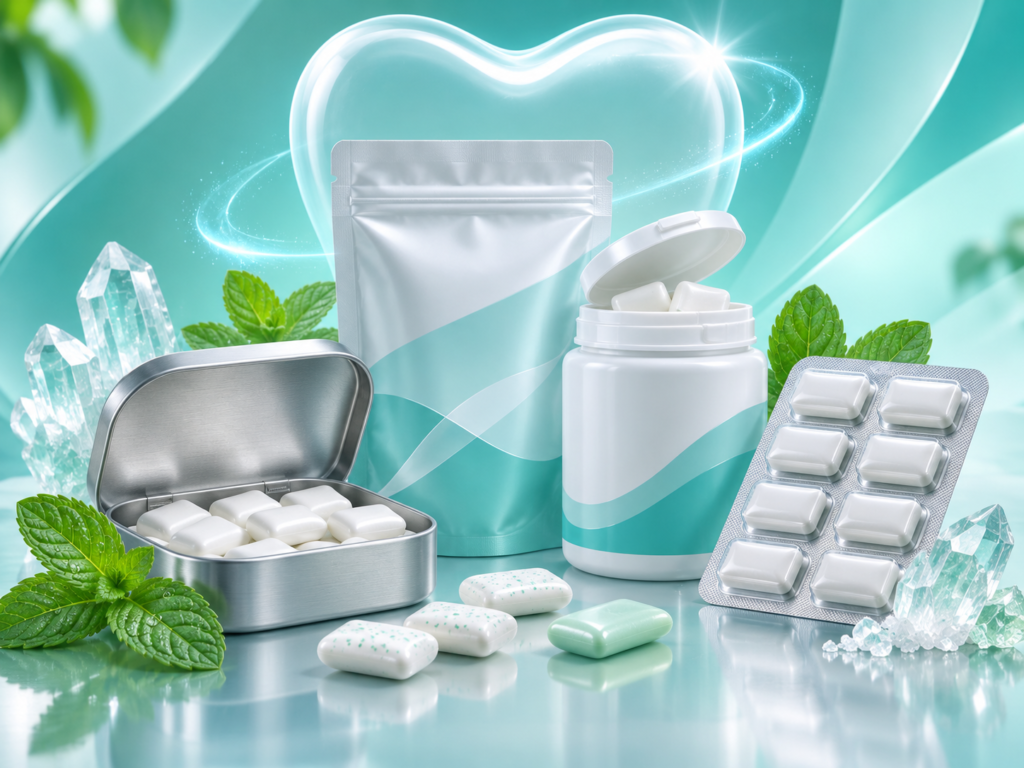
The best chewing gum for teeth is generally a suitable sugar-free product that encourages saliva production without supplying readily fermentable sugar. Xylitol gum is a practical option. Hydroxyapatite and calcium phosphate gums may interest people researching mineral-containing formulas, but finished-product clinical evidence is more limited. No gum replaces fluoride toothpaste, interdental cleaning, or appropriate dental treatment.
What Is the Best Xylitol Gum for Everyday Dental Health?
The best xylitol gum combines a clearly identified sweetener composition, comfortable chewing texture, reasonable price, and appropriate product information. Brands such as PUR, Spry, and Epic Dental are worth comparing. Products that disclose the amount of xylitol per piece make ingredient comparisons easier, but the highest advertised xylitol quantity does not automatically mean the best clinical result.
Is Sugar Free Chewing Gum Better Than Regular Chewing Gum?
Sugar-free chewing gum is generally preferable for dental health because it avoids supplying ordinary sugar that plaque bacteria can ferment into acids. Both types of gum stimulate saliva, but sugar-containing gum introduces an additional source of fermentable carbohydrate.
| Factor | Sugar-free gum | Sugar-sweetened gum |
|---|---|---|
| Stimulates saliva | Yes | Yes |
| Supplies conventional sugar | Generally no | Yes |
| Suitable for tooth-friendly after-meal chewing | Generally preferable | Less desirable |
| Replaces brushing | No | No |
Does Hydroxyapatite Chewing Gum Rebuild Enamel?
Hydroxyapatite chewing gum is designed to deliver mineral particles, but claims that it rebuilds lost enamel are too broad. Early enamel mineral loss may be reversible under suitable conditions, whereas established cavities and missing enamel structure cannot be restored by chewing gum. Research on hydroxyapatite-containing gum is preliminary, and the performance of individual commercial formulations needs product-specific evaluation.
What Is the Best Chewing Gum for Dry Mouth and Bad Breath?
A comfortable sugar-free gum is often a useful starting point for dry mouth and temporary breath freshness. Xylitol formulations are among the available options. For persistent dryness, choose a product that does not irritate sensitive tissues. For recurring bad breath, investigate the underlying cause rather than relying solely on strongly flavored gum.
People Also Ask
Is Chewing Gum Good for Your Teeth After Every Meal?
Sugar-free chewing gum can be beneficial after meals because chewing stimulates saliva, which helps dilute and neutralize oral acids. Approximately 20 minutes of post-meal chewing is commonly supported by dental guidance. However, frequent gum use is not suitable for everyone, particularly individuals with jaw pain or temporomandibular disorders.
How Long Should You Chew Sugar-Free Gum for Dental Benefits?
Around 20 minutes after a meal is a useful reference for the established saliva-related benefits of sugar-free chewing gum. This does not mean that chewing longer provides proportionally greater benefits. For specialized mineral or probiotic products, follow the manufacturer’s suitable instructions without assuming the same duration has been clinically validated for every formula.
Is Xylitol Gum vs Sorbitol Gum Better for Preventing Cavities?
Both xylitol and sorbitol can be used in noncariogenic sugar-free gum. Some research suggests additional benefits of xylitol for reducing decay-associated bacteria and plaque, while cavity outcomes vary across studies. Sorbitol gum can still provide saliva stimulation without introducing conventional sugar. Neither product should replace established cavity-prevention measures.
Can Probiotic Chewing Gum Improve the Oral Microbiome and Cure Bad Breath?
Some oral probiotics have shown promising results for halitosis-related measures, but evidence depends on the strain, formulation, and delivery method. Those findings do not prove that every probiotic chewing gum will produce the same effects.
| Claim | Appropriate interpretation |
|---|---|
| Improves the oral microbiome | Possible for particular studied formulations |
| Reduces odor-related bacterial activity | Promising but strain-dependent |
| Permanently eliminates bad breath | Not established |
| Treats periodontal disease | Not a replacement for professional treatment |
| Works identically in gum and lozenges | Not established |
Is Natural Plastic-Free Chewing Gum Healthier Than Conventional Gum?
Natural plastic-free chewing gum may appeal to individuals who prefer plant-derived gum bases such as chicle. However, its material origin does not establish better dental performance. A natural gum containing cane sugar may be less desirable for enamel protection than a conventional sugar-free gum. Evaluate sugar content, ingredients, and documented environmental claims separately.
Editorial Insights
The chewing gum market is becoming more specialized, but specialization and clinical value are not the same thing.
The strongest foundation remains straightforward: selecting suitable sugar-free gum, encouraging saliva after meals, and maintaining effective daily oral hygiene.
Xylitol adds an ingredient with substantial dental research and practical everyday appeal. Hydroxyapatite and calcium phosphate products introduce more ambitious mineral-delivery concepts, although their commercial claims require closer examination. Probiotic and prebiotic formulations extend the category toward oral microbial ecology, where strain identification and finished-product evidence are particularly important.
Meanwhile, natural and plastic-free chewing gums address another question entirely: what the product is made from and how its material composition fits an individual’s preferences.
These distinctions should shape the purchasing decision.
A person seeking affordable after-meal gum does not necessarily need an expensive remineralizing product. Someone investigating hydroxyapatite should not assume that every formula is equivalent. And an individual dealing with persistent bad breath or dry mouth may need professional assessment rather than another strongly marketed gum.
The most meaningful progress in specialty chewing gum will come from manufacturers publishing precise formulations, ingredient release data, reproducible human studies, and realistic product claims.
Until that evidence becomes more consistent, the best chewing gum for teeth is the product whose demonstrated benefits, ingredient profile, comfort, and cost most closely match the individual’s actual needs.
For additional oral-care product research, enamel science, and detailed comparisons across other dental categories, return to the HydroPaste Homepage.