Hydroxyapatite Mechanism: How Tooth-Like Minerals Help Repair Early Enamel Damage
Amazon Affiliate Disclosure
Hydropaste.com may earn a commission from qualifying purchases made through affiliate links, including Amazon links. This does not affect the price you pay. Our editorial guidance is based on ingredient function, oral care science, user intent, and practical product evaluation rather than commission value.
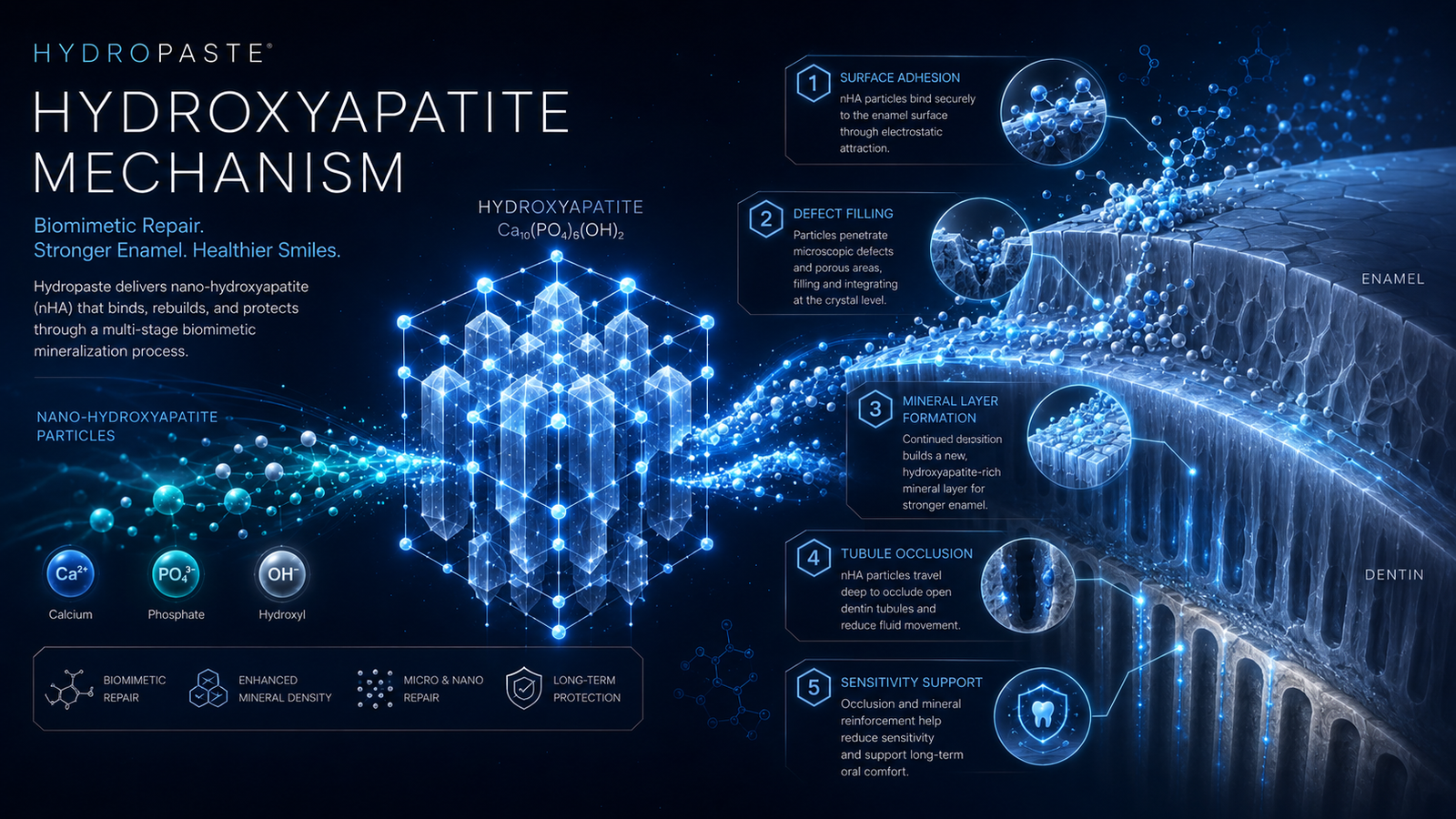
Hydroxyapatite mechanism is one of the most important topics in modern enamel remineralization science because it explains how a toothpaste ingredient can behave less like a coating and more like a tooth-compatible mineral repair system. Hydroxyapatite is not an unfamiliar chemical added randomly to oral care. It is closely related to the mineral structure that gives enamel and dentin their hardness, shape, and resistance.
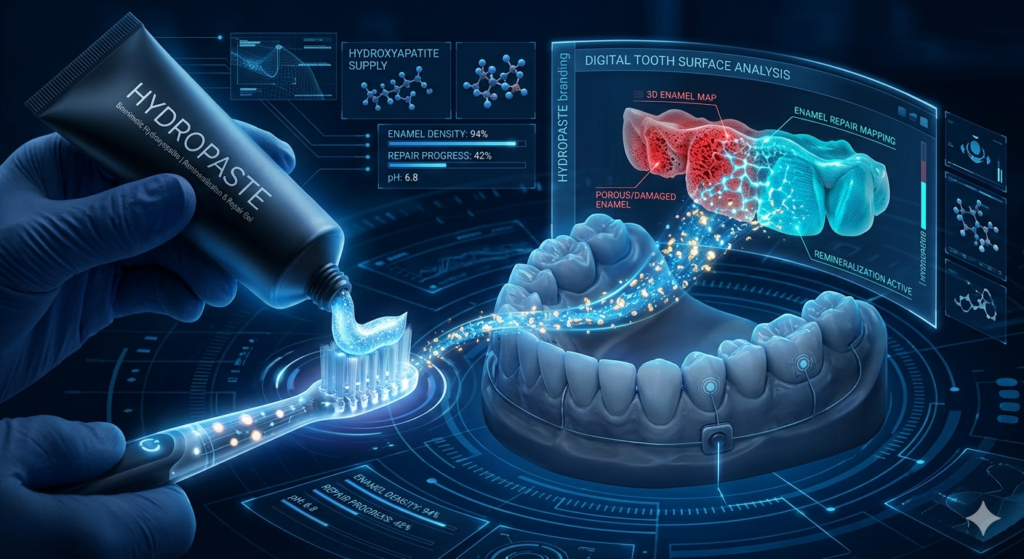
That is why hydroxyapatite toothpaste has become a serious subject in enamel repair, sensitivity care, fluoride free toothpaste, white spot management, and biomimetic oral care. The mechanism is not magic. It is a mineral interaction story: tiny hydroxyapatite particles attach to roughened enamel, fill microscopic defects, support calcium-phosphate redeposition, reduce surface porosity, and help block exposed dentinal tubules that cause sensitivity.
This page sits under the enamel remineralization science lab on Hydropaste. The science page explains the full mineral repair ecosystem, this page explains one major ingredient pathway in detail: how hydroxyapatite works on teeth.
Recent reviews describe hydroxyapatite toothpastes as capable of depositing on demineralized enamel, supporting remineralization, and contributing to caries-prevention strategies, while newer clinical and laboratory discussions continue to compare hydroxyapatite with fluoride-based systems.
Quick Jump
| Reader Goal | Best Section | What You’ll Learn |
| Understand the guide’s clinical purpose | What This Guide Is For | How hydroxyapatite interacts with enamel and what specific product claims mean. |
| Identify who benefits from this technology | Who Needs Hydroxyapatite Mechanism Guidance? | Ideal clinical profiles, including users looking for fluoride-free care, parents, and those with acid wear. |
| Review the structural pros of hydroxyapatite | Benefits of Hydroxyapatite Toothpaste | Six structural advantages, from biomimetic enamel support to surface smoothing and sensitivity relief. |
| Learn the core chemistry and biological steps | Hydroxyapatite Mechanism Explained | The 5-part mechanism detailing how particles adhere, fill micro-defects, and form a surface layer. |
| Compare different particle dimensions | Nano Hydroxyapatite vs Micro Hydroxyapatite | Why particle scale matters for deep lesion intrusion and tubule occlusion. |
| Find relief for dentin hypersensitivity | Hydroxyapatite for Sensitive Teeth | Physical mineral-blocking mechanisms for cold or tactile triggers, and when to see a dentist instead. |
| Address post-orthodontic mineral loss | Hydroxyapatite and White Spot Lesions | How tooth-like particles improve early, non-cavitated white lesions and restore surface gloss. |
| Compare mineral deposition with traditional chemistry | Hydroxyapatite vs Fluoride Mechanism | The structural differences between crystalline particle deposition and acid-resistant chemical pathways. |
| Differentiate hydroxyapatite from ionic systems | Hydroxyapatite vs Calcium Phosphate Systems | Why preformed biomimetic crystals differ from ion-release platforms like CPP-ACP or bioactive glass. |
| Explore available formats and mediums | Hydroxyapatite Product Categories | Product form breakdowns, including toothpastes, gels, rinses, and gentle whitening systems. |
| Evaluate active formulas before purchasing | What to Look for in a Hydroxyapatite Toothpaste | Crucial purchasing metrics like exact mineral type, low abrasion levels, and daily comfort. |
| Plan product budget and analyze value | Costs: What Hydroxyapatite Oral Care Usually Costs | Cost tiers ranging from basic formulas to premium gels and professional management systems. |
| Understand safety limits and boundaries | Risks and Limitations | Why mineral pastes cannot treat open cavities, and how formula quality and abrasion levels vary. |
| Discover next-generation dental innovations | Trends & Latest Tech in Hydroxyapatite Toothpaste | Emerging market shifts, including zinc-carbonate hybrids and advanced nano configurations. |
| Preview emerging oral care technologies | Upcoming Models in Hydroxyapatite Oral Care | Future systems like multi-mineral biomimetic configurations and smart toothbrush integration. |
| Access summary data matrices and charts | Charts & Tables | Cross-referenced data models, including the use-case matrix and the master ingredient comparison. |
| Incorporate biomimetic care into your day | Practical Hydroxyapatite Routine | Targeted morning, night, and post-acid application protocols for optimal mineral contact. |
| Get quick answers to common questions | FAQs | Direct answers regarding structural mechanisms, cavity boundaries, and fluoride status. |
| Explore additional important queries | People Also Ask | Quick insights into physiological mineral roles and realistic treatment timelines. |
| Read the final summary on mineral selection | Editorial Insights | A high-level wrap-up explaining how to choose a specific system based on personal clinical requirements. |
What This Guide Is For
This guide is for readers who want to understand the mechanism of hydroxyapatite toothpaste before choosing an enamel repair product. Many toothpastes use phrases such as “rebuild enamel,” “repair teeth,” “restore minerals,” or “biomimetic whitening.” Some of those phrases are useful. Others can be vague.
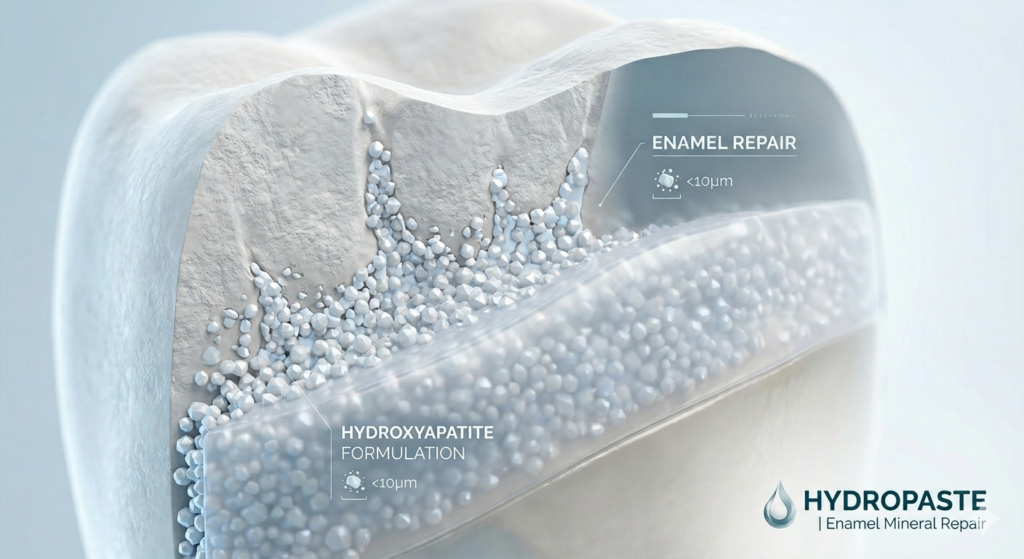
This page clarifies what hydroxyapatite can realistically do.
It explains:
How hydroxyapatite interacts with enamel
Why nano hydroxyapatite toothpaste is different from ordinary polishing toothpaste
How hydroxyapatite supports early enamel remineralization
Why it may help tooth sensitivity
How it compares with fluoride
Where it fits in a complete enamel repair routine
What to look for when buying hydroxyapatite toothpaste
What claims should be treated carefully
For the broader scientific framework, read enamel remineralization science. For the traditional cavity-prevention pathway, continue to fluoride remineralization science.
Who Needs Hydroxyapatite Mechanism Guidance?
People Looking for Fluoride Free Remineralizing Toothpaste
Hydroxyapatite is often searched by people who want enamel support without fluoride. It gives them a mineral-based option because hydroxyapatite is chemically similar to the tooth’s natural mineral structure. This does not mean fluoride is unnecessary for everyone. It means hydroxyapatite has a different mechanism that may suit certain users, especially those prioritizing biomimetic oral care.
People With Early White Spots
White spots after braces, frequent snacking, acidic drinks, dry mouth, or poor plaque control can represent early enamel mineral loss. Hydroxyapatite may help support mineral deposition in early, non-cavitated lesions. It cannot reverse a hole in the tooth, but it can support the surface environment before breakdown becomes irreversible.
People With Tooth Sensitivity
Sensitivity often occurs when microscopic dentin tubules become exposed. These tubules act like tiny channels that transmit cold, heat, air, sweetness, or touch toward the nerve. Hydroxyapatite particles can help occlude those tubules, creating a physical mineral barrier that may reduce sensitivity over repeated use. Reviews of nanohydroxyapatite dentistry describe its use in remineralization and dentinal hypersensitivity applications. (PMC)
Parents Comparing Children’s Toothpaste
Parents often compare hydroxyapatite toothpaste with fluoride toothpaste for children. The decision depends on cavity risk, age, swallowing habits, dental advice, and comfort with ingredients. Hydroxyapatite is attractive because it is tooth-like and fluoride free, but high-risk children may still need dentist-guided fluoride prevention.
Adults With Acid Wear or Enamel Roughness
People who consume coffee, citrus, soda, sports drinks, wine, or acidic foods may experience enamel softening and surface roughness. Hydroxyapatite may support smoother enamel texture, especially when paired with low-acid habits and gentle brushing.
Premium Oral Care Buyers
Hydroxyapatite toothpaste is usually more expensive than standard fluoride toothpaste. Understanding the mechanism helps buyers avoid paying premium prices for weak formulas, unclear concentrations, or marketing-heavy products.
Benefits of Hydroxyapatite Toothpaste
1. Biomimetic Enamel Support
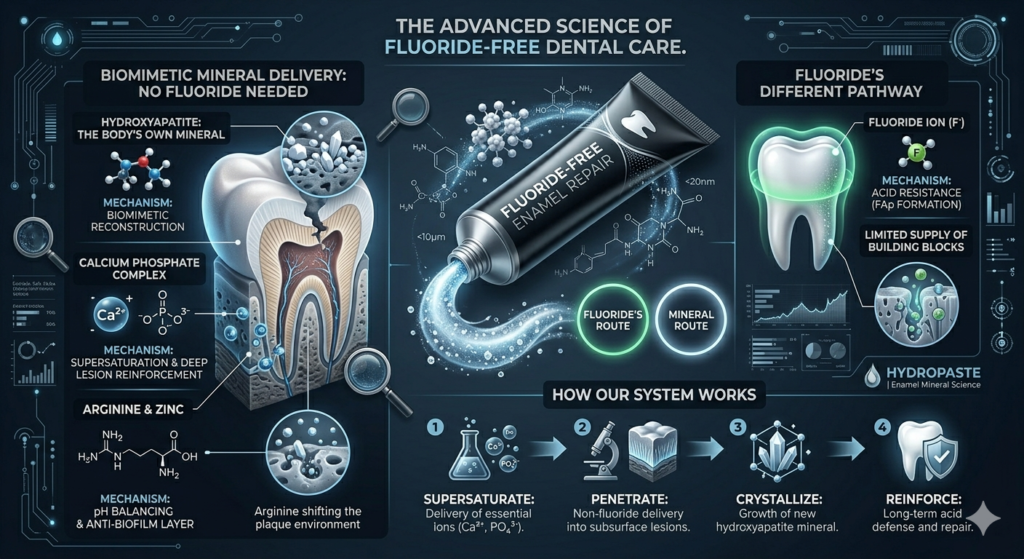
Hydroxyapatite is valued because it resembles the mineral family already present in teeth. Instead of only changing the chemical environment, it provides tooth-compatible mineral particles that can interact with enamel surfaces.
2. Early Enamel Remineralization
Hydroxyapatite particles may deposit into microscopic defects and weakened areas of enamel, supporting mineral recovery when the lesion is still early and non-cavitated.
3. Sensitivity Reduction
Hydroxyapatite can help block dentinal tubules. This makes it especially relevant for people who feel sharp discomfort from cold drinks, air, sweet foods, or brushing near the gumline.
4. Surface Smoothing
By filling micro-irregularities, hydroxyapatite may help enamel feel smoother. A smoother surface can also be less prone to staining and plaque accumulation compared with rough, porous enamel.
5. Fluoride Free Toothpaste Appeal
Hydroxyapatite offers a remineralizing pathway for readers who prefer fluoride free toothpaste. Current safety opinions from the European Scientific Committee on Consumer Safety consider hydroxyapatite nano safe in toothpaste up to specified concentrations, with a 2025 opinion listing up to 29.5% in toothpaste and 10% in mouthwash based on the provided data. (Public Health)
6. Compatibility With Daily Oral Care
Hydroxyapatite is used in toothpaste, gels, mouthwash, and professional-style remineralization products. Its value depends on the formula, particle behavior, concentration, and consistency of use.
Hydroxyapatite Mechanism Explained
What Is Hydroxyapatite?
Hydroxyapatite is a calcium phosphate mineral. Tooth enamel is mostly made of hydroxyapatite-like mineral crystals. Dentin also contains hydroxyapatite, though it is less mineralized than enamel and contains more organic material.
In toothpaste, hydroxyapatite can appear as:
Micro-hydroxyapatite
Nano-hydroxyapatite
Zinc-carbonate hydroxyapatite
Synthetic hydroxyapatite
Medical-grade hydroxyapatite
Functionalized hydroxyapatite blends
The mechanism depends on particle size, shape, concentration, stability, and how the formula behaves in saliva.
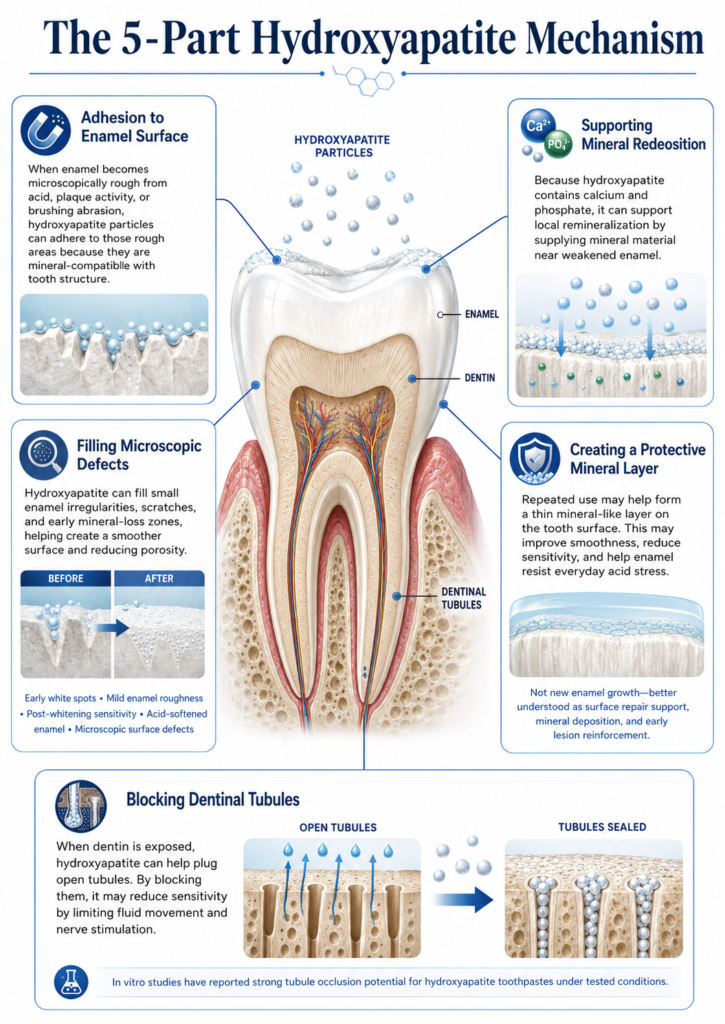
The 5-Part Hydroxyapatite Mechanism
1. Adhesion to Enamel Surface
When enamel is exposed to acid, brushing abrasion, or plaque activity, its surface may become microscopically rough. Hydroxyapatite particles can adhere to these rough areas because they share mineral compatibility with tooth structure.
Think of damaged enamel like a stone wall with tiny chips. Hydroxyapatite does not rebuild the entire wall overnight. It supplies compatible mineral material that can settle into the chipped areas and help smooth the surface.
2. Filling Microscopic Defects
Hydroxyapatite particles can fill small enamel irregularities, scratches, and early mineral-loss zones. This creates a smoother surface and may reduce porosity.
This is especially relevant for:
Early white spots
Mild enamel roughness
Post-whitening sensitivity
Acid-softened enamel
Microscopic surface defects
3. Supporting Mineral Redeosition
Hydroxyapatite contains calcium and phosphate, the same mineral building blocks involved in enamel structure. In the right oral environment, these particles can support local remineralization by providing mineral material near weakened enamel.
4. Creating a Protective Mineral Layer
Repeated use may help form a thin mineral-like layer on the tooth surface. This layer may improve smoothness, reduce sensitivity, and help enamel resist everyday acid stress.
This is not the same as growing new enamel. It is better understood as surface repair support, mineral deposition, and early lesion reinforcement.
5. Blocking Dentinal Tubules
When dentin is exposed, hydroxyapatite can help plug open tubules. This matters because tubules transmit fluid movement and nerve stimulation. By blocking them, hydroxyapatite may reduce sensitivity.
In vitro studies comparing desensitizing materials have reported strong tubule occlusion potential for hydroxyapatite toothpastes under tested conditions. (ScienceDirect)
Hydroxyapatite Mechanism Table
| Mechanism Step | What Happens | User Benefit |
|---|---|---|
| Surface attraction | Hydroxyapatite particles adhere to enamel | Better contact with weak areas |
| Defect filling | Particles settle into microscopic roughness | Smoother enamel feel |
| Mineral support | Calcium phosphate material supports repair environment | Helps early remineralization |
| Protective layer | Repeated use may create mineral-like surface coverage | Better resistance to daily stress |
| Tubule occlusion | Particles block exposed dentin channels | Reduced sensitivity |
| Plaque-surface effect | Smoother surfaces may reduce plaque retention | Cleaner-feeling teeth |
Nano Hydroxyapatite vs Micro Hydroxyapatite
Why Particle Size Matters
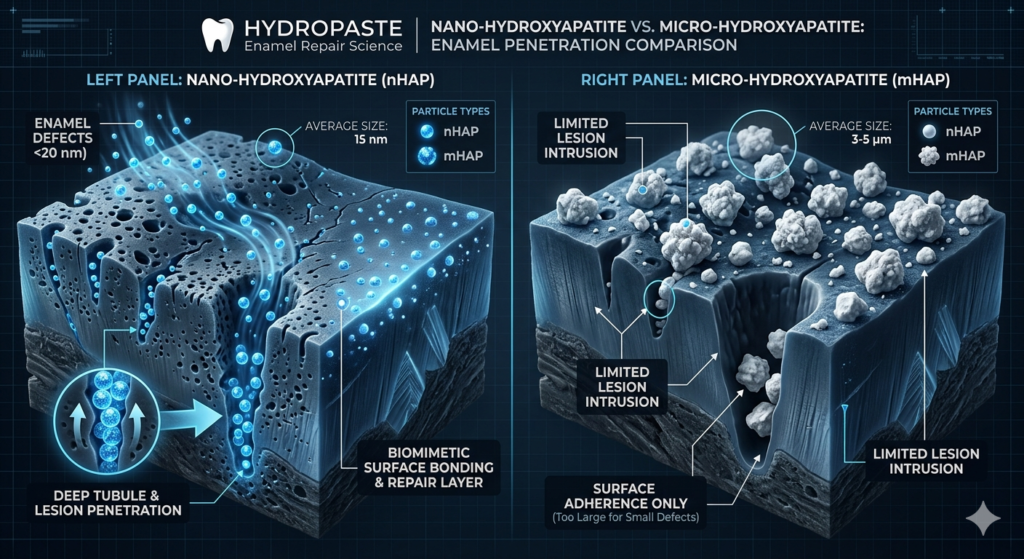
Nano hydroxyapatite toothpaste uses very small particles. Smaller particles have more surface area relative to their size, which may help them interact with microscopic enamel defects and dentinal tubules.
Micro-hydroxyapatite particles are larger. They can still support enamel surface mineralization, but nano-sized particles are often marketed for deeper surface interaction and better tubule occlusion.
Nano vs Micro Hydroxyapatite
| Feature | Nano Hydroxyapatite | Micro Hydroxyapatite |
|---|---|---|
| Particle size | Smaller | Larger |
| Surface area | Higher | Lower |
| Enamel defect interaction | Strong potential | Moderate potential |
| Tubule occlusion | Strong potential | Moderate potential |
| Texture | Often smoother in premium formulas | May feel more mineral/paste-like |
| Product positioning | Advanced biomimetic repair | General mineral support |
| Cost | Usually higher | Often lower or mid-range |
Which Is Better?
Nano hydroxyapatite may have an advantage where microscopic surface interaction and sensitivity support are priorities. Micro-hydroxyapatite can still be useful, especially when the formula is well designed and affordable.
The better product is not always the smallest particle. The full formula matters: concentration, abrasivity, pH behavior, humectants, surfactants, and whether the paste stays in contact with teeth long enough to work.
Hydroxyapatite for Sensitive Teeth
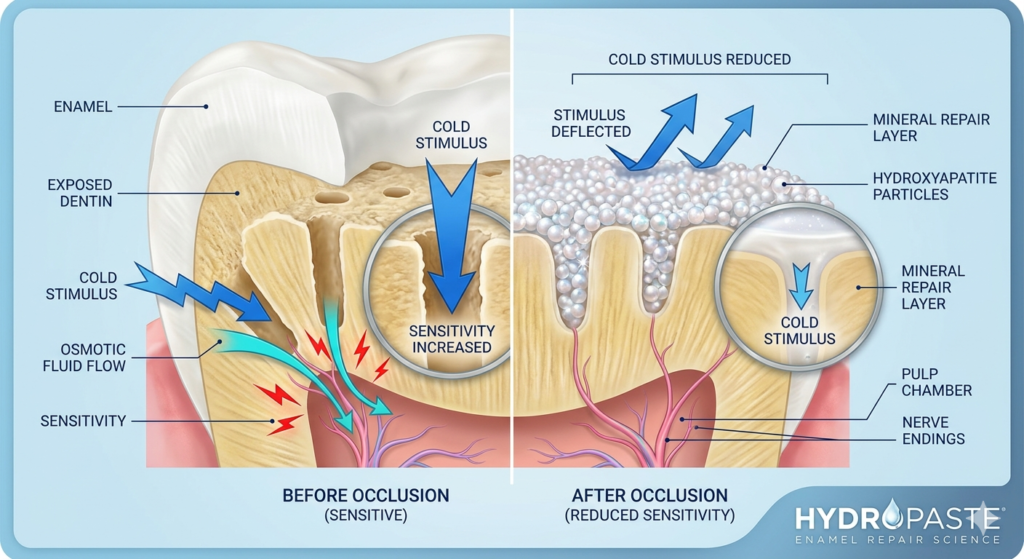
Hydroxyapatite for sensitive teeth works mainly through a physical mineral-blocking mechanism.
When gum recession, enamel wear, or dentin exposure opens tubules, external triggers can cause fluid movement inside those tubules. This movement stimulates nerves and creates pain. Hydroxyapatite particles can help seal these tubules, reducing the pathway for stimulation.
Sensitivity Use Cases
Hydroxyapatite toothpaste may help with:
Cold sensitivity
Air sensitivity
Mild sweet sensitivity
Sensitivity after whitening
Sensitivity from enamel roughness
Gumline sensitivity from exposed dentin
Post-scaling sensitivity
When Sensitivity Needs a Dentist
Do not treat all sensitivity as a toothpaste problem. See a dentist if sensitivity is:
Sharp and localized
Triggered by biting
Lingering after cold or heat
Associated with swelling
Linked to a cracked tooth
Getting worse
Only on one tooth
Accompanied by visible decay
Hydroxyapatite supports mineral repair and tubule occlusion, but it cannot fix an infection, crack, deep cavity, or failing filling.
Hydroxyapatite and White Spot Lesions
White spot lesions can appear when minerals are lost beneath the enamel surface. They are common after braces, around plaque-prone areas, and in people with frequent acid exposure.
Hydroxyapatite may support white spot improvement by:
Depositing tooth-like mineral particles
Smoothing porous enamel
Supporting calcium-phosphate availability
Improving surface gloss over time
Reducing sensitivity in weakened areas
Realistic Expectations
White spots do not disappear overnight. Some improve with remineralization. Others require professional treatment such as resin infiltration, microabrasion, whitening balance, or restorative care.
Hydroxyapatite is most appropriate when the white spot is early, non-cavitated, and still has an intact surface.
Hydroxyapatite vs Fluoride Mechanism
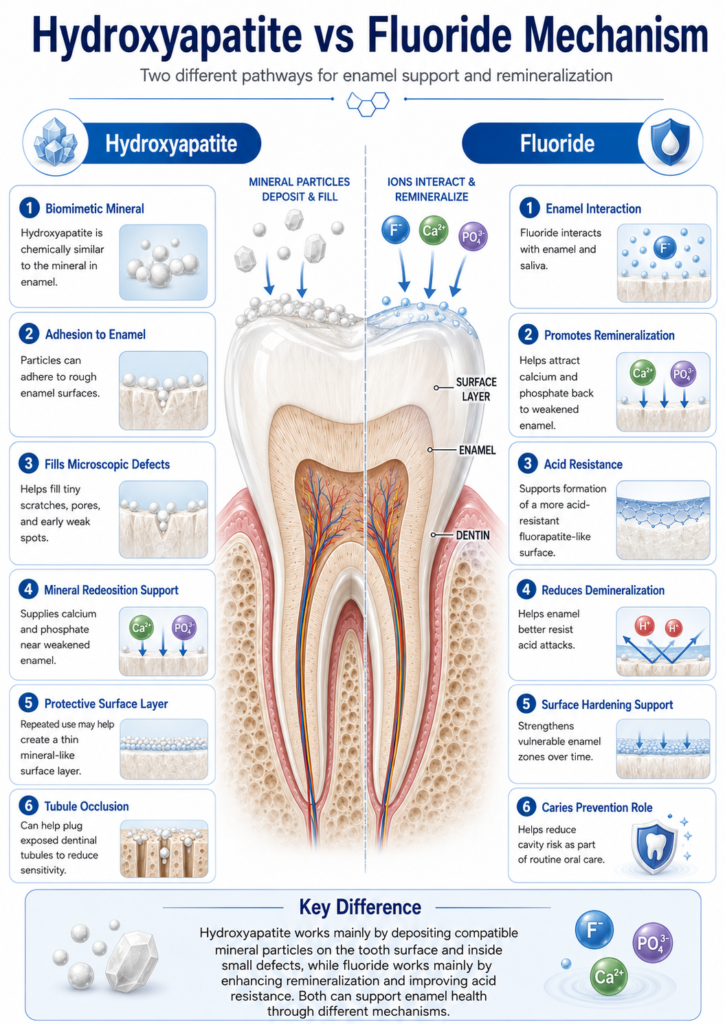
Hydroxyapatite and fluoride are often compared, but they do not work in the same way.
Fluoride helps enamel become more acid-resistant and supports remineralization through fluoride-enhanced mineral chemistry. Hydroxyapatite provides tooth-like mineral particles that can deposit on enamel and fill surface defects.
Hydroxyapatite vs Fluoride Comparison Chart
| Category | Hydroxyapatite | Fluoride |
|---|---|---|
| Main mechanism | Tooth-like mineral deposition | Acid-resistant mineral support |
| Fluoride free | Yes | No |
| Sensitivity support | Strong through tubule occlusion | Moderate; stronger with stannous fluoride |
| Cavity prevention history | Growing evidence | Long-established evidence |
| White spot support | Strong potential | Strong potential |
| Best for | Fluoride-free remineralization, sensitivity, enamel surface support | High cavity risk, traditional caries prevention |
| Main limitation | Formula quality varies | Requires correct dose and age-appropriate use |
Can They Be Used Together?
Some formulas combine hydroxyapatite and fluoride. The idea is to pair mineral deposition with fluoride-supported acid resistance. A 2025 review discussed remineralizing and desensitizing potential across hydroxyapatite and fluoride formulations, including the possibility that combined systems may perform strongly in certain outcomes. (MDPI)
Hydroxyapatite vs Calcium Phosphate Systems
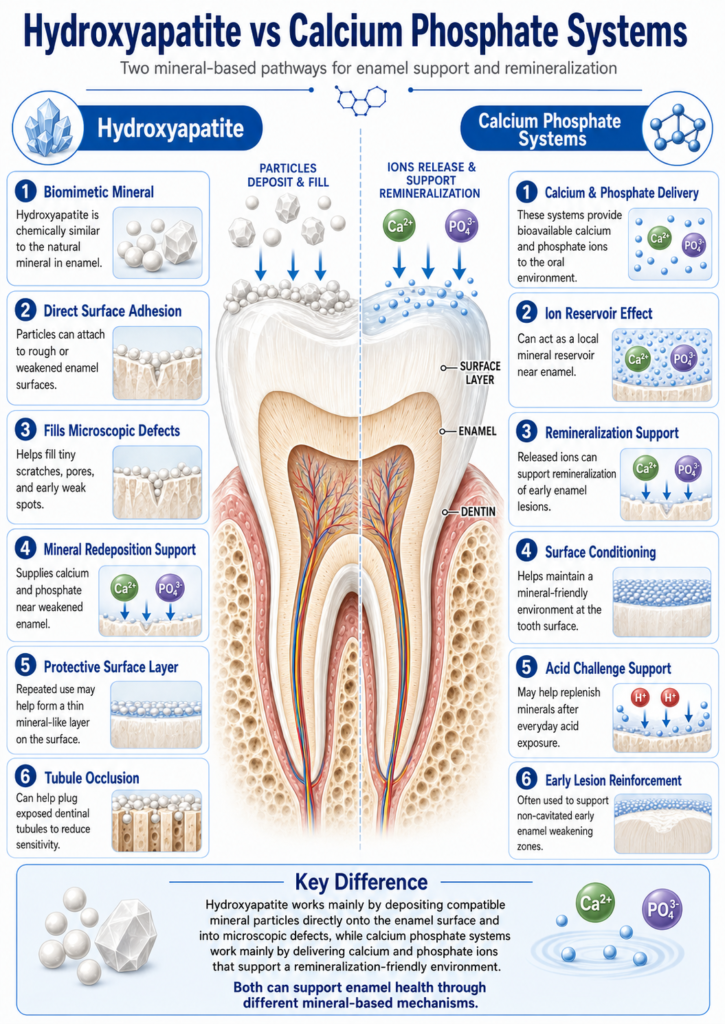
Hydroxyapatite is itself a calcium phosphate mineral, but not all calcium phosphate systems are hydroxyapatite.
Some products use amorphous calcium phosphate, CPP-ACP, beta-tricalcium phosphate, functionalized calcium phosphate, or bioactive glass. These systems are designed to make calcium and phosphate available near enamel.
Hydroxyapatite differs because it is already a tooth-like mineral particle. It does not only supply ions; it may also physically bind, fill, and occlude.
Hydroxyapatite Product Categories
1. Hydroxyapatite Toothpaste
This is the most common format. It is used twice daily and works through repeated mineral contact. Look for clear ingredient labeling, low-abrasion positioning, and a formula built for daily use.
2. Nano Hydroxyapatite Toothpaste
Usually positioned as premium enamel repair or sensitivity toothpaste. Best for readers who want advanced biomimetic surface support.
3. Hydroxyapatite Mouthwash
May help extend mineral contact after brushing, though toothpaste usually provides more direct mechanical contact with enamel.
4. Hydroxyapatite Gel
Used as an add-on for sensitivity, white spots, or focused enamel support. Some gels are designed for trays or targeted application.
5. Hydroxyapatite Whitening Toothpaste
These products often rely on surface smoothing rather than harsh whitening. The best versions avoid excessive abrasivity and focus on enamel-safe brightness.
What to Look for in a Hydroxyapatite Toothpaste
Clear Hydroxyapatite Type
A serious formula should make it clear whether it uses hydroxyapatite, nano hydroxyapatite, zinc-carbonate hydroxyapatite, or another mineral form.
Low Abrasion
This is critical. A toothpaste claiming enamel repair should not rely on aggressive abrasives that may worsen sensitivity or erosion-prone enamel.
Daily-Use Formula
Hydroxyapatite works best with repeated contact. Choose a toothpaste that feels comfortable enough to use twice daily.
Sensitivity Support
If the goal is sensitivity, look for hydroxyapatite plus a formula designed to block tubules and avoid irritation.
No Unrealistic Claims
Avoid products that suggest they can regrow missing enamel, reverse deep cavities, or eliminate the need for dental care.
Costs: What Hydroxyapatite Oral Care Usually Costs
Hydroxyapatite products are usually more expensive than basic fluoride toothpaste because they are positioned as specialty or premium mineral repair formulas.
Hydroxyapatite Cost Chart
| Product Type | Typical Cost Level | Best For |
|---|---|---|
| Basic hydroxyapatite toothpaste | Mid-range | Daily fluoride free toothpaste enamel support |
| Nano hydroxyapatite toothpaste | Mid to premium | Sensitivity, early enamel support |
| Hydroxyapatite whitening toothpaste | Mid to premium | Gentle brightness and surface smoothing |
| Hydroxyapatite gel | Premium | Targeted white spots or sensitivity |
| Hydroxyapatite mouthwash | Mid to premium | Add-on mineral support |
| Professional remineralization systems | Higher | Dentist-guided enamel management |
How to Judge Value
A good hydroxyapatite toothpaste should justify its price through:
Transparent active ingredient
Low-abrasion formula
Good mouthfeel
Daily comfort
Sensitivity support
Clear use directions
No exaggerated enamel-regrowth claims
Strong fit for the user’s actual concern
Risks and Limitations
Hydroxyapatite Cannot Fill a Cavity
Hydroxyapatite supports early enamel repair. It cannot rebuild tooth structure after a cavity has formed. If a tooth has a hole, shadow, food trap, pain, or rough cavity edge, dental treatment is needed.
Formula Quality Varies
Some products use hydroxyapatite as a headline ingredient but do not clearly explain particle type, concentration, or use case. The label matters.
Nano Does Not Automatically Mean Better
Nano hydroxyapatite may offer surface-area advantages, but the complete formula determines performance. A poorly made nano formula may be less useful than a well-designed micro-hydroxyapatite formula.
Abrasion Still Matters
A remineralizing toothpaste can still be too abrasive for some users. This matters for people with erosion, gum recession, exposed dentin, sensitivity, or aggressive brushing.
High Cavity Risk May Need Fluoride
People with frequent cavities, dry mouth, orthodontic appliances, high sugar exposure, exposed roots, or medical risk factors may need fluoride or professional prevention. Hydroxyapatite can be useful, but it should not replace personalized dental advice in high-risk cases.
Swallowing and Children
Children should use toothpaste under supervision. Even fluoride free toothpaste should not be swallowed casually. Parents should follow product directions and ask a dentist when cavity risk is high.
Trends & Latest Tech in Hydroxyapatite Toothpaste
Nano Hydroxyapatite Formulas
Nano hydroxyapatite remains the most visible trend because it supports the idea of microscopic enamel interaction. The focus is on smaller particles, better defect filling, smoother enamel, and improved sensitivity support.
Zinc-Carbonate Hydroxyapatite
Some formulas use zinc-carbonate hydroxyapatite to combine biomimetic mineral behavior with additional oral care benefits. Reviews have discussed zinc-hydroxyapatite products in relation to enamel and dentin remineralization, tubule occlusion, and hypersensitivity reduction. (ResearchGate)
For the next generation of enamel repair, biomimetic mineral repair compounds explores future mineral systems beyond standard toothpaste.
Hydroxyapatite + Fluoride Hybrid Toothpaste
Hybrid products are emerging for users who want both tooth-like mineral deposition and fluoride-supported acid resistance. This may become a major product category for people who are not strictly fluoride free.
Hydroxyapatite Whitening Without Harsh Abrasion
The future of whitening toothpaste is likely to move away from aggressive scrubbing and toward enamel smoothing, stain resistance, and optical brightness.
Hydroxyapatite for Orthodontic White Spots
Post-braces white spots are a major niche. Hydroxyapatite products may increasingly target orthodontic patients who want early enamel support after brackets are removed.
Upcoming Models in Hydroxyapatite Oral Care
1. Personalized Remineralization Toothpaste
Future hydroxyapatite products may be matched to saliva flow, pH risk, sensitivity pattern, diet, and cavity history. A dry-mouth user and a post-whitening user do not need the same formula.
2. Hydroxyapatite Gels for Targeted Lesions
Instead of only brushing, future products may include targeted gels for white spots, sensitivity zones, and orthodontic enamel recovery.
3. Smart Toothbrush Pairing
Connected toothbrushes may eventually recommend remineralization routines based on brushing pressure, brushing time, missed areas, and sensitivity zones.
4. Multi-Mineral Biomimetic Systems
The next wave may combine hydroxyapatite with calcium phosphate, bioactive glass, fluoride, or peptide-guided mineral systems for broader enamel support.
5. Low-Abrasion Premium Whitening Systems
Hydroxyapatite whitening may evolve around surface smoothness, enamel gloss, and stain resistance rather than harsh polishing.
Charts & Tables
Hydroxyapatite Mechanism Pathway
| Stage | What Happens | Why It Matters |
|---|---|---|
| Acid exposure | Enamel loses minerals | Surface becomes weaker and rougher |
| Hydroxyapatite contact | Toothpaste delivers mineral particles | Particles reach weak enamel areas |
| Surface adhesion | Particles attach to enamel | Improves mineral contact |
| Defect filling | Particles settle into micro-gaps | Supports smoother enamel |
| Mineral layer formation | Repeated use builds surface support | May improve resistance and comfort |
| Tubule occlusion | Open dentin channels are blocked | Sensitivity may decrease |
Hydroxyapatite Use Case Matrix
| User Concern | Hydroxyapatite Relevance | Notes |
|---|---|---|
| White spots | High | Best when lesions are early and non-cavitated |
| Sensitivity | High | Tubule occlusion is a key mechanism |
| Fluoride-free oral care | High | Main alternative remineralizing pathway |
| High cavity risk | Moderate | May need fluoride or professional care |
| Acid erosion | Moderate to high | Works best with diet changes |
| Whitening | Moderate | Best through smoothing, not harsh abrasion |
| Gum inflammation | Low to moderate | Stannous fluoride may be stronger for gums |
| Dry mouth | Moderate | Saliva support is still essential |
Hydroxyapatite Buying Checklist
| Feature | Why It Matters |
|---|---|
| Hydroxyapatite clearly listed | Confirms the active mineral system |
| Nano or micro type identified | Helps match product to sensitivity or surface repair goals |
| Low-abrasion formula | Protects weakened enamel and exposed dentin |
| Sensitivity positioning | Useful for tubule occlusion needs |
| No harsh whitening abrasives | Prevents conflict with enamel repair goals |
| Daily-use instructions | Hydroxyapatite works through repeated contact |
| Transparent brand education | Reduces misleading repair claims |
Hydroxyapatite vs Other Remineralization Ingredients
| Ingredient | Mechanism | Best For | Main Advantage | Main Limitation |
|---|---|---|---|---|
| Hydroxyapatite | Tooth-like mineral deposition and defect filling | Fluoride-free enamel repair, sensitivity | Biomimetic mineral support | Formula quality varies |
| Nano hydroxyapatite | Smaller particle mineral interaction | Sensitivity, white spots, premium repair | Better surface-area potential | Usually more expensive |
| Fluoride | Acid-resistant remineralization chemistry | Cavity prevention, high-risk users | Strong evidence and dental acceptance | Not fluoride free |
| Stannous fluoride | Fluoride + tin-based plaque/sensitivity benefits | Gumline sensitivity, gingivitis risk | Multi-benefit active | Taste/staining concerns in some formulas |
| Calcium phosphate systems | Mineral ion support | Early enamel weakness | Supports calcium/phosphate availability | May need complementary actives |
| Bioactive glass | Ion release and tubule support | Sensitivity and mineral release | Useful desensitizing pathway | Less common in mainstream toothpaste |
Practical Hydroxyapatite Routine
Morning Routine
Brush with hydroxyapatite toothpaste for two minutes. Use a soft toothbrush and light pressure. Spit out excess paste, but avoid heavy rinsing immediately after brushing if your goal is to keep mineral ingredients in contact with enamel.
After Acidic Foods or Drinks
Do not brush immediately after acidic exposure. Rinse with water, let saliva recover, and brush later. This helps reduce abrasion on temporarily softened enamel.
Night Routine
Night brushing matters because saliva flow decreases during sleep. A hydroxyapatite toothpaste used before bed may give enamel longer mineral contact during a lower-saliva period.
Weekly Check
Watch for changes in sensitivity, white spot appearance, roughness, and gumline discomfort. If symptoms worsen, the issue may be beyond toothpaste.
FAQs
How does hydroxyapatite toothpaste work on enamel?
Hydroxyapatite toothpaste works by delivering tooth-like calcium phosphate particles to the enamel surface. These particles can adhere to roughened enamel, fill microscopic defects, support mineral redeposition, and create a smoother surface layer with repeated use.
The mechanism is biomimetic because hydroxyapatite resembles the mineral structure naturally found in teeth. It does not grow back missing enamel, but it can support early enamel repair when the surface is still intact.
Is nano hydroxyapatite toothpaste better than regular hydroxyapatite toothpaste?
Nano hydroxyapatite toothpaste may have advantages because smaller particles have greater surface area and may interact more effectively with tiny enamel defects and dentinal tubules. This can make nano hydroxyapatite especially relevant for sensitivity and early enamel surface repair.
However, “nano” alone does not guarantee a better product. Concentration, formula stability, abrasivity, pH, flavor system, and daily-use comfort all matter. A well-designed hydroxyapatite toothpaste is more important than a marketing claim about particle size.
Can hydroxyapatite toothpaste repair cavities?
Hydroxyapatite toothpaste cannot repair an open cavity. It may support remineralization of early, non-cavitated enamel lesions, but once the enamel surface breaks down, professional dental care is needed.
A simple way to think about it: hydroxyapatite can help reinforce weak mineral zones, but it cannot replace missing tooth structure. If there is a hole, pain, food trapping, or a dark soft area, a dentist should evaluate it.
Is hydroxyapatite toothpaste good for sensitive teeth?
Hydroxyapatite toothpaste can be useful for sensitive teeth because it may help block exposed dentinal tubules. These tubules transmit cold, heat, air, and sweet triggers toward the nerve. By depositing mineral particles into the tubules, hydroxyapatite can reduce the pathway for sensitivity signals.
It is most useful for mild to moderate sensitivity related to enamel wear, exposed dentin, whitening, or gumline sensitivity. Severe, localized, or lingering pain should be checked by a dentist.
Is hydroxyapatite toothpaste fluoride-free?
Most hydroxyapatite toothpastes are fluoride free, which is one reason they are popular among people looking for alternative remineralizing toothpaste. However, some newer formulas combine hydroxyapatite with fluoride.
Always check the active ingredient list. If the product includes sodium fluoride, stannous fluoride, or sodium monofluorophosphate, it is not fluoride free.
People Also Ask
What does hydroxyapatite do for teeth?
Hydroxyapatite supports teeth by supplying tooth-like mineral particles that can attach to enamel, fill microscopic roughness, support remineralization, and reduce sensitivity. It is especially relevant for early enamel weakness, white spots, fluoride-free oral care, and exposed dentin sensitivity.
Its role is best understood as mineral support rather than complete tooth rebuilding. It helps the surface recover from early mineral stress when used consistently and paired with good oral habits.
How long does hydroxyapatite toothpaste take to work?
Some people notice sensitivity improvement within days or weeks, especially if exposed tubules begin to occlude. Enamel surface changes, white spot improvement, and remineralization support usually take longer and require consistent daily use.
A realistic timeline is several weeks to several months. Results depend on diet, saliva flow, acid exposure, plaque control, brushing technique, and product quality.
Can hydroxyapatite whiten teeth?
Hydroxyapatite can make teeth appear brighter by smoothing the enamel surface and reducing microscopic roughness where stains can collect. Some formulas may also improve surface gloss.
It is not a bleaching agent like peroxide. It does not chemically whiten deep tooth color. Its whitening effect is usually more about enamel smoothness, stain resistance, and optical brightness.
Is hydroxyapatite better for kids than fluoride?
Hydroxyapatite may be attractive for children because it is fluoride free and tooth-like, but that does not automatically make it better for every child. The best choice depends on cavity risk, age, brushing supervision, diet, and dental history.
Children at low cavity risk may do well with dentist-approved hydroxyapatite toothpaste. Children at high cavity risk may still need fluoride. Parents should follow pediatric dental advice instead of choosing only by ingredient trend.
Can hydroxyapatite and fluoride be used together?
Yes, hydroxyapatite and fluoride can be used together in some formulas or routines. The combination may offer two mechanisms: hydroxyapatite for tooth-like mineral deposition and fluoride for acid-resistant remineralization support.
People who want a fluoride free toothpaste should avoid combination formulas. People with high cavity risk may benefit from dentist-guided use of fluoride, hydroxyapatite, or both depending on their situation.
Editorial Insights
The hydroxyapatite mechanism is powerful because it is not built around a foreign idea. It is built around the mineral identity of the tooth itself. Enamel and dentin are already calcium-phosphate structures, and hydroxyapatite toothpaste uses that biological compatibility to support surface repair, mineral deposition, tubule occlusion, and sensitivity relief.
The most accurate way to describe hydroxyapatite is not “instant enamel regrowth.” It is biomimetic mineral support for early damage. It helps most when the enamel surface is still intact, the user brushes consistently, acid exposure is controlled, and the formula is well designed.
For Hydropaste’s enamel education system, this cluster page should act as the bridge between broad remineralization science and real product decisions. The reader arrives with a simple question — “how does hydroxyapatite toothpaste work?” — and leaves understanding the mechanism, benefits, limits, costs, risks, product categories, and next steps.