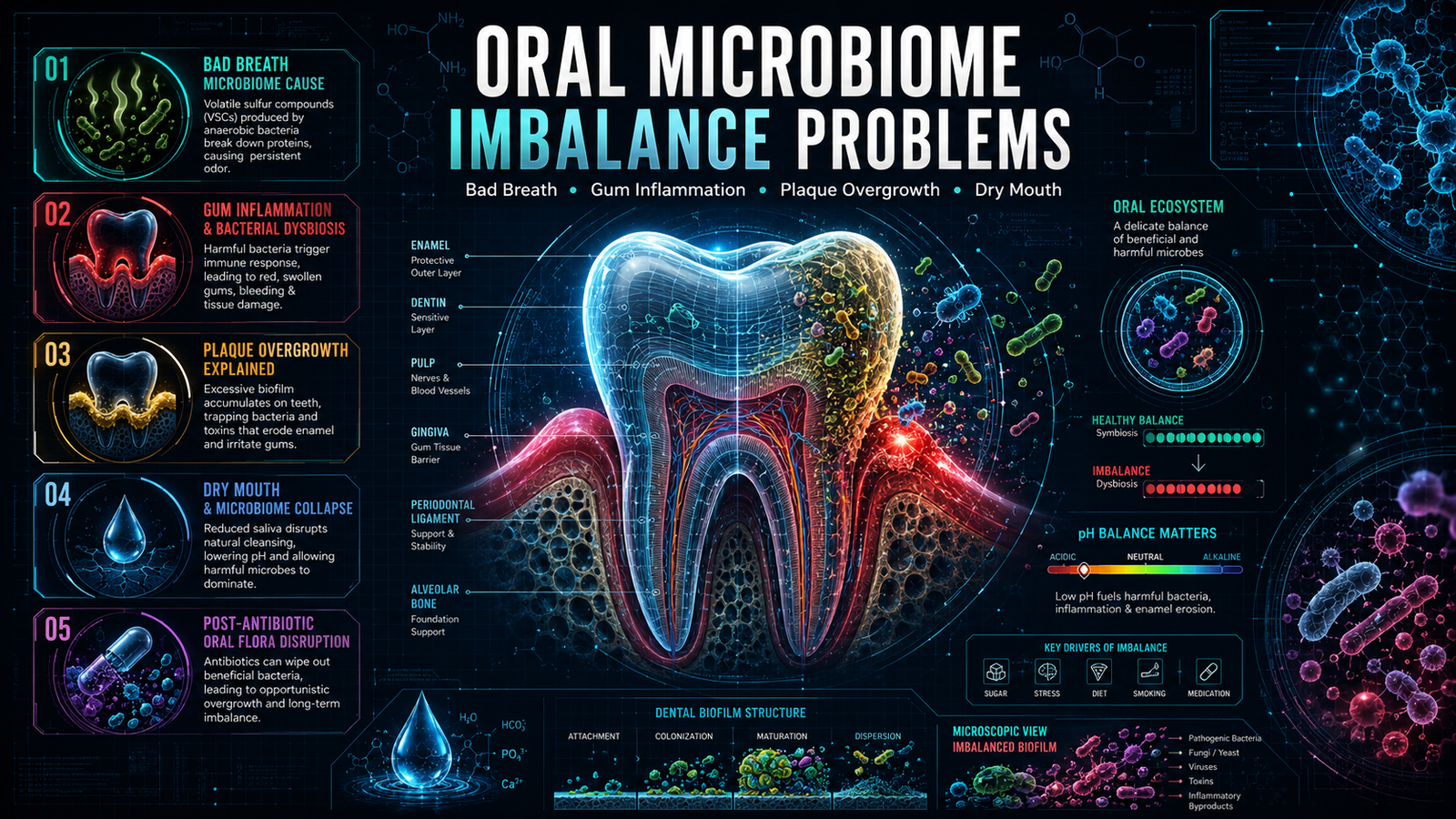
Oral Microbiome Imbalance Problems: Bad Breath, Gum Inflammation, Plaque Overgrowth & Dry Mouth
Amazon Affiliate Disclosure
HydroPaste may earn a commission from qualifying purchases made through affiliate links, including Amazon affiliate links. This does not change the price you pay, and it does not influence our editorial standards. Product mentions are intended to help readers compare oral-care options more clearly, not replace professional dental advice.
When the Mouth’s Ecosystem Falls Out of Balance
Oral microbiome imbalance problems rarely begin with one dramatic symptom. More often, they show up quietly: breath that returns soon after brushing, gums that bleed during flossing, plaque that feels thicker by evening, a coated tongue, morning dryness, or sensitivity that seems to move from one tooth to another.
The mouth is not supposed to be sterile. It is a living ecosystem of bacteria, fungi, minerals, saliva, enamel surfaces, gum tissue, oxygen levels, pH changes, food residue, and daily hygiene habits. A healthy oral microbiome is not about killing everything. It is about keeping the right balance so protective organisms, saliva flow, mineral exchange, and gum defenses can work together.
That is why HydroPaste approaches oral care through balance instead of harshness. For readers building a complete enamel and microbiome-friendly routine, the HydroPaste oral care center is the best place to begin.
This guide explains what happens when that balance breaks down, why common problems like bad breath and gum inflammation often share the same microbial roots, and how to build a smarter daily routine without overcorrecting.
Quick Picks: Jump to the Problem You Want to Understand
Use these quick links to move directly to the section that matches your concern:
| Concern | Jump | Best For |
|---|---|---|
| What this guide covers | Go to section | Readers who want the big picture first |
| Who needs this guide | Go to section | People with recurring breath, plaque, gum, or dry mouth issues |
| Benefits of restoring balance | Go to section | Readers comparing prevention vs symptom control |
| Oral microbiome imbalance explained | Go to section | Foundational understanding |
| Warning signs chart | Go to section | Fast symptom matching |
| Imbalance Framework | Go to section | 5 Forces to understand |
| Bad breath and bacteria | Go to section | Persistent halitosis |
| Gum inflammation and dysbiosis | Go to section | Bleeding, tenderness, swollen gums |
| Plaque overgrowth | Go to section | Fast plaque buildup and rough teeth |
| Dry mouth and microbiome collapse | Go to section | Xerostomia, mouth breathing, medication-related dryness |
| Post-antibiotic oral flora disruption | Go to section | Mouth changes after antibiotics |
| Daily Routine | Go to section | Balanced Routine Guide |
| Latest tech and trends | Go to section | Future-focused oral care |
| FAQs | Go to section | Imbalance related answers |
What This Guide Is For
This guide is designed to help readers understand the most common oral microbiome imbalance problems and how they connect.
Many people treat each oral symptom separately. Bad breath gets a mint. Bleeding gums get ignored unless there is pain. Plaque buildup gets blamed on brushing technique. Dry mouth gets treated with water alone. But in many cases, these symptoms are part of the same bigger pattern: a microbial environment that has shifted away from balance.
This page helps you understand:
| Problem | What It Often Signals | Why It Matters |
|---|---|---|
| Bad breath | Sulfur-producing bacteria, tongue coating, low saliva | Breath products may mask odor without changing the cause |
| Gum inflammation | Bacterial dysbiosis near the gumline | Early inflammation can become a recurring gum problem |
| Plaque overgrowth | Biofilm maturity and poor disruption | Thick plaque supports acid, odor, and inflammatory bacteria |
| Dry mouth | Reduced saliva protection | Saliva loss changes pH, mineral flow, and microbial control |
| Post-antibiotic disruption | Reduced microbial diversity | Temporary imbalance can affect breath, tongue coating, and gum comfort |
For readers who want the foundation before symptoms, HydroPaste’s guide to the oral microbiome explains how bacteria, saliva, enamel, gums, and daily habits interact.
Who Needs This Guide
This guide is useful for anyone who feels their mouth is “clean” for only a short time after brushing.
You may benefit from reading it if you experience:
- Bad breath that returns quickly after brushing
- Gum bleeding during flossing or brushing
- Swollen, tender, or irritated gum margins
- Plaque that feels thick by the end of the day
- A coated tongue or sour taste
- Dry mouth in the morning
- Mouth changes after antibiotics
- Frequent mouthwash use that seems to help briefly, then stop working
- Sensitivity that appears alongside gum irritation or dryness
- Oral-care routines that feel aggressive but still do not solve the problem
This page is not a substitute for a dental examination. If you have severe gum bleeding, tooth mobility, facial swelling, pus, fever, persistent ulcers, or pain that wakes you at night, seek professional dental care promptly.
Benefits of Balancing the Oral Microbiome
The goal is not to “destroy bacteria.” That thinking is outdated. The mouth needs a stable microbial community, healthy saliva flow, regular plaque disruption, and mineral support.
A balanced oral microbiome may support:
| Benefit | Practical Meaning |
|---|---|
| Fresher breath | Less odor from tongue coating and sulfur-producing bacteria |
| Healthier gums | Reduced irritation around the gumline |
| Lower plaque pressure | Biofilm is easier to disrupt before it matures |
| Better enamel environment | More stable pH and mineral exchange |
| Less dry-mouth damage | Improved comfort and lower risk of odor and plaque acceleration |
| Smarter mouthwash use | Better product matching instead of random rinsing |
| More predictable oral-care routine | Fewer cycles of symptom flare and harsh correction |
The deeper benefit is control. When you understand the pattern behind symptoms, you stop chasing every flare-up as if it is a separate problem.
What Is Oral Microbiome Imbalance?
Oral microbiome imbalance, also called oral microbiome dysbiosis, happens when the normal community of microorganisms in the mouth shifts in a harmful direction.
That shift can involve:
- Too much acid-producing activity
- More odor-producing bacteria
- Gumline bacteria becoming more inflammatory
- Reduced microbial diversity
- Low saliva flow
- Higher plaque maturity
- Tongue coating buildup
- Overuse of harsh rinses
- Diet patterns that feed frequent acid attacks
- Medication-related dryness
- Antibiotic-related disruption
A healthy mouth still contains bacteria. The problem begins when conditions favor the wrong behavior: acid production, sulfur odor, gum inflammation, sticky biofilm growth, and tissue irritation.
Oral Microbiome Imbalance vs Gum Disease
This distinction matters.
| Topic | Oral Microbiome Imbalance | Gum Disease |
|---|---|---|
| Meaning | A shift in the microbial environment | A diagnosed condition affecting gum tissue and supporting structures |
| Early signs | Bad breath, plaque, mild bleeding, coated tongue | Bleeding, pocketing, recession, bone involvement in advanced cases |
| Main focus | Balance, prevention, daily routine | Professional diagnosis and treatment |
| At-home role | Important for hygiene and maintenance | Supportive, but not a replacement for dental care |
| Urgency | Depends on symptoms | Higher if bleeding, pain, recession, mobility, or deep pockets exist |
The two are connected, but they are not identical. Oral microbiome imbalance can contribute to gum irritation, while established gum disease requires professional assessment.
Oral Microbiome Imbalance Warning Signs
The mouth usually gives early signals before major problems develop.
| Warning Sign | Possible Microbiome Pattern | What to Watch |
|---|---|---|
| Bad breath returns fast | Tongue coating, sulfur-producing bacteria, dry mouth | Odor after brushing, morning breath, metallic taste |
| Bleeding gums | Gumline dysbiosis and inflammation | Bleeding when flossing, red gum edges |
| Fast plaque buildup | Biofilm overgrowth | Rough teeth, visible film near gumline |
| Dry mouth | Reduced saliva defense | Sticky mouth, difficulty swallowing dry foods |
| Coated tongue | Biofilm accumulation on tongue surface | White/yellow coating, sour taste |
| Tooth sensitivity with dryness | pH instability and low mineral buffering | Sensitivity after acidic foods or mouth breathing |
| Mouth changes after antibiotics | Reduced microbial diversity | New odor, coating, thrush-like symptoms, gum tenderness |
One symptom alone does not prove dysbiosis. The pattern matters. Bad breath plus dry mouth plus tongue coating tells a different story than breath odor after garlic-heavy food.
The 5-Part Imbalance Framework
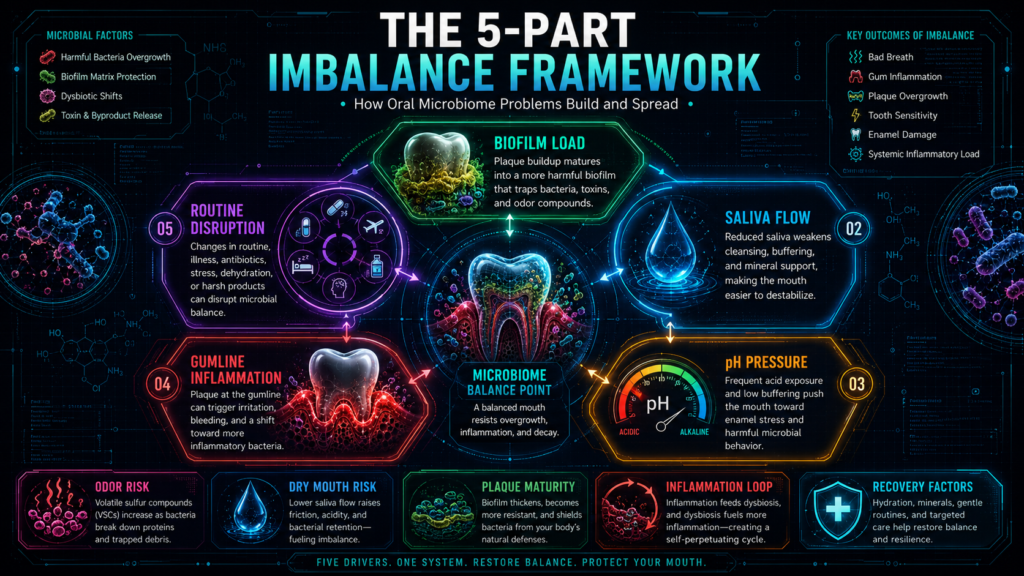
A practical way to understand microbiome problems is to look at five forces.
1. Biofilm Load
Biofilm is the organized microbial layer that forms on teeth, tongue, gumline, and dental appliances. Early biofilm is easier to disrupt. Mature plaque becomes more resistant, more irritating, and more likely to trap odor compounds.
2. Saliva Flow
Saliva is not just moisture. It helps buffer acids, carries minerals, supports swallowing, dilutes odor compounds, and keeps microbial growth under pressure. When saliva drops, the ecosystem becomes easier to destabilize.
3. pH Pressure
Frequent snacking, sugary drinks, acidic beverages, reflux, and low saliva can push the mouth into repeated acidic episodes. This makes enamel more vulnerable and encourages acid-tolerant microbial behavior.
4. Gumline Inflammation
The gumline is where plaque, immune response, oxygen levels, and tissue health meet. A small amount of missed plaque near the gum margin can become a recurring inflammatory trigger.
5. Routine Disruption
Antibiotics, illness, stress, dehydration, mouth breathing, travel, sleep changes, and harsh rinsing can all disrupt the oral environment. Sometimes the problem is not poor hygiene. It is a routine that changed faster than the mouth could adapt.
Bad Breath Microbiome Cause
Bad breath is often treated like a fragrance problem. In reality, persistent bad breath is usually a microbial and saliva problem.
Many odor compounds are produced when bacteria break down proteins from food debris, dead cells, saliva proteins, and tongue coating. These compounds can collect on the tongue, around the gumline, between teeth, under dental work, and in areas where saliva flow is weak.
Common Microbiome-Linked Bad Breath Patterns
| Pattern | Possible Cause | Better Direction |
|---|---|---|
| Morning breath is intense | Overnight saliva reduction, mouth breathing | Hydration, nasal breathing support, tongue cleaning |
| Breath returns soon after brushing | Tongue coating or gumline biofilm | Tongue cleaning, interdental cleaning, therapeutic rinse |
| Sour or metallic taste | Dryness, reflux, pH instability | Address dryness and acid exposure |
| Odor with bleeding gums | Gumline inflammation | Dental evaluation and plaque control |
| Odor after antibiotics | Flora disruption | Gentle routine, hydration, monitor for fungal signs |
Why Mints Rarely Fix It
Mints add flavor. They do not remove tongue biofilm, disrupt gumline plaque, restore saliva flow, or change the microbial environment. Some sugary mints may even worsen the conditions that allow odor to return.
A better strategy is to identify whether the odor is driven by tongue coating, gum inflammation, dry mouth, diet timing, dental appliances, or deeper periodontal issues.
Practical Routine for Breath-Related Dysbiosis
- Brush teeth twice daily with a gentle, enamel-supportive toothpaste.
- Clean between teeth once daily.
- Clean the tongue gently without scraping aggressively.
- Use alcohol-free mouthwash if dryness or irritation is present.
- Avoid constant snacking and sugary lozenges.
- Hydrate consistently, especially before sleep.
- Seek dental care if odor is paired with bleeding, pus, pain, or loose teeth.
Gum Inflammation and Bacterial Dysbiosis
Gum inflammation is one of the clearest signs that the immune system is reacting to microbial pressure.
Healthy gums are not supposed to bleed during gentle brushing or flossing. Occasional bleeding after restarting flossing can happen, but recurring bleeding suggests plaque, inflammation, or a deeper gum issue.
How Dysbiosis Affects the Gumline
The gumline creates a narrow ecological zone. Food residue, saliva, oxygen gradients, plaque, and immune cells all meet there. When plaque remains undisturbed, the bacterial community matures. As it matures, it can become more inflammatory.
This does not mean every gum problem is severe. But it does mean gum bleeding should not be normalized.
Gum Inflammation Signs
| Symptom | What It May Suggest |
|---|---|
| Bleeding while brushing | Gumline plaque and inflammation |
| Bleeding while flossing | Interdental plaque or technique issues |
| Puffy gum edges | Local irritation or plaque retention |
| Tender gums | Inflammatory response |
| Receding gums | Requires dental assessment |
| Bad breath with gum bleeding | Possible periodontal involvement |
Oral Microbiome Imbalance vs Gum Disease
A person can have microbial imbalance before advanced gum disease develops. That is the opportunity window. If you respond early with better plaque control, professional cleaning, and gentler product choices, the mouth has a better chance of returning to stability.
If bleeding persists beyond consistent hygiene improvement, professional dental evaluation is important. The goal is not to guess; the goal is to prevent early signs from becoming structural problems.
Plaque Overgrowth Explained
Plaque is not just “dirt on teeth.” It is a structured biofilm.
At first, plaque is soft and easier to remove. Over time, it becomes more organized, more adhesive, and more protective of the microbes inside it. If it mineralizes, it becomes tartar, which cannot be removed by brushing alone.
Why Some People Build Plaque Faster
Plaque buildup varies between people because of:
- Saliva composition
- Diet frequency
- Tooth crowding
- Gum recession
- Dry mouth
- Orthodontic appliances
- Retainers, night guards, dentures, or aligners
- Brushing technique
- Flossing consistency
- Mouth breathing
- Medication effects
- Mineral balance in saliva
Fast plaque buildup does not always mean someone is careless. Sometimes the mouth has a plaque-friendly environment.
Plaque Overgrowth and Microbiome Risk
| Plaque Stage | What Happens | Risk |
|---|---|---|
| Early film | Bacteria attach to tooth surfaces | Usually easy to disrupt |
| Mature plaque | Biofilm becomes more organized | Higher gum irritation and odor |
| Thick gumline plaque | More inflammatory microbial activity | Bleeding and tenderness |
| Tartar | Mineralized plaque | Requires professional cleaning |
| Plaque plus dry mouth | Less natural flushing | Faster odor, decay, and gum issues |
Better Plaque Control Strategy
The strongest plaque strategy is not brushing harder. It is disrupting plaque more intelligently.
- Use a soft toothbrush or electric toothbrush with light pressure.
- Angle bristles toward the gumline.
- Clean between teeth daily.
- Do not skip the back molars.
- Replace old toothbrush heads.
- Use mouthwash as a support tool, not a substitute.
- Consider professional cleaning if plaque mineralizes quickly.
Readers comparing rinse options can review HydroPaste’s guide to the best mouthwash for oral microbiome support, especially if plaque, dryness, and enamel support are all concerns.
Dry Mouth and Microbiome Collapse
Dry mouth is one of the most underestimated drivers of oral microbiome imbalance.
When saliva drops, the mouth loses part of its natural defense system. Food debris lingers longer. Odor compounds become more concentrated. Acids are buffered less effectively. Plaque feels stickier. The tongue may become coated. The gums may feel more sensitive.
Common Dry Mouth Triggers
| Trigger | Why It Matters |
|---|---|
| Medications | Many common medicines reduce saliva flow |
| Mouth breathing | Dries oral surfaces during sleep |
| Dehydration | Reduces fluid availability |
| Stress | Can alter saliva and breathing patterns |
| Aging | Saliva changes may become more common with medication use |
| Caffeine and alcohol | Can worsen dryness in some people |
| Sleep apnea or snoring | Often linked with overnight mouth dryness |
| Autoimmune conditions | May significantly affect saliva glands |
Dry Mouth Is Not Just Discomfort
A dry mouth can change the entire ecosystem. Saliva helps keep harmful microbial growth in check. When saliva is reduced, the mouth may become more vulnerable to tooth decay, fungal overgrowth, plaque accumulation, and persistent odor.
Dry Mouth Routine Direction
- Sip water throughout the day instead of relying on large amounts at once.
- Use sugar-free xylitol gum or lozenges if appropriate.
- Avoid alcohol-heavy rinses if they worsen dryness.
- Consider a saliva-supportive oral rinse.
- Use a humidifier if night dryness is severe.
- Discuss medication-related dry mouth with a clinician or dentist.
- Seek care if dryness is persistent, severe, or paired with burning, sores, or white patches.
The key is not just adding moisture. It is restoring a mouth environment where saliva, pH, minerals, and microbes can stabilize again.
Post-Antibiotic Oral Flora Disruption
Antibiotics can be medically necessary and sometimes lifesaving. But they can also disturb microbial communities, including those in the mouth.
After antibiotics, some people notice:
- New bad breath
- Coated tongue
- Altered taste
- Dryness
- Gum tenderness
- Oral irritation
- White patches
- Burning sensation
- Increased plaque feel
This does not mean antibiotics should be avoided when prescribed. It means the mouth may need a recovery-friendly routine afterward.
Why Antibiotics Can Affect the Oral Microbiome
Antibiotics do not always target only the bacteria causing the original infection. Depending on the medication, they may reduce parts of the normal microbial community as well. When that balance shifts, opportunistic organisms may temporarily gain more space.
Post-Antibiotic Recovery Direction
| Step | Why It Helps |
|---|---|
| Keep brushing gentle and consistent | Prevents plaque from gaining momentum |
| Clean the tongue carefully | Reduces coating without irritating tissue |
| Hydrate well | Supports saliva function |
| Avoid harsh over-rinsing | Prevents additional irritation |
| Watch for white patches or burning | May suggest fungal overgrowth needing care |
| Rebuild diet quality | Supports a more stable oral environment |
| See a dentist if symptoms persist | Rules out infection, thrush, or gum disease |
The mistake is to respond to post-antibiotic imbalance with maximum harshness. A fragile ecosystem often needs consistency, moisture, and targeted care — not punishment.
How to Choose Microbiome-Friendly Mouthwash
Mouthwash can be useful, but it should be matched to the problem.
A cosmetic rinse may only freshen flavor. A therapeutic rinse may help with plaque, gingivitis, odor, enamel support, or dry mouth depending on its ingredients. A prescription rinse may be appropriate for specific gum conditions, but it should be used under professional guidance.
For readers exploring enamel-safe rinse options, HydroPaste’s hydroxyapatite mouthwash hub explains how remineralization-focused rinses fit into a broader oral microbiome balance routine.
Mouthwash Selection Chart
| Concern | Better Mouthwash Direction | Be Careful With |
|---|---|---|
| Bad breath | Zinc, CPC, chlorine dioxide, tongue routine support | Fragrance-only rinses |
| Gum inflammation | Therapeutic antibacterial rinse when appropriate | Long-term harsh use without dental guidance |
| Dry mouth | Alcohol-free, moisturizing, saliva-friendly rinse | Alcohol-heavy formulas |
| Enamel support | Hydroxyapatite or fluoride-based remineralizing rinse | Acidic or abrasive routines |
| Post-antibiotic sensitivity | Gentle alcohol-free rinse | Overuse of strong antiseptics |
| Plaque overgrowth | Therapeutic plaque-support rinse plus flossing | Replacing brushing/flossing with rinsing |
Mouthwash Should Not Replace Mechanical Cleaning
Biofilm is physical. It needs physical disruption. Mouthwash can reach areas brushing misses, but it cannot fully replace brushing, flossing, interdental brushes, tongue cleaning, or professional cleaning.
The best mouthwash is the one that supports the right routine for your specific pattern.
Daily Routine for Oral Microbiome Balance
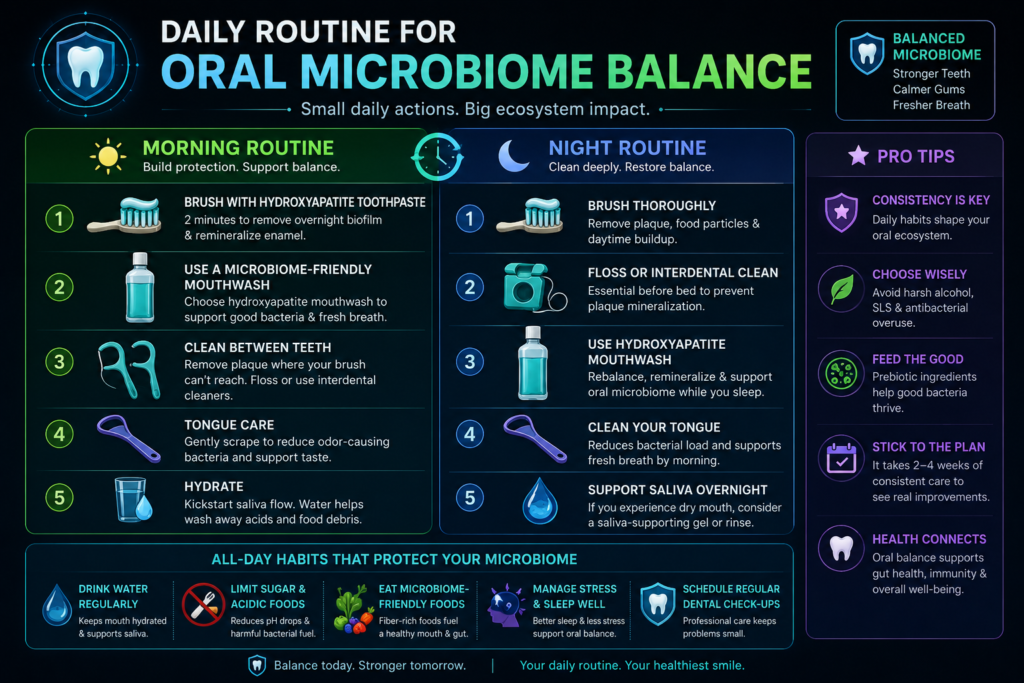
A balanced routine should be effective without being aggressive.
Morning Routine
- Drink water before coffee or tea if your mouth feels dry.
- Brush gently with a soft brush.
- Clean the tongue if coated.
- Use interdental cleaning where food gets trapped.
- Use mouthwash if it matches your need.
Evening Routine
- Clean between teeth first.
- Brush carefully along the gumline.
- Clean the tongue if odor or coating is present.
- Use a gentle rinse if recommended or appropriate.
- Avoid sugary snacks after brushing.
Weekly Check
Once a week, ask:
- Are my gums bleeding less?
- Does breath stay fresher longer?
- Is plaque forming more slowly?
- Is my mouth less dry in the morning?
- Is my tongue coating improving?
- Do I need professional evaluation?
Tracking symptoms gives you better feedback than constantly switching products.
Food, Saliva, pH and the Oral Microbiome
Diet affects the oral microbiome through frequency, texture, sugar exposure, acidity, hydration, and chewing.
Better Oral Microbiome Food Habits
| Habit | Why It Helps |
|---|---|
| Eat structured meals instead of constant snacking | Gives saliva time to recover pH |
| Drink water after acidic drinks | Helps dilute acids |
| Include fibrous foods when possible | Supports chewing and saliva flow |
| Limit sticky sugary foods | Reduces prolonged plaque feeding |
| Avoid sipping sweet drinks for hours | Prevents repeated acid pressure |
| Choose sugar-free gum when appropriate | Can stimulate saliva |
This is not about perfection. It is about reducing repeated microbial triggers.
Product Mistakes That Can Worsen Imbalance
Some routines feel “strong” but quietly make the mouth less stable.
Common Mistakes
| Mistake | Why It Can Backfire |
|---|---|
| Brushing too hard | Irritates gums and may contribute to recession |
| Using harsh rinses too often | May worsen dryness or irritation |
| Skipping floss but using mouthwash | Leaves interdental biofilm intact |
| Ignoring tongue coating | Misses a major odor source |
| Treating dry mouth with flavor only | Does not restore saliva function |
| Switching products every few days | Makes it hard to know what works |
| Ignoring bleeding gums | Allows inflammation to become normal |
The mouth responds best to steady pressure in the right direction.
When to See a Dentist
At-home routines can help with balance, but some signs need professional care.
See a dentist or qualified oral-health professional if you have:
- Bleeding gums that persist
- Gum recession
- Loose teeth
- Pus around gums
- Severe bad breath with gum pain
- White patches after antibiotics
- Burning mouth symptoms
- Dry mouth that does not improve
- Tooth pain or swelling
- Tartar buildup that cannot be brushed away
- Mouth sores lasting more than two weeks
A microbiome-friendly routine is not a replacement for diagnosis. It works best when paired with professional care when needed.
Symptom Masking vs Microbiome-Supportive Care
| Approach | Symptom Masking | Microbiome-Supportive Care |
|---|---|---|
| Bad breath | Mint or perfume-like rinse | Tongue, gumline, saliva, and odor bacteria addressed |
| Gum bleeding | Ignore unless painful | Treat as an early warning sign |
| Plaque | Brush harder | Improve technique, interdental cleaning, product support |
| Dry mouth | Drink water only | Address saliva, rinse choice, medication triggers, sleep dryness |
| Mouthwash | Strongest flavor wins | Formula matched to the problem |
| Long-term result | Repeating flare-ups | More stable daily oral environment |
The difference is strategy. A symptom-masking routine asks, “How do I hide this?” A microbiome-supportive routine asks, “Why does this keep returning?”
Upcoming Trends and Latest Tech
Oral microbiome care is moving beyond simple “kills germs” messaging. The next stage is more precise, more personalized, and more focused on maintaining balance.
1. Saliva-Based Oral Health Testing
Saliva testing is becoming more important because saliva can reflect inflammation, microbial activity, pH, dryness risk, and oral-systemic signals. Future consumer and clinical tools may help identify whether a person’s main issue is odor bacteria, acid pressure, gum inflammation, or saliva weakness.
2. Microbiome-Sensitive Mouthwash Formulas
The next generation of rinses will likely focus less on maximum burn and more on selective support: odor control, pH balance, enamel remineralization, gum comfort, and reduced dryness.
3. Hydroxyapatite-Based Remineralization Routines
Hydroxyapatite is becoming more visible in enamel-support routines because it fits the direction many consumers want: mineral support without a harsh mouthfeel. For microbiome imbalance, the relevance is not that hydroxyapatite “fixes bacteria” directly, but that enamel-friendly routines can support a healthier oral environment.
4. Oral Probiotic and Postbiotic Research
Oral probiotics, postbiotics, and microbiota-based therapies are gaining attention. The most promising future will not be random probiotic claims; it will be strain-specific, condition-specific, and evidence-guided use.
5. Smart Toothbrush and App-Based Plaque Coaching
Smart toothbrushes already track brushing zones, pressure, timing, and consistency. The next layer may combine brushing data with bleeding logs, dryness tracking, diet frequency, and dental history to guide more personalized oral-care routines.
6. Dry Mouth Support Systems
Dry mouth care is likely to become more sophisticated, especially for older adults, medication users, mouth breathers, and people with sleep-related dryness. Expect more saliva-supportive gels, rinses, lozenges, and overnight hydration systems.
7. Personalized Mouthwash Selection
Instead of choosing mouthwash by flavor, future routines may match formulas to specific patterns:
- Bad breath dominant
- Gum inflammation dominant
- Dry mouth dominant
- Enamel risk dominant
- Post-antibiotic disruption
- Orthodontic plaque risk
- Senior dry-mouth risk
This is where oral care is heading: not more products, but better matching.
Editorial Insights
Oral microbiome imbalance is not a single condition with one solution. It is a pattern. Bad breath, gum inflammation, plaque overgrowth, dry mouth, and post-antibiotic disruption often overlap because they share the same ecological space.
The most effective routines are not the harshest. They are the most consistent, well-matched, and respectful of the mouth’s biology.
The future of oral care will likely belong to products and systems that understand this balance: mineral support, saliva support, plaque disruption, gumline care, breath control, and microbiome-aware formulations working together.
For readers building a full oral-care routine, return to HydroPaste for enamel, mouthwash, hydroxyapatite, and oral microbiome guidance.
FAQs
What are the most common oral microbiome imbalance problems?
The most common oral microbiome imbalance problems include persistent bad breath, gum inflammation, plaque overgrowth, dry mouth, coated tongue, sour taste, and oral changes after antibiotics. These symptoms may look separate, but they often share the same underlying pattern: a shift in saliva flow, pH balance, biofilm behavior, and microbial activity.
Bad breath may come from tongue coating and sulfur-producing bacteria. Gum bleeding may come from inflammatory plaque near the gumline. Dry mouth may reduce the mouth’s natural ability to control microbes. Plaque overgrowth may create a stronger biofilm that supports odor, acid, and inflammation.
The best first step is to identify the dominant pattern instead of using the same product for every symptom.
How do you fix oral microbiome imbalance naturally?
To support oral microbiome balance naturally, focus on gentle plaque disruption, saliva support, pH stability, and consistent hygiene. Brush twice daily with a soft brush, clean between teeth, clean the tongue if coated, drink enough water, avoid constant snacking, and use an alcohol-free mouthwash if dryness or irritation is present.
Natural does not mean doing nothing. It means working with the mouth’s biology rather than attacking it harshly. If bleeding gums, severe bad breath, white patches, or persistent dry mouth continue, professional dental care is important.
Can oral microbiome dysbiosis cause bad breath?
Yes, oral microbiome dysbiosis can contribute to bad breath. Odor often comes from bacteria that produce volatile sulfur compounds, especially when tongue coating, gumline plaque, food debris, and low saliva are present.
If bad breath returns quickly after brushing, the issue may not be toothpaste strength. It may be tongue biofilm, interdental plaque, gum inflammation, dry mouth, or dental disease. Breath control works best when the cause is addressed directly.
What is the best mouthwash for oral microbiome imbalance?
The best mouthwash for oral microbiome imbalance depends on the main concern. For dry mouth, an alcohol-free moisturizing rinse may be better. For plaque and gum irritation, a therapeutic rinse may help. For enamel support, a hydroxyapatite or fluoride-based remineralizing rinse may be useful. For bad breath, zinc, CPC, or chlorine dioxide formulas may be appropriate.
The wrong rinse can disappoint because it treats the wrong problem. A breath-focused rinse may not solve bleeding gums. A strong antiseptic may not be ideal for someone with dry mouth. Match the product to the symptom pattern.
Is oral microbiome imbalance the same as gum disease?
No. Oral microbiome imbalance and gum disease are connected, but they are not the same. Oral microbiome imbalance describes a shift in the microbial environment of the mouth. Gum disease is a diagnosed condition involving gum tissue and, in more advanced cases, the supporting structures around teeth.
Microbiome imbalance can contribute to gum inflammation, but persistent bleeding, recession, loose teeth, pus, or deep gum pockets require professional evaluation.
People Also Ask
How do I know if my oral microbiome is unhealthy?
You may suspect an unhealthy oral microbiome if you have recurring bad breath, bleeding gums, fast plaque buildup, coated tongue, dry mouth, sour taste, or mouth irritation after antibiotics. One symptom alone does not prove imbalance, but repeated patterns suggest the oral environment may need attention.
Track when symptoms appear. Morning dryness, breath after meals, bleeding during flossing, and plaque by evening each point to different drivers. A dentist can help identify whether the issue is hygiene-related, saliva-related, gum-related, or medical.
Can mouthwash damage the oral microbiome?
Mouthwash can be helpful when used correctly, but overuse or poor formula choice may irritate the mouth or worsen dryness in some people. Alcohol-heavy rinses may feel powerful but can be uncomfortable for sensitive or dry mouths. Strong medicated rinses may be useful for specific conditions but are not always meant for casual long-term use.
A microbiome-friendly approach uses mouthwash as a support tool. It should not replace brushing, flossing, tongue cleaning, hydration, or dental care.
Why do my gums bleed even though I brush every day?
Daily brushing does not always clean the gumline and spaces between teeth well enough. Gums may bleed because plaque remains near the gum margin, between teeth, under retainers, around crowded areas, or along dental work. Brushing too aggressively can also irritate tissue.
If bleeding continues after consistent gentle brushing and interdental cleaning, schedule a dental evaluation. Bleeding is common, but it should not be treated as normal.
Why does dry mouth make bad breath worse?
Dry mouth makes bad breath worse because saliva helps dilute odor compounds, wash away debris, buffer acids, and control microbial growth. When saliva flow drops, bacteria and odor compounds become more concentrated. The tongue may develop more coating, and plaque may feel stickier.
This is why many people notice worse breath in the morning, during dehydration, after certain medications, or when sleeping with the mouth open.
Can antibiotics cause oral microbiome imbalance?
Yes, antibiotics can temporarily disrupt the oral microbiome by reducing parts of the normal bacterial community. Some people notice coated tongue, altered taste, bad breath, dryness, gum tenderness, or oral irritation afterward.
This does not mean prescribed antibiotics should be avoided. It means the mouth may need a gentle recovery routine: hydration, consistent brushing, tongue cleaning, alcohol-free rinsing when appropriate, and professional care if white patches, burning, or persistent symptoms appear.