
Interdental Care: The Cosmic System for Interproximal Health
Amazon Affiliate Disclosure
Hydropaste may earn a commission when readers purchase qualifying products through affiliate links, including Amazon links. This does not change the price you pay and does not influence our editorial standards. Product recommendations and tool discussions are written to help readers understand oral-care fit, safety, usability, and practical value.
The Space Between Teeth Is Not Empty
Interdental care is the missing architecture in most oral-care routines. People brush the visible surfaces, polish the smile line, rinse for freshness, and buy whitening products, yet the tight spaces between teeth often remain biologically active, poorly cleaned, and easy to ignore. That hidden zone is called the interproximal area, and it is one of the most important places to understand if you want healthier gums, fresher breath, cleaner enamel margins, and a more complete oral-care system.
At Hydropaste, oral care is treated as a connected system rather than a single-product habit. Toothpaste matters. Brushing matters. Mouth rinsing matters. Tongue cleaning matters. But if the space between teeth is neglected, the whole system has a weak point.
Interdental care is not just “flossing.” It includes dental floss, interdental brushes, soft picks, water flossers, tongue cleaning support, night plaque removal routines, braces-specific tools, and advanced biofilm control strategies. The best routine depends on tooth spacing, gum condition, dexterity, restorations, orthodontics, sensitivity, bleeding, and personal consistency.
Use this revised version:
Think of your mouth like a small galaxy. Teeth are the planets, gums are the orbital tissue, saliva is the atmosphere, and biofilm is the living layer that constantly tries to organize itself. Brushing cleans the broad surfaces, but the narrow corridors between teeth behave like gravitational pockets. Food debris, bacterial film, and inflammatory triggers collect there, which is why understanding interdental cleaning science matters for building a complete oral-care routine. Interdental care is the cosmic system that keeps those corridors from becoming neglected zones.
Quick Jump
- What Is Interdental Care?
- What Is Interdental Care For?
- Why Interproximal Health Matters
- Who Needs Interdental Cleaning?
- Benefits of Interdental Care
- The Cosmic System for Between-Teeth Health
- Floss vs Interdental Brush vs Water Flosser
- How to Choose the Best Interdental Cleaning Tools
- Interproximal Brush Guide
- Interdental Care and Plaque Removal
- Interproximal Reduction: What Buyers Should Know
- Daily Interdental Care Routine (A.C.C.E.S.S)
- Advanced Interdental Health Strategy
- Upcoming Trends and Latest Tech
- Product and Tool Buying Framework
- Buyer Checklist
- Editorial Insights
- FAQs
What Is Interdental Care?
Interdental care means cleaning the spaces between teeth where a regular toothbrush cannot fully reach. These spaces include the contact points between teeth, the gumline triangles, the side walls of adjacent teeth, areas around crowns or fillings, and the narrow channels around braces, retainers, bridges, implants, and orthodontic attachments.
The word “interdental” simply means “between teeth.” The word “interproximal” is often used in dentistry to describe the adjacent surfaces where two teeth face each other. In everyday language, interdental care and interproximal cleaning are closely connected because both focus on the hidden areas where plaque can collect.
A complete interdental routine may include:
| Interdental Tool | Best Use Case | Main Benefit | Watch-Out |
|---|---|---|---|
| String floss | Tight contacts between teeth | Slides through narrow spaces | Technique matters |
| Interdental brush | Open spaces, recession, braces, larger gaps | Better side-wall contact in wider areas | Must not be forced |
| Soft rubber pick | Sensitive gums, travel, quick daytime cleaning | Gentle and easy to use | May not fully clean tight contacts |
| Water flosser | Braces, implants, bridges, gum pockets, dexterity issues | Flushes debris and supports gumline cleaning | Does not always replace mechanical contact |
| Floss pick | Convenience and compliance | Easy for beginners | Less adaptable angle than string floss |
| Tongue cleaner | Breath and bacterial spread support | Reduces tongue coating | Should be gentle |
Interdental care is therefore not one tool. It is a category of cleaning decisions.
For readers who want to understand how tongue bacteria can influence the wider mouth environment, Hydropaste’s science of tongue scraper guide explains why tongue cleaning belongs in a complete between-teeth health system.
What Is Interdental Care For?
Interdental care is for plaque removal, gumline protection, bad breath control, food debris clearance, and long-term interproximal health. It helps clean the parts of the mouth most likely to be missed by brushing alone.
The core purposes are:
- Remove plaque between teeth before it matures into a more stubborn biofilm.
- Support gum health by reducing irritation at the interdental papilla, the small gum tissue between teeth.
- Reduce bleeding triggers caused by accumulated plaque and poor cleaning access.
- Improve breath quality by limiting trapped debris and bacterial buildup.
- Protect enamel margins around tight contact points and restorations.
- Support orthodontic hygiene around braces, aligner attachments, retainers, and wires.
- Improve product performance by allowing toothpaste and rinse ingredients to work in a cleaner oral environment.
A toothbrush can clean the broad outer, inner, and biting surfaces of teeth. It cannot reliably wrap around every contact point or scrub the side walls hidden between teeth. That is why interdental care matters: it targets the zones where standard brushing has physical limitations.
Why Interproximal Health Matters
Interproximal health is the condition of the tooth and gum surfaces between teeth. This area matters because it is narrow, sheltered, and biologically active. It is not easily seen in the mirror, and it does not always hurt when problems begin.
Many people only become aware of interproximal issues when they notice:
- Bleeding after flossing
- Food getting stuck between teeth
- Bad breath that returns quickly
- Tender gum triangles
- Dark spaces near the gumline
- Sensitivity between teeth
- Recurrent plaque buildup
- Dentist comments about “inflammation between the teeth”
- Cavities detected on bitewing X-rays
- Gum recession that makes spaces look larger
The interproximal area is like the back alley of oral hygiene. It may not be visible from the street, but it can determine the health of the whole neighborhood.
A clean interproximal system supports three important outcomes:
1. Cleaner Tooth Surfaces
Plaque can collect on the side walls of teeth. When it is not disrupted, it can become more organized, sticky, and difficult to remove. Interdental cleaning breaks that cycle before it becomes more established.
2. Calmer Gum Tissue
Gums react to microbial buildup. The tissue between teeth is delicate and shaped like a small peak. When plaque remains near that tissue, it can become swollen, red, tender, or prone to bleeding.
3. Better Breath Control
Bad breath is not always caused by the stomach or by food. In many cases, it is associated with bacterial activity in the mouth, especially on the tongue and in poorly cleaned spaces. Interdental care and tongue cleaning work better together than either one alone.
Who Needs Interdental Cleaning?
Nearly everyone with natural teeth needs some form of interdental cleaning. The exact tool can vary, but the need is broad.
Adults With Tight Teeth
People with tight contacts usually need string floss, thin tape floss, expanding floss, or carefully selected floss picks. Interdental brushes may not fit safely in tight contacts and should never be forced.
Adults With Gum Recession
When gums recede, spaces between teeth can become more open. Floss may pass through the space but fail to contact the broader exposed side surfaces well. An interproximal brush or soft pick may clean more effectively in these areas.
People With Braces
Brackets and wires create plaque traps. A braces-care routine often needs orthodontic floss threaders, interdental brushes, water flossers, and careful night cleaning.
Clear Aligner Users
Aligners reduce the mouth’s natural rinsing exposure while worn. If plaque or food remains between teeth before aligners go back in, the environment can become more stagnant. Interdental cleaning before reinserting aligners is especially important.
People With Crowns, Bridges, Implants or Retainers
Restorations and appliances change the shape of cleaning access. Bridges may need super floss, threaders, or water flossers. Implants require gentle, non-damaging cleaning around the gumline. Fixed retainers often need interdental brushes or floss threaders.
People With Bleeding Gums
Bleeding is often a sign that the tissue is irritated, inflamed, or not tolerating current cleaning patterns. Gentle consistency matters. Aggressive flossing can make the problem worse, but avoiding the area usually allows plaque to remain.
People With Bad Breath
Bad breath routines often fail when they focus only on mouthwash. Interdental cleaning helps remove trapped debris, while tongue cleaning addresses coating on the tongue. Hydropaste’s Tongue Cleaner Guide 2026 is a useful next step for readers who want fresher breath through better oral-surface control.
People Who Want Preventive Oral Care
Interdental care is not only for people with symptoms. It is part of preventive hygiene for buyers who want to reduce long-term risk and maintain a cleaner mouth between dental visits.
Benefits of Interdental Care
Interdental care has practical benefits that go beyond the old advice to “floss daily.” The true value is not the ritual. It is the access.
1. Better Plaque Removal Between Teeth
Plaque removal is the central goal. Brushing cleans exposed surfaces. Interdental tools help disturb biofilm where bristles cannot reliably reach.
The misspelled search term “plauqe removal” often appears because people are looking quickly for help with plaque buildup. The correct phrase is plaque removal, and interdental care is one of the most important categories for achieving it between teeth.
2. Healthier Gumline Between Teeth
Gum tissue between teeth is highly responsive. When plaque is repeatedly left behind, the gumline can become irritated. Consistent interdental cleaning helps create a calmer environment.
3. Fresher Breath
Food particles and bacterial buildup between teeth can contribute to odor. Interdental cleaning removes trapped material before it becomes a persistent smell source.
4. Better Results From Toothpaste and Mouth Rinse
A toothpaste or rinse can perform better when the mouth is not overloaded with debris and mature plaque. Interdental cleaning prepares the terrain.
For readers interested in surface-level cleaning and stain-aware oral care, Hydropaste’s guide to micro-abrasive polishing explains how polishing systems should be understood separately from interdental plaque control.
5. Better Cosmetic Confidence
Interdental care can reduce visible debris, gumline redness, and odor anxiety. It supports the kind of clean-mouth confidence that brushing alone does not always deliver.
6. More Personalized Oral Care
The best interdental routine is not identical for everyone. It can be adjusted based on spacing, gum sensitivity, dental work, orthodontics, and lifestyle.
The Cosmic System for Between-Teeth Health
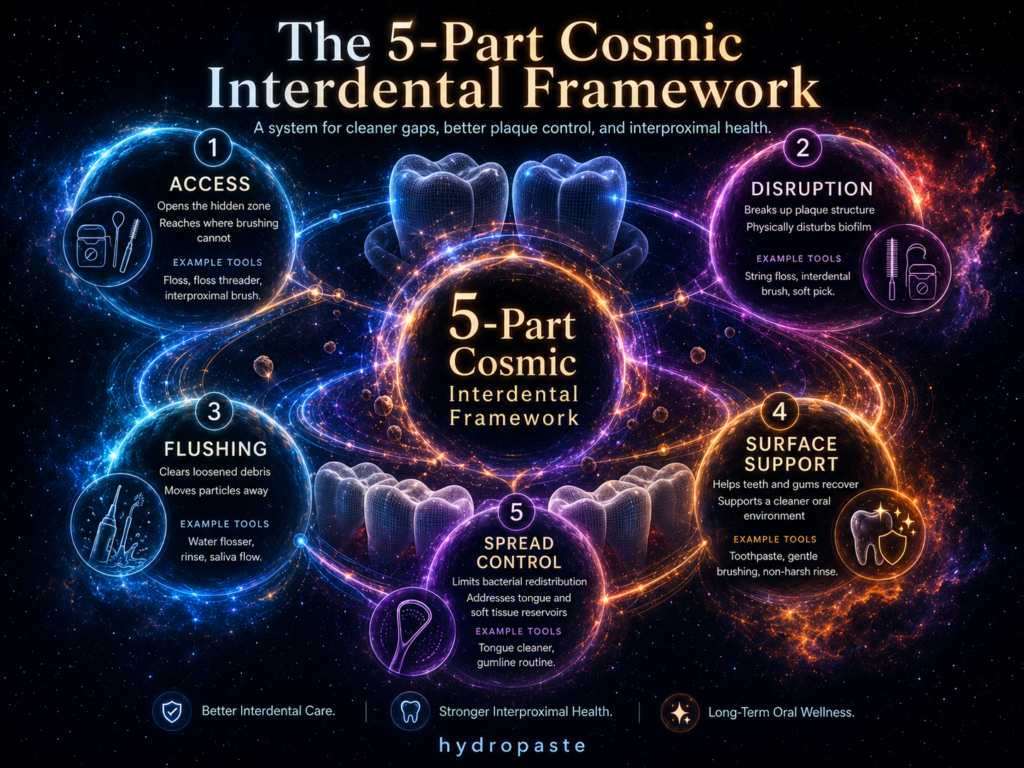
A strong interdental routine works like a cosmic system: every part has a role, and the order matters.
The 5-Part Cosmic Interdental Framework
| Stage | System Role | What It Does | Example Tools |
|---|---|---|---|
| 1. Access | Opens the hidden zone | Reaches where brushing cannot | Floss, floss threader, interproximal brush |
| 2. Disruption | Breaks up plaque structure | Physically disturbs biofilm | String floss, interdental brush, soft pick |
| 3. Flushing | Clears loosened debris | Moves particles away | Water flosser, rinse, saliva flow |
| 4. Surface Support | Helps teeth and gums recover | Supports a cleaner oral environment | Toothpaste, gentle brushing, non-harsh rinse |
| 5. Spread Control | Limits bacterial redistribution | Addresses tongue and soft tissue reservoirs | Tongue cleaner, gumline routine |
This framework is useful because it prevents a common mistake: choosing a tool without understanding its job.
A water flosser is excellent for flushing. A brush is better at side-wall contact. Floss is useful for tight contacts. A tongue cleaner supports breath and microbial spread dynamics. Toothpaste supports exposed tooth surfaces. None of these is “the whole system” by itself.
The goal is not to buy every tool. The goal is to build a routine where the right tool reaches the right space.
Floss vs Interdental Brush vs Water Flosser
The most common buying question is simple: should you use floss, an interdental brush, or a water flosser?
The answer depends on the space.
Best Tool by Interdental Situation
| Situation | Best Starting Tool | Why |
|---|---|---|
| Very tight contacts | String floss or thin tape floss | Slides through narrow contact points |
| Open triangles near gumline | Interdental brush | Better surface contact in wider spaces |
| Braces | Interdental brush + water flosser | Cleans around brackets and wires |
| Fixed retainer | Floss threader or interdental brush | Reaches under and around the wire |
| Bridge | Super floss, threader, water flosser | Cleans under connected dental work |
| Implants | Soft interdental brush or water flosser | Gentle cleaning around restoration margins |
| Sensitive gums | Soft pick or gentle floss | Reduces harsh contact |
| Travel routine | Floss picks or soft picks | Convenient and easy to carry |
| Bad breath focus | Interdental cleaning + tongue cleaner | Addresses debris and tongue coating |
| Low dexterity | Water flosser or floss holder | Easier handling |
Floss: Best for Tight Contact Points
Floss works well when teeth are close together. It can pass through the contact point and clean along the side surfaces if used correctly. The problem is that many people snap it down, cut the gum, or move it up and down without hugging the tooth.
Proper flossing uses a C-shape around each tooth, gentle pressure, and controlled movement beneath the gumline margin without trauma.
For readers comparing premium floss options, Hydropaste’s Boka Dental Floss review can help evaluate texture, usability, and routine fit.
Interdental Brush: Best for Open Spaces
An interdental brush is a small brush designed to clean between teeth. It is sometimes called an interproximal brush. It is excellent when the space is large enough for the brush to enter without force.
The brush should glide through with light resistance. If it bends, jams, causes pain, or feels like it is wedging teeth apart, it is too large or the wrong tool for that space.
Water Flosser: Best for Flushing and Appliances
A water flosser uses a stream of water to flush debris and support gumline cleaning. It can be especially useful for braces, bridges, implants, and people who struggle with string floss.
However, water alone may not always replace the mechanical contact of floss or a small brush in every space. Many people get the best results by combining water flossing with targeted mechanical cleaning.
Soft Picks: Best for Gentle Convenience
Soft picks are flexible, portable, and beginner-friendly. They are especially useful after meals, while traveling, or for people who dislike floss. They may not clean tight contacts as thoroughly as floss, but they can improve consistency.
How to Choose the Best Interdental Cleaning Tools
Choosing the best interdental cleaning tools is not about buying the most advanced device. It is about matching the tool to your mouth.
Hydropaste’s best teeth tools hub is designed for readers who want practical product guidance across floss, brushes, tongue cleaners, and between-teeth cleaning devices.
The Tool-Fit Decision Matrix
| Your Mouth Condition | Tool Priority | Avoid |
|---|---|---|
| Tight teeth | Waxed floss, tape floss, expanding floss | Forcing interdental brushes |
| Wide spaces | Interdental brush | Using only thin floss with poor surface contact |
| Bleeding gums | Gentle floss or soft brush with consistency | Aggressive scrubbing |
| Braces | Interdental brush, threader, water flosser | Skipping night cleaning |
| Implants | Soft, implant-safe tools | Metal wire trauma near implant tissue |
| Bad breath | Floss + tongue cleaner | Only masking odor with rinse |
| Limited dexterity | Water flosser, floss holder | Complex routines that are abandoned |
| Travel | Floss picks, soft picks, compact brush | Bulky tools only |
Product Features That Matter
When evaluating interdental products, look for:
- Appropriate size options
- Softness and comfort
- Grip control
- Durability
- Non-shredding floss texture
- Gentle wire coating on interdental brushes
- Travel hygiene
- Ease of replacement
- Compatibility with braces or restorations
- Clear instructions
- Realistic daily use
The best product is not always the most expensive. The best product is the one that cleans the correct space without causing damage and is easy enough to use repeatedly.
Interproximal Brush Guide
An interproximal brush is a small brush designed to clean between teeth, especially where gum recession, spacing, braces, or dental work create accessible gaps.
How an Interproximal Brush Works
The brush enters the interdental space and lightly contacts the side surfaces of the teeth. Its bristles disrupt plaque in a way that string floss may not achieve in wider spaces.
How to Choose the Right Size
The brush should:
- Enter the space without pain
- Feel snug but not forced
- Move through with gentle resistance
- Not bend sharply
- Not scrape the gum aggressively
- Not create pressure that feels like wedging
Many people need more than one size because the mouth is not uniform. Front teeth, molars, recession areas, and restored teeth may require different sizes.
How to Use an Interproximal Brush
- Stand in front of a mirror.
- Insert the brush gently between teeth near the gumline.
- Keep the angle natural; do not jam it downward.
- Move the brush in and out a few times.
- Rinse the brush as debris collects.
- Replace when bristles bend or wear out.
- Stop if a space feels painful or too tight.
Common Mistakes
| Mistake | Why It Causes Problems | Better Approach |
|---|---|---|
| Forcing a brush into tight teeth | Can injure gums or wedge teeth | Use floss instead |
| Using one size for every space | Mouth spaces vary | Use size-matched brushes |
| Scrubbing aggressively | Irritates tissue | Use light controlled movement |
| Reusing worn brushes too long | Poor cleaning and roughness | Replace regularly |
| Ignoring bleeding | May signal inflammation or trauma | Adjust technique and ask a dental professional |
Interdental Care and Plaque Removal
Plaque is not just “stuff on teeth.” It is a living, sticky film that forms repeatedly. The interproximal spaces are ideal collection points because they are protected from direct brushing and less visible during daily routines.
Why Plaque Between Teeth Is Hard to Remove
Plaque between teeth is difficult because:
- Toothbrush bristles cannot fully enter tight contacts.
- Saliva flow may not clear sheltered areas well.
- Food can wedge between teeth.
- Gum inflammation can create deeper pockets.
- Braces and retainers create additional plaque traps.
- People often rush night routines.
- Many users choose the wrong interdental tool.
The Plaque Maturity Problem
Fresh plaque is easier to disturb. Older plaque becomes more organized. If the space between teeth is skipped for several days, the biofilm becomes more established and harder to remove with casual cleaning.
This is why consistency beats intensity. A gentle nightly routine is usually more useful than aggressive flossing once a week.
The Night Plaque Removal Advantage
Night cleaning matters because the mouth becomes less active during sleep. Saliva flow changes, swallowing is reduced, and debris left between teeth can remain in place for hours.
A practical night routine should include:
- Interdental cleaning before brushing
- Gentle brushing with appropriate toothpaste
- Tongue cleaning if breath or coating is a concern
- A non-harsh rinse if suitable
- Avoiding sugary snacks after cleaning
Interproximal Reduction: What Buyers Should Know
Interproximal reduction is different from interdental cleaning. It is an orthodontic procedure, not a home-care routine.
Interproximal reduction, often shortened to IPR, means a dental professional removes a very small amount of enamel from between selected teeth to create space for orthodontic movement. People may search for it as “interpromixal reduction,” but the correct term is interproximal reduction.
Why Interproximal Reduction Is Mentioned in Interdental Care
Many clear aligner users hear about IPR during orthodontic treatment. After IPR, the shape and spacing between teeth may change slightly, and cleaning instructions may become more important.
What IPR Is For
IPR may be used to:
- Create small amounts of space for crowded teeth
- Improve tooth alignment
- Reduce black triangle risk in some cases
- Help clear aligners track better
- Refine tooth contact relationships
What IPR Is Not
IPR is not:
- A whitening method
- A plaque removal method
- A DIY procedure
- A substitute for flossing
- A home enamel-shaping technique
- A cosmetic shortcut to be attempted with tools at home
Interdental Care After IPR
After professional IPR, patients may need to be more attentive to:
- Food trapping
- Newly opened spaces
- Gentle flossing
- Interdental brush sizing
- Sensitivity changes
- Aligners or retainers
- Professional follow-up
If a gap feels new, rough, sensitive, or hard to clean after orthodontic work, a dentist or orthodontist should guide the tool selection.
Daily Interdental Care Routine
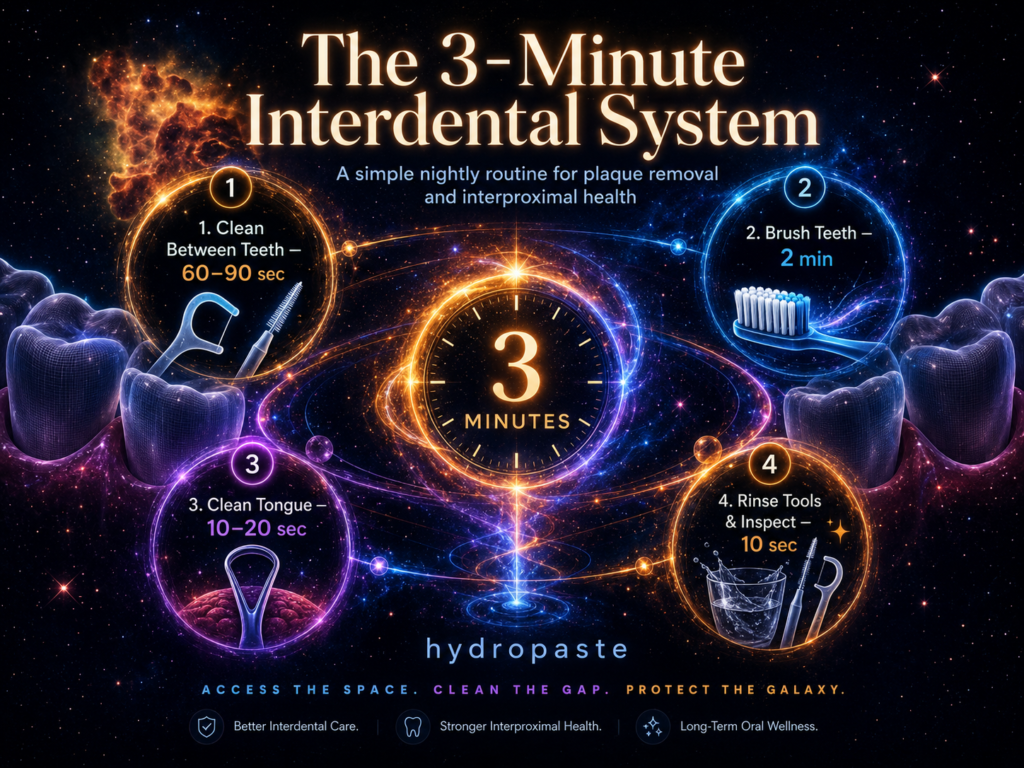
A good interdental routine should be effective, repeatable, and gentle. It should not feel like a punishment.
The 3-Minute Interdental System
| Step | Action | Time |
|---|---|---|
| 1 | Clean between teeth with floss, brush, or soft pick | 60–90 seconds |
| 2 | Brush teeth carefully | 2 minutes |
| 3 | Clean tongue if needed | 10–20 seconds |
| 4 | Rinse tool and inspect problem areas | 10 seconds |
This is not complicated, but order matters. Interdental cleaning before brushing can help remove debris so brushing can spread toothpaste more effectively across tooth surfaces.
Morning Routine
Morning interdental cleaning is useful for people with food trapping, morning breath, braces, or gum sensitivity. However, for most people, the highest-value routine is at night.
Night Routine
Night is the non-negotiable window. If you only clean between teeth once daily, make it the evening routine before sleep.
After-Meal Mini Routine
For people with open spaces or food trapping, a soft pick or water rinse after meals can improve comfort. This does not replace the night routine, but it helps prevent debris from sitting between teeth for hours.
Weekly Review
Once per week, check:
- Which spaces bleed
- Which spaces trap food
- Which tool feels too tight
- Which brush size is wearing out
- Whether breath improves after tongue cleaning
- Whether your routine is realistic
This review helps turn interdental care from a vague habit into a managed system.
Advanced Interdental Health Strategy
Advanced interdental care is about customizing the routine to your risk profile.
Gum Disease Between Teeth
Gum disease often shows up between teeth because plaque collects where brushing is weakest. Warning signs include bleeding, tenderness, swelling, persistent bad breath, and gum recession.
A strong between-teeth routine should focus on gentle mechanical disruption, not harsh chemicals or aggressive scraping.
Braces and Orthodontics
Braces create multiple micro-zones where plaque can accumulate:
- Around brackets
- Under wires
- Between teeth
- Near the gumline
- Around molar bands
- Near elastics or hooks
A braces routine may require an interdental brush, orthodontic floss, a water flosser, and more time at night.
Bad Breath Control
Bad breath control needs a multi-surface approach:
- Clean between teeth.
- Brush the gumline.
- Clean the tongue gently.
- Hydrate well.
- Avoid masking odor with harsh rinse alone.
- Address persistent odor with a dental professional.
Bad breath that remains despite good oral hygiene may involve periodontal pockets, dry mouth, tonsil stones, diet, medication, reflux, or other factors.
Full-Mouth Biofilm Control
Full-mouth biofilm control means thinking beyond teeth. It includes:
- Tooth surfaces
- Interproximal spaces
- Gumline margins
- Tongue surface
- Cheeks and soft tissue
- Saliva quality
- Oral pH
- Product compatibility
Hydropaste’s soft-tissue integration resource is useful for readers who want to understand how gums, tongue, cheeks, and oral surfaces fit into a complete care strategy.
Upcoming Trends and Latest Tech
Interdental care is becoming more personalized, more ergonomic, and more connected to whole-mouth health. The next phase is not just “better floss.” It is smarter access.
1. Size-Matched Interdental Brush Systems
More brands are moving toward multi-size brush kits that help users match brush diameter to the actual space between teeth. This matters because one-size interdental tools can be too loose in one area and too aggressive in another.
2. Water Flossers With Smarter Pressure Control
Pressure customization is becoming more important. High pressure is not always better, especially for sensitive gums, implants, and recession areas. Better devices are focusing on pulse patterns, gum comfort, and controlled delivery.
3. Hybrid Brush-Floss Devices
Combination devices that merge brushing and water flossing are becoming more attractive for users who want fewer steps. The key question is whether convenience improves consistency without reducing cleaning quality.
4. Travel Interdental Systems
Travel-size soft picks, compact floss, collapsible water flossers, and hygienic carrying cases are growing because many routines fail outside the bathroom. Portability supports compliance.
5. Orthodontic and Aligner-Specific Tools
Clear aligner users are a major audience for interdental care. Expect more products designed for aligner hygiene, attachment cleaning, and between-teeth cleaning before trays are reinserted.
6. Tongue and Interdental Pairing
Breath-focused oral care is shifting from mouthwash-only thinking toward tongue-plus-interdental systems. A cleaner tongue can reduce odor load, while interdental cleaning removes trapped debris.
7. Biofilm-Aware Oral Care
The future of oral hygiene will likely focus less on “killing everything” and more on managing biofilm behavior, surface ecology, pH, saliva, and tissue compatibility.
For readers comparing broader product categories across oral-care performance, Hydropaste’s best ever center can help connect interdental care with top-level buying decisions.
Product and Tool Buying Framework
Before buying interdental products, use the A.C.C.E.S.S. framework
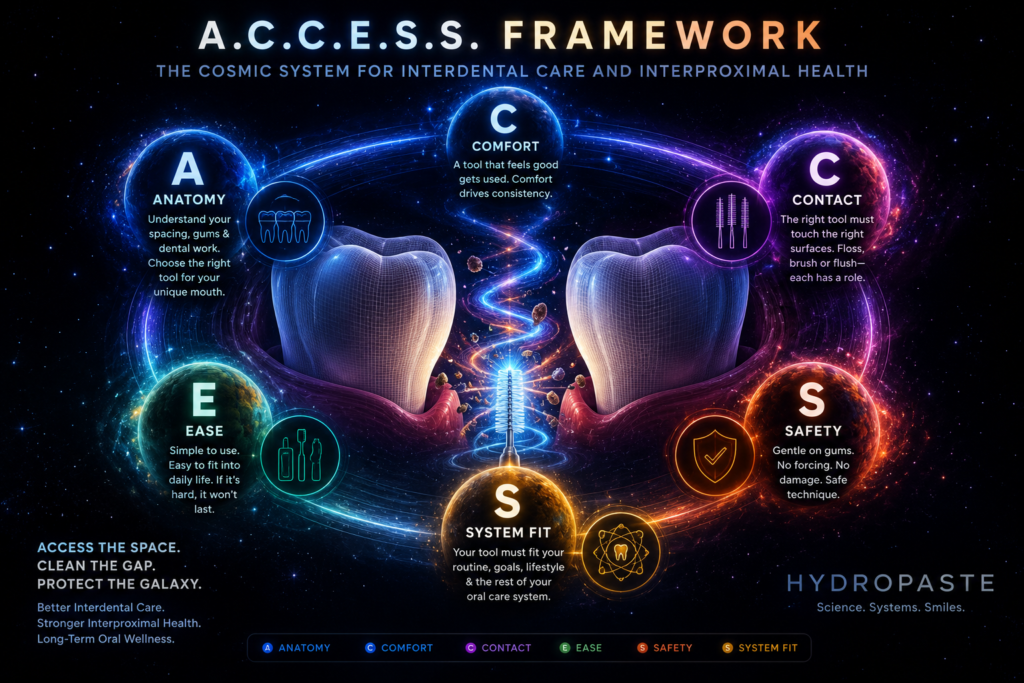
A — Anatomy
Look at your spacing. Tight teeth, open gaps, recession, braces, implants, crowns, and bridges all require different tools.
C — Comfort
A tool that causes pain will not become a habit. Comfort is not a luxury. It is part of long-term compliance.
C — Contact
The tool must contact the surface you are trying to clean. A water flosser flushes. Floss hugs tight contacts. An interdental brush scrubs wider side walls.
E — Ease
If a product is too complicated, it will sit in a drawer. Ease of use determines whether the routine survives real life.
S — Safety
Do not force tools, saw into gums, scrape aggressively, or use sharp objects between teeth. Interdental care should be controlled and gentle.
S — System Fit
The tool must fit your full routine: toothpaste, brushing, tongue cleaning, travel, night schedule, orthodontics, and professional dental advice.
Buyer Checklist
| Buying Question | Best Direction |
|---|---|
| Do my teeth feel very tight? | Start with floss, not a brush |
| Do I have open gum triangles? | Try a size-matched interdental brush |
| Do my gums bleed? | Use gentle technique and stay consistent |
| Do I wear braces? | Use brush + threader + water flosser |
| Do I have bad breath? | Add tongue cleaning to interdental care |
| Do I travel often? | Keep soft picks or floss picks available |
| Do I have implants or bridges? | Ask for restoration-safe tool guidance |
| Do I quit routines quickly? | Choose the simplest effective tool |
Common Interdental Care Mistakes
Mistake 1: Treating Floss as the Only Option
Floss is useful, but not always the best tool for every mouth. Wider spaces may respond better to an interdental brush.
Mistake 2: Forcing Interdental Brushes
If the brush does not fit, do not push harder. Choose a smaller size or use floss.
Mistake 3: Cleaning Only When Food Is Stuck
Interdental care is not just for removing visible food. It is for disrupting plaque before problems become obvious.
Mistake 4: Using Mouthwash as a Substitute
Mouthwash can freshen the mouth, but it does not physically remove plaque between teeth the way floss, brushes, or picks can.
Mistake 5: Ignoring the Tongue
The tongue can hold coating and odor-producing bacteria. Breath routines work better when tongue cleaning is included.
Mistake 6: Giving Up When Gums Bleed
Bleeding can happen when gums are inflamed or when technique is too aggressive. The answer is not to ignore the area forever. Use gentle technique and seek dental advice if bleeding persists.
Mistake 7: Buying Tools Without a Map
A good interdental system begins by identifying tight spaces, open spaces, restoration areas, and problem zones. Buy according to anatomy, not marketing.
Best Interdental Routine by User Type
| User Type | Recommended System | Priority |
|---|---|---|
| Beginner | Waxed floss or floss picks + night brushing | Build consistency |
| Gum recession | Interdental brushes + gentle brushing | Clean open spaces |
| Braces | Interdental brush + water flosser + threader | Clean around hardware |
| Clear aligners | Floss before tray reinsertion | Avoid trapped debris |
| Bad breath | Interdental cleaning + tongue cleaner | Reduce odor sources |
| Busy professional | Night floss + travel soft picks | Keep routine realistic |
| Older adult | Water flosser or floss holder | Improve access |
| Implant patient | Soft tools + professional guidance | Protect tissue |
| Whitening-focused user | Interdental cleaning + polishing-aware routine | Reduce stain traps |
| Sensitive gums | Soft picks or gentle floss | Avoid trauma |
Interdental Care for Buyers: What to Look For Before Spending Money
Commercial oral care is crowded. Buyers see floss with charcoal, floss with expanding fibers, flavored floss, water flossers, sonic flossers, rubber picks, bamboo picks, travel brushes, copper tongue cleaners, stainless tongue cleaners, and subscription refill systems.
The smartest buyer does not start with the brand. The smartest buyer starts with the problem.
Problem: Food Gets Stuck Between Molars
Choose a soft pick, interdental brush, or floss depending on space size. If food trapping is new or worsening, a dental evaluation may be needed.
Problem: Gums Bleed When Flossing
Use gentle technique. Do not snap floss. Consider whether the space needs floss, a smaller brush, or professional cleaning.
Problem: Bad Breath Returns Quickly
Add tongue cleaning and interdental cleaning. Mouthwash alone may mask the issue.
Problem: Braces Are Hard to Clean
Use an orthodontic cleaning kit: interdental brush, floss threader, water flosser, and careful night brushing.
Problem: Floss Shreds
Try waxed floss, tape floss, or expanding floss. Shredding may also suggest rough dental edges or tight contacts.
Problem: Water Flosser Feels Messy
Use it in the shower, start on a lower pressure, lean over the sink, and close lips slightly around the tip while letting water drain.
Interdental Care and the Rest of the Oral-Care System
Interdental care works best when it connects with the rest of the routine.
Toothpaste
Toothpaste supports tooth surfaces after debris and plaque are disturbed. Interdental cleaning before brushing can make the brushing stage feel more complete.
Toothbrush
Use a soft brush and controlled technique. Brushing too hard can damage gums and enamel margins.
Mouth Rinse
Rinse can support breath and comfort, but it should not replace mechanical cleaning.
Oral Microbiome Balance
Interdental care should not be viewed as an isolated cleaning step. The spaces between teeth are part of a larger oral ecosystem where plaque behavior, saliva quality, gum response, tongue coating, pH, and product choice all interact. A routine that aggressively attacks every surface may feel powerful at first, but long-term oral wellness depends on maintaining a cleaner, more balanced microbial environment rather than simply chasing a stripped-clean feeling. For a deeper look at how bacteria, biofilm, saliva, and product choices influence whole-mouth health, read Hydropaste’s guide to oral microbiome balance.
Tongue Cleaner
A tongue cleaner is important for breath-focused routines. The tongue can act like a reservoir for coating and odor.
Diet and Hydration
Sticky snacks, frequent sugar exposure, dry mouth, and low hydration can all affect plaque behavior.
Dental Visits
Professional cleaning and exams help identify calculus, gum pockets, cavities, failing restorations, and areas that need special home-care tools.
Editorial Insight: The Future of Interproximal Health Is Personal
Interdental care has been oversimplified for decades. The usual message was “just floss.” That message is too narrow for modern buyers.
A person with tight teeth may need floss. A person with gum recession may need interdental brushes. A person with braces may need three tools. A person with bad breath may need tongue cleaning as much as flossing. A person with implants may need gentle, restoration-safe cleaning. A clear aligner user may need a routine built around tray reinsertion.
The future of interdental care is not one universal product. It is tool matching, routine design, biofilm awareness, and long-term consistency.
Interproximal health is where preventive oral care becomes serious. It asks a simple question: are you only cleaning what you can see, or are you cleaning the spaces where problems quietly begin?
For more oral-care systems, product guidance, and whole-mouth hygiene education, return to the Hydropaste homepage.
FAQs
What is the best interdental care routine for plaque removal between teeth?
The best interdental care routine for plaque removal between teeth is one that matches the tool to the space. Tight contacts usually need floss, while wider spaces may need an interdental brush. Braces, bridges, implants, and fixed retainers often require additional tools such as floss threaders or water flossers.
A strong routine starts at night. Clean between teeth first, then brush carefully with a soft toothbrush and suitable toothpaste. If breath is a concern, add gentle tongue cleaning. The goal is not to perform a dramatic routine once in a while. The goal is to disrupt plaque daily before it becomes more established.
Is an interproximal brush better than floss for gum health?
An interproximal brush can be better than floss when the spaces between teeth are wide enough for the brush to fit safely. It can contact the side surfaces of teeth more effectively in open spaces, especially where gum recession or orthodontic appliances create larger gaps.
Floss is still useful for tight contacts where a brush cannot safely enter. The wrong brush size can injure tissue or feel uncomfortable. The best approach is often mixed: floss for tight spaces, interdental brushes for open spaces, and a water flosser for flushing around appliances or hard-to-reach areas.
How to remove plaque from teeth if floss does not work for me?
If floss does not work for you, first identify why. If floss shreds, you may need waxed floss, tape floss, or a dental check for rough edges. If your fingers struggle with the technique, a floss holder or water flosser may help. If your spaces are wider, an interdental brush or soft pick may clean better than thin floss.
Plaque removal between teeth requires physical disruption. Mouthwash alone is not enough. Choose a tool you can use consistently, and focus on gentle technique rather than force.
Can interdental care help with bad breath between teeth?
Yes, interdental care can help with bad breath when odor is linked to trapped food, plaque, or bacterial buildup between teeth. Cleaning those areas removes material that can contribute to unpleasant smell.
For better results, combine interdental cleaning with tongue cleaning. The tongue can hold coating and odor-producing bacteria, while spaces between teeth can trap debris. A breath routine that ignores either zone may feel incomplete.
What are the best interdental cleaning tools for braces and aligners?
For braces, the best interdental cleaning tools often include an interdental brush, floss threader, orthodontic floss, and water flosser. Brackets and wires create many plaque traps, so a single tool may not be enough.
For clear aligners, flossing before reinserting trays is especially important. Food and plaque trapped under aligners can create a stagnant environment. Aligner users should clean between teeth after meals whenever possible and maintain a careful night routine.
People Also Ask
How often should you clean between your teeth for interproximal health?
Most people should clean between teeth once per day, ideally at night. Night cleaning is valuable because debris and plaque left between teeth can remain undisturbed during sleep. If you have braces, food trapping, gum disease risk, or aligners, you may need additional quick cleaning after meals.
The key is consistency. Gentle daily cleaning is usually more effective than aggressive occasional cleaning.
Should I floss before or after brushing?
Many routines work, but flossing or interdental cleaning before brushing is often practical because it loosens debris before toothpaste is spread across the teeth. This order can make the mouth feel cleaner and helps brushing reach surfaces that were partly blocked by food particles.
If you already floss after brushing and do it consistently, that is still better than skipping interdental cleaning entirely. The best order is the one you can maintain, but interdental cleaning before brushing is a strong default.
Why do my gums bleed when I use floss or an interdental brush?
Gums may bleed because plaque has irritated the tissue, because the technique is too aggressive, or because the tool is the wrong size. Bleeding does not always mean you should stop cleaning between teeth, but it does mean you should be gentle and observant.
Do not snap floss into the gums or force brushes into tight spaces. If bleeding continues despite careful technique, a dental professional should evaluate the area.
Are water flossers enough for plaque removal between teeth?
Water flossers are useful for flushing debris and supporting gumline cleaning, especially around braces, bridges, implants, and areas that are hard to reach. However, they may not always replace the mechanical contact of floss or interdental brushes in every space.
For many users, the best routine combines a water flosser with targeted mechanical cleaning. Think of water flossing as flushing the system, while floss or brushes physically disrupt plaque where contact is needed.
What is the difference between interdental care and interproximal reduction?
Interdental care is daily cleaning between teeth using tools like floss, interdental brushes, soft picks, and water flossers. Interproximal reduction is a dental or orthodontic procedure where a professional removes a tiny amount of enamel between selected teeth to create space for tooth movement.
They are not the same. Interdental care is home hygiene. Interproximal reduction is clinical treatment. If you have had IPR during aligner or braces treatment, ask your dental professional which cleaning tools are safest for the newly adjusted spaces.