
Calcium Phosphate Systems: How Mineral Delivery Supports Enamel Remineralization
Amazon Affiliate Disclosure
Hydropaste.com may earn a commission from qualifying purchases made through affiliate links, including Amazon links. This does not change the price you pay. Editorial recommendations are based on enamel science, ingredient behavior, product category fit, and practical oral care needs rather than commission value.
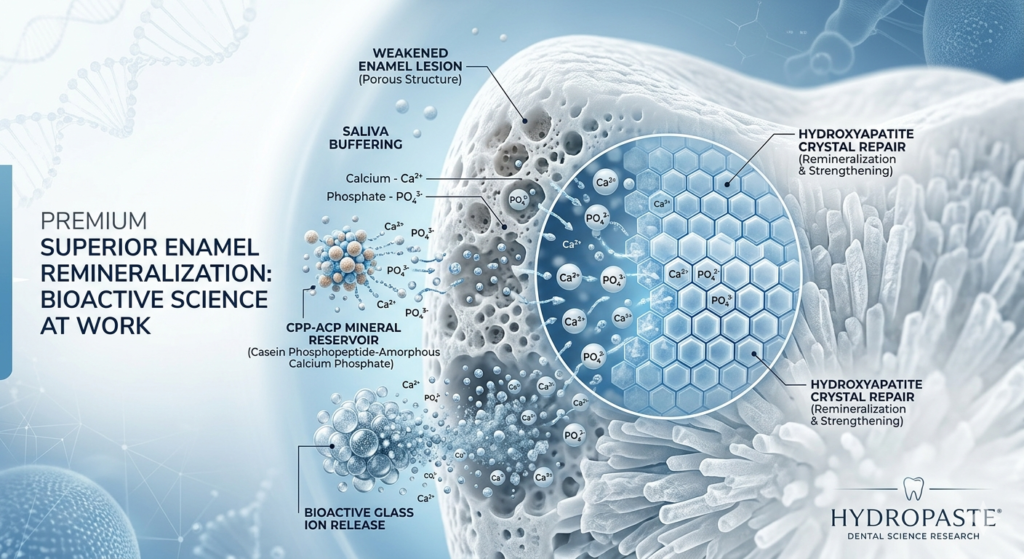
Calcium phosphate systems sit at the mineral-supply center of enamel remineralization science. Fluoride gets much of the attention because it helps enamel resist acid. Hydroxyapatite gets attention because it resembles tooth mineral. But beneath both conversations is a more basic question: where do the calcium and phosphate minerals come from when enamel begins to repair?
Tooth enamel is mainly built from calcium phosphate mineral crystals. When plaque acids, acidic drinks, dry mouth, frequent snacking, or poor plaque control pull minerals out of enamel, the tooth needs calcium and phosphate back in the right place, at the right time, under the right pH conditions. Calcium phosphate systems are designed to support that environment.
This system page belongs under the enamel remineralization science hub. It explains how calcium phosphate enamel remineralization works, how CPP-ACP toothpaste differs from amorphous calcium phosphate and functionalized tricalcium phosphate, where bioactive glass toothpaste fits, how these technologies compare with fluoride and hydroxyapatite and when they may matter most for white spots, sensitivity, early enamel weakness and acid-related mineral loss.
The Enamel Remineralization Center connects enamel repair science with practical toothpaste guidance for sensitivity, white spots, acid wear and daily mineral protection.
Recent reviews describe CPP-ACP as a calcium-phosphate reservoir on enamel that can release mineral ions into subsurface lesions, while bioactive glass research continues to focus on mineral release, dentinal tubule occlusion, and enamel/dentin repair applications. (PMC)
Quick Jump
| Reader Goal | Best Section | What You’ll Learn |
| Understand who benefits from mineral therapies | Who Needs Calcium Phosphate Systems? | High-risk profiles, including orthodontic patients, dry mouth sufferers, and those with white spots or sensitivity. |
| Review the pros of calcium phosphate | Benefits of Calcium Phosphate Systems | The six distinct advantages of mineral delivery, from fluoride compatibility to professional flexibility. |
| Understand calcium phosphate enamel repair | The Core Science: Why Calcium and Phosphate Matter | How the tooth’s structure interacts with saliva—the original mineral delivery system. |
| Learn how minerals penetrate tooth layers | How Calcium Phosphate Systems Work | Local availability, supersaturation mechanics, and subsurface lesion penetration. |
| Compare CPP-ACP, ACP, TCP, and bioactive glass | Types of Calcium Phosphate Systems | The distinct science behind ion-release platforms vs. preformed biomimetic particles. |
| Understand the clinical profile of milk derivatives | CPP-ACP Toothpaste and Dental Mousse | How the stabilized casein complex creates a bioavailable mineral reservoir, plus ideal use cases. |
| Evaluate glass ceramic alternatives | Bioactive Glass Toothpaste | Ion release mechanics, tubule occlusion for sensitivity, and comparisons with CPP-ACP. |
| Compare with fluoride | Calcium Phosphate vs Fluoride | Co-dependent roles: mineral building blocks vs. acid-resistant mineral fortification. |
| Compare with hydroxyapatite | Calcium Phosphate vs Hydroxyapatite | Soluble ionic delivery systems contrasted against structural, biomimetic mineral particles. |
| Find support for white spots | Calcium Phosphate for White Spot Lesions | Realities of subsurface mineral recovery, lesson depth, and establishing realistic aesthetic expectations. |
| Identify delivery formats | Where Calcium Phosphate Systems Appear | Product mediums including toothpastes, concentrated creams, lozenges, and professional varnishes. |
| Evaluate structural attributes before purchasing | What to Look for in a Calcium Phosphate Product | Key indicators like system identification, fluoride status, abrasion ratings, and safety tags. |
| Plan cost and buying strategy | What Calcium Phosphate Products Usually Cost | Cost tiers (low to premium) and financial strategies based on specific cavity or sensitivity risks. |
| Understand safety and limits | Risks and Limitations | Critical boundaries, including the inability to heal open cavities, milk allergies, and dietary limits. |
| Discover emerging dental therapies | Trends & Latest Tech in Calcium Phosphate Systems | Hybrid ion configurations, localized gels, and non-toothpaste application form factors. |
| Preview future oral care technologies | Upcoming Models in Calcium Phosphate Oral Care | Saliva-responsive mineral release, smart oral care pairings, and personalized peptide repair blends. |
| Access summary matrices and data lists | Charts & Tables | Cross-referenced decision matrices, three-way comparisons, and product checklist criteria. |
| Choose an active system for your specific issue | Which Calcium Phosphate System Should You Choose? | Direct protocols matching individual conditions to CPP-ACP, CPP-ACPF, Bioactive Glass, fTCP, or HA. |
| Integrate mineral therapy into your day | Practical Calcium Phosphate Routine | Tailored morning, night, post-acid, and specialized white-spot care applications. |
| Get a high-level summary of the mineral economy | Editorial Insights | Why matching individual patient needs to the right clinical system matters more than finding a single “best” compound. |
| Find quick answers to common questions | FAQs | Direct explanations of mineral definitions and practical applications. |
What This Guide Is For
This guide is for readers who want to understand how calcium phosphate systems support enamel remineralization. Many oral care products mention “calcium,” “phosphate,” “mineral repair,” “enamel strengthening,” “bioactive minerals,” or “tooth remineralization.” These claims can sound similar, but the systems behind them are not identical.
This page explains:
How calcium and phosphate help enamel recover from early mineral loss
Why saliva is the original mineral delivery system
What amorphous calcium phosphate means
How CPP-ACP toothpaste and creams work
What functionalized tricalcium phosphate does
Where bioactive glass toothpaste fits
How calcium phosphate compares with fluoride and hydroxyapatite
Who should be cautious with milk-derived CPP-ACP products
How to choose calcium phosphate oral care products without falling for vague “enamel repair” claims
For the traditional acid-resistance route, see fluoride remineralization science.
Who Needs Calcium Phosphate Systems?
People With Early Enamel Mineral Loss
Early enamel damage often begins as subsurface mineral loss before the tooth surface collapses. Calcium phosphate systems may help supply mineral ions near weakened enamel, especially when the lesion is still non-cavitated.
People With White Spot Lesions
White spot lesions after braces, plaque accumulation, frequent snacking, or acidic habits are one of the most common reasons people search for remineralization products. CPP-ACP, CPP-ACPF, fluoride, hydroxyapatite, and bioactive glass are frequently compared in this category. A 2024 systematic review reported remineralizing impact for CPP-ACP/CPP-ACPF in early enamel caries, while also noting mixed evidence when compared with fluoride forms. (PubMed)
People With Dry Mouth
Saliva naturally supplies calcium and phosphate. When saliva is reduced, enamel loses one of its main mineral-defense systems. Calcium phosphate systems may be useful as part of a broader dry-mouth strategy, although dry mouth often needs hydration, medication review, saliva substitutes, dentist guidance, and cavity-risk management.
Orthodontic Patients
Braces and aligners create plaque-retentive areas. Calcium phosphate products may help support mineral balance around brackets or attachment zones, especially when paired with fluoride, hydroxyapatite, or dentist-guided care.
People With Sensitivity
Some calcium phosphate and bioactive glass systems may help sensitivity by forming mineral deposits that block exposed dentinal tubules. Bioactive glass desensitizing products have been studied for dentin hypersensitivity in both home and professional applications. (PMC)
If gumline sensitivity is a part of the concern, stannous fluoride effects is the next science layer to read.
People Comparing Fluoride-Free Remineralizing Products
Some calcium phosphate systems are fluoride-free, while others include fluoride. This makes the category important for readers comparing fluoride-free toothpaste, hydroxyapatite toothpaste, CPP-ACP creams, and bioactive glass toothpaste.
Benefits of Calcium Phosphate Systems
1. Mineral Supply for Enamel Repair
Enamel remineralization requires calcium and phosphate. Calcium phosphate systems are designed to place those minerals close to weakened enamel, where they may support mineral redeposition.
2. Support for Early Lesions
When a white spot or early enamel lesion has not cavitated, mineral delivery may help reinforce the subsurface lesion. This is where calcium phosphate systems are most relevant.
3. Compatibility With Fluoride
Fluoride works best when calcium and phosphate are available. Some calcium phosphate systems are combined with fluoride to support both mineral supply and acid-resistant remineralization.
4. Sensitivity Support
Certain calcium phosphate systems, especially bioactive glass and hydroxyapatite-adjacent formulations, may help reduce sensitivity by depositing mineral material over open dentinal tubules.
5. Fluoride-Free Options
Some calcium phosphate systems provide a mineral-based route for users who want fluoride-free enamel support, though high-cavity-risk users may still need fluoride-based prevention.
6. Professional and At-Home Flexibility
Calcium phosphate systems appear in toothpaste, creams, gels, dental mousse products, varnishes, polishing pastes, and desensitizing products. That makes the category flexible for different risk levels.
The Core Science: Why Calcium and Phosphate Matter
Enamel Is a Calcium Phosphate Structure
Tooth enamel is mostly mineral. Its main crystal family is hydroxyapatite, a calcium phosphate mineral. When enamel loses minerals, it is mainly losing calcium and phosphate from the crystal structure.
That mineral loss creates porosity. The enamel may look chalky, matte, white, rough, or sensitive. If the surface remains intact, remineralization may still be possible.
Saliva Is the Original Calcium Phosphate System
Before toothpaste enters the story, saliva is the mouth’s natural remineralization fluid. It helps:
Buffer acids
Supply calcium
Supply phosphate
Wash away food debris
Maintain oral pH
Support enamel mineral balance
Reduce the time enamel spends in a demineralizing state
Calcium phosphate products try to enhance or imitate part of this natural mineral-support function.
Why Mineral Delivery Is Difficult
Calcium and phosphate are reactive. If they simply meet too early in a toothpaste tube, they can form insoluble particles before reaching enamel. The challenge is not just adding calcium and phosphate. The challenge is delivering them in a usable form at the tooth surface.
That is why different technologies exist: CPP-ACP stabilizes amorphous calcium phosphate, TCP systems try to keep calcium compatible until use, bioactive glass releases ions under oral conditions, and hydroxyapatite provides preformed tooth-like mineral particles.
How Calcium Phosphate Systems Work
1. They Increase Local Mineral Availability
The primary goal is to increase calcium and phosphate near enamel during the repair window after acid exposure.
2. They Support Supersaturation Around Enamel
For remineralization to occur, the fluid around enamel should favor mineral deposition rather than mineral loss. Calcium phosphate systems help push the local environment toward mineral saturation.
3. They Can Penetrate or Support Subsurface Lesions
Early white spot lesions often have subsurface mineral loss. Some systems aim to deliver ions into porous enamel so minerals can redeposit beneath the surface.
4. They May Work Better With Fluoride
Fluoride helps guide minerals into more acid-resistant forms. Calcium phosphate supplies mineral building blocks. Together, they may be stronger than either system alone in some situations.
5. Some Systems Occlude Tubules
Bioactive glass and hydroxyapatite-like systems can deposit mineral material that blocks dentinal tubules, which may reduce sensitivity.
Calcium Phosphate Remineralization Pathway
| Stage | What Happens | Calcium Phosphate Role |
|---|---|---|
| Acid exposure | Plaque acids dissolve enamel minerals | Calcium/phosphate loss begins |
| Early lesion | Enamel becomes porous but not cavitated | Mineral delivery may still help |
| Saliva recovery | pH rises and minerals become available | Natural calcium/phosphate return |
| Product application | Toothpaste, cream, gel, or mousse contacts enamel | Extra mineral supply near lesion |
| Ion release | Calcium and phosphate become available | Supports mineral redeposition |
| Surface/subsurface repair | Minerals return to weakened zones | Enamel becomes less porous |
| Long-term maintenance | Daily habits determine balance | Mineral support must be consistent |
Types of Calcium Phosphate Systems
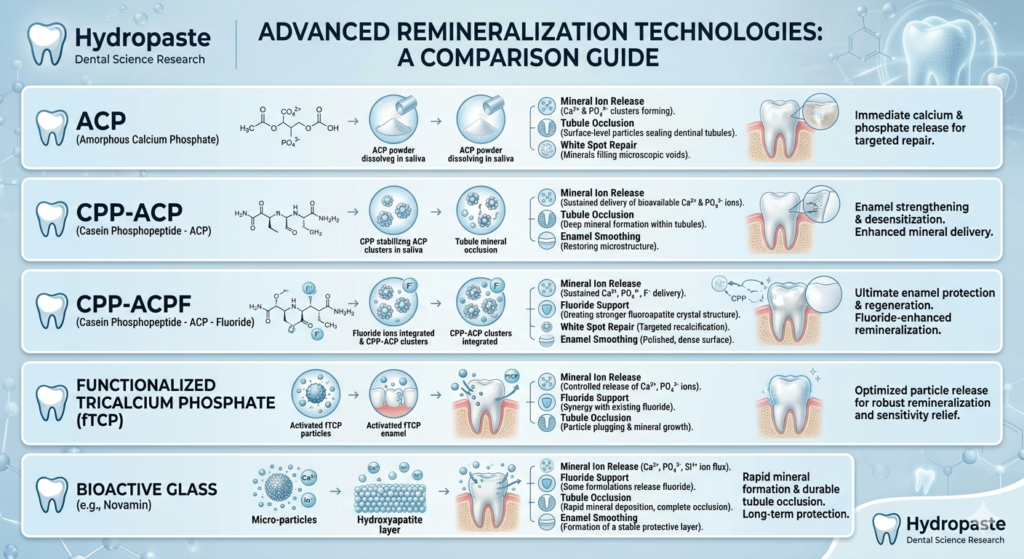
Amorphous Calcium Phosphate Teeth Systems
Amorphous calcium phosphate, often shortened to ACP, is a less-crystalline calcium phosphate phase. Its value comes from its ability to act as a source of calcium and phosphate ions.
ACP is considered attractive because it can release minerals that may support enamel remineralization. The challenge is keeping ACP stable and delivering it effectively before it transforms into less useful mineral forms.
CPP-ACP Toothpaste and Creams
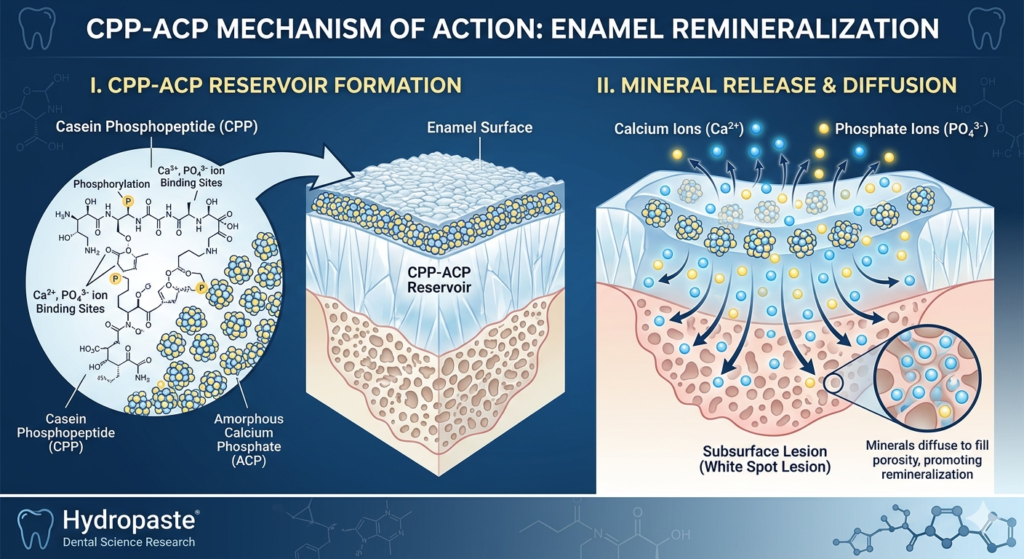
CPP-ACP stands for casein phosphopeptide-amorphous calcium phosphate. Casein phosphopeptides are derived from milk protein. They help stabilize calcium and phosphate in an amorphous form and hold them near the tooth surface.
CPP-ACP is often used in creams, pastes, and mousse-style products for early enamel lesions, white spots, and mineral support. A 2025 review describes ACP as a bioceramic material that can promote remineralization of dental hard tissues and discusses CPP-ACP’s role in white spot lesion management. (MDPI)
Important Safety Note
CPP-ACP is milk-protein based. People with milk protein allergy should avoid it unless a qualified clinician advises otherwise. Lactose intolerance is different from milk protein allergy, but allergy warnings should be taken seriously.
CPP-ACPF
CPP-ACPF adds fluoride to CPP-ACP. This combination aims to supply calcium and phosphate while also adding fluoride’s acid-resistance and remineralization advantages.
This may be relevant for higher-risk early enamel lesions, orthodontic white spots, and users who need mineral support but are not avoiding fluoride.
Functionalized Tricalcium Phosphate
Functionalized tricalcium phosphate, often associated with fTCP, is designed to deliver calcium while maintaining compatibility with fluoride in a toothpaste formula. The purpose is to prevent calcium from reacting too early with fluoride before brushing.
This system is often positioned as a way to combine mineral supply with fluoride-based enamel protection.
Bioactive Glass Toothpaste
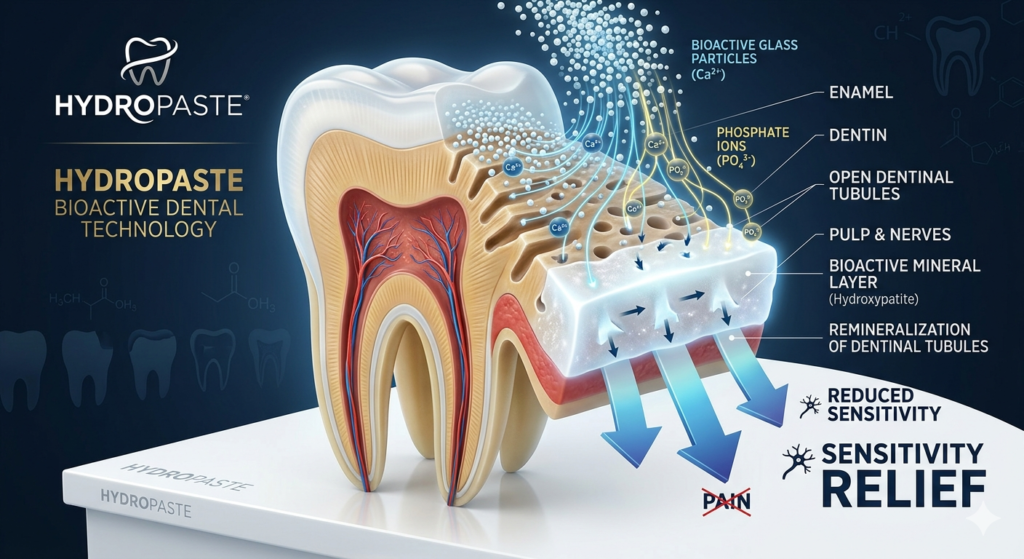
Bioactive glass releases calcium, phosphate, and sometimes sodium or other ions under oral conditions. It may form hydroxycarbonate apatite-like deposits on tooth surfaces and inside dentinal tubules.
Bioactive glass toothpaste is often marketed for sensitivity and enamel mineral support. A 2024 clinical trial reported that both an experimental bioactive glass toothpaste and NovaMin toothpaste showed more significant dentin hypersensitivity reduction than a negative control, with no toothpaste-related adverse reactions observed. (ScienceDirect)
Hydroxyapatite as a Calcium Phosphate System
Hydroxyapatite is technically a calcium phosphate mineral, but in oral care it deserves its own category because it is a preformed tooth-like mineral particle rather than only an ion-delivery system.
Major Calcium Phosphate Systems
| System | How It Works | Best For | Strengths | Limitations |
|---|---|---|---|---|
| ACP | Releases calcium/phosphate ions | Early mineral support | Direct mineral supply | Stability and delivery can be challenging |
| CPP-ACP | Stabilizes ACP with milk-derived peptides | White spots, early lesions | Holds minerals near enamel | Not for milk protein allergy |
| CPP-ACPF | CPP-ACP plus fluoride | Higher-risk early lesions | Mineral supply + fluoride support | Not fluoride-free |
| fTCP | Functionalized calcium delivery, often with fluoride | Fluoride toothpaste enhancement | Designed for formula compatibility | Product-specific performance varies |
| Bioactive glass | Releases ions and forms mineral deposits | Sensitivity, enamel/dentin support | Tubule occlusion and mineral release | More common in specialty formulas |
| Hydroxyapatite | Tooth-like mineral particle deposition | Fluoride-free repair, sensitivity | Biomimetic surface support | Depends on particle quality and formula |
CPP-ACP Toothpaste and Dental Mousse
CPP-ACP is one of the best-known calcium phosphate systems because it is designed to keep calcium and phosphate available near enamel.
How CPP-ACP Works
CPP binds and stabilizes ACP, helping prevent calcium and phosphate from crystallizing too early. When applied to the tooth surface, it can create a reservoir of bioavailable calcium and phosphate.
This reservoir may release ions when enamel needs them, especially under acidic conditions. That is why CPP-ACP is often discussed for white spots and early enamel lesions.
Best Use Cases
CPP-ACP may be relevant for:
White spot lesions
Post-orthodontic enamel support
Early non-cavitated caries
Mild enamel roughness
Mineral support after acid exposure
Some sensitivity cases
Professional remineralization routines
Where CPP-ACP Is Not Ideal
Avoid or use caution if:
The user has milk protein allergy
There is an open cavity
Pain is severe or localized
The product is being used instead of dental care
The user expects instant cosmetic disappearance of white spots
Bioactive Glass Toothpaste
Bioactive glass toothpaste is one of the most interesting calcium phosphate-adjacent systems because it releases mineral ions and can form deposits on tooth surfaces.
How Bioactive Glass Works
When exposed to saliva, bioactive glass can release ions that help form a mineral layer. In sensitivity care, this layer may block open dentinal tubules. In enamel care, the mineral release may support remineralization conditions.
Best Use Cases
Bioactive glass may be useful for:
Dentin hypersensitivity
Exposed tubules
Mild enamel mineral support
Post-whitening sensitivity
Root sensitivity
Users looking for mineral-active toothpaste
Bioactive Glass vs CPP-ACP
| Category | Bioactive Glass | CPP-ACP |
|---|---|---|
| Main action | Ion release and mineral layer formation | Stabilized calcium/phosphate reservoir |
| Sensitivity support | Strong through tubule occlusion | Moderate to strong depending on product |
| White spot focus | Moderate | Stronger category association |
| Milk protein issue | Usually no | Yes, avoid in milk protein allergy |
| Common format | Toothpaste, desensitizers | Creams, mousse, gels, paste |
Calcium Phosphate vs Fluoride
Calcium phosphate and fluoride are not enemies. They are complementary.
Fluoride helps enamel become more acid-resistant and supports remineralization. Calcium phosphate systems supply or stabilize the calcium and phosphate minerals needed for repair.
Comparison Chart
| Category | Calcium Phosphate Systems | Fluoride |
|---|---|---|
| Primary role | Mineral supply and delivery | Acid-resistant remineralization support |
| Best for | Early mineral loss, white spots, sensitivity support | Cavity prevention, high caries risk |
| Works by | Increasing calcium/phosphate availability | Reducing demineralization and enhancing remineralization |
| Fluoride-free options | Yes | No |
| Professional use | Creams, gels, desensitizers | Varnish, prescription paste, gels |
| Main limitation | Delivery stability and product variability | Requires correct dose and supervision |
Calcium Phosphate vs Hydroxyapatite
Hydroxyapatite is itself a calcium phosphate mineral, but its behavior differs from that of many calcium phosphate delivery systems used in oral-care formulations.
Conventional calcium phosphate technologies generally focus on supplying calcium and phosphate ions that can participate in tooth remineralization when oral pH, saliva flow and surface conditions are favorable. Hydroxyapatite takes a more directly biomimetic approach by delivering tooth-like mineral particles that may deposit onto enamel, occupy microscopic surface irregularities and help block exposed dentinal tubules.
Stannous fluoride works through a different protective pathway. Tin-containing deposits can form on the tooth surface and may improve resistance to acid dissolution, making stabilized stannous fluoride particularly relevant for individuals with erosion-prone enamel.
Comparison Chart
| Category | Calcium Phosphate Systems | Hydroxyapatite |
|---|---|---|
| Main form | Mineral ions or stabilized complexes | Tooth-like mineral particles |
| Best for | Mineral availability and white spot support | Surface repair, sensitivity, fluoride-free toothpaste |
| Mechanism | Releases or stabilizes calcium/phosphate | Deposits into defects and tubules |
| Fluoride-free | Often, but not always | Usually |
| Sensitivity support | Strong in bioactive glass; variable in others | Strong through tubule occlusion |
| Main buying concern | System type and allergy profile | Particle size, concentration, abrasivity |
Calcium Phosphate for White Spot Lesions
White spot lesions are one of the strongest reasons to understand calcium phosphate systems. These lesions often represent mineral loss beneath an enamel surface that has not yet cavitated.
Why Calcium Phosphate May Help
White spot lesions need mineral recovery. Calcium phosphate systems may help by increasing calcium and phosphate availability near the lesion. In some cases, fluoride is also included to improve acid resistance.
Realistic Expectations
White spots may improve if they are early, active, and non-cavitated. But results depend on:
Lesion depth
Age of the lesion
Surface integrity
Plaque control
Diet and acid frequency
Saliva flow
Product type
Use consistency
Whether fluoride is included
Whether the spot is truly demineralization
Old, deep, developmental, or fluorosis-related spots may not respond like active early caries lesions.
Where Calcium Phosphate Systems Appear
1. Calcium Phosphate Toothpaste
Daily-use toothpaste may include ACP, TCP, bioactive glass, hydroxyapatite, or other mineral systems. These are best for ongoing maintenance and mild risk support.
2. CPP-ACP Creams and Dental Mousse
These are often used after brushing or at specific times for white spots and early mineral support. They may be more concentrated than ordinary toothpaste.
3. CPP-ACPF Products
These products add fluoride to CPP-ACP. They are usually positioned for stronger remineralization support where fluoride is appropriate.
4. Bioactive Glass Toothpaste
These are commonly marketed for sensitivity and mineral repair. They may be helpful for exposed dentin and tubule occlusion.
5. Professional Polishing and Desensitizing Products
Some calcium phosphate systems are used in dental offices for sensitivity, polishing, or remineralization support.
6. Mouth Rinses and Lozenges
Emerging systems include mineral-releasing rinses, tablets, lozenges, and probiotic-mineral concepts. A 2025 study examined CPP-ACP-containing probiotic lozenges for remineralization potential in artificial caries lesions, reflecting a broader trend toward non-toothpaste mineral delivery. (Springer Link)
What to Look for in a Calcium Phosphate Product
Clear System Identification
Look for specific terms:
CPP-ACP
CPP-ACPF
Amorphous calcium phosphate
Functionalized tricalcium phosphate
Bioactive glass
Calcium sodium phosphosilicate
Hydroxyapatite
Nano-hydroxyapatite
Avoid products that only say “minerals” without explaining the system. If a formula focuses primarily on chalk or surface-level abrasives like standard calcium carbonate polishing, it will lack the native structural elements required for true subsurface crystal repair.
Fluoride Status
Some calcium phosphate products contain fluoride. Others do not. Check whether the formula is fluoride-free or fluoride-enhanced.
Allergy Information
CPP-ACP is derived from milk protein. People with milk protein allergy should avoid it unless advised otherwise by a qualified clinician.
Low-Abrasion Formula
Mineral repair can be undermined by abrasive toothpaste. Low-abrasion positioning matters for sensitivity, acid erosion, gum recession, and exposed dentin.
Intended Use
A toothpaste, gel, mousse, and professional varnish do not work the same way. Contact time and concentration matter.
What Calcium Phosphate Products Usually Cost
Calcium phosphate products often cost more than standard fluoride toothpaste because many are specialty mineral systems.
Cost Chart
| Product Type | Typical Cost Level | Best For |
|---|---|---|
| Standard mineral toothpaste | Low to mid | Daily enamel support |
| Bioactive glass toothpaste | Mid to premium | Sensitivity and mineral repair |
| Hydroxyapatite toothpaste | Mid to premium | Fluoride-free biomimetic support |
| CPP-ACP cream/mousse | Premium | White spots and focused mineral support |
| CPP-ACPF product | Premium | Mineral support with fluoride |
| Professional desensitizer | Professional cost | Severe sensitivity or exposed dentin |
| Dentist-guided remineralization plan | Higher | High-risk or post-orthodontic cases |
Best Value Strategy
The best value depends on risk. For average users, a well-formulated fluoride or hydroxyapatite toothpaste may be enough. For white spots, orthodontic history, or sensitivity, a calcium phosphate add-on may be worthwhile. For repeated cavities or dry mouth, professional guidance may save money by preventing future restorative work.
Risks and Limitations
Calcium Phosphate Cannot Heal an Open Cavity
Calcium phosphate systems support early remineralization. They cannot rebuild a broken enamel surface or fill a cavity.
CPP-ACP Is Not for Milk Protein Allergy
CPP-ACP uses casein-derived peptides. People with milk protein allergy should avoid CPP-ACP products unless a qualified clinician specifically clears them.
Product Claims Can Be Vague
“Mineral repair” can mean many things. A serious product should identify its active system, not hide behind broad claims.
White Spots May Need Professional Treatment
Some white spots do not respond fully to remineralizing products. Resin infiltration, microabrasion, whitening, or restorative treatment may be needed.
High Cavity Risk May Require Fluoride
Calcium phosphate systems can support mineral availability, but high-risk users may still need fluoride toothpaste, stannous fluoride, varnish, or prescription products.
Acid Habits Can Overpower Mineral Support
Frequent soda, citrus, sports drinks, reflux, sweet coffee sipping, and snacking can keep enamel in a demineralizing state. Mineral products work best when acid frequency is controlled.
Trends & Latest Tech in Calcium Phosphate Systems
CPP-ACP for White Spot Lesions
CPP-ACP continues to be studied for white spot lesion remineralization, especially in orthodontic and early caries contexts. Recent reviews suggest promise, but outcomes depend on product type, lesion type, comparison agent, and study design. (PMC)
Bioactive Glass for Sensitivity and Mineral Repair
Bioactive glass is gaining attention because it can release mineral ions and help occlude dentinal tubules. Newer reviews and clinical trials continue to evaluate its role in dentin hypersensitivity and hard-tissue remineralization. (ScienceDirect)
Hybrid Ion Delivery Systems
Research is moving toward combinations: CPP-ACP with fluoride, bioactive glass with CPP-ACP, fluoride with tricalcium phosphate, and calcium phosphate with hydroxyapatite-like systems.
Non-Toothpaste Delivery Formats
Lozenges, gels, tablets, varnishes, and professional desensitizers are growing because they can increase contact time or target specific sites.
Personalized Enamel Repair
Future products may be matched to saliva flow, acid exposure, orthodontic status, sensitivity pattern, diet, and cavity history rather than marketed as one-size-fits-all “enamel repair.”
Upcoming Models in Calcium Phosphate Oral Care
1. Multi-Active Remineralization Toothpaste
Future formulas may combine fluoride, calcium phosphate, hydroxyapatite, and low-abrasion polishing in one product. The goal will be mineral supply, acid resistance, sensitivity support, and surface smoothness.
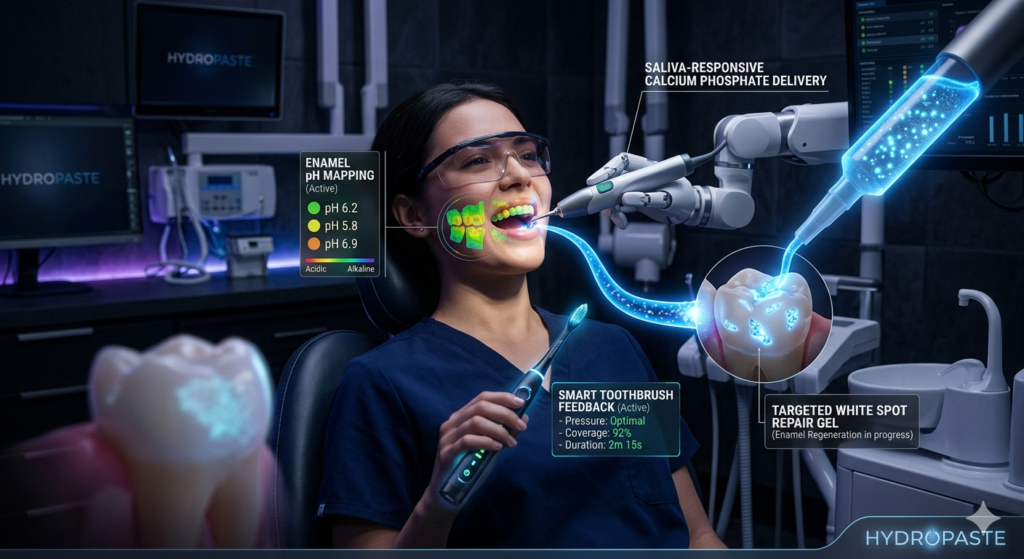
2. Targeted White Spot Gels
Post-orthodontic white spots may drive more targeted gels with CPP-ACP, CPP-ACPF, hydroxyapatite, or bioactive glass.
3. Saliva-Responsive Mineral Systems
Newer systems may release calcium and phosphate more intelligently when pH drops, acting when enamel is under acid stress.
4. Smart Oral Care Pairing
Digital toothbrushes and saliva testing may eventually recommend mineral-support routines based on brushing patterns, pH risk, and sensitivity zones.
5. Biomimetic Mineral Repair Blends
The future may combine calcium phosphate systems with peptide-guided mineralization, nano-hydroxyapatite, and bioactive ceramics. For the broader future-facing category, see biomimetic mineral repair compounds.
Charts & Tables
Calcium Phosphate System Decision Matrix
| User Situation | Best-Fit Calcium Phosphate Direction | Why |
|---|---|---|
| White spots after braces | CPP-ACP or CPP-ACPF | Mineral reservoir near enamel |
| Fluoride-free mineral support | ACP, bioactive glass, hydroxyapatite | Mineral-based approach |
| Sensitivity from exposed dentin | Bioactive glass or hydroxyapatite | Tubule occlusion support |
| High cavity risk | Fluoride + calcium phosphate | Mineral supply plus acid resistance |
| Dry mouth | Dentist-guided mineral support | Saliva mineral supply is reduced |
| Milk protein allergy | Avoid CPP-ACP | Casein-derived system |
| Acid erosion | Low-abrasion mineral toothpaste | Must reduce acid frequency too |
Calcium Phosphate vs Fluoride vs Hydroxyapatite
| Feature | Calcium Phosphate Systems | Fluoride | Hydroxyapatite |
|---|---|---|---|
| Core role | Supplies/stabilizes minerals | Improves acid resistance | Deposits tooth-like particles |
| Main minerals | Calcium + phosphate | Fluoride-enhanced apatite support | Calcium phosphate mineral |
| Fluoride-free options | Yes | No | Usually yes |
| White spot relevance | High | High | High |
| Sensitivity relevance | Moderate to high | Moderate; high as stannous fluoride | High |
| Best format | Creams, gels, toothpaste | Toothpaste, varnish, prescription paste | Toothpaste, gels |
| Best user | Mineral support seeker | Cavity-risk user | Biomimetic repair seeker |
Calcium Phosphate Product Checklist
| Checklist Item | Why It Matters |
|---|---|
| Names the exact mineral system | Avoids vague “enamel repair” claims |
| States fluoride-free or fluoride-added | Matches user preference and risk |
| Low-abrasion formula | Protects weakened enamel |
| Clear age directions | Important for children |
| Allergy warning for CPP-ACP | Casein/milk protein issue |
| Designed for contact time | Creams/gels may need longer exposure |
| Does not promise cavity reversal | More scientifically credible |
Which Calcium Phosphate System Should You Choose?
Choose CPP-ACP If:
You have early white spots, post-orthodontic mineral concerns, or want a targeted mineral cream or mousse. Avoid it if you have milk protein allergy.
Choose CPP-ACPF If:
You want calcium phosphate support plus fluoride and are not avoiding fluoride. This may be more relevant for higher-risk early lesions.
Choose Bioactive Glass If:
Sensitivity and exposed dentin are major concerns. Bioactive glass may help by mineral release and tubule occlusion.
Choose Functionalized TCP If:
You want a fluoride toothpaste that also includes a calcium phosphate technology designed for formula compatibility.
Choose Hydroxyapatite If:
You want a fluoride-free toothpaste with tooth-like mineral particles, sensitivity support, and biomimetic surface repair.
Choose Fluoride First If:
You have repeated cavities, dry mouth, exposed roots, orthodontic risk, or a dentist has advised fluoride.
Practical Calcium Phosphate Routine
Morning Routine
Brush with a remineralizing toothpaste suited to your risk level. If using a calcium phosphate toothpaste, use light pressure and avoid abrasive brushing. The goal is mineral contact, not scrubbing force.
After Acid Exposure
After citrus, soda, sports drinks, coffee, wine, or reflux, rinse with water and let saliva recover before brushing. Calcium phosphate systems work better when enamel is not under constant acid attack.
Night Routine
Nighttime is valuable because saliva flow drops during sleep. A calcium phosphate cream, mousse, or gel may be most useful at night if the product directions allow longer contact.
White Spot Routine
For white spots, consistency matters. Use the product as directed for weeks to months, reduce plaque accumulation, control sugar frequency, and get a dentist’s evaluation if the spot is rough, spreading, or not improving.
If plaque is a part of the concern, stannous fluoride effects is the next science layer to read.
FAQs
What are calcium phosphate systems in toothpaste?
Calcium phosphate systems are oral care technologies designed to supply, stabilize, or release calcium and phosphate minerals near the tooth surface. Since enamel is built mainly from calcium phosphate mineral crystals, these systems aim to support the natural remineralization process.
Examples include amorphous calcium phosphate, CPP-ACP, CPP-ACPF, functionalized tricalcium phosphate, bioactive glass, and hydroxyapatite. They are used in toothpaste, creams, gels, mousse products, rinses, and professional desensitizers.
Does CPP-ACP toothpaste help white spot lesions?
CPP-ACP may help some white spot lesions when the enamel surface is still intact and the spot represents early mineral loss. It works by creating a reservoir of calcium and phosphate near enamel, which can support mineral redeposition.
However, white spots do not all have the same cause. Some are developmental, fluorosis-related, old, deep, or cosmetic. CPP-ACP is most realistic for early non-cavitated lesions, especially when combined with plaque control, reduced sugar frequency, and dental monitoring.
Is calcium phosphate better than fluoride for enamel remineralization?
Calcium phosphate and fluoride do different jobs. Calcium phosphate systems supply or stabilize the minerals enamel needs. Fluoride helps those minerals form a more acid-resistant repair pattern and reduces mineral loss during acid attacks.
For high cavity risk, fluoride is usually the stronger foundation. For mineral support, white spot management, or fluoride-free preferences, calcium phosphate systems may be useful. Some products combine both because the mechanisms can complement each other.
Is bioactive glass toothpaste good for sensitive teeth?
Bioactive glass toothpaste can be useful for sensitive teeth because it may release mineral ions and form deposits that block open dentinal tubules. These tubules transmit cold, heat, air, and sweet triggers toward the nerve.
Its effectiveness depends on the formula, contact time, severity of sensitivity, and cause of exposed dentin. If sensitivity is sharp, localized, worsening, or linked to biting pain, a dentist should check for cracks, decay, gum recession, or exposed roots.
Is CPP-ACP safe for daily use?
CPP-ACP products are commonly used for enamel mineral support, but they are not suitable for everyone. CPP-ACP is derived from milk protein, so people with milk protein allergy should avoid it unless a qualified clinician advises otherwise.
For daily use, follow product directions. Do not treat it as a replacement for dental care if you have cavities, pain, swelling, rough enamel breakdown, or high decay risk.
People Also Ask
What is amorphous calcium phosphate for teeth?
Amorphous calcium phosphate, or ACP, is a non-crystalline calcium phosphate material used as a source of calcium and phosphate ions. In oral care, the goal is to make these minerals available near enamel so they can support remineralization.
ACP is often stabilized or combined with other systems because calcium and phosphate can react too early if not properly managed. CPP-ACP is one example where milk-derived peptides help stabilize amorphous calcium phosphate near the tooth surface.
Can calcium phosphate rebuild enamel?
Calcium phosphate can support remineralization of early enamel mineral loss, but it cannot rebuild missing enamel after a cavity has formed. It helps most when the enamel surface is still intact and minerals have been lost beneath the surface.
A realistic claim is “supports early enamel remineralization,” not “regrows lost enamel.” Once tooth structure is physically missing, restorative dental treatment is required.
What is the difference between CPP-ACP and CPP-ACPF?
CPP-ACP contains casein phosphopeptide and amorphous calcium phosphate. It is designed to hold calcium and phosphate near enamel. CPP-ACPF includes fluoride as well.
CPP-ACPF may be more appropriate when fluoride is desired for added acid resistance and cavity prevention. CPP-ACP may be chosen when the goal is calcium phosphate support without added fluoride, though users must still consider milk protein allergy.
Is calcium phosphate toothpaste fluoride-free?
Some calcium phosphate toothpastes are fluoride-free, but not all. CPP-ACP may be fluoride-free, while CPP-ACPF contains fluoride. Some tricalcium phosphate systems are designed to work inside fluoride toothpaste. Bioactive glass toothpastes may or may not include fluoride depending on the brand.
Always check the active ingredient label instead of assuming that “calcium phosphate” means fluoride-free.
Which is better: hydroxyapatite or calcium phosphate toothpaste?
Hydroxyapatite is a calcium phosphate mineral, but in toothpaste it works differently from many calcium phosphate ion-delivery systems. Hydroxyapatite provides tooth-like particles that can deposit into enamel defects and block dentinal tubules. Other calcium phosphate systems focus more on releasing or stabilizing calcium and phosphate ions.
Hydroxyapatite may be better for fluoride-free daily toothpaste and sensitivity support. CPP-ACP or CPP-ACPF may be better for targeted white spot management. Bioactive glass may be better for sensitivity where tubule occlusion is the main goal.
Editorial Insights
Calcium phosphate systems matter because enamel repair is not only about protection. It is also about supply. Fluoride helps make enamel more acid-resistant. Hydroxyapatite provides tooth-like mineral particles. But the basic repair economy of enamel still depends on calcium and phosphate being available when the tooth surface is ready to remineralize.
That is why this category deserves its own cluster page. CPP-ACP, ACP, CPP-ACPF, functionalized TCP, bioactive glass, and hydroxyapatite-adjacent systems all represent different ways of solving the same problem: how to keep repair minerals available in a wet, acidic, bacteria-rich, constantly changing mouth.
The most practical view is not to crown one system as universally best. Calcium phosphate systems are strongest when matched to the user: CPP-ACP for white spot mineral support, CPP-ACPF for mineral support with fluoride, bioactive glass for sensitivity and tubule occlusion, hydroxyapatite for biomimetic daily repair, and fluoride-first strategies for high cavity risk.